Pepper Review (2026): AI SDR Pricing, Limits & Alternatives
Bottom line
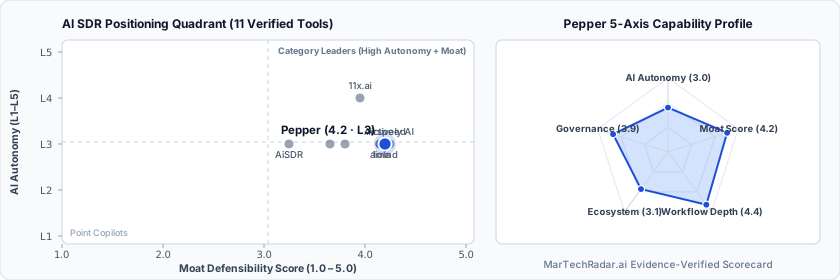
Pepper is a Web SaaS tool for AI SDR (Autonomous B2B Sales Agents & AI BDRs) in AI SDR & Outbound. Pricing: Custom / enterprise pricing. Best suited to B2B Sales Leaders, SDR/BDR Teams and Revenue Operations (RevOps). Editor ratings: AI autonomy L3 (conditional automation); moat score 4.2/5.0 (Proprietary moat). Fact-checked by Jagmeet Sine on Oct 12, 2026.
AI-powered digital operating system and commerce engine purpose-built for independent wholesale food distributors to automate order ingestion and field.
Pepper buyer fit verdict: when to choose vs. when to walk away
Choose Pepper if (Best Fit)
- Target ICP & Stack Fit: You operate as B2B Sales Leaders, SDR/BDR Teams and Revenue Operations (RevOps) requiring a Web SaaS deployment for AI SDR.
- L3 Architecture & Defensibility: Deep vertical domain integrations into legacy food distribution ERPs combined with multimodal intake engines parsing unstructured voicemails, physical scans, and texts into verified line-item orders.
- Commercial Model Fit: Your procurement budget aligns with Custom / enterprise pricing.
Walk away from Pepper if (Deal-Breakers)
- Walk away if you require transparent self-serve monthly billing or your budget ceiling is under $1,000/mo (Pepper requires sales-gated custom quoting).
- Walk away if your workflow cannot tolerate legacy ERP connector brittleness: Bidirectional synchronizations with on-premise wholesale legacy ERPs can encounter schema drift and batch latency, temporarily stalling real-time inventory reconciliation.
- Walk away if catalog catch-weight discrepancies is a deal-breaker for your team: Processing non-standard catch-weight agricultural and protein products requires manual verification when raw customer orders lack specific weight and yield metrics.
Pepper key facts & scorecard
| Pricing | Custom / enterprise pricing |
|---|---|
| Free plan | No / not disclosed |
| Delivery | Web SaaS |
| Audience | B2B Sales Leaders, SDR/BDR Teams, Revenue Operations (RevOps) |
| AI autonomy level | L3 · Conditional automationEditor-verified |
| Moat tier & score | 4.2 / 5.0 · Proprietary moatEditor-verified |
| Funding | Series C+ |
| Total funding | $100MBacked by BoxGroup, Gaingels |
| Founders | Bowie Cheung, Chetan Narain, Ivana Tesanovic |
| Company size | 51-200 employees |
| Governance & docs | Trust & Security ↗ · Privacy ↗ |
| Headquarters | New York City, New York |
| Founded | 2019 |
| Last verified |
Pepper pros & cons: strengths vs. operational limitations
Pros: core strengths & capabilities
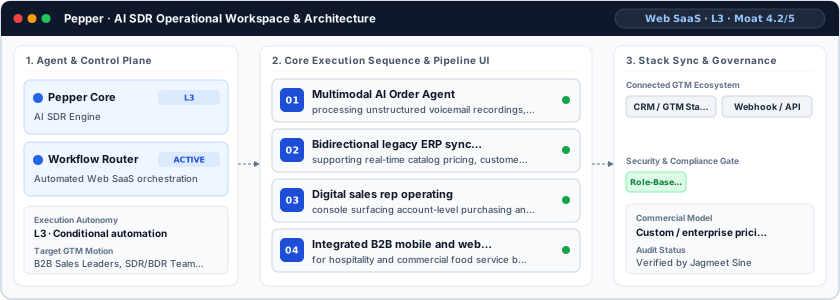
- Multimodal AI Order Agent: processing unstructured voicemail recordings, SMS messages, and PDF purchase orders
- Bidirectional legacy ERP synchronization: supporting real-time catalog pricing, customer-specific inventory, and route cutoffs
- Digital sales rep operating: console surfacing account-level purchasing anomalies and cross-sell recommendations
- Integrated B2B mobile and web ordering portal: for hospitality and commercial food service buyers
Cons: operational limitations & risks
- Legacy ERP Connector Brittleness: Bidirectional synchronizations with on-premise wholesale legacy ERPs can encounter schema drift and batch latency, temporarily stalling real-time inventory reconciliation.
- Catalog Catch-Weight Discrepancies: Processing non-standard catch-weight agricultural and protein products requires manual verification when raw customer orders lack specific weight and yield metrics.
- Voicemail Transcription Ambient Noise Sensitivity: Kitchen background noise in acoustic intake channels occasionally degrades transcription confidence, triggering fallback validation workflows that require rep intervention.
Pepper TCO & deal-breaker stress test
Simulate 12-month stepped TCO, hidden cost multipliers, contract lock-in exposure, and stack failure modes using only facts verified by Jagmeet Sine on · Capture SHA 639dab28.
Pepper triggers high-severity friction under your 5-seat / $800/mo constraints. Benchmark the verified subtrack alternatives below before committing.
| Plan / Tier | Verified Rate | Scale Fit | Scope & Quota Notes |
|---|---|---|---|
| Enterprise / Custom | Custom quote | 15–50+ seats (Enterprise SLA) | Sales-negotiated annual contract for custom volume, SSO/RBAC governance, and dedicated SLA. |
- Moat Score
- 4.2 / 5.0
- AI Autonomy
- L3
- Free Tier / Trial
- None disclosed
Triggered audit signals & failure modes
- Opaque Enterprise Quoting vs. SMB/Mid-Market BudgetVerified Pricing Ledger
Pepper does not disclose a public self-serve floor (Custom / enterprise pricing). Buyers with a $800/mo cap face high sales-qualification friction.
- Sales-Gated Contract TermsFact-checked by Jagmeet Sine
Commercial pricing is available on request through tailored enterprise sales quotes based on organizational scale and seats.
- Primary Operational Bottleneck: Legacy ERP Connector BrittlenessAudit by Jagmeet Sine
Bidirectional synchronizations with on-premise wholesale legacy ERPs can encounter schema drift and batch latency, temporarily stalling real-time inventory reconciliation.
Hidden TCO Multipliers & Quota Gates
- Legacy ERP Connector Brittleness: Bidirectional synchronizations with on-premise wholesale legacy ERPs can encounter schema drift and batch latency, temporarily stalling real-time inventory reconciliation.
- Catalog Catch-Weight Discrepancies: Processing non-standard catch-weight agricultural and protein products requires manual verification when raw customer orders lack specific weight and yield metrics.
When to Walk Away & Negotiation Levers
- Walk away if you require transparent self-serve monthly billing or your budget ceiling is under $1,000/mo (Pepper requires sales-gated custom quoting).
- Walk away if your workflow cannot tolerate legacy ERP connector brittleness: Bidirectional synchronizations with on-premise wholesale legacy ERPs can encounter schema drift and batch latency, temporarily stalling real-time inventory reconciliation.
- Walk away if catalog catch-weight discrepancies is a deal-breaker for your team: Processing non-standard catch-weight agricultural and protein products requires manual verification when raw customer orders lack specific weight and yield metrics.
- Demand a 30- to 60-day paid pilot opt-out clause in the Pepper order form before signing a 12-month enterprise commitment.
- Require a sandbox proof-of-concept testing legacy ERP connector brittleness against your live CRM/data schema before annual sign-off.
Ask a custom procurement or TCO stress-test question about Pepper
Lower 5-seat floor (~$56/mo vs. Custom Quote) · Transparent self-serve entry without mandatory annual lock-in
Verified AI SDR peer (Custom / enterprise pricing · Moat 4.2/5.0)
Pepper moat & subtrack positioning
Deep vertical domain integrations into legacy food distribution ERPs combined with multimodal intake engines parsing unstructured voicemails, physical scans, and texts into verified line-item orders.
Editorial review
Fact-checked by Jagmeet Sine (Senior MarTech Infrastructure & Agentic Workflow Architect) on .
Background
Architected as a verticalized operating platform for food distribution commerce, Pepper bridges legacy wholesale logistics systems with modern machine learning automation. Headquartered in New York City, New York, and founded in 2019, the organization has secured $100M in venture funding to displace antiquated distribution software. Engineered specifically for wholesale food distributors, regional suppliers, and distributor sales representatives, the infrastructure addresses high-friction order processing. Rather than acting as a generalized horizontal CRM, the platform centralizes catalog management, inbound demand intake, and inventory synchronization into a unified commercial workflow.
How Pepper works
At its architectural core, Pepper deploys multimodal ingestion pipelines designed to convert unstructured communications into structured ledger entries. The system accepts multi-channel order feeds, including customer voicemails, unstructured SMS threads, and raw PDF invoices, routing them through domain-specific natural language models trained on food service terminology and unit-of-measure hierarchies. Extracted items are reconciled against live enterprise resource planning databases to confirm inventory availability, pack sizes, and customer-specific contract pricing. Within this pipeline, the system generates staging-ready sales orders for rep approval while independently flagging item mismatches, out-of-stock substitutions, and order cutoff breaches before final ERP posting.
Limitations
Operational considerations and platform boundaries include:
- Legacy ERP Connector Brittleness: Bidirectional synchronizations with on-premise wholesale legacy ERPs can encounter schema drift and batch latency, temporarily stalling real-time inventory reconciliation.
- Catalog Catch-Weight Discrepancies: Processing non-standard catch-weight agricultural and protein products requires manual verification when raw customer orders lack specific weight and yield metrics.
- Voicemail Transcription Ambient Noise Sensitivity: Kitchen background noise in acoustic intake channels occasionally degrades transcription confidence, triggering fallback validation workflows that require rep intervention.
Pepper pricing
Commercial pricing is available on request through tailored enterprise sales quotes based on organizational scale and seats. Pepper aligns its commercial structure with a pay-for-performance model tied to operational throughput, order volume, and distributor baseline requirements. Enterprise agreements bundle core ERP data connectors, the automated ingestion engine, and portal licenses into customized deployment packages determined during commercial technical discovery without public list prices.
How Pepper compares
While generalized autonomous sales platforms like 11x.ai, 1mind, and Actively AI concentrate on horizontal outbound cold prospecting, multi-channel email cadences, and early-funnel B2B pipeline creation, Pepper focuses strictly on bottom-of-the-funnel inbound commerce and account retention within supply chains. Its primary technical distinction lies in its food distribution ontology, catching unit-of-measure variances and managing complex delivery route logic that generic sales bots cannot parse. The platform is best suited for mid-market to enterprise independent food, beverage, and specialty distributors processing high-frequency recurring wholesale orders requiring deep ERP integration.
Direct competitors & market radar
Top algorithmic competitors based on category positioning, capability overlap, and ICP alignment.
Frequently asked questions about Pepper
How much does Pepper cost and does it require a custom enterprise quote?
Published pricing summary for Pepper: Custom / enterprise pricing. A permanent free plan is not disclosed for Pepper. Commercial pricing is available on request through tailored enterprise sales quotes based on organizational scale and seats. Pepper aligns its commercial structure with a pay-for-performance model tied to operational throughput, order volume, and distributor baseline requirements.
How does Pepper work and how autonomous is its AI architecture?
AI-powered digital operating system and commerce engine purpose-built for independent wholesale food distributors to automate order ingestion and field. Within AI SDR (Autonomous B2B Sales Agents & AI BDRs), MarTechRadar rates its execution architecture at L3 · Conditional automation with a verified Moat Score of 4.2 / 5.0 (Proprietary moat). Deep vertical domain integrations into legacy food distribution ERPs combined with multimodal intake engines parsing unstructured voicemails, physical scans, and texts into verified line-item orders. Corporate profile: Founded by Bowie Cheung, Chetan Narain, Ivana Tesanovic, operating at 51-200 employees scale.
What are the main limitations of Pepper and when should buyers walk away?
Based on our editorial technical audit, key operational considerations and boundaries for Pepper include: (1) Legacy ERP Connector Brittleness: Bidirectional synchronizations with on-premise wholesale legacy ERPs can encounter schema drift and batch latency, temporarily stalling real-time inventory reconciliation. (2) Catalog Catch-Weight Discrepancies: Processing non-standard catch-weight agricultural and protein products requires manual verification when raw customer orders lack specific weight and yield metrics. (3) Voicemail Transcription Ambient Noise Sensitivity: Kitchen background noise in acoustic intake channels occasionally degrades transcription confidence, triggering fallback validation workflows that require rep intervention. Primary procurement walk-away rule: Walk away if you require transparent self-serve monthly billing or your budget ceiling is under $1,000/mo (Pepper requires sales-gated custom quoting).
What integrations, compliance certifications, and contract terms apply to Pepper?
First-party governance and developer endpoints verified on domain include: Trust/Security (https://www.usepepper.com/solutions/security). Key TCO multiplier to watch: Legacy ERP Connector Brittleness (Bidirectional synchronizations with on-premise wholesale legacy ERPs can encounter schema drift and batch latency, temporarily stalling real-time inventory reconciliation.) Before signing a contract, procurement teams should demand a 30- to 60-day paid pilot opt-out clause in the Pepper order form before signing a 12-month enterprise commitment.
What are the best Pepper alternatives and head-to-head competitors in 2026?
Top fact-checked alternatives to Pepper in AI SDR (Autonomous B2B Sales Agents & AI BDRs) include Pocus (Custom / enterprise pricing), PhantomBuster (From $56/mo), Pavoot (Custom / enterprise pricing), Pinova (Custom / enterprise pricing). While generalized autonomous sales platforms like 11x.ai, 1mind, and Actively AI concentrate on horizontal outbound cold prospecting, multi-channel email cadences, and early-funnel B2B pipeline creation, Pepper focuses strictly on bottom-of-the-funnel inbound commerce and account retention within supply chains.
Verified sources & evidence trail
- Official product domain: https://www.usepepper.com
- Commercial pricing verification: Verified against official vendor pricing policy (Custom / enterprise pricing)
- Verified corporate entity profiles (
sameAs): LinkedIn Company Profile · Crunchbase Entity Record - First-party governance & documentation links: Trust & Security · Privacy
- Editorial audit sign-off: Fact-checked by Jagmeet Sine on under the MarTechRadar Evidence-Ledger Protocol.