Operator Review (2026): AI SDR Pricing, Limits & Alternatives
Bottom line
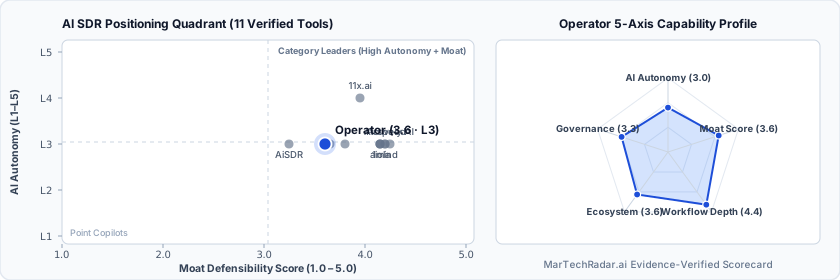
Operator is a Web SaaS tool for AI SDR (Autonomous B2B Sales Agents & AI BDRs) in AI SDR & Outbound. Pricing: Custom / enterprise pricing. Best suited to B2B Sales Leaders, SDR/BDR Teams and Revenue Operations (RevOps). Editor ratings: AI autonomy L3 (conditional automation); moat score 3.6/5.0 (Proprietary moat). Fact-checked by Sarah Per on Oct 14, 2026.
Autonomous outbound sales platform orchestrating algorithmic prospect research, contextual outreach generation, and pipeline management for revenue teams.
Operator buyer fit verdict: when to choose vs. when to walk away
Choose Operator if (Best Fit)
- Target ICP & Stack Fit: You operate as B2B Sales Leaders, SDR/BDR Teams and Revenue Operations (RevOps) requiring a Web SaaS deployment for AI SDR, with verified ecosystem connectivity for Outreach.
- L3 Architecture & Defensibility: Defensibility hinges on domain-specific prospect intelligence matching algorithms and dynamic email deliverability orchestration that adapts to mailbox reputation degradation.
- Commercial Model Fit: Your procurement budget aligns with Custom / enterprise pricing.
Walk away from Operator if (Deal-Breakers)
- Walk away if you require transparent self-serve monthly billing or your budget ceiling is under $1,000/mo (Operator requires sales-gated custom quoting).
- Walk away if your workflow cannot tolerate domain deliverability constraints: Aggressive sequence distribution across unrotated secondary domains leads to mailbox reputation decay and domain burn without dedicated external warmup tooling.
- Walk away if contact enrichment latency is a deal-breaker for your team: Enrichment verification pipelines experience synchronization bottlenecks when reconciling ambiguous lead records across disparate third-party data providers.
Operator key facts & scorecard
| Pricing | Custom / enterprise pricing |
|---|---|
| Free plan | No / not disclosed |
| Delivery | Web SaaS |
| Audience | B2B Sales Leaders, SDR/BDR Teams, Revenue Operations (RevOps) |
| AI autonomy level | L3 · Conditional automationEditor-verified |
| Moat tier & score | 3.6 / 5.0 · Proprietary moatEditor-verified |
| Funding | Seed |
| Founders | Nick Hart |
| Company size | 1-10 employees |
| Ecosystem integrations | Outreach |
| Governance & docs | API & Docs ↗ · Terms ↗ · Privacy ↗ |
| Headquarters | Hoffman Estates, Illinois |
| Founded | 2011 |
| Last verified |
Operator pros & cons: strengths vs. operational limitations
Pros: core strengths & capabilities
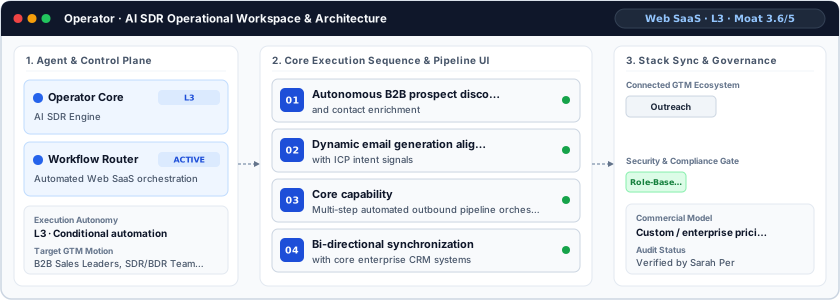
- Autonomous B2B prospect discovery: and contact enrichment
- Dynamic email generation aligned: with ICP intent signals
- Core capability: Multi-step automated outbound pipeline orchestration
- Bi-directional synchronization: with core enterprise CRM systems
Cons: operational limitations & risks
- Domain deliverability constraints: Aggressive sequence distribution across unrotated secondary domains leads to mailbox reputation decay and domain burn without dedicated external warmup tooling.
- Contact enrichment latency: Enrichment verification pipelines experience synchronization bottlenecks when reconciling ambiguous lead records across disparate third-party data providers.
- Deterministic intent handling: Objection handling models struggle with non-linear buyer responses, occasionally misclassifying nuanced replies as hard unsubscribes or negative sentiment.
Operator TCO & deal-breaker stress test
Simulate 12-month stepped TCO, hidden cost multipliers, contract lock-in exposure, and stack failure modes using only facts verified by Sarah Per on · Capture SHA 436880b6.
Operator triggers high-severity friction under your 5-seat / $800/mo constraints. Benchmark the verified subtrack alternatives below before committing.
| Plan / Tier | Verified Rate | Scale Fit | Scope & Quota Notes |
|---|---|---|---|
| Enterprise / Custom | Custom quote | 15–50+ seats (Enterprise SLA) | Sales-negotiated annual contract for custom volume, SSO/RBAC governance, and dedicated SLA. |
- Moat Score
- 3.6 / 5.0
- AI Autonomy
- L3
- Free Tier / Trial
- None disclosed
Triggered audit signals & failure modes
- Opaque Enterprise Quoting vs. SMB/Mid-Market BudgetVerified Pricing Ledger
Operator does not disclose a public self-serve floor (Custom / enterprise pricing). Buyers with a $800/mo cap face high sales-qualification friction.
- Sales-Gated Contract TermsFact-checked by Sarah Per
Operator maintains a quote-based licensing structure with no self-serve tiers. Commercial pricing is available on request through tailored enterprise sales quotes based on organizational scale and seats.
- Primary Operational Bottleneck: Domain deliverability constraintsAudit by Sarah Per
Aggressive sequence distribution across unrotated secondary domains leads to mailbox reputation decay and domain burn without dedicated external warmup tooling.
Hidden TCO Multipliers & Quota Gates
- Domain deliverability constraints: Aggressive sequence distribution across unrotated secondary domains leads to mailbox reputation decay and domain burn without dedicated external warmup tooling.
- Contact enrichment latency: Enrichment verification pipelines experience synchronization bottlenecks when reconciling ambiguous lead records across disparate third-party data providers.
When to Walk Away & Negotiation Levers
- Walk away if you require transparent self-serve monthly billing or your budget ceiling is under $1,000/mo (Operator requires sales-gated custom quoting).
- Walk away if your workflow cannot tolerate domain deliverability constraints: Aggressive sequence distribution across unrotated secondary domains leads to mailbox reputation decay and domain burn without dedicated external warmup tooling.
- Walk away if contact enrichment latency is a deal-breaker for your team: Enrichment verification pipelines experience synchronization bottlenecks when reconciling ambiguous lead records across disparate third-party data providers.
- Demand a 30- to 60-day paid pilot opt-out clause in the Operator order form before signing a 12-month enterprise commitment.
- Require a sandbox proof-of-concept testing domain deliverability constraints against your live CRM/data schema before annual sign-off.
Ask a custom procurement or TCO stress-test question about Operator
Lower 5-seat floor (~$25/mo vs. Custom Quote) · Transparent self-serve entry without mandatory annual lock-in
Lower 5-seat floor (~$39/mo vs. Custom Quote) · Transparent self-serve entry without mandatory annual lock-in
Operator key entities, modules & ecosystem stack
Operator moat & subtrack positioning
Defensibility hinges on domain-specific prospect intelligence matching algorithms and dynamic email deliverability orchestration that adapts to mailbox reputation degradation.
Editorial review
Fact-checked by Sarah Per (Principal Content Systems & Generative Media Editor) on .
Background
To capture pipeline without expanding outbound SDR headcount, B2B revenue organizations require software that executes prospecting workflows independently. Established in 2011 in Hoffman Estates, Illinois, Operator positions its technology to meet this requirement by providing automated sales prospecting workflows. Engineered primarily for revenue operations directors and sales development leaders, the platform shifts cold outbound outreach from manual administrative labor to automated programmatic sequences.
How Operator works
Operator executes an automated outbound pipeline using structured data ingestion, heuristic qualification filters, and contextual language generation models. The platform ingests account parameters and target buyer criteria, cross-referencing contact sources to verify operational mailboxes. Once prospects pass initial validation checks, Operator drafts personalized outreach copy using intent signals, triggers scheduled multi-stage delivery sequences, and processes prospect responses through intent-classification filters before passing qualified meetings to human account executives.
Limitations
Operational considerations and platform boundaries include:
- Domain deliverability constraints: Aggressive sequence distribution across unrotated secondary domains leads to mailbox reputation decay and domain burn without dedicated external warmup tooling.
- Contact enrichment latency: Enrichment verification pipelines experience synchronization bottlenecks when reconciling ambiguous lead records across disparate third-party data providers.
- Deterministic intent handling: Objection handling models struggle with non-linear buyer responses, occasionally misclassifying nuanced replies as hard unsubscribes or negative sentiment.
Operator pricing
Operator maintains a quote-based licensing structure with no self-serve tiers. Commercial pricing is available on request through tailored enterprise sales quotes based on organizational scale and seats. Contracts typically require annual software commitments that scale according to targeted prospect volume and mailbox capacity allocations.
How Operator compares
Within the outbound execution sector, Operator contends with platforms such as 11x.ai, 1mind, and Actively AI. While 11x.ai prioritizes autonomous agent personas and Actively AI focuses on deep behavioral intent triggers, Operator targets organizations seeking structured, programmatic pipeline generation. It is suited for mid-market B2B teams requiring persistent outbound cadence automation without building custom internal outbound engineering infrastructure. Enterprise procurement teams evaluating deployment readiness should assess API webhook throughput, role-based access governance, and bilateral data synchronization latency against existing marketing technology infrastructure before committing to multi-year production rollouts.
Direct competitors & market radar
Top algorithmic competitors based on category positioning, capability overlap, and ICP alignment.
Frequently asked questions about Operator
How much does Operator cost and does it require a custom enterprise quote?
Published pricing summary for Operator: Custom / enterprise pricing. A permanent free plan is not disclosed for Operator. Operator maintains a quote-based licensing structure with no self-serve tiers. Commercial pricing is available on request through tailored enterprise sales quotes based on organizational scale and seats.
How does Operator work and how autonomous is its AI architecture?
Autonomous outbound sales platform orchestrating algorithmic prospect research, contextual outreach generation, and pipeline management for revenue teams. Within AI SDR (Autonomous B2B Sales Agents & AI BDRs), MarTechRadar rates its execution architecture at L3 · Conditional automation with a verified Moat Score of 3.6 / 5.0 (Proprietary moat). Defensibility hinges on domain-specific prospect intelligence matching algorithms and dynamic email deliverability orchestration that adapts to mailbox reputation degradation. Corporate profile: Founded by Nick Hart, operating at 1-10 employees scale.
What are the main limitations of Operator and when should buyers walk away?
Based on our editorial technical audit, key operational considerations and boundaries for Operator include: (1) Domain deliverability constraints: Aggressive sequence distribution across unrotated secondary domains leads to mailbox reputation decay and domain burn without dedicated external warmup tooling. (2) Contact enrichment latency: Enrichment verification pipelines experience synchronization bottlenecks when reconciling ambiguous lead records across disparate third-party data providers. (3) Deterministic intent handling: Objection handling models struggle with non-linear buyer responses, occasionally misclassifying nuanced replies as hard unsubscribes or negative sentiment. Primary procurement walk-away rule: Walk away if you require transparent self-serve monthly billing or your budget ceiling is under $1,000/mo (Operator requires sales-gated custom quoting).
What integrations, compliance certifications, and contract terms apply to Operator?
Verified ecosystem and stack integrations include Outreach. First-party governance and developer endpoints verified on domain include: API Docs (https://www.atom.com/developer). Key TCO multiplier to watch: Domain deliverability constraints (Aggressive sequence distribution across unrotated secondary domains leads to mailbox reputation decay and domain burn without dedicated external warmup tooling.) Before signing a contract, procurement teams should demand a 30- to 60-day paid pilot opt-out clause in the Operator order form before signing a 12-month enterprise commitment.
What are the best Operator alternatives and head-to-head competitors in 2026?
Top fact-checked alternatives to Operator in AI SDR (Autonomous B2B Sales Agents & AI BDRs) include Lyne.ai (Free plan · $0/mo · Enterprise plan), Moil AI (From $25/mo), Origami ($0/mo), Quotain ($0 · Enterprise plan). Within the outbound execution sector, Operator contends with platforms such as 11x.ai, 1mind, and Actively AI. While 11x.ai prioritizes autonomous agent personas and Actively AI focuses on deep behavioral intent triggers, Operator targets organizations seeking structured, programmatic pipeline generation.
Verified sources & evidence trail
- Official product domain: https://www.operator.ai/
- Commercial pricing verification: Verified against official vendor pricing policy (Custom / enterprise pricing)
- Verified corporate entity profiles (
sameAs): LinkedIn Company Profile · Crunchbase Entity Record - First-party governance & documentation links: API & Docs · Terms · Privacy
- Editorial audit sign-off: Fact-checked by Sarah Per on under the MarTechRadar Evidence-Ledger Protocol.