Muraena Review (2026): AI SDR Pricing, Limits & Alternatives
Bottom line
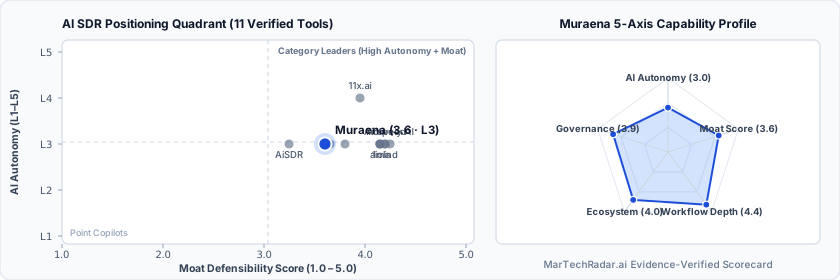
Muraena is a Web SaaS tool for AI SDR (Autonomous B2B Sales Agents & AI BDRs) in AI SDR & Outbound. Pricing: Free plan · $0/mo · Enterprise plan. Best suited to B2B Sales Leaders, SDR/BDR Teams and Revenue Operations (RevOps). Editor ratings: AI autonomy L3 (conditional automation); moat score 3.6/5.0 (Proprietary moat). Fact-checked by Tim Fenolz on Oct 14, 2026.
Autonomous B2B lead generation and prospect discovery platform leveraging AI-driven targeting, buyer intent signals, and technographic filters.
Muraena buyer fit verdict: when to choose vs. when to walk away
Choose Muraena if (Best Fit)
- Target ICP & Stack Fit: You operate as B2B Sales Leaders, SDR/BDR Teams and Revenue Operations (RevOps) requiring a Web SaaS deployment for AI SDR, with verified ecosystem connectivity for Pipedrive, Outreach.
- L3 Architecture & Defensibility: Muraena maintains defensibility through programmatic integration of technographic mapping and buyer intent synthesis into direct execution channels like Lemlist and Pipedrive. However, its early-stage capitalization and reliance on commodity contact enrichment waterfalls create architectural exposure compared to vertically integrated agent platforms.
- Commercial Model Fit: Your procurement budget aligns with Free plan · $0/mo · Enterprise plan and want a self-serve free tier for zero-cost initial validation.
Walk away from Muraena if (Deal-Breakers)
- Walk away if your workflow requires uncapped enterprise volume on the Free plan · $0/mo · Enterprise plan entry plan without upgrading tiers.
- Walk away if your workflow cannot tolerate outbound execution dependency: The platform functions primarily as an identification layer, requiring external orchestration tools such as Lemlist or CRM infrastructure to execute delivery sequences.
- Walk away if credit consumption caps is a deal-breaker for your team: Data extraction velocity remains strictly bound to monthly allocation ledgers, causing pipeline throttling when high-volume enrichment queries exhaust available balance limits.
Muraena key facts & scorecard
| Pricing | Free plan · $0/mo · Enterprise planVendor pricing page |
|---|---|
| Free plan | Yes |
| Delivery | Web SaaS |
| Audience | B2B Sales Leaders, SDR/BDR Teams, Revenue Operations (RevOps) |
| AI autonomy level | L3 · Conditional automationEditor-verified |
| Moat tier & score | 3.6 / 5.0 · Proprietary moatEditor-verified |
| Funding | Pre-seed |
| Total funding | $100K |
| Company size | 2-10 employees |
| Ecosystem integrations | Pipedrive, Outreach |
| Governance & docs | Terms ↗ · Privacy ↗ |
| Headquarters | San Francisco, California |
| Founded | 2023 |
| Last verified |
Muraena pros & cons: strengths vs. operational limitations
Pros: core strengths & capabilities
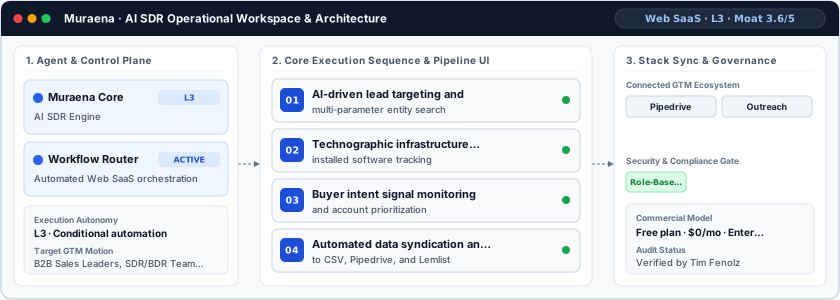
- AI-driven lead targeting and: multi-parameter entity search
- Technographic infrastructure profiling and: installed software tracking
- Buyer intent signal monitoring: and account prioritization
- Automated data syndication and export: to CSV, Pipedrive, and Lemlist
Cons: operational limitations & risks
- Outbound execution dependency: The platform functions primarily as an identification layer, requiring external orchestration tools such as Lemlist or CRM infrastructure to execute delivery sequences.
- Credit consumption caps: Data extraction velocity remains strictly bound to monthly allocation ledgers, causing pipeline throttling when high-volume enrichment queries exhaust available balance limits.
- CRM integration surface: Native bi-directional data synchronization is restricted to select endpoints like Pipedrive, requiring custom engineering via public API endpoints for broader RevOps stacks.
Muraena TCO & deal-breaker stress test
Simulate 12-month stepped TCO, hidden cost multipliers, contract lock-in exposure, and stack failure modes using only facts verified by Tim Fenolz on · Capture SHA 68980763.
Muraena is viable for 5 seats, but requires commercial or technical verification on the flagged items below.
| Plan / Tier | Verified Rate | Scale Fit | Scope & Quota Notes |
|---|---|---|---|
| Free / Sandbox | $0 | 1–2 seats (Evaluation) | Entry free tier with capped usage or feature quotas for initial workflow testing. |
| Basic | $19/mo | 1–2 seats | 1,000 email credits / month |
| Business | $89/mo | 5 seats | 10,000 email credits / month |
| Enterprise / Custom | Custom quote | 15–50+ seats (Enterprise SLA) | Sales-negotiated annual contract for custom volume, SSO/RBAC governance, and dedicated SLA. |
- Moat Score
- 3.6 / 5.0
- AI Autonomy
- L3
- Free Tier / Trial
- Free plan
Triggered audit signals & failure modes
- Opaque Enterprise Quoting vs. SMB/Mid-Market BudgetVerified Pricing Ledger
Muraena does not disclose a public self-serve floor (Free plan · $0/mo · Enterprise plan). Buyers with a $800/mo cap face high sales-qualification friction.
- Published Self-Serve Entry FloorVerified Pricing Ledger
Muraena publishes a transparent entry point (Free plan · $0/mo · Enterprise plan) with a free tier for initial validation before committing.
- Tier Fit for 5-Seat Scale: Basic ($19/mo)Verified Tier Schedule
1,000 email credits / month
- Primary Operational Bottleneck: Credit consumption capsAudit by Tim Fenolz
Data extraction velocity remains strictly bound to monthly allocation ledgers, causing pipeline throttling when high-volume enrichment queries exhaust available balance limits.
Hidden TCO Multipliers & Quota Gates
- Per-Seat Linear Scaling: Muraena prices licenses on a per-user/seat basis (Free plan · $0/mo · Enterprise plan); expanding from 2 to 15+ operators multiplies base recurring spend linearly.
- Credit & Usage Burn Multiplier: Automated workflows consume metered credits/usage quotas; multi-step enrichment, voice minutes, or high-frequency agent runs can trigger mid-cycle top-up packs.
When to Walk Away & Negotiation Levers
- Walk away if your workflow requires uncapped enterprise volume on the Free plan · $0/mo · Enterprise plan entry plan without upgrading tiers.
- Walk away if your workflow cannot tolerate outbound execution dependency: The platform functions primarily as an identification layer, requiring external orchestration tools such as Lemlist or CRM infrastructure to execute delivery sequences.
- Walk away if credit consumption caps is a deal-breaker for your team: Data extraction velocity remains strictly bound to monthly allocation ledgers, causing pipeline throttling when high-volume enrichment queries exhaust available balance limits.
- Validate exact quota thresholds (seats, credits, or API calls) included in Muraena's Free plan · $0/mo · Enterprise plan tier before converting from monthly to annual billing.
- Require a sandbox proof-of-concept testing outbound execution dependency against your live CRM/data schema before annual sign-off.
Ask a custom procurement or TCO stress-test question about Muraena
Lower 5-seat floor (~$49/mo vs. Custom Quote)
Lower 5-seat floor (~$39/mo vs. Custom Quote)
Muraena key entities, modules & ecosystem stack
Muraena moat & subtrack positioning
Muraena maintains defensibility through programmatic integration of technographic mapping and buyer intent synthesis into direct execution channels like Lemlist and Pipedrive. However, its early-stage capitalization and reliance on commodity contact enrichment waterfalls create architectural exposure compared to vertically integrated agent platforms.
Editorial review
Fact-checked by Tim Fenolz (Lead AdTech, Programmatic & Attribution Analyst) on .
Background
To solve the operational friction of manual account sourcing, revenue teams deploy specialized prospecting software to automate data collection and qualification. Founded in 2023 and headquartered in San Francisco, California, Muraena addresses this workflow through an AI-driven targeting engine. Backed by $100K in early-stage venture funding, the company engineers its platform specifically for growth practitioners, SDR leads, and revenue operations specialists who require automated discovery of verified business contacts.
How Muraena works
Operating at an L3 autonomy profile, Muraena automates lead discovery through a continuous ingest and enrichment pipeline. The platform aggregates buyer intent signals, firmographic registries, and technographic footprints to populate dynamic target lists. Users run natural language and algorithmic queries to filter accounts matching ideal customer parameters. Once accounts qualify, the system matches contacts against an enrichment ledger to resolve verified email addresses. The resolved payloads automatically synchronize via direct webhooks into downstream execution environments such as Pipedrive and Lemlist, or export into tabular flat files for cold outreach distribution.
Limitations
Operational considerations and platform boundaries include:
- Outbound execution dependency: The platform functions primarily as an identification layer, requiring external orchestration tools such as Lemlist or CRM infrastructure to execute delivery sequences.
- Credit consumption caps: Data extraction velocity remains strictly bound to monthly allocation ledgers, causing pipeline throttling when high-volume enrichment queries exhaust available balance limits.
- CRM integration surface: Native bi-directional data synchronization is restricted to select endpoints like Pipedrive, requiring custom engineering via public API endpoints for broader RevOps stacks.
Muraena pricing
Commercial access uses a tiered credit subscription structure. A entry-level tier begins at $0 for 50 monthly credits with access to technographic filters and intent insights. Paid scaling introduces self-serve tiers, including a $19 per month tier allocating 1,000 monthly export credits, alongside custom enterprise agreements tailored for custom volumes and API integrations.
How Muraena compares
Within the autonomous sales development landscape, Muraena competes against platforms like 11x.ai, 1mind, and Actively AI. While competitors emphasize end-to-end conversational agent execution across omnichannel sequences, Muraena focuses purely on data intelligence and initial list enrichment. This lightweight model serves early-stage sales teams needing affordable account intelligence, whereas enterprise organizations requiring autonomous multi-touch outreach agents will find greater utility in fully autonomous conversational alternatives.
Direct competitors & market radar
Top algorithmic competitors based on category positioning, capability overlap, and ICP alignment.
Frequently asked questions about Muraena
How much does Muraena cost and what pricing tiers are available?
Published pricing summary for Muraena: Free plan · $0/mo · Enterprise plan. Muraena includes a free tier or sandbox entry point. Verified tier schedule: Free / Sandbox ($0 for 1–2 seats (Evaluation)); Basic ($19/mo for 1–2 seats); Business ($89/mo for 5 seats); Enterprise / Custom (Custom quote for 15–50+ seats (Enterprise SLA)). Commercial access uses a tiered credit subscription structure. A entry-level tier begins at $0 for 50 monthly credits with access to technographic filters and intent insights.
How does Muraena work and how autonomous is its AI architecture?
Autonomous B2B lead generation and prospect discovery platform leveraging AI-driven targeting, buyer intent signals, and technographic filters. Within AI SDR (Autonomous B2B Sales Agents & AI BDRs), MarTechRadar rates its execution architecture at L3 · Conditional automation with a verified Moat Score of 3.6 / 5.0 (Proprietary moat). Muraena maintains defensibility through programmatic integration of technographic mapping and buyer intent synthesis into direct execution channels like Lemlist and Pipedrive. However, its early-stage capitalization and reliance on commodity contact enrichment waterfalls create architectural exposure compared to vertically integrated agent platforms. Corporate profile: operating at 2-10 employees scale.
What are the main limitations of Muraena and when should buyers walk away?
Based on our editorial technical audit, key operational considerations and boundaries for Muraena include: (1) Outbound execution dependency: The platform functions primarily as an identification layer, requiring external orchestration tools such as Lemlist or CRM infrastructure to execute delivery sequences. (2) Credit consumption caps: Data extraction velocity remains strictly bound to monthly allocation ledgers, causing pipeline throttling when high-volume enrichment queries exhaust available balance limits. (3) CRM integration surface: Native bi-directional data synchronization is restricted to select endpoints like Pipedrive, requiring custom engineering via public API endpoints for broader RevOps stacks. Primary procurement walk-away rule: Walk away if your workflow requires uncapped enterprise volume on the Free plan · $0/mo · Enterprise plan entry plan without upgrading tiers.
What integrations, compliance certifications, and contract terms apply to Muraena?
Verified ecosystem and stack integrations include Pipedrive, Outreach. Key TCO multiplier to watch: Per-Seat Linear Scaling (Muraena prices licenses on a per-user/seat basis (Free plan · $0/mo · Enterprise plan); expanding from 2 to 15+ operators multiplies base recurring spend linearly.) Before signing a contract, procurement teams should validate exact quota thresholds (seats, credits, or API calls) included in Muraena's Free plan · $0/mo · Enterprise plan tier before converting from monthly to annual billing.
What are the best Muraena alternatives and head-to-head competitors in 2026?
Top fact-checked alternatives to Muraena in AI SDR (Autonomous B2B Sales Agents & AI BDRs) include Seamless.ai (Custom / enterprise pricing), Chirp Labs (Free plan · $0/mo · Enterprise plan), Covena (Custom / enterprise pricing), Dmand AI (From $49/mo). Within the autonomous sales development landscape, Muraena competes against platforms like 11x.ai, 1mind, and Actively AI. While competitors emphasize end-to-end conversational agent execution across omnichannel sequences, Muraena focuses purely on data intelligence and initial list enrichment.
Verified sources & evidence trail
- Official product domain: https://muraena.ai
- Commercial pricing verification: https://muraena.ai/pricing
- Verified corporate entity profiles (
sameAs): LinkedIn Company Profile · Crunchbase Entity Record - First-party governance & documentation links: Terms · Privacy
- Editorial audit sign-off: Fact-checked by Tim Fenolz on under the MarTechRadar Evidence-Ledger Protocol.