Loomly Review (2026): Social Media Scheduling Pricing, Pros & Cons
Bottom line
Loomly is a Web SaaS tool for Social Media Scheduling (Social Media Scheduling & Auto-Publishing) in Social & Influencer. Pricing: From $49/mo. Best suited to DTC / eCommerce and Enterprise Brands. Editor ratings: AI autonomy L3 (conditional automation); moat score 4.5/5.0 (Proprietary moat (category leader)). Fact-checked by MarTechRadar Research Desk on Oct 14, 2026.
Multi-channel social media management platform providing automated content scheduling, approval governance, audience interaction tracking, and AI-assisted.
Is Loomly worth it in 2026? Buyer fit & when to walk away
Choose Loomly if (Best Fit)
- Target ICP & Stack Fit: You operate as DTC / eCommerce and Enterprise Brands requiring a Web SaaS deployment for Social Media Scheduling, with verified ecosystem connectivity for Slack, Microsoft Teams, Twilio Segment, Zendesk.
- L3 Architecture & Defensibility: Proprietary collaborative workflow engine combining granular role-based approvals, native network API connections, and automated cross-network asset formatting within the Traject software portfolio.
- Commercial Model Fit: Your procurement budget aligns with From $49/mo.
Walk away from Loomly if (Deal-Breakers)
- Walk away if your workflow cannot tolerate social network API rate limits: Publishing throughput and real-time interaction syncing remain subject to third-party network API quotas, causing occasional scheduling delays during API updates.
- Walk away if asset transformation boundaries is a deal-breaker for your team: Complex multi-image carousels and vertical video formats frequently require manual pre-formatting adjustments to adhere to idiosyncratic platform aspect ratios.
Loomly pricing, free plan & scorecard at a glance
| Pricing | From $49/moVendor pricing page |
|---|---|
| Free plan | No / not disclosed |
| Delivery | Web SaaS |
| Audience | DTC / eCommerce, Enterprise Brands |
| AI autonomy level | L3 · Conditional automationEditor-verified |
| Moat tier & score | 4.5 / 5.0 · Proprietary moat (category leader)Editor-verified |
| Funding | AcquiredAcquired by Traject |
| Founders | Noemie Clement, Thibaud Clément |
| Company size | 11-50 employees |
| Ecosystem integrations | Slack, Microsoft Teams, Twilio Segment, Zendesk, Zapier |
| Governance & docs | Trust & Security ↗ · System Status ↗ · DPA ↗ · Terms ↗ · Privacy ↗ |
| Headquarters | New York |
| Founded | 2015 |
| Last verified | Oct 14, 2026 |
Loomly pros & cons: strengths vs. operational limitations
Pros: core strengths & capabilities
- Multi-channel calendar orchestration and automated post scheduling across major networks
- Embedded AI assistant: for copy ideation, post drafting, and content variation generation
- Multi-tier approval workflows: with role-based governance and audit histories
- Unified interaction management console: for community monitoring and direct response tracking
Cons: operational limitations & risks
- Social Network API Rate Limits: Publishing throughput and real-time interaction syncing remain subject to third-party network API quotas, causing occasional scheduling delays during API updates.
- Asset Transformation Boundaries: Complex multi-image carousels and vertical video formats frequently require manual pre-formatting adjustments to adhere to idiosyncratic platform aspect ratios.
- Community Ingestion Lag: High-volume comment streams can encounter indexing latency in the unified inbox, impeding rapid-fire moderation during brand crises.
Loomly TCO & deal-breaker stress test
Simulate 12-month stepped TCO, hidden cost multipliers, contract lock-in exposure, and stack failure modes using only facts verified by MarTechRadar Research Desk on 2026-10-14 · Capture SHA 3e17e3ef.
Loomly aligns with your 5-seat / $800/mo profile. Review the walk-away triggers and contract levers below before deployment.
- Moat Score
- 4.5 / 5.0
- AI Autonomy
- L3
- Free Tier / Trial
- None disclosed
Triggered audit signals & failure modes
- Published Self-Serve Entry FloorVerified Pricing Ledger
Loomly publishes a transparent entry point (From $49/mo) for initial validation before committing.
- Primary Operational Bottleneck: Social Network API Rate LimitsAudit by MarTechRadar Research Desk
Publishing throughput and real-time interaction syncing remain subject to third-party network API quotas, causing occasional scheduling delays during API updates.
Test a custom Loomly budget or stack constraint
Lower 5-seat floor (~$10/mo vs. From $49 / mo)
Lower 5-seat floor (~$18/mo vs. From $49 / mo)
Loomly integrations, API, security & compliance stack
Loomly AI moat & Social Media Scheduling positioning
Proprietary collaborative workflow engine combining granular role-based approvals, native network API connections, and automated cross-network asset formatting within the Traject software portfolio.
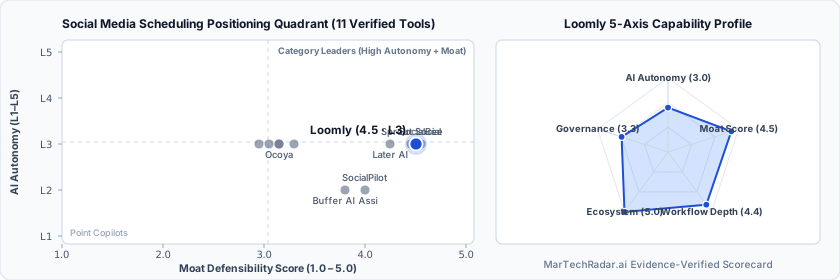
Loomly in-depth review, pricing & architecture analysis
Editor sign-off: Oct 14, 2026. How profiles are made.
What is Loomly? Overview & background
Within fragmented digital distribution ecosystems, modern brand teams require structured governance rather than ungoverned publishing pipelines. Established in 2015 in New York and subsequently acquired by Traject, Loomly addresses this operational friction for agency leads, social media managers, and brand marketing directors. The platform centralizes multi-account content coordination into an auditable editorial calendar framework.
How Loomly works: architecture & workflow
Loomly functions as an orchestration layer using network-specific OAuth integrations and event-driven publishing queues. Content ingestion flows into structured calendar schemas where an embedded AI assistant generates copy drafts and hashtag suggestions. The pipeline applies multi-tiered approval logic before dispatching payloads via platform webhooks, operating at L3 autonomy where generation and scheduling run semi-autonomously under human approval gates, alongside native workflow integrations for Slack, Microsoft Teams, Zapier, and Zendesk.
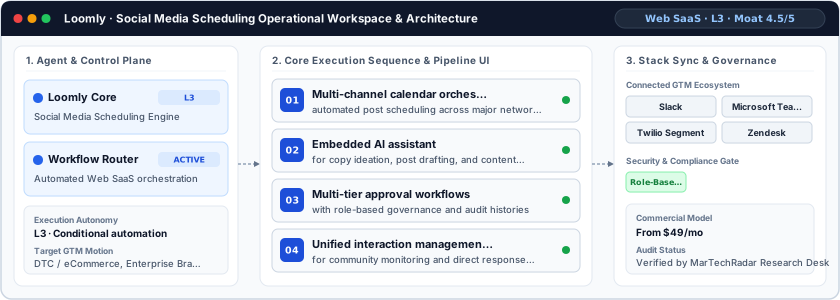
Loomly limitations, drawbacks & risks
Operational considerations and platform boundaries include:
- Social Network API Rate Limits: Publishing throughput and real-time interaction syncing remain subject to third-party network API quotas, causing occasional scheduling delays during API updates.
- Asset Transformation Boundaries: Complex multi-image carousels and vertical video formats frequently require manual pre-formatting adjustments to adhere to idiosyncratic platform aspect ratios.
- Community Ingestion Lag: High-volume comment streams can encounter indexing latency in the unified inbox, impeding rapid-fire moderation during brand crises.
Loomly pricing, plans & cost breakdown
Commercial access follows a tiered software-as-a-service model. Entry tiers start at $49 per month when billed annually at $588, which includes coverage for twelve social accounts and three users. The Beyond tier scales to $249 per month ($2988 billed yearly), unlocking up to sixty accounts, unlimited team members, and custom role controls.
| Plan / Tier | Verified Price & Billing | Target Seat / Scale Fit | Included Scope & Contract Terms |
|---|---|---|---|
| Unlimited | $49/mo | Unlimited seats | Per month, billed yearly ($588 per year) |
| Contract Watchout: Annual Billing Headline vs. Monthly Premium | The vendor pricing page advertises an annual-billing discount (Save 25%); month-to-month billing carries a higher effective monthly rate. | ||
How Loomly compares vs. competitors & alternatives
Relative to Agorapulse, Loomly offers a lighter collaboration footprint tailored to distributed creative teams, though Agorapulse maintains deeper social CRM tagging within the Social Media Scheduling segment. Versus niche offerings like Antela.ai, Inc. and Apaya, Loomly provides mature channel integrations backed by Traject's infrastructure. It fits mid-market marketing teams requiring predictable editorial controls without enterprise deployment complexity.
Direct competitors & market radar
Top algorithmic competitors based on category positioning, capability overlap, and ICP alignment.
Frequently asked questions about Loomly
How much does Loomly cost in 2026?
Loomly pricing: From $49/mo. No free plan is publicly disclosed. Commercial access follows a tiered software-as-a-service model. Entry tiers start at $49 per month when billed annually at $588, which includes coverage for twelve social accounts and three users.
What are the top Loomly alternatives in Social Media Scheduling?
Verified Social Media Scheduling alternatives include DGTLsuite (From $18/mo), Metricool (Free plan · $10–$45/mo), Palo AI (Custom / enterprise pricing), Traackr (Custom / enterprise pricing). Relative to Agorapulse, Loomly offers a lighter collaboration footprint tailored to distributed creative teams, though Agorapulse maintains deeper social CRM tagging within the Social Media Scheduling segment.
What are the main limitations and trade-offs of Loomly?
Operational considerations and platform boundaries include: Social Network API Rate Limits: Publishing throughput and real-time interaction syncing remain subject to third-party network API quotas, causing occasional scheduling delays during API updates. Walk away if your workflow cannot tolerate social network API rate limits: Publishing throughput and real-time interaction syncing remain subject to third-party network API quotas, causing occasional scheduling delays during API updates.
Verified sources & evidence trail
- Official product domain: https://loomly.com
- Commercial pricing verification: https://www.loomly.com/pricing
- Verified corporate entity profiles (
sameAs): LinkedIn Company Profile · Crunchbase Entity Record - First-party governance & documentation links: Trust & Security · System Status · DPA · Terms · Privacy
- Editor sign-off: Oct 14, 2026 (how profiles are made).
