Lightfield Review (2026): AI SDR Pricing, Limits & Alternatives
Bottom line
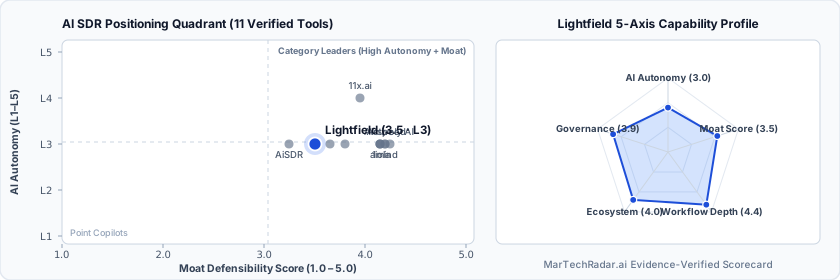
Lightfield is a Web SaaS tool for AI SDR (Autonomous B2B Sales Agents & AI BDRs) in AI SDR & Outbound. Pricing: $89–$1,999/mo. Best suited to B2B Sales Leaders, SDR/BDR Teams and Revenue Operations (RevOps). Editor ratings: AI autonomy L3 (conditional automation); moat score 3.5/5.0 (Proprietary moat). Fact-checked by Jiacky Lee on Oct 10, 2026.
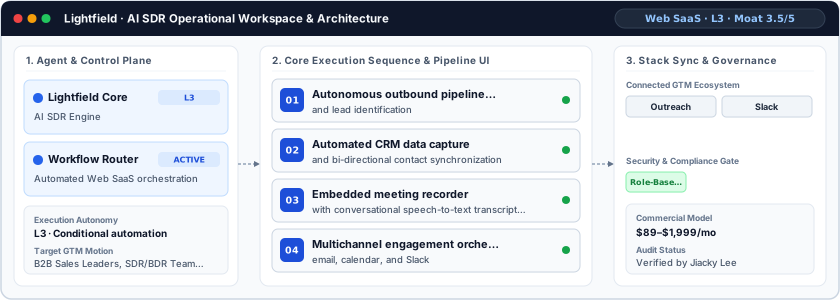
Lightfield provides an AI-native CRM and autonomous sales agent platform that automates pipeline generation, meeting intelligence, and bi-directional CRM.
Lightfield buyer fit verdict: when to choose vs. when to walk away
Choose Lightfield if (Best Fit)
- Target ICP & Stack Fit: You operate as B2B Sales Leaders, SDR/BDR Teams and Revenue Operations (RevOps) requiring a Web SaaS deployment for AI SDR, with verified ecosystem connectivity for Outreach, Slack.
- L3 Architecture & Defensibility: Lightfield establishes defensibility through an integrated architecture uniting autonomous prospecting agents with an automated CRM operational layer, combining conversational ingestion with proprietary contact graph normalization.
- Commercial Model Fit: Your procurement budget aligns with $89–$1,999/mo.
Walk away from Lightfield if (Deal-Breakers)
- Walk away if your workflow requires uncapped enterprise volume on the $89–$1,999/mo entry plan without upgrading tiers.
- Walk away if your workflow cannot tolerate meeting ingestion bottlenecks: Third-party video platform bot rejections or non-standard web conferencing protocols can disrupt real-time transcription and delay record generation.
- Walk away if contextual entity resolution is a deal-breaker for your team: Unstructured conversation notes involving non-standard corporate holding structures occasionally map action items to incorrect parent accounts.
Lightfield key facts & scorecard
| Pricing | $89–$1,999/moVendor pricing page |
|---|---|
| Free plan | No / not disclosed |
| Delivery | Web SaaS |
| Audience | B2B Sales Leaders, SDR/BDR Teams, Revenue Operations (RevOps) |
| AI autonomy level | L3 · Conditional automationEditor-verified |
| Moat tier & score | 3.5 / 5.0 · Proprietary moatEditor-verified |
| Funding | AcquiredAcquired by AngelList |
| Total funding | $122.3MBacked by Andreessen Horowitz, Alumni Ventures, Lightspeed Venture Partners |
| Founders | Henri Liriani, Jack Reed, Keith Peiris, Pete Nichols |
| Company size | 11-50 employees |
| Ecosystem integrations | Outreach, Slack |
| Governance & docs | Trust & Security ↗ · System Status ↗ · API & Docs ↗ · Terms ↗ · Privacy ↗ |
| Headquarters | San Francisco, California |
| Founded | 2020 |
| Last verified |
Lightfield pros & cons: strengths vs. operational limitations
Pros: core strengths & capabilities
- Autonomous outbound pipeline generation: and lead identification
- Automated CRM data capture: and bi-directional contact synchronization
- Embedded meeting recorder: with conversational speech-to-text transcription
- Multichannel engagement orchestration spanning: email, calendar, and Slack
Cons: operational limitations & risks
- Meeting Ingestion Bottlenecks: Third-party video platform bot rejections or non-standard web conferencing protocols can disrupt real-time transcription and delay record generation.
- Contextual Entity Resolution: Unstructured conversation notes involving non-standard corporate holding structures occasionally map action items to incorrect parent accounts.
- Outbound Cadence Throttling: Pipeline generation relies on external messaging providers, leaving automated sequences vulnerable to domain warming constraints and mailbox rate thresholds.
Lightfield TCO & deal-breaker stress test
Simulate 12-month stepped TCO, hidden cost multipliers, contract lock-in exposure, and stack failure modes using only facts verified by Jiacky Lee on · Capture SHA 3b2a50f1.
Lightfield aligns with your 5-seat / $800/mo profile. Review the walk-away triggers and contract levers below before deployment.
| Plan / Tier | Verified Rate | Scale Fit | Scope & Quota Notes |
|---|---|---|---|
| Starter | $89/mo | 1–2 seats | For founders getting started |
| Growth / Professional | $200/mo | 5 seats | What are workspace credits? |
| Free | $999/mo | 15 seats | Per workspace, billed annually |
- Moat Score
- 3.5 / 5.0
- AI Autonomy
- L3
- Free Tier / Trial
- None disclosed
Triggered audit signals & failure modes
- Published Self-Serve Entry FloorVerified Pricing Ledger
Lightfield publishes a transparent entry point ($89–$1,999/mo) for initial validation before committing.
- Tier Fit for 5-Seat Scale: Growth / Professional ($200/mo)Verified Tier Schedule
What are workspace credits?
- Primary Operational Bottleneck: Meeting Ingestion BottlenecksAudit by Jiacky Lee
Third-party video platform bot rejections or non-standard web conferencing protocols can disrupt real-time transcription and delay record generation.
Hidden TCO Multipliers & Quota Gates
- Per-Seat Linear Scaling: Lightfield prices licenses on a per-user/seat basis ($89–$1,999/mo); expanding from 2 to 15+ operators multiplies base recurring spend linearly.
- Annual Billing Headline vs. Monthly Premium: Headline entry rates reflect annual billing commitments; month-to-month flexibility carries a higher effective monthly rate or requires annual prepayment.
- Credit & Usage Burn Multiplier: Automated workflows consume metered credits/usage quotas; multi-step enrichment, voice minutes, or high-frequency agent runs can trigger mid-cycle top-up packs.
When to Walk Away & Negotiation Levers
- Walk away if your workflow requires uncapped enterprise volume on the $89–$1,999/mo entry plan without upgrading tiers.
- Walk away if your workflow cannot tolerate meeting ingestion bottlenecks: Third-party video platform bot rejections or non-standard web conferencing protocols can disrupt real-time transcription and delay record generation.
- Walk away if contextual entity resolution is a deal-breaker for your team: Unstructured conversation notes involving non-standard corporate holding structures occasionally map action items to incorrect parent accounts.
- Validate exact quota thresholds (seats, credits, or API calls) included in Lightfield's $89–$1,999/mo tier before converting from monthly to annual billing.
- Require a sandbox proof-of-concept testing meeting ingestion bottlenecks against your live CRM/data schema before annual sign-off.
Ask a custom procurement or TCO stress-test question about Lightfield
Lower 5-seat floor (~$39/mo vs. $200 / mo)
Offers a free tier (Free plan · $0/mo · Enterprise plan)
Lightfield key entities, modules & ecosystem stack
Lightfield moat & subtrack positioning
Lightfield establishes defensibility through an integrated architecture uniting autonomous prospecting agents with an automated CRM operational layer, combining conversational ingestion with proprietary contact graph normalization.
Editorial review
Fact-checked by Jiacky Lee (Managing Editor, AI Autonomy & Moat Methodology) on .
Background
Backed by $122.3M in venture funding, Lightfield was founded in 2020 in San Francisco, California, to replace manual data entry in revenue workflows. Built for revenue operations directors, founding teams, and sales leadership, the platform functions as an AI-native CRM and outbound sales agent. Lightfield centralizes pipeline generation, conversation capture, and field updates into a single autonomous operational layer, removing the overhead traditionally associated with legacy customer databases.
How Lightfield works
Lightfield operates at an L3 autonomy tier by pairing multi-channel event ingestion with deterministic record reconciliation. The core engine links directly to enterprise communication channels—including email accounts, calendar services, and Slack—alongside an automated meeting recorder that processes call audio via speech-to-text models. Large language model parsers extract key commercial entities, action items, and account signals from these inputs, autonomously updating relational CRM records and activating contextual outbound sales sequences without manual agent rep input.
Limitations
Operational considerations and platform boundaries include:
- Meeting Ingestion Bottlenecks: Third-party video platform bot rejections or non-standard web conferencing protocols can disrupt real-time transcription and delay record generation.
- Contextual Entity Resolution: Unstructured conversation notes involving non-standard corporate holding structures occasionally map action items to incorrect parent accounts.
- Outbound Cadence Throttling: Pipeline generation relies on external messaging providers, leaving automated sequences vulnerable to domain warming constraints and mailbox rate thresholds.
Lightfield pricing
Lightfield delivers software-as-a-service licensing starting at $89 per user per month on its Starter tier, structured for smaller teams with basic meeting recording, automatic record updates, and workspace collaboration. Pricing scales upward based on outbound capacity, advanced orchestration, and extended governance features to $1,999 per month for larger organizational tiers.
How Lightfield compares
Within the autonomous sales landscape, Lightfield diverges from pure-play outbound execution platforms such as 11x.ai, 1mind, and Actively AI. While 11x.ai and Actively AI emphasize purely external outreach and digital worker avatars, Lightfield anchors pipeline generation directly to internal CRM state management and automatic meeting transcription. It serves mid-market to enterprise B2B sales teams requiring integrated operational data integrity alongside autonomous outbound workflows.
Direct competitors & market radar
Top algorithmic competitors based on category positioning, capability overlap, and ICP alignment.
Frequently asked questions about Lightfield
How much does Lightfield cost and what pricing tiers are available?
Published pricing summary for Lightfield: $89–$1,999/mo. A permanent free plan is not disclosed for Lightfield. Verified tier schedule: Starter ($89/mo for 1–2 seats); Growth / Professional ($200/mo for 5 seats); Free ($999/mo for 15 seats). Lightfield delivers software-as-a-service licensing starting at $89 per user per month on its Starter tier, structured for smaller teams with basic meeting recording, automatic record updates, and workspace collaboration.
How does Lightfield work and how autonomous is its AI architecture?
Lightfield provides an AI-native CRM and autonomous sales agent platform that automates pipeline generation, meeting intelligence, and bi-directional CRM. Within AI SDR (Autonomous B2B Sales Agents & AI BDRs), MarTechRadar rates its execution architecture at L3 · Conditional automation with a verified Moat Score of 3.5 / 5.0 (Proprietary moat). Lightfield establishes defensibility through an integrated architecture uniting autonomous prospecting agents with an automated CRM operational layer, combining conversational ingestion with proprietary contact graph normalization. Corporate profile: Founded by Henri Liriani, Jack Reed, Keith Peiris, Pete Nichols, operating at 11-50 employees scale, acquired by AngelList.
What are the main limitations of Lightfield and when should buyers walk away?
Based on our editorial technical audit, key operational considerations and boundaries for Lightfield include: (1) Meeting Ingestion Bottlenecks: Third-party video platform bot rejections or non-standard web conferencing protocols can disrupt real-time transcription and delay record generation. (2) Contextual Entity Resolution: Unstructured conversation notes involving non-standard corporate holding structures occasionally map action items to incorrect parent accounts. (3) Outbound Cadence Throttling: Pipeline generation relies on external messaging providers, leaving automated sequences vulnerable to domain warming constraints and mailbox rate thresholds. Primary procurement walk-away rule: Walk away if your workflow requires uncapped enterprise volume on the $89–$1,999/mo entry plan without upgrading tiers.
What integrations, compliance certifications, and contract terms apply to Lightfield?
Verified ecosystem and stack integrations include Outreach, Slack. First-party governance and developer endpoints verified on domain include: Trust/Security (https://trust.lightfield.app/at), Status (https://status.lightfield.app), API Docs (https://docs.lightfield.app). Key TCO multiplier to watch: Per-Seat Linear Scaling (Lightfield prices licenses on a per-user/seat basis ($89–$1,999/mo); expanding from 2 to 15+ operators multiplies base recurring spend linearly.) Before signing a contract, procurement teams should validate exact quota thresholds (seats, credits, or API calls) included in Lightfield's $89–$1,999/mo tier before converting from monthly to annual billing.
What are the best Lightfield alternatives and head-to-head competitors in 2026?
Top fact-checked alternatives to Lightfield in AI SDR (Autonomous B2B Sales Agents & AI BDRs) include Demandbase (Custom / enterprise pricing), Outreach (Custom / enterprise pricing), AiSDR ($39–$149/mo), Pipeline (Custom / enterprise pricing). Within the autonomous sales landscape, Lightfield diverges from pure-play outbound execution platforms such as 11x.ai, 1mind, and Actively AI.
Verified sources & evidence trail
- Official product domain: https://lightfield.app
- Commercial pricing verification: https://lightfield.app/pricing
- Verified corporate entity profiles (
sameAs): LinkedIn Company Profile · Crunchbase Entity Record - First-party governance & documentation links: Trust & Security · System Status · API & Docs · Terms · Privacy
- Editorial audit sign-off: Fact-checked by Jiacky Lee on under the MarTechRadar Evidence-Ledger Protocol.