Haku AI Review (2026): AI SDR Pricing, Limits & Alternatives
Bottom line
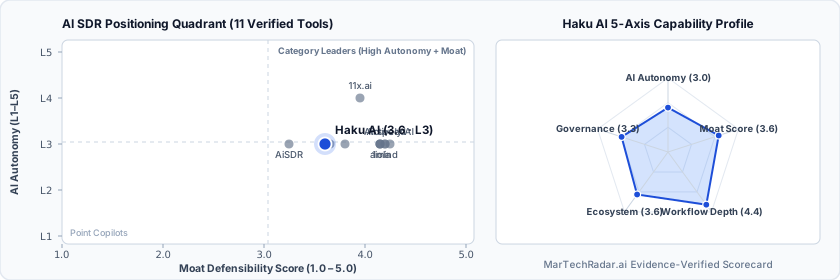
Haku AI is a Web SaaS tool for AI SDR (Autonomous B2B Sales Agents & AI BDRs) in AI SDR & Outbound. Pricing: Custom / enterprise pricing. Best suited to B2B Sales Leaders, SDR/BDR Teams and Revenue Operations (RevOps). Editor ratings: AI autonomy L3 (conditional automation); moat score 3.6/5.0 (Proprietary moat). Fact-checked by Jagmeet Sine on Oct 14, 2026.
Signal-based autonomous B2B sales agent platform executing contextual prospect research, buying signal monitoring, and pipeline outbound automation.
Haku AI buyer fit verdict: when to choose vs. when to walk away
Choose Haku AI if (Best Fit)
- Target ICP & Stack Fit: You operate as B2B Sales Leaders, SDR/BDR Teams and Revenue Operations (RevOps) requiring a Web SaaS deployment for AI SDR, with verified ecosystem connectivity for Outreach.
- L3 Architecture & Defensibility: Defensibility rests on custom buying signal extraction models that maintain context fidelity during deep web research, preventing hallucinated buyer context across autonomous prospecting workflows.
- Commercial Model Fit: Your procurement budget aligns with Custom / enterprise pricing.
Walk away from Haku AI if (Deal-Breakers)
- Walk away if you require transparent self-serve monthly billing or your budget ceiling is under $1,000/mo (Haku AI requires sales-gated custom quoting).
- Walk away if your workflow cannot tolerate signal ingestion latency: Unstructured web signal monitoring introduces processing delays when target accounts limit external crawl indexing or deploy anti-scraping defenses.
- Walk away if context window drift is a deal-breaker for your team: Deep autonomous research workflows risk factual extrapolation when synthesizing multi-source data across disparate press releases and hiring boards.
Haku AI key facts & scorecard
| Pricing | Custom / enterprise pricing |
|---|---|
| Free plan | No / not disclosed |
| Delivery | Web SaaS |
| Audience | B2B Sales Leaders, SDR/BDR Teams, Revenue Operations (RevOps) |
| AI autonomy level | L3 · Conditional automationEditor-verified |
| Moat tier & score | 3.6 / 5.0 · Proprietary moatEditor-verified |
| Funding | Pre-seed |
| Company size | 11-50 employees |
| Ecosystem integrations | Outreach |
| Headquarters | London |
| Founded | 2025 |
| Last verified |
Haku AI pros & cons: strengths vs. operational limitations
Pros: core strengths & capabilities
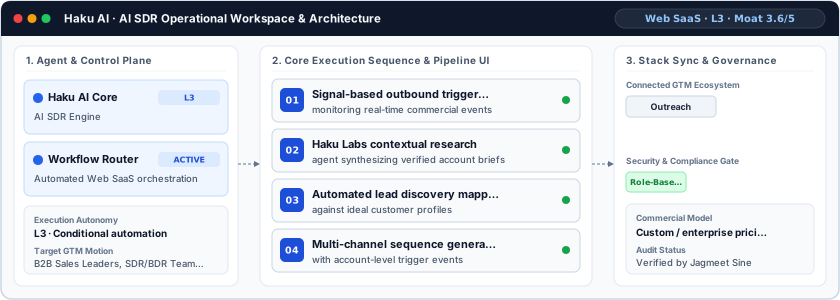
- Signal-based outbound trigger engine: monitoring real-time commercial events
- Haku Labs contextual research: agent synthesizing verified account briefs
- Automated lead discovery mapped: against ideal customer profiles
- Multi-channel sequence generation aligned: with account-level trigger events
Cons: operational limitations & risks
- Signal Ingestion Latency: Unstructured web signal monitoring introduces processing delays when target accounts limit external crawl indexing or deploy anti-scraping defenses.
- Context Window Drift: Deep autonomous research workflows risk factual extrapolation when synthesizing multi-source data across disparate press releases and hiring boards.
- Deliverability Bottlenecks: Automated trigger-to-send volume spikes necessitate rigorous external domain warming and mailbox pool governance to avoid reputation penalties.
Haku AI TCO & deal-breaker stress test
Simulate 12-month stepped TCO, hidden cost multipliers, contract lock-in exposure, and stack failure modes using only facts verified by Jagmeet Sine on · Capture SHA 9e9dfb2a.
Haku AI triggers high-severity friction under your 5-seat / $800/mo constraints. Benchmark the verified subtrack alternatives below before committing.
| Plan / Tier | Verified Rate | Scale Fit | Scope & Quota Notes |
|---|---|---|---|
| Enterprise / Custom | Custom quote | 15–50+ seats (Enterprise SLA) | Sales-negotiated annual contract for custom volume, SSO/RBAC governance, and dedicated SLA. |
- Moat Score
- 3.6 / 5.0
- AI Autonomy
- L3
- Free Tier / Trial
- None disclosed
Triggered audit signals & failure modes
- Opaque Enterprise Quoting vs. SMB/Mid-Market BudgetVerified Pricing Ledger
Haku AI does not disclose a public self-serve floor (Custom / enterprise pricing). Buyers with a $800/mo cap face high sales-qualification friction.
- Sales-Gated Contract TermsFact-checked by Jagmeet Sine
Commercial access operates under custom enterprise pricing available on request through tailored sales quotes based on organizational deployment scale, seat counts, and monitored signal volume.
- Primary Operational Bottleneck: Signal Ingestion LatencyAudit by Jagmeet Sine
Unstructured web signal monitoring introduces processing delays when target accounts limit external crawl indexing or deploy anti-scraping defenses.
Hidden TCO Multipliers & Quota Gates
- Signal Ingestion Latency: Unstructured web signal monitoring introduces processing delays when target accounts limit external crawl indexing or deploy anti-scraping defenses.
- Context Window Drift: Deep autonomous research workflows risk factual extrapolation when synthesizing multi-source data across disparate press releases and hiring boards.
When to Walk Away & Negotiation Levers
- Walk away if you require transparent self-serve monthly billing or your budget ceiling is under $1,000/mo (Haku AI requires sales-gated custom quoting).
- Walk away if your workflow cannot tolerate signal ingestion latency: Unstructured web signal monitoring introduces processing delays when target accounts limit external crawl indexing or deploy anti-scraping defenses.
- Walk away if context window drift is a deal-breaker for your team: Deep autonomous research workflows risk factual extrapolation when synthesizing multi-source data across disparate press releases and hiring boards.
- Demand a 30- to 60-day paid pilot opt-out clause in the Haku AI order form before signing a 12-month enterprise commitment.
- Require a sandbox proof-of-concept testing signal ingestion latency against your live CRM/data schema before annual sign-off.
Ask a custom procurement or TCO stress-test question about Haku AI
Lower 5-seat floor (~$49/mo vs. Custom Quote) · Transparent self-serve entry without mandatory annual lock-in
Verified AI SDR peer (Custom / enterprise pricing · Moat 3.6/5.0)
Haku AI key entities, modules & ecosystem stack
Haku AI moat & subtrack positioning
Defensibility rests on custom buying signal extraction models that maintain context fidelity during deep web research, preventing hallucinated buyer context across autonomous prospecting workflows.
Editorial review
Fact-checked by Jagmeet Sine (Senior MarTech Infrastructure & Agentic Workflow Architect) on .
Background
Architectured around event-driven outbound infrastructure, Haku AI addresses the operational disconnect between raw intent data and autonomous outreach execution. Established in 2025 and headquartered in London, the platform targets enterprise revenue leaders, outbound demand generation heads, and business development teams seeking automated lead discovery. Instead of relying on static database queries, the system introduces contextual research agents that monitor real-time commercial triggers to initiate pipeline generation.
How Haku AI works
At its architectural core, the system runs an asynchronous pipeline that continuously ingests web signals, corporate events, and organizational changes to surface qualified accounts. A context-preserving research module parses account-level developments, generating structured buyer dossiers without losing source attribution. The engine then coordinates multi-step outbound workflows at an L3 autonomy level, synthesizing contextualized messaging triggers and dispatching outreach tasks directly to revenue communication endpoints.
Limitations
Operational considerations and platform boundaries include:
- Signal Ingestion Latency: Unstructured web signal monitoring introduces processing delays when target accounts limit external crawl indexing or deploy anti-scraping defenses.
- Context Window Drift: Deep autonomous research workflows risk factual extrapolation when synthesizing multi-source data across disparate press releases and hiring boards.
- Deliverability Bottlenecks: Automated trigger-to-send volume spikes necessitate rigorous external domain warming and mailbox pool governance to avoid reputation penalties.
Haku AI pricing
Commercial access operates under custom enterprise pricing available on request through tailored sales quotes based on organizational deployment scale, seat counts, and monitored signal volume. The company provides prospective evaluation periods through a structured pilot trial, allowing revenue operations teams to validate trigger accuracy and sequence fidelity before committing to annual contractual agreements.
How Haku AI compares
Within the autonomous sales landscape, Haku AI competes directly against digital worker platforms like 11x.ai, conversational engines like 1mind, and signal-led agents like Actively AI. While 11x.ai emphasizes fully delegated digital BDR personas and 1mind concentrates on conversational response pathways, Haku AI differentiates via granular, context-faithful intent signal mapping. The solution best fits mid-market and enterprise B2B sales organizations with distinct buying triggers that demand tailored research before initiating contact.
Frequently asked questions about Haku AI
How much does Haku AI cost and does it require a custom enterprise quote?
Published pricing summary for Haku AI: Custom / enterprise pricing. A permanent free plan is not disclosed for Haku AI. Commercial access operates under custom enterprise pricing available on request through tailored sales quotes based on organizational deployment scale, seat counts, and monitored signal volume.
How does Haku AI work and how autonomous is its AI architecture?
Signal-based autonomous B2B sales agent platform executing contextual prospect research, buying signal monitoring, and pipeline outbound automation. Within AI SDR (Autonomous B2B Sales Agents & AI BDRs), MarTechRadar rates its execution architecture at L3 · Conditional automation with a verified Moat Score of 3.6 / 5.0 (Proprietary moat). Defensibility rests on custom buying signal extraction models that maintain context fidelity during deep web research, preventing hallucinated buyer context across autonomous prospecting workflows. Corporate profile: operating at 11-50 employees scale.
What are the main limitations of Haku AI and when should buyers walk away?
Based on our editorial technical audit, key operational considerations and boundaries for Haku AI include: (1) Signal Ingestion Latency: Unstructured web signal monitoring introduces processing delays when target accounts limit external crawl indexing or deploy anti-scraping defenses. (2) Context Window Drift: Deep autonomous research workflows risk factual extrapolation when synthesizing multi-source data across disparate press releases and hiring boards. (3) Deliverability Bottlenecks: Automated trigger-to-send volume spikes necessitate rigorous external domain warming and mailbox pool governance to avoid reputation penalties. Primary procurement walk-away rule: Walk away if you require transparent self-serve monthly billing or your budget ceiling is under $1,000/mo (Haku AI requires sales-gated custom quoting).
What integrations, compliance certifications, and contract terms apply to Haku AI?
Verified ecosystem and stack integrations include Outreach. Key TCO multiplier to watch: Signal Ingestion Latency (Unstructured web signal monitoring introduces processing delays when target accounts limit external crawl indexing or deploy anti-scraping defenses.) Before signing a contract, procurement teams should demand a 30- to 60-day paid pilot opt-out clause in the Haku AI order form before signing a 12-month enterprise commitment.
What are the best Haku AI alternatives and head-to-head competitors in 2026?
Top fact-checked alternatives to Haku AI in AI SDR (Autonomous B2B Sales Agents & AI BDRs) include Hexus (From $49/mo), Cluster (Custom / enterprise pricing), Gravitas.io (Custom / enterprise pricing), Marvin.ai (Custom / enterprise pricing). Within the autonomous sales landscape, Haku AI competes directly against digital worker platforms like 11x.ai, conversational engines like 1mind, and signal-led agents like Actively AI.
Verified sources & evidence trail
- Official product domain: https://hakulabs.com/
- Commercial pricing verification: Verified against official vendor pricing policy (Custom / enterprise pricing)
- Verified corporate entity profiles (
sameAs): LinkedIn Company Profile · Crunchbase Entity Record - Editorial audit sign-off: Fact-checked by Jagmeet Sine on under the MarTechRadar Evidence-Ledger Protocol.