GrowthBar Review (2026): Content Optimization Pricing, Pros & Cons
Bottom line
GrowthBar is a Browser Extension tool for Content Optimization (Content Optimization & SERP Intelligence) in GEO & AI SEO. Pricing: From $29/mo. Best suited to Creators / Solo. Editor ratings: AI autonomy L2 (workflow copilot); moat score 2.6/5.0 (Workflow-embedded). Fact-checked by MarTechRadar Research Desk on Oct 14, 2026.
AI-powered long-form content generation and SEO auditing platform designed to streamline organic research, competitive analysis, and editorial execution.
Is GrowthBar worth it in 2026? Buyer fit & when to walk away
Choose GrowthBar if (Best Fit)
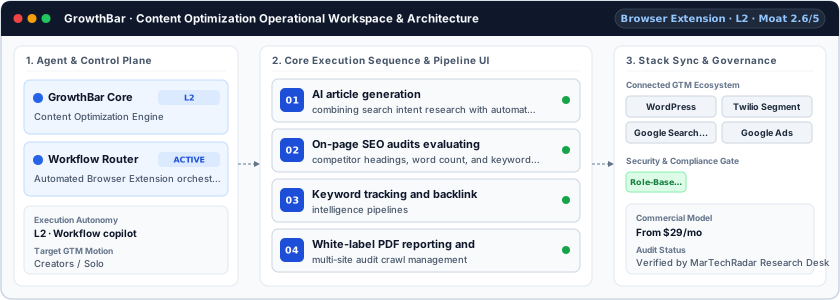
- Target ICP & Stack Fit: You operate as Creators / Solo requiring a Browser Extension deployment for Content Optimization, with verified ecosystem connectivity for WordPress, Twilio Segment, Google Search Console, Google Ads.
- L2 Architecture & Defensibility: Proprietary integration of real-time SERP competitive scraping, automated keyword difficulty heuristics, and continuous on-page content grading within a unified writing environment.
- Commercial Model Fit: Your procurement budget aligns with From $29/mo.
Walk away from GrowthBar if (Deal-Breakers)
- Walk away if your workflow cannot tolerate algorithmic drift and SERP volatility: Static keyword frequency recommendations can lag dynamic search engine algorithm updates, resulting in over-optimized content profiles if editorial teams do not manually audit real-time changes in search intent.
- Walk away if crawl capacity ceilings is a deal-breaker for your team: Auditing and backlink lookups enforce rigid monthly crawl quotas, causing execution bottlenecks for enterprise environments managing multi-domain digital portfolios or high-volume publishing schedules.
GrowthBar pricing, free plan & scorecard at a glance
| Pricing | From $29/moVendor pricing page |
|---|---|
| Free plan | No / not disclosed |
| Delivery | Browser Extension |
| Audience | Creators / Solo |
| AI autonomy level | L2 · Workflow copilotEditor-verified |
| Moat tier & score | 2.6 / 5.0 · Workflow-embeddedEditor-verified |
| Funding | Bootstrapped |
| Founders | Hailey Friedman, Mark Spera |
| Company size | 11-50 employees |
| Ecosystem integrations | WordPress, Twilio Segment, Google Search Console, Google Ads |
| Governance & docs | Terms ↗ · Privacy ↗ |
| Headquarters | West Hollywood, California, United States |
| Founded | 2020 |
| Last verified | Oct 14, 2026 |
GrowthBar pros & cons: strengths vs. operational limitations
Pros: core strengths & capabilities
- AI article generation: combining search intent research with automated drafting
- On-page SEO audits evaluating: competitor headings, word count, and keyword distribution
- Keyword tracking and backlink: intelligence pipelines
- White-label PDF reporting and multi-site audit crawl management
Cons: operational limitations & risks
- Algorithmic Drift and SERP Volatility: Static keyword frequency recommendations can lag dynamic search engine algorithm updates, resulting in over-optimized content profiles if editorial teams do not manually audit real-time changes in search intent.
- Crawl Capacity Ceilings: Auditing and backlink lookups enforce rigid monthly crawl quotas, causing execution bottlenecks for enterprise environments managing multi-domain digital portfolios or high-volume publishing schedules.
- Semantic Depth Constraints: The generation framework relies primarily on publicly indexed search results, which limits the platform's ability to incorporate proprietary internal research or complex primary data without substantial manual prompt engineering.
GrowthBar TCO & deal-breaker stress test
Simulate 12-month stepped TCO, hidden cost multipliers, contract lock-in exposure, and stack failure modes using only facts verified by MarTechRadar Research Desk on 2026-10-14 · Capture SHA b66dbf27.
GrowthBar aligns with your 5-seat / $800/mo profile. Review the walk-away triggers and contract levers below before deployment.
- Moat Score
- 2.6 / 5.0
- AI Autonomy
- L2
- Free Tier / Trial
- None disclosed
Triggered audit signals & failure modes
- Published Self-Serve Entry FloorVerified Pricing Ledger
GrowthBar publishes a transparent entry point (From $29/mo) for initial validation before committing.
- Primary Operational Bottleneck: Algorithmic Drift and SERP VolatilityAudit by MarTechRadar Research Desk
Static keyword frequency recommendations can lag dynamic search engine algorithm updates, resulting in over-optimized content profiles if editorial teams do not manually audit real-time changes in search intent.
Test a custom GrowthBar budget or stack constraint
Fits within $800/mo budget (From $179/mo)
Fits within $800/mo budget (From $29/mo)
GrowthBar integrations, API, security & compliance stack
GrowthBar AI moat & Content Optimization positioning
Proprietary integration of real-time SERP competitive scraping, automated keyword difficulty heuristics, and continuous on-page content grading within a unified writing environment.
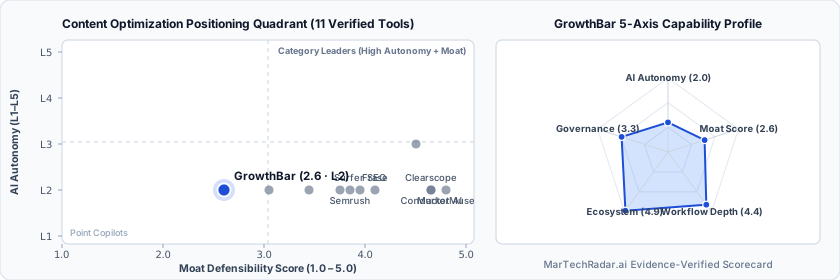
GrowthBar in-depth review, pricing & architecture analysis
Editor sign-off: Oct 14, 2026. How profiles are made.
What is GrowthBar? Overview & background
Established in 2020 and headquartered in West Hollywood, California, United States, GrowthBar targets growth marketers and editorial teams requiring integrated search optimization alongside generative composition. The platform focuses on eliminating the workflow fragmentation between disparate keyword research utilities and text generation engines. By marrying competitive search data with natural language drafting within a unified operational canvas, it provides content strategists with structured editorial workflows for organic acquisition campaigns.
How GrowthBar works: architecture & workflow
At its architectural core, GrowthBar couples external SERP scraping pipelines with large language model prompt orchestration to deliver long-form editorial generation. The system extracts top-ranking competitor headers, calculates term frequencies, and models target keyword difficulty before assembling structured outlines. Once an outline is approved, the generation engine populates sections with domain context while an integrated scoring heuristic audits keyword density, readability indices, and external link distributions against live search engine results, alongside native workflow integrations for Google Search Console, WordPress, Google Ads, and Semrush.
GrowthBar limitations, drawbacks & risks
Operational considerations and platform boundaries include:
- Algorithmic Drift and SERP Volatility: Static keyword frequency recommendations can lag dynamic search engine algorithm updates, resulting in over-optimized content profiles if editorial teams do not manually audit real-time changes in search intent.
- Crawl Capacity Ceilings: Auditing and backlink lookups enforce rigid monthly crawl quotas, causing execution bottlenecks for enterprise environments managing multi-domain digital portfolios or high-volume publishing schedules.
- Semantic Depth Constraints: The generation framework relies primarily on publicly indexed search results, which limits the platform's ability to incorporate proprietary internal research or complex primary data without substantial manual prompt engineering.
GrowthBar pricing, plans & cost breakdown
Commercial access operates through a tiered monthly subscription model starting at $29 for the DIY tier, which packages basic crawl quotas and article allocations. The White Label tier is priced at $39 per month, adding client reporting capabilities and multi-user seats. For higher audit demands, the Lead Generation tier scales to $59 per month with expanded keyword tracking limits.
How GrowthBar compares vs. competitors & alternatives
Within organic search optimization, GrowthBar maintains a focused position relative to alternative marketing architectures within the AI Content Marketing segment. While Typeface structures creator-led brand matching and AndromedAI provides broad omni-channel automation, GrowthBar concentrates specifically on text-based search relevance. Concurrently, platforms like Amdahl target synthetic text governance and detection verification rather than active generation. Consequently, GrowthBar serves mid-market marketing departments and boutique digital agencies prioritizing search visibility without the complex implementation overhead of enterprise content suites.
Direct competitors & market radar
Top algorithmic competitors based on category positioning, capability overlap, and ICP alignment.
Frequently asked questions about GrowthBar
How much does GrowthBar cost in 2026?
GrowthBar pricing: From $29/mo. No free plan is publicly disclosed. Commercial access operates through a tiered monthly subscription model starting at $29 for the DIY tier, which packages basic crawl quotas and article allocations.
What are the top GrowthBar alternatives in Content Optimization?
Verified Content Optimization alternatives include Toppi (From $179/mo), Amboras ($39–$2,499/mo), Solara AI (From $29/mo), FastFix (From $997/mo). Within organic search optimization, GrowthBar maintains a focused position relative to alternative marketing architectures within the AI Content Marketing segment.
What are the main limitations and trade-offs of GrowthBar?
Operational considerations and platform boundaries include: Algorithmic Drift and SERP Volatility: Static keyword frequency recommendations can lag dynamic search engine algorithm updates, resulting in over-optimized content profiles if editorial teams do not manually audit real-time changes in search intent. Walk away if your workflow cannot tolerate algorithmic drift and SERP volatility: Static keyword frequency recommendations can lag dynamic search engine algorithm updates, resulting in over-optimized content profiles if editorial teams do not manually audit real-time changes in search intent.
Verified sources & evidence trail
- Official product domain: https://growthbarseo.com
- Commercial pricing verification: https://www.seoptimer.com/pricing/
- Verified corporate entity profiles (
sameAs): LinkedIn Company Profile · Crunchbase Entity Record - First-party governance & documentation links: Terms · Privacy
- Editor sign-off: Oct 14, 2026 (how profiles are made).
