Post.ai Review (2026): AI Content Marketing Pricing, Limits & Alternatives
Bottom line
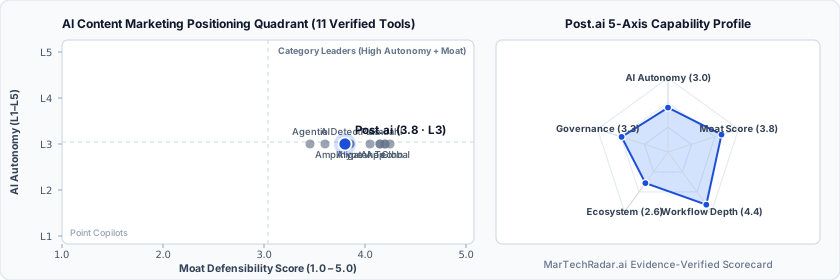
Post.ai is a Web SaaS tool for AI Content Marketing (Enterprise & Long-Form Brand Content) in Copy & Content. Pricing: Free plan · $0/mo · Enterprise plan. Best suited to Enterprise Content Teams, Brand Marketers and Global Copywriters. Editor ratings: AI autonomy L3 (conditional automation); moat score 3.8/5.0 (Proprietary moat). Fact-checked by Jagmeet Sine on Oct 11, 2026.
Automated blog writing and content marketing software generating SEO-optimized long-form articles with custom brand voice matching.
Post.ai buyer fit verdict: when to choose vs. when to walk away
Choose Post.ai if (Best Fit)
- Target ICP & Stack Fit: You operate as Enterprise Content Teams, Brand Marketers and Global Copywriters requiring a Web SaaS deployment for AI Content Marketing.
- L3 Architecture & Defensibility: Defensibility stems from semantic keyword clustering, automated SERP entity mapping, and multi-profile brand voice alignment engines.
- Commercial Model Fit: Your procurement budget aligns with Free plan · $0/mo · Enterprise plan and want a self-serve free tier for zero-cost initial validation.
Walk away from Post.ai if (Deal-Breakers)
- Walk away if your workflow requires uncapped enterprise volume on the Free plan · $0/mo · Enterprise plan entry plan without upgrading tiers.
- Walk away if your workflow cannot tolerate topical entity drift: The algorithmic synthesis occasionally injects repetitive entity phrasing into subheadings, necessitating manual copyediting to prevent unnatural keyword stuffing penalties.
- Walk away if dynamic SERP latency is a deal-breaker for your team: Content structures rely on snapshot SERP parsing, which struggles to incorporate intraday algorithmic shifts or sudden news hooks during breaking search trends.
Post.ai key facts & scorecard
| Pricing | Free plan · $0/mo · Enterprise planVendor pricing page |
|---|---|
| Free plan | Yes |
| Delivery | Web SaaS |
| Audience | Enterprise Content Teams, Brand Marketers, Global Copywriters |
| AI autonomy level | L3 · Conditional automationEditor-verified |
| Moat tier & score | 3.8 / 5.0 · Proprietary moatEditor-verified |
| Funding | Seed |
| Total funding | SeedBacked by Bootstrapped |
| Governance & docs | Changelog ↗ · Terms ↗ · Privacy ↗ |
| Headquarters | United States |
| Founded | 2026 |
| Last verified |
Post.ai pros & cons: strengths vs. operational limitations
Pros: core strengths & capabilities
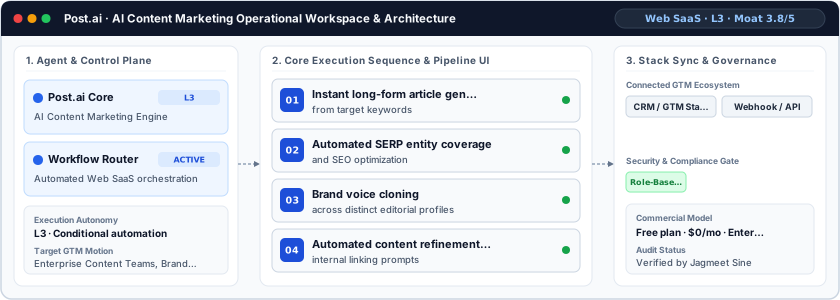
- Instant long-form article generation: from target keywords
- Automated SERP entity coverage: and SEO optimization
- Brand voice cloning: across distinct editorial profiles
- Automated content refinement and: internal linking prompts
Cons: operational limitations & risks
- Topical Entity Drift: The algorithmic synthesis occasionally injects repetitive entity phrasing into subheadings, necessitating manual copyediting to prevent unnatural keyword stuffing penalties.
- Dynamic SERP Latency: Content structures rely on snapshot SERP parsing, which struggles to incorporate intraday algorithmic shifts or sudden news hooks during breaking search trends.
- CMS API Ingestion Bottlenecks: Direct headless CMS synchronization lacks deep bi-directional field mapping, requiring editorial teams to manually format rich media embed blocks post-generation.
Post.ai TCO & deal-breaker stress test
Simulate 12-month stepped TCO, hidden cost multipliers, contract lock-in exposure, and stack failure modes using only facts verified by Jagmeet Sine on · Capture SHA c63aea42.
Post.ai is viable for 5 seats, but requires commercial or technical verification on the flagged items below.
| Plan / Tier | Verified Rate | Scale Fit | Scope & Quota Notes |
|---|---|---|---|
| Free / Sandbox | $0 | 1–2 seats (Evaluation) | Entry free tier with capped usage or feature quotas for initial workflow testing. |
| Pro | $29/mo | 1–2 seats | For serious bloggers and content marketers. |
| Agency | $99/mo | 5 seats | For teams and high-volume publishers. |
| Enterprise / Custom | Custom quote | 15–50+ seats (Enterprise SLA) | Sales-negotiated annual contract for custom volume, SSO/RBAC governance, and dedicated SLA. |
- Moat Score
- 3.8 / 5.0
- AI Autonomy
- L3
- Free Tier / Trial
- Free plan
Triggered audit signals & failure modes
- Opaque Enterprise Quoting vs. SMB/Mid-Market BudgetVerified Pricing Ledger
Post.ai does not disclose a public self-serve floor (Free plan · $0/mo · Enterprise plan). Buyers with a $800/mo cap face high sales-qualification friction.
- Published Self-Serve Entry FloorVerified Pricing Ledger
Post.ai publishes a transparent entry point (Free plan · $0/mo · Enterprise plan) with a free tier for initial validation before committing.
- Tier Fit for 5-Seat Scale: Pro ($29/mo)Verified Tier Schedule
For serious bloggers and content marketers.
- Primary Operational Bottleneck: Topical Entity DriftAudit by Jagmeet Sine
The algorithmic synthesis occasionally injects repetitive entity phrasing into subheadings, necessitating manual copyediting to prevent unnatural keyword stuffing penalties.
Hidden TCO Multipliers & Quota Gates
- Annual Billing Headline vs. Monthly Premium: Headline entry rates reflect annual billing commitments (Save 20%); month-to-month flexibility carries a higher effective monthly rate or requires annual prepayment.
- Topical Entity Drift: The algorithmic synthesis occasionally injects repetitive entity phrasing into subheadings, necessitating manual copyediting to prevent unnatural keyword stuffing penalties.
- Dynamic SERP Latency: Content structures rely on snapshot SERP parsing, which struggles to incorporate intraday algorithmic shifts or sudden news hooks during breaking search trends.
When to Walk Away & Negotiation Levers
- Walk away if your workflow requires uncapped enterprise volume on the Free plan · $0/mo · Enterprise plan entry plan without upgrading tiers.
- Walk away if your workflow cannot tolerate topical entity drift: The algorithmic synthesis occasionally injects repetitive entity phrasing into subheadings, necessitating manual copyediting to prevent unnatural keyword stuffing penalties.
- Walk away if dynamic SERP latency is a deal-breaker for your team: Content structures rely on snapshot SERP parsing, which struggles to incorporate intraday algorithmic shifts or sudden news hooks during breaking search trends.
- Validate exact quota thresholds (seats, credits, or API calls) included in Post.ai's Free plan · $0/mo · Enterprise plan tier before converting from monthly to annual billing.
- Require a sandbox proof-of-concept testing topical entity drift against your live CRM/data schema before annual sign-off.
Ask a custom procurement or TCO stress-test question about Post.ai
Lower 5-seat floor (~$13/mo vs. Custom Quote)
Lower 5-seat floor (~$49/mo vs. Custom Quote)
Post.ai moat & subtrack positioning
Defensibility stems from semantic keyword clustering, automated SERP entity mapping, and multi-profile brand voice alignment engines.
Editorial review
Fact-checked by Jagmeet Sine (Senior MarTech Infrastructure & Agentic Workflow Architect) on .
Background
To capture organic search demand, editorial marketing teams must consistently deliver technically optimized long-form content without incurring excessive agency overhead. Founded in 2026 and based in the United States, Post.ai targets growth marketers, digital publishers, and agency operators seeking structured long-form content production. The system automates the creation of search-aligned articles by translating target keyword inputs into publication-ready copy that mirrors established editorial guidelines.
How Post.ai works
Post.ai operates through an autonomous pipeline that combines semantic keyword decomposition with automated draft synthesis. Upon receiving a target topic, the system scrapes competitive search engine results pages to determine required topical entities, header hierarchies, and question-based subheadings. It then passes these parameters through fine-tuned generation models to construct drafts incorporating internal linking hooks and contextual sections, enforcing stylistic consistency across drafts using configured brand voice embeddings.
Limitations
Operational considerations and platform boundaries include:
- Topical Entity Drift: The algorithmic synthesis occasionally injects repetitive entity phrasing into subheadings, necessitating manual copyediting to prevent unnatural keyword stuffing penalties.
- Dynamic SERP Latency: Content structures rely on snapshot SERP parsing, which struggles to incorporate intraday algorithmic shifts or sudden news hooks during breaking search trends.
- CMS API Ingestion Bottlenecks: Direct headless CMS synchronization lacks deep bi-directional field mapping, requiring editorial teams to manually format rich media embed blocks post-generation.
Post.ai pricing
Commercial access follows a tiered software-as-a-service model. Entry-level usage begins at $0 for baseline generation quotas. Paid production scaling is available at $29 per month for pro creator features, while the agency tier costs $99 per month to unlock programmatic API access and custom voice libraries.
How Post.ai compares
Within enterprise content pipelines, Post.ai contrasts sharply with niche tools in adjacent sectors. While Agentio targets creator sponsorship workflows, Aha Global addresses localized global campaigns, and AIDetectPlus focuses on AI text verification, Post.ai specializes strictly in search-driven editorial production. The platform suits content teams needing high-throughput, structured SEO blogging without maintaining sprawling external freelance writing rosters.
Direct competitors & market radar
Top algorithmic competitors based on category positioning, capability overlap, and ICP alignment.
Frequently asked questions about Post.ai
How much does Post.ai cost and what pricing tiers are available?
Published pricing summary for Post.ai: Free plan · $0/mo · Enterprise plan. Post.ai includes a free tier or sandbox entry point. Verified tier schedule: Free / Sandbox ($0 for 1–2 seats (Evaluation)); Pro ($29/mo for 1–2 seats); Agency ($99/mo for 5 seats); Enterprise / Custom (Custom quote for 15–50+ seats (Enterprise SLA)). Commercial access follows a tiered software-as-a-service model. Entry-level usage begins at $0 for baseline generation quotas. Paid production scaling is available at $29 per month for pro creator features, while the agency tier costs $99 per month to unlock programmatic API access and custom voice libraries.
How does Post.ai work and how autonomous is its AI architecture?
Automated blog writing and content marketing software generating SEO-optimized long-form articles with custom brand voice matching. Within AI Content Marketing (Enterprise & Long-Form Brand Content), MarTechRadar rates its execution architecture at L3 · Conditional automation with a verified Moat Score of 3.8 / 5.0 (Proprietary moat). Defensibility stems from semantic keyword clustering, automated SERP entity mapping, and multi-profile brand voice alignment engines.
What are the main limitations of Post.ai and when should buyers walk away?
Based on our editorial technical audit, key operational considerations and boundaries for Post.ai include: (1) Topical Entity Drift: The algorithmic synthesis occasionally injects repetitive entity phrasing into subheadings, necessitating manual copyediting to prevent unnatural keyword stuffing penalties. (2) Dynamic SERP Latency: Content structures rely on snapshot SERP parsing, which struggles to incorporate intraday algorithmic shifts or sudden news hooks during breaking search trends. (3) CMS API Ingestion Bottlenecks: Direct headless CMS synchronization lacks deep bi-directional field mapping, requiring editorial teams to manually format rich media embed blocks post-generation. Primary procurement walk-away rule: Walk away if your workflow requires uncapped enterprise volume on the Free plan · $0/mo · Enterprise plan entry plan without upgrading tiers.
What integrations, compliance certifications, and contract terms apply to Post.ai?
Key TCO multiplier to watch: Annual Billing Headline vs. Monthly Premium (Headline entry rates reflect annual billing commitments (Save 20%); month-to-month flexibility carries a higher effective monthly rate or requires annual prepayment.) Before signing a contract, procurement teams should validate exact quota thresholds (seats, credits, or API calls) included in Post.ai's Free plan · $0/mo · Enterprise plan tier before converting from monthly to annual billing.
What are the best Post.ai alternatives and head-to-head competitors in 2026?
Top fact-checked alternatives to Post.ai in AI Content Marketing (Enterprise & Long-Form Brand Content) include Copy.ai (Workflows) ($49–$249/mo), Parrot Content (Free plan · $0/mo · Enterprise plan), Serpier (From €0/mo), Veel (From $0.05/mo). Within enterprise content pipelines, Post.ai contrasts sharply with niche tools in adjacent sectors. While Agentio targets creator sponsorship workflows, Aha Global addresses localized global campaigns, and AIDetectPlus focuses on AI text verification, Post.ai specializes strictly in search-driven editorial production.
Verified sources & evidence trail
- Official product domain: https://www.trypostai.tech
- Commercial pricing verification: https://www.trypostai.tech/pricing
- First-party governance & documentation links: Changelog · Terms · Privacy
- Editorial audit sign-off: Fact-checked by Jagmeet Sine on under the MarTechRadar Evidence-Ledger Protocol.