Default Review (2026): Sales Intelligence Pricing, Limits & Alternatives
Bottom line
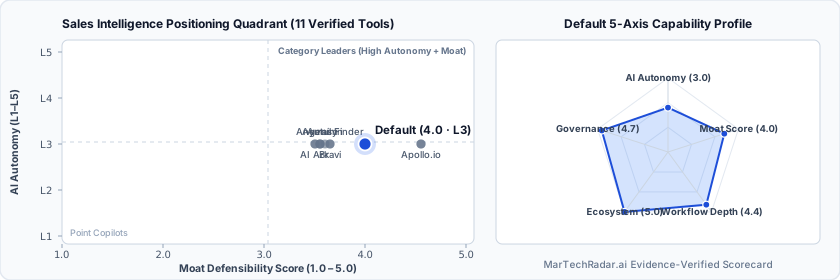
Default is a SaaS Platform tool for Sales Intelligence (Lead Enrichment & Waterfall Orchestration) in AI SDR & Outbound. Pricing: $446/yr. Best suited to B2B Marketing & GTM Teams. Editor ratings: AI autonomy L3 (conditional automation); moat score 4.0/5.0 (Proprietary moat). Fact-checked by Jiacky Lee on Oct 25, 2026.
B2B inbound lead routing, meeting scheduling, and waterfall contact enrichment platform for revenue operations.
Default buyer fit verdict: when to choose vs. when to walk away
Choose Default if (Best Fit)
- Target ICP & Stack Fit: You operate as B2B Marketing & GTM Teams requiring a SaaS Platform deployment for Sales Intelligence, with verified ecosystem connectivity for Salesforce, HubSpot, Apollo.io, Slack.
- L3 Architecture & Defensibility: Default consolidates fragmented GTM form capture, multi-vendor waterfall enrichment, round-robin scheduling, and visual CRM territory routing into a single workflow canvas backed by $20.3M in Series A funding.
- Commercial Model Fit: Your procurement budget aligns with $446/yr.
Walk away from Default if (Deal-Breakers)
- Walk away if your team is at early validation stage with a <$250/mo tool budget (Default starts at $446/yr before seat or usage expansion).
- Walk away if your workflow cannot tolerate primary operational trade-off: In day-to-day enterprise deployment, the primary trade-off is that Default is engineered specifically for B2B revenue teams with structured CRM pipelines rather than B2C e-commerce merchants or solo creators.
- Walk away if functional scope boundary is a deal-breaker for your team: It is not built for outbound cold email inbox warm-up or top-of-funnel ad creative generation.
Default key facts & scorecard
| Pricing | $446/yrVendor pricing page |
|---|---|
| Free plan | No / not disclosed |
| Delivery | SaaS Platform |
| Audience | B2B Marketing & GTM Teams |
| AI autonomy level | L3 · Conditional automationEditor-verified |
| Moat tier & score | 4.0 / 5.0 · Proprietary moatEditor-verified |
| Funding | Series A |
| Total funding | $20.3MBacked by BoxGroup, 8VC, Tribe Capital, Craft Ventures, Caffeinated Capital |
| Founders | Nico Ferreyra, Victor Papyshev |
| Company size | 11-50 employees |
| Ecosystem integrations | Salesforce, HubSpot, Apollo.io, Slack, Twilio Segment, Adobe Marketo |
| Compliance & governance | SOC 2 |
| Headquarters | New York, New York, United States |
| Founded | 2021 |
| Last verified |
Default pros & cons: strengths vs. operational limitations
Pros: core strengths & capabilities
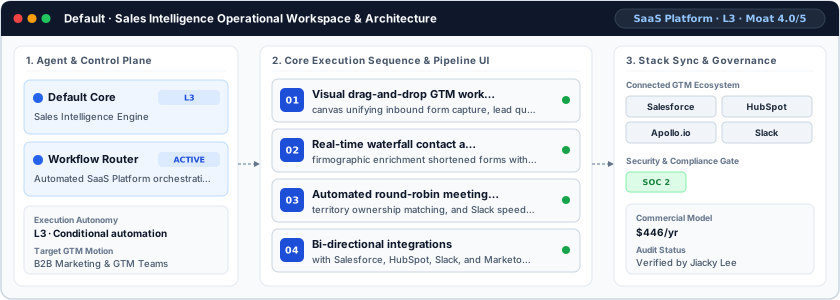
- Visual drag-and-drop GTM workflow: canvas unifying inbound form capture, lead qualification, and automated CRM record creation
- Real-time waterfall contact and: firmographic enrichment shortened forms with instant buyer qualification
- Automated round-robin meeting scheduler,: territory ownership matching, and Slack speed-to-lead deal alerts
- Bi-directional integrations: with Salesforce, HubSpot, Slack, and Marketo plus Model Context Protocol (MCP) support and SOC 2 Type II compliance
Cons: operational limitations & risks
- Primary Operational Trade-Off: In day-to-day enterprise deployment, the primary trade-off is that Default is engineered specifically for B2B revenue teams with structured CRM pipelines rather than B2C e-commerce merchants or solo creators.
- Functional Scope Boundary: It is not built for outbound cold email inbox warm-up or top-of-funnel ad creative generation.
- Deployment & Governance Considerations: Migrating complex legacy territory logic from tools like LeanData or custom Salesforce Apex triggers requires upfront workflow mapping and testing overhead, and high-volume inbound operations must monitor waterfall enrichment credit usage ($0.10 per credit on overages) and per-seat routing user fees as sales headcount scales.
Are you a founder, co-founder, or product/growth lead at Default? Verify your official @default.com email to publish a factual architectural response or 2026 roadmap update below these limitations.
Default TCO & deal-breaker stress test
Simulate 12-month stepped TCO, hidden cost multipliers, contract lock-in exposure, and stack failure modes using only facts verified by Jiacky Lee on · Capture SHA 16394880.
Default is viable for 5 seats, but requires commercial or technical verification on the flagged items below.
| Plan / Tier | Verified Rate | Scale Fit | Scope & Quota Notes |
|---|---|---|---|
| Entry / Starter | $446/yr | 1–2 seats | Verified $446/yr tier from vendor pricing schedule. |
| Growth / Professional | $540/yr | 5 seats | For SEs, managers, or BDRs. Create booking links, join queues and booking links, and hand meeti |
| Scale / Advanced | $828/yr | 15 seats | Website intent tool |
- Moat Score
- 4.0 / 5.0
- AI Autonomy
- L3
- Free Tier / Trial
- None disclosed
Triggered audit signals & failure modes
- Annual Contract Lock-in Risk DetectedFact-checked by Jiacky Lee
Default structures its commercial pricing around workspace tiers, routing seats, and included enrichment credits.
- Tier Fit for 5-Seat Scale: Entry / Starter ($446/yr)Verified Tier Schedule
Verified $446/yr tier from vendor pricing schedule.
- Primary Operational Bottleneck: Deployment & Governance ConsiderationsAudit by Jiacky Lee
Migrating complex legacy territory logic from tools like LeanData or custom Salesforce Apex triggers requires upfront workflow mapping and testing overhead, and high-volume inbound operations must monitor waterfall enrichment credit usage ($0.10 per credit on overages) and per-seat routing user fees as sales headcount scales.
Hidden TCO Multipliers & Quota Gates
- Per-Seat Linear Scaling: Default prices licenses on a per-user/seat basis ($446/yr); expanding from 2 to 15+ operators multiplies base recurring spend linearly.
- Credit & Usage Burn Multiplier: Automated workflows consume metered credits/usage quotas; multi-step enrichment, voice minutes, or high-frequency agent runs can trigger mid-cycle top-up packs.
- Enterprise Governance & Add-On Gating: Advanced capabilities such as Single Sign-On (SSO), custom role permissions, or specialized analytics modules are gated behind upper tiers or paid add-ons.
When to Walk Away & Negotiation Levers
- Walk away if your team is at early validation stage with a <$250/mo tool budget (Default starts at $446/yr before seat or usage expansion).
- Walk away if your workflow cannot tolerate primary operational trade-off: In day-to-day enterprise deployment, the primary trade-off is that Default is engineered specifically for B2B revenue teams with structured CRM pipelines rather than B2C e-commerce merchants or solo creators.
- Walk away if functional scope boundary is a deal-breaker for your team: It is not built for outbound cold email inbox warm-up or top-of-funnel ad creative generation.
- Negotiate price-lock protection on additional seats and overage credits above the $446/yr entry tier.
- Require a sandbox proof-of-concept testing primary operational trade-off against your live CRM/data schema before annual sign-off.
4 hard questions to ask on a Default sales or technical demo
“Between Default's Entry / Starter ($446/yr) and Growth / Professional ($540/yr) tiers, what exact seat, workspace, or credit ceiling triggers a mandatory upgrade—and are mid-cycle overages billed at the base unit rate or forced onto an annual Growth / Professional commitment?”
Contract / Technical Proof to Require: Negotiate price-lock protection on additional seats and overage credits above the $446/yr entry tier.
“Our technical audit of Default flagged "Primary Operational Trade-Off" (In day-to-day enterprise deployment, the primary trade-off is that Default is engineered specifically for B2B revenue teams with structured CRM pipelines rather than B2C e-commerce merchants or solo creators.). Can you demonstrate how Default handles this scenario live against Salesforce without manual CSV workarounds or webhook latency?”
Contract / Technical Proof to Require: Walk away if your team is at early validation stage with a <$250/mo tool budget (Default starts at $446/yr before seat or usage expansion).
“Because Default operates at L3 · Conditional automation (Sales Intelligence), how do operators prevent "Functional Scope Boundary" (It is not built for outbound cold email inbox warm-up or top-of-funnel ad creative generation.) during high-volume campaigns, and what human-in-the-loop approval gates are configurable?”
Contract / Technical Proof to Require: Require a sandbox proof-of-concept testing primary operational trade-off against your live CRM/data schema before annual sign-off.
“We see Default documents SOC 2. Can you provide the current audit report, sub-processor list, and written confirmation that customer inputs in Default are never used to train shared foundation models?”
Contract / Technical Proof to Require: Attach a signed DPA with zero model-training rights and 30-day data deletion SLA upon contract termination.
Ask a custom procurement or TCO stress-test question about Default
Generate your 4-role approval packet or request a custom Default sandbox & Sales Intelligence quote
Active spec: 5 Seats · ≤ $800/mo ceiling · Any Stack · No Annual Lock-in
Fits within $800/mo budget (Free plan · $200/mo · Enterprise plan) · Transparent self-serve entry without mandatory annual lock-in
Lower 5-seat floor (~$20/mo vs. $446 / yr upfront) · Transparent self-serve entry without mandatory annual lock-in
No public buyer quote requests logged in the current window for Default. Be the first to lock a verified procurement specification above.
Default key entities, modules & ecosystem stack
Default moat & subtrack positioning
Default consolidates fragmented GTM form capture, multi-vendor waterfall enrichment, round-robin scheduling, and visual CRM territory routing into a single workflow canvas backed by $20.3M in Series A funding.
Editorial review
Fact-checked by Jiacky Lee (Managing Editor, AI Autonomy & Moat Methodology) on .
Background
Default is an all-in-one B2B inbound orchestration, waterfall data enrichment, and lead routing platform built for revenue operations (RevOps) leaders, growth engineers, and sales operations teams. Founded in 2021 by Nico Ferreyra and Victor Papyshev and headquartered in New York, the company operates with 11 to 50 employees and has raised $20.3M through Series A funding backed by BoxGroup, 8VC, Tribe Capital, Craft Ventures, and Caffeinated Capital. It serves fast-growing software companies looking to replace disconnected form builders, enrichment vendors, calendar schedulers, and legacy CRM routing scripts with a unified system.
How Default works
At the architectural level, Default provides a node-based workflow engine that triggers the moment a prospect submits a web form, books a demo, or enters the CRM. Before routing a lead, Default executes real-time waterfall enrichment across multiple B2B firmographic and contact data providers, allowing marketing teams to keep web forms short while still qualifying prospects on employee count, tech stack, and funding data. Qualified leads are immediately presented with an embedded round-robin or account-owner calendar scheduler, while the underlying workflow automatically deduplicates contacts, matches accounts in Salesforce, HubSpot, or Marketo, dispatches interactive Slack notifications, and exposes Model Context Protocol (MCP) endpoints for AI agents.
Limitations
Operational considerations and platform boundaries include:
- Primary Operational Trade-Off: In day-to-day enterprise deployment, the primary trade-off is that Default is engineered specifically for B2B revenue teams with structured CRM pipelines rather than B2C e-commerce merchants or solo creators.
- Functional Scope Boundary: It is not built for outbound cold email inbox warm-up or top-of-funnel ad creative generation.
- Deployment & Governance Considerations: Migrating complex legacy territory logic from tools like LeanData or custom Salesforce Apex triggers requires upfront workflow mapping and testing overhead, and high-volume inbound operations must monitor waterfall enrichment credit usage ($0.10 per credit on overages) and per-seat routing user fees as sales headcount scales.
Default pricing
Default structures its commercial pricing around workspace tiers, routing seats, and included enrichment credits. Entry and mid-market self-serve tiers start around $446 per month ($5,352 per year, with routing seats at $20 to $28 per user per month and $49 to $69/month add-on modules, scaling through $149, $240, $540, and $828 monthly options). Annual Growth and Enterprise packages scale from $1,788, $2,400, $3,360, and $5,880 per year up to $12,000, $17,400, $19,608, and $25,000 per year for organizations requiring 24,000+ enrichment credits, custom Salesforce object routing, and SOC 2 Type II security controls.
How Default compares
Compared to point solutions such as Chili Piper, Calendly, and LeanData, Default eliminates the integration fragility of stitching separate form, enrichment, and scheduling tools together within the Sales Intelligence segment, alongside verified subtrack peers such as Apollo.io. Against outbound-first enrichment workbooks like Clay, Default specializes in real-time sub-second inbound conversion and instant calendar booking. B2B SaaS RevOps teams should evaluate Default when consolidating their inbound speed-to-lead stack.
Frequently asked questions about Default
How much does Default cost and what pricing tiers are available?
Published pricing summary for Default: $446/yr. A permanent free plan is not disclosed for Default. Verified tier schedule: Entry / Starter ($446/yr for 1–2 seats); Growth / Professional ($540/yr for 5 seats); Scale / Advanced ($828/yr for 15 seats). Default structures its commercial pricing around workspace tiers, routing seats, and included enrichment credits.
How does Default work and how autonomous is its AI architecture?
B2B inbound lead routing, meeting scheduling, and waterfall contact enrichment platform for revenue operations. Within Sales Intelligence (Lead Enrichment & Waterfall Orchestration), MarTechRadar rates its execution architecture at L3 · Conditional automation with a verified Moat Score of 4.0 / 5.0 (Proprietary moat). Default consolidates fragmented GTM form capture, multi-vendor waterfall enrichment, round-robin scheduling, and visual CRM territory routing into a single workflow canvas backed by $20.3M in Series A funding. Corporate profile: Founded by Nico Ferreyra, Victor Papyshev, operating at 11-50 employees scale.
What are the main limitations of Default and when should buyers walk away?
Based on our editorial technical audit, key operational considerations and boundaries for Default include: (1) Primary Operational Trade-Off: In day-to-day enterprise deployment, the primary trade-off is that Default is engineered specifically for B2B revenue teams with structured CRM pipelines rather than B2C e-commerce merchants or solo creators. (2) Functional Scope Boundary: It is not built for outbound cold email inbox warm-up or top-of-funnel ad creative generation. (3) Deployment & Governance Considerations: Migrating complex legacy territory logic from tools like LeanData or custom Salesforce Apex triggers requires upfront workflow mapping and testing overhead, and high-volume inbound operations must monitor waterfall enrichment credit usage ($0.10 per credit on overages) and per-seat routing user fees as sales headcount scales. Primary procurement walk-away rule: Walk away if your team is at early validation stage with a <$250/mo tool budget (Default starts at $446/yr before seat or usage expansion).
What integrations, compliance certifications, and contract terms apply to Default?
Verified ecosystem and stack integrations include Salesforce, HubSpot, Apollo.io, Slack, Twilio Segment, Adobe Marketo, Model Context Protocol (MCP). Documented security and governance attestations include SOC 2. Key TCO multiplier to watch: Per-Seat Linear Scaling (Default prices licenses on a per-user/seat basis ($446/yr); expanding from 2 to 15+ operators multiplies base recurring spend linearly.) Before signing a contract, procurement teams should negotiate price-lock protection on additional seats and overage credits above the $446/yr entry tier.
What are the best Default alternatives and head-to-head competitors in 2026?
Top fact-checked alternatives to Default in Sales Intelligence (Lead Enrichment & Waterfall Orchestration) include Apify (Free plan · $0/mo · Enterprise plan), Freckle (Free plan · $0/mo), LoneScale (Free plan · $200/mo · Enterprise plan), Abmatic AI (Free plan · $3,000/mo · Enterprise plan). Compared to point solutions such as Chili Piper, Calendly, and LeanData, Default eliminates the integration fragility of stitching separate form, enrichment, and scheduling tools together within the Sales Intelligence segment, alongside verified subtrack peers such as Apollo.io.
Default profile completeness & verified buyer trust checklist
Our analysts verified the first 5 baseline facts below from public captures. Founders and growth leads at Default can reach 100% Gold Verified Transparency (and unlock priority buyer sandbox inquiries) by supplying workflow screenshots, customer ROI case studies, and direct support SLA contacts:
- 1. Corporate Identity & HQ: Founded 2021 · New York, New York, United States · Founders: Nico Ferreyra, Victor Papyshev
- 2. Team Scale & Backing: 11-50 employees · $20.3M
- 3. Published Pricing Floor: $446/yr (Sentinel S7 verified)
- 4. Free Trial & Onboarding: Demo / Sales onboarding
- 5. Stack & Compliance Signals: Salesforce, HubSpot, Apollo.io, Slack · SOC 2
- 6. Product Workflow Screenshots & Customer Case Studies: Upload 3 UI screenshots & verified ROI case study (+15% completeness) →
- 7. Direct Support SLA, Hotline & Reader Perk Code: Add official support email/phone, SLA & exclusive buyer trial perk (+10% completeness) →
Verified sources & evidence trail
- Official product domain: https://default.com
- Commercial pricing verification: https://www.default.com/pricing
- Verified corporate entity profiles (
sameAs): LinkedIn Company Profile · Crunchbase Entity Record - Editorial audit sign-off: Fact-checked by Jiacky Lee on under the MarTechRadar Evidence-Ledger Protocol.