Contentpen Review (2026): Programmatic SEO Pricing, Limits & Alternatives
Bottom line
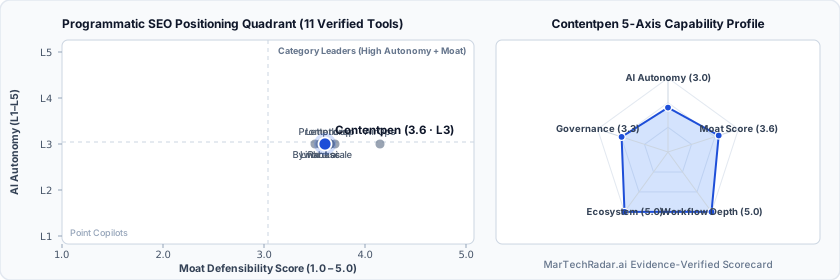
Contentpen is a Web SaaS tool for Programmatic SEO (Programmatic SEO & Scaled Page Engines) in GEO & AI SEO. Pricing: From $19/mo. Best suited to B2B Marketing Teams and Revenue Operations. Editor ratings: AI autonomy L3 (conditional automation); moat score 3.6/5.0 (Proprietary moat). Fact-checked by Sarah Per on Oct 26, 2026.
Programmatic SEO and answer engine optimization software generating structured content pipelines and tracking LLM citation visibility across search.
Contentpen buyer fit verdict: when to choose vs. when to walk away
Choose Contentpen if (Best Fit)
- Target ICP & Stack Fit: You operate as B2B Marketing Teams and Revenue Operations requiring a Web SaaS deployment for Programmatic SEO, with verified ecosystem connectivity for Shopify, WordPress, Webflow, Google Search Console.
- L3 Architecture & Defensibility: Technical defensibility centers on unified tracking across standard search engine rank tracking and LLM answer engine citations, supplemented by native Model Context Protocol (MCP) server endpoints for external workflow automation.
- Commercial Model Fit: Your procurement budget aligns with From $19/mo.
Walk away from Contentpen if (Deal-Breakers)
- Walk away if your workflow requires uncapped enterprise volume on the From $19/mo entry plan without upgrading tiers.
- Walk away if your workflow cannot tolerate index latency and citation provenance: Because the platform lacks an internal, multi-petabyte search index, its AI Visibility module depends on external API sampling of LLM outputs, which creates temporal delays when tracking rapidly shifting real-time citations across conversational engines.
- Walk away if CMS integration breadth is a deal-breaker for your team: Native publishing connectors remain constrained primarily to Shopify and Make webhooks, requiring organizations using enterprise headless stacks like Contentful or custom database clusters to engineer intermediary synchronization endpoints.
Contentpen key facts & scorecard
| Pricing | From $19/moVendor pricing page |
|---|---|
| Free plan | No / not disclosed |
| Delivery | Web SaaS |
| Audience | B2B Marketing Teams, Revenue Operations |
| AI autonomy level | L3 · Conditional automationEditor-verified |
| Moat tier & score | 3.6 / 5.0 · Proprietary moatEditor-verified |
| Funding | Seed |
| Founders | Muhammad Azhar, Waqar Azeem |
| Company size | 2-10 employees |
| Ecosystem integrations | Shopify, WordPress, Webflow, Google Search Console, Make, Model Context Protocol (MCP) |
| Governance & docs | API & Docs ↗ · Terms ↗ · Privacy ↗ |
| Headquarters | Philadelphia, Pennsylvania, United States |
| Founded | 2025 |
| Last verified |
Contentpen pros & cons: strengths vs. operational limitations
Pros: core strengths & capabilities
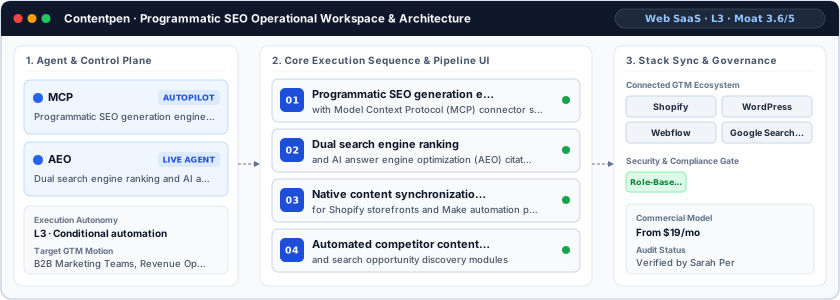
- Programmatic SEO generation engine: with Model Context Protocol (MCP) connector support
- Dual search engine ranking: and AI answer engine optimization (AEO) citation tracker
- Native content synchronization endpoints: for Shopify storefronts and Make automation pipelines
- Automated competitor content auditing: and search opportunity discovery modules
Cons: operational limitations & risks
- Index Latency and Citation Provenance: Because the platform lacks an internal, multi-petabyte search index, its AI Visibility module depends on external API sampling of LLM outputs, which creates temporal delays when tracking rapidly shifting real-time citations across conversational engines.
- CMS Integration Breadth: Native publishing connectors remain constrained primarily to Shopify and Make webhooks, requiring organizations using enterprise headless stacks like Contentful or custom database clusters to engineer intermediary synchronization endpoints.
- Complex Relational Generation Controls: The templating engine focuses on linear article and product page formats, offering limited native support for multifaceted hierarchical relational schemas compared to dedicated programmatic DAG pipeline orchestrators.
Are you a founder, co-founder, or product/growth lead at Contentpen? Verify your official @contentpen.ai email to publish a factual architectural response or 2026 roadmap update below these limitations.
Contentpen TCO & deal-breaker stress test
Simulate 12-month stepped TCO, hidden cost multipliers, contract lock-in exposure, and stack failure modes using only facts verified by Sarah Per on · Capture SHA b0a667b2.
Contentpen aligns with your 5-seat / $800/mo profile. Review the walk-away triggers and contract levers below before deployment.
| Plan / Tier | Verified Rate | Scale Fit | Scope & Quota Notes |
|---|---|---|---|
| Entry / Starter | $19/mo | Unlimited seats (Entry credits) | Compare plans in detail |
| Growth / Professional | $29/mo | Unlimited seats (Growth credits) | 50, 150 or 400 credits. They never expire. |
| Starter | $39/mo | Unlimited seats (Scale credits) | Billed $468 yearly · save $120 |
- Moat Score
- 3.6 / 5.0
- AI Autonomy
- L3
- Free Tier / Trial
- None disclosed
Triggered audit signals & failure modes
- Published Self-Serve Entry FloorVerified Pricing Ledger
Contentpen publishes a transparent entry point (From $19/mo) for initial validation before committing.
- Tier Fit for 5-Seat Scale: Growth / Professional ($29/mo)Verified Tier Schedule
50, 150 or 400 credits. They never expire.
- Primary Operational Bottleneck: Index Latency and Citation ProvenanceAudit by Sarah Per
Because the platform lacks an internal, multi-petabyte search index, its AI Visibility module depends on external API sampling of LLM outputs, which creates temporal delays when tracking rapidly shifting real-time citations across conversational engines.
Hidden TCO Multipliers & Quota Gates
- Annual Billing Headline vs. Monthly Premium: Headline entry rates reflect annual billing commitments (Save 20%); month-to-month flexibility carries a higher effective monthly rate or requires annual prepayment.
- Credit & Usage Burn Multiplier: Automated workflows consume metered credits/usage quotas; multi-step enrichment, voice minutes, or high-frequency agent runs can trigger mid-cycle top-up packs.
- Enterprise Governance & Add-On Gating: Advanced capabilities such as Single Sign-On (SSO), custom role permissions, or specialized analytics modules are gated behind upper tiers or paid add-ons.
When to Walk Away & Negotiation Levers
- Walk away if your workflow requires uncapped enterprise volume on the From $19/mo entry plan without upgrading tiers.
- Walk away if your workflow cannot tolerate index latency and citation provenance: Because the platform lacks an internal, multi-petabyte search index, its AI Visibility module depends on external API sampling of LLM outputs, which creates temporal delays when tracking rapidly shifting real-time citations across conversational engines.
- Walk away if CMS integration breadth is a deal-breaker for your team: Native publishing connectors remain constrained primarily to Shopify and Make webhooks, requiring organizations using enterprise headless stacks like Contentful or custom database clusters to engineer intermediary synchronization endpoints.
- Validate exact quota thresholds (seats, credits, or API calls) included in Contentpen's From $19/mo tier before converting from monthly to annual billing.
- Require a sandbox proof-of-concept testing index latency and citation provenance against your live CRM/data schema before annual sign-off.
4 hard questions to ask on a Contentpen sales or technical demo
“Between Contentpen's Entry / Starter ($19/mo) and Growth / Professional ($29/mo) tiers, what exact seat, workspace, or credit ceiling triggers a mandatory upgrade—and are mid-cycle overages billed at the base unit rate or forced onto an annual Growth / Professional commitment?”
Contract / Technical Proof to Require: Validate exact quota thresholds (seats, credits, or API calls) included in Contentpen's From $19/mo tier before converting from monthly to annual billing.
“Our technical audit of Contentpen flagged "Index Latency and Citation Provenance" (Because the platform lacks an internal, multi-petabyte search index, its AI Visibility module depends on external API sampling of LLM outputs, which creates temporal delays when tracking rapidly shifting real-time citations across conversational engines.). Can you demonstrate how Contentpen handles this scenario live against Shopify without manual CSV workarounds or webhook latency?”
Contract / Technical Proof to Require: Walk away if your workflow requires uncapped enterprise volume on the From $19/mo entry plan without upgrading tiers.
“Because Contentpen operates at L3 · Conditional automation (Programmatic SEO), how do operators prevent "CMS Integration Breadth" (Native publishing connectors remain constrained primarily to Shopify and Make webhooks, requiring organizations using enterprise headless stacks like Contentful or custom database clusters to engineer intermediary synchronization endpoints.) during high-volume campaigns, and what human-in-the-loop approval gates are configurable?”
Contract / Technical Proof to Require: Require a sandbox proof-of-concept testing index latency and citation provenance against your live CRM/data schema before annual sign-off.
“Our review of Contentpen did not find public SOC 2 Type II or ISO 27001 certificates on the pricing page. Can you share your security packet, DPA, and zero-data-retention policy for LLM sub-processors?”
Contract / Technical Proof to Require: Attach a signed DPA with zero model-training rights and 30-day data deletion SLA upon contract termination.
Ask a custom procurement or TCO stress-test question about Contentpen
Generate your 4-role approval packet or request a custom Contentpen sandbox & Programmatic SEO quote
Active spec: 5 Seats · ≤ $800/mo ceiling · Any Stack · No Annual Lock-in
Lower 5-seat floor (~$7/mo vs. $29 / mo)
Fits within $800/mo budget (From $39/mo)
No public buyer quote requests logged in the current window for Contentpen. Be the first to lock a verified procurement specification above.
Contentpen key entities, modules & ecosystem stack
Programmatic SEO generation engine with Model Context Protocol connector support
Dual search engine ranking and AI answer engine optimization citation tracker
Contentpen moat & subtrack positioning
Technical defensibility centers on unified tracking across standard search engine rank tracking and LLM answer engine citations, supplemented by native Model Context Protocol (MCP) server endpoints for external workflow automation.
Editorial review
Fact-checked by Sarah Per (Principal Content Systems & Generative Media Editor) on .
Background
Architected as a dual search optimization platform, Contentpen was founded in 2025 in Philadelphia, Pennsylvania, United States, to merge standard search engine ranking mechanics with emerging answer engine visibility. Operating within the Programmatic SEO category as a focused SEO Page Generator, the platform targets growth marketers, digital agencies, and ecommerce technical teams. Rather than treating conversational AI engines and traditional search indexers as separate acquisition channels, Contentpen centralizes automated content drafting and synthetic citation discovery into a single operational interface.
How Contentpen works
Under the hood, Contentpen runs an orchestration engine built for L3 autonomy, using Model Context Protocol (MCP) endpoints to bridge data retrieval and content generation. The system operates dedicated modules including Opportunities, Visibility, AI Visibility, and Competitors to benchmark topic targets. The engine pulls comparative keyword metrics, maps query intent, and formats output pages for indexing. Content ingestion and deployment pipelines connect directly to Make scenarios and Shopify stores, passing structured markdown and product schemas to CMS endpoints without requiring manual data formatting, alongside native workflow integrations for Google Search Console, WordPress, and Webflow.
Limitations
Operational considerations and platform boundaries include:
- Index Latency and Citation Provenance: Because the platform lacks an internal, multi-petabyte search index, its AI Visibility module depends on external API sampling of LLM outputs, which creates temporal delays when tracking rapidly shifting real-time citations across conversational engines.
- CMS Integration Breadth: Native publishing connectors remain constrained primarily to Shopify and Make webhooks, requiring organizations using enterprise headless stacks like Contentful or custom database clusters to engineer intermediary synchronization endpoints.
- Complex Relational Generation Controls: The templating engine focuses on linear article and product page formats, offering limited native support for multifaceted hierarchical relational schemas compared to dedicated programmatic DAG pipeline orchestrators.
Contentpen pricing
Contentpen utilizes a tiered software-as-a-service commercial model with entry-level plans starting at $19 per month. Pricing tiers scale based on tracked search terms, generated page volumes, and automated answer engine visibility lookups. Advanced capabilities, including high-throughput automation via Make and expanded MCP connector requests, require transitioning to upper-tier subscriptions. The commercial design targets independent site operators and mid-market growth teams seeking entry points without enterprise multi-year contracts.
How Contentpen compares
Within the programmatic generation landscape, Contentpen competes against platforms like AirOps, Letterdrop, and Linkboss. While AirOps delivers configurable directed acyclic graph (DAG) pipelines for technical data engineering, Contentpen prioritizes out-of-the-box tracking for AI citation metrics alongside standard SERP positions. Unlike Letterdrop, which emphasizes editorial governance and enterprise marketing automation integrations, or Linkboss, which concentrates purely on internal link graph optimization, Contentpen appeals to small-to-midmarket ecommerce merchants needing unified, budget-conscious programmatic publishing and search tracking. Teams evaluating verified options alongside AirOps and Letterdrop should weigh its workflow integration depth and contract structure against daily volume requirements.
Frequently asked questions about Contentpen
How much does Contentpen cost and what pricing tiers are available?
Published pricing summary for Contentpen: From $19/mo. A permanent free plan is not disclosed for Contentpen. Verified tier schedule: Entry / Starter ($19/mo for Unlimited seats (Entry credits)); Growth / Professional ($29/mo for Unlimited seats (Growth credits)); Starter ($39/mo for Unlimited seats (Scale credits)). Contentpen utilizes a tiered software-as-a-service commercial model with entry-level plans starting at $19 per month. Pricing tiers scale based on tracked search terms, generated page volumes, and automated answer engine visibility lookups.
How does Contentpen work and how autonomous is its AI architecture?
Programmatic SEO and answer engine optimization software generating structured content pipelines and tracking LLM citation visibility across search. Within Programmatic SEO (Programmatic SEO & Scaled Page Engines), MarTechRadar rates its execution architecture at L3 · Conditional automation with a verified Moat Score of 3.6 / 5.0 (Proprietary moat). Technical defensibility centers on unified tracking across standard search engine rank tracking and LLM answer engine citations, supplemented by native Model Context Protocol (MCP) server endpoints for external workflow automation. Corporate profile: Founded by Muhammad Azhar, Waqar Azeem, operating at 2-10 employees scale.
What are the main limitations of Contentpen and when should buyers walk away?
Based on our editorial technical audit, key operational considerations and boundaries for Contentpen include: (1) Index Latency and Citation Provenance: Because the platform lacks an internal, multi-petabyte search index, its AI Visibility module depends on external API sampling of LLM outputs, which creates temporal delays when tracking rapidly shifting real-time citations across conversational engines. (2) CMS Integration Breadth: Native publishing connectors remain constrained primarily to Shopify and Make webhooks, requiring organizations using enterprise headless stacks like Contentful or custom database clusters to engineer intermediary synchronization endpoints. (3) Complex Relational Generation Controls: The templating engine focuses on linear article and product page formats, offering limited native support for multifaceted hierarchical relational schemas compared to dedicated programmatic DAG pipeline orchestrators. Primary procurement walk-away rule: Walk away if your workflow requires uncapped enterprise volume on the From $19/mo entry plan without upgrading tiers.
What integrations, compliance certifications, and contract terms apply to Contentpen?
Verified ecosystem and stack integrations include Shopify, WordPress, Webflow, Google Search Console, Make, Model Context Protocol (MCP), Contentful. First-party governance and developer endpoints verified on domain include: API Docs (https://docs.contentpen.ai). Key TCO multiplier to watch: Annual Billing Headline vs. Monthly Premium (Headline entry rates reflect annual billing commitments (Save 20%); month-to-month flexibility carries a higher effective monthly rate or requires annual prepayment.) Before signing a contract, procurement teams should validate exact quota thresholds (seats, credits, or API calls) included in Contentpen's From $19/mo tier before converting from monthly to annual billing.
What are the best Contentpen alternatives and head-to-head competitors in 2026?
Top fact-checked alternatives to Contentpen in Programmatic SEO (Programmatic SEO & Scaled Page Engines) include Letterdrop (Custom / enterprise pricing), Linkboss (Custom / enterprise pricing), Byword.ai (From $2.50), Promptloop (Custom / enterprise pricing). Within the programmatic generation landscape, Contentpen competes against platforms like AirOps, Letterdrop, and Linkboss.
Contentpen profile completeness & verified buyer trust checklist
Our analysts verified the first 5 baseline facts below from public captures. Founders and growth leads at Contentpen can reach 100% Gold Verified Transparency (and unlock priority buyer sandbox inquiries) by supplying workflow screenshots, customer ROI case studies, and direct support SLA contacts:
- 1. Corporate Identity & HQ: Founded 2025 · Philadelphia, Pennsylvania, United States · Founders: Muhammad Azhar, Waqar Azeem
- 2. Team Scale & Backing: 2-10 employees · Bootstrapped / Undisclosed
- 3. Published Pricing Floor: From $19/mo (Sentinel S7 verified)
- 4. Free Trial & Onboarding: Demo / Sales onboarding
- 5. Stack & Compliance Signals: Shopify, WordPress, Webflow, Google Search Console
- 6. Product Workflow Screenshots & Customer Case Studies: Upload 3 UI screenshots & verified ROI case study (+15% completeness) →
- 7. Direct Support SLA, Hotline & Reader Perk Code: Add official support email/phone, SLA & exclusive buyer trial perk (+10% completeness) →
Verified sources & evidence trail
- Official product domain: https://contentpen.ai
- Commercial pricing verification: https://contentpen.ai/pricing
- Verified corporate entity profiles (
sameAs): LinkedIn Company Profile · Crunchbase Entity Record - First-party governance & documentation links: API & Docs · Terms · Privacy
- Editorial audit sign-off: Fact-checked by Sarah Per on under the MarTechRadar Evidence-Ledger Protocol.