Byword.ai Review (2026): Programmatic SEO Pricing, Pros & Cons
Bottom line
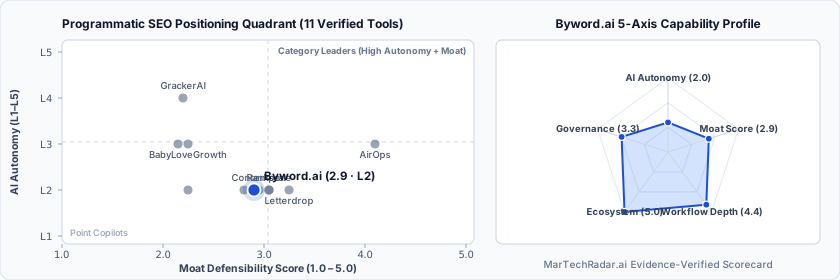
Byword.ai is a Web SaaS tool for Programmatic SEO (Programmatic SEO & Scaled Page Engines) in GEO & AI SEO. Pricing: Usage-based pricing. Best suited to B2B SaaS and Marketing Agencies. Editor ratings: AI autonomy L2 (workflow copilot); moat score 2.9/5.0 (Workflow-embedded). Fact-checked by MarTechRadar Research Desk on Oct 7, 2026.
Programmatic SEO content engine converting keyword lists and SERP research into fully formatted, search-optimized articles at batch scale.
Is Byword.ai worth it in 2026? Buyer fit & when to walk away
Choose Byword.ai if (Best Fit)
- Target ICP & Stack Fit: You operate as B2B SaaS and Marketing Agencies requiring a Web SaaS deployment for Programmatic SEO, with verified ecosystem connectivity for HubSpot, Slack, Shopify, WordPress.
- L2 Architecture & Defensibility: Proprietary SERP entity-extraction workflows coupled with optimized prompt chains and programmatic CMS webhooks provide cost-effective bulk publication speed.
- Commercial Model Fit: Your procurement budget aligns with Usage-based pricing.
Walk away from Byword.ai if (Deal-Breakers)
- Walk away if you need published self-serve pricing: Byword.ai is sold by custom quote.
- Walk away if your workflow cannot tolerate semantic homogeneity: Large batch generations sharing similar prompt topologies risk producing formulaic sentence structures, requiring post-generation human editorial audits to preserve distinct brand depth.
- Walk away if deep technical schema absence is a deal-breaker for your team: The system focuses primarily on markdown and article copy generation rather than constructing complex nested JSON-LD schemas or interactive tabular data layouts.
Byword.ai pricing, free plan & scorecard at a glance
| Pricing | Usage-based pricingVendor pricing page |
|---|---|
| Free plan | No / not disclosed |
| Delivery | Web SaaS |
| Audience | B2B SaaS, Marketing Agencies |
| AI autonomy level | L2 · Workflow copilotEditor-verified |
| Moat tier & score | 2.9 / 5.0 · Workflow-embeddedEditor-verified |
| Funding | Bootstrapped |
| Company size | 2-10 employees |
| Ecosystem integrations | HubSpot, Slack, Shopify, WordPress, Webflow |
| Governance & docs | System Status ↗ · API & Docs ↗ · Changelog ↗ · Privacy ↗ |
| Headquarters | London, United Kingdom |
| Founded | 2022 |
| Last verified | Oct 7, 2026 |
Byword.ai pros & cons: strengths vs. operational limitations
Pros: core strengths & capabilities
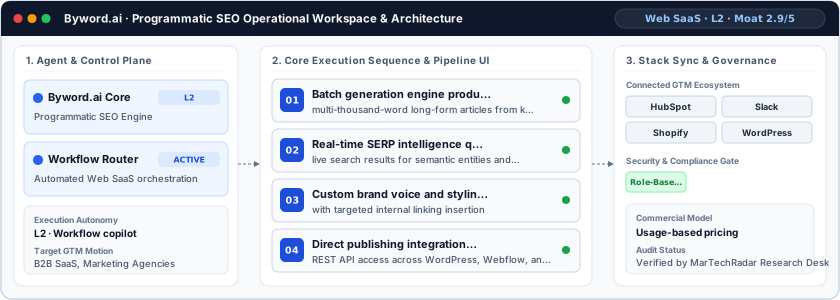
- Batch generation engine producing: multi-thousand-word long-form articles from keyword lists
- Real-time SERP intelligence querying: live search results for semantic entities and structural headings
- Custom brand voice and styling injection: with targeted internal linking insertion
- Direct publishing integrations and REST API access across WordPress, Webflow, and custom headless CMSs
Cons: operational limitations & risks
- Semantic Homogeneity: Large batch generations sharing similar prompt topologies risk producing formulaic sentence structures, requiring post-generation human editorial audits to preserve distinct brand depth.
- Deep Technical Schema Absence: The system focuses primarily on markdown and article copy generation rather than constructing complex nested JSON-LD schemas or interactive tabular data layouts.
- Information Gain Ceilings: Because outline generation relies directly on scraping current top-ranking SERPs, output runs the structural risk of mimicking incumbent search results without introducing novel primary research.
Byword.ai TCO & deal-breaker stress test
Simulate 12-month stepped TCO, hidden cost multipliers, contract lock-in exposure, and stack failure modes using only facts verified by MarTechRadar Research Desk on 2026-10-07 · Capture SHA c1657b39.
Byword.ai triggers high-severity friction under your 5-seat / $800/mo constraints. Benchmark the verified subtrack alternatives below before committing.
- Moat Score
- 2.9 / 5.0
- AI Autonomy
- L2
- Free Tier / Trial
- None disclosed
Triggered audit signals & failure modes
- Opaque Enterprise Quoting vs. SMB/Mid-Market BudgetVerified Pricing Ledger
Byword.ai does not disclose a public self-serve floor (Usage-based pricing). Buyers with a $800/mo cap face high sales-qualification friction.
- Sales-Gated Contract TermsFact-checked by MarTechRadar Research Desk
Byword.ai structures commercial licensing around monthly and annual volume tiers, pricing additional production from $2.50 per article. Annual packages begin with Starter at $83 per month ($3.32 per article, saving $198 annually) for 25 articles, with overages at $3.50.
- Usage / Credit Burn VolatilityCommercial Model Audit
Byword.ai uses credit or usage-metered billing (Usage-based pricing). High-volume automated workflows across 5 seats can trigger mid-cycle overage charges.
- Primary Operational Bottleneck: Semantic HomogeneityAudit by MarTechRadar Research Desk
Large batch generations sharing similar prompt topologies risk producing formulaic sentence structures, requiring post-generation human editorial audits to preserve distinct brand depth.
Test a custom Byword.ai budget or stack constraint
Lower 5-seat floor (~$19/mo vs. Custom Quote) · Transparent self-serve entry without mandatory annual lock-in
Lower 5-seat floor (~$49/mo vs. Custom Quote) · Transparent self-serve entry without mandatory annual lock-in
Byword.ai integrations, API, security & compliance stack
Byword.ai AI moat & Programmatic SEO positioning
Proprietary SERP entity-extraction workflows coupled with optimized prompt chains and programmatic CMS webhooks provide cost-effective bulk publication speed.
Byword.ai in-depth review, pricing & architecture analysis
Editor sign-off: Oct 7, 2026. How profiles are made.
What is Byword.ai? Overview & background
Established in 2022 in London, United Kingdom, Byword.ai operates as a programmatic article engine designed to solve the throughput bottlenecks of high-volume organic search operations. Headquartered in the UK, the company addresses content marketing directors, growth teams, and digital agencies seeking to convert structured keyword sets into comprehensive written content without manual copywriter dependencies. Byword.ai replaces fragmented multi-step drafting pipelines with an integrated workflow spanning topical research, drafting, internal link mapping, and CMS delivery.
How Byword.ai works: architecture & workflow
At the architectural layer, the system autonomy, Byword.ai uses an automated batch orchestration engine coupled with live web grounding. Users ingest target keywords or query clusters via CSV upload or direct API payloads. The pipeline retrieves real-time search engine result pages, analyzing established semantic subtopics, structural heading frameworks, and relevant factual citations. An LLM orchestration layer formats this contextual data into structured articles, applying user-defined brand profiles, custom citation styles, and dynamic internal link insertion before pushing drafts directly via headless CMS webhooks, alongside native workflow integrations for HubSpot, Slack, and Shopify.
Byword.ai limitations, drawbacks & risks
Operational considerations and platform boundaries include:
- Semantic Homogeneity: Large batch generations sharing similar prompt topologies risk producing formulaic sentence structures, requiring post-generation human editorial audits to preserve distinct brand depth.
- Deep Technical Schema Absence: The system focuses primarily on markdown and article copy generation rather than constructing complex nested JSON-LD schemas or interactive tabular data layouts.
- Information Gain Ceilings: Because outline generation relies directly on scraping current top-ranking SERPs, output runs the structural risk of mimicking incumbent search results without introducing novel primary research.
Byword.ai pricing, plans & cost breakdown
Byword.ai structures commercial licensing around monthly and annual volume tiers, pricing additional production from $2.50 per article. Annual packages begin with Starter at $83 per month ($3.32 per article, saving $198 annually) for 25 articles, with overages at $3.50. Standard costs $249 per month ($3.11 per article, saving $598 annually) for 80 articles with API access, extra seats at $25, and overages at $3.00. Scale runs $833 per month ($2.78 per article, saving $1998 annually) for 300 articles, offering overage generation at $2.50 per article.
How Byword.ai compares vs. competitors & alternatives
Within programmatic search publishing, Byword.ai competes with modular AI workflow builders like AirOps and self-hosted generation engines like Cuppa.sh. While AirOps offers broader operational flexibility by letting engineers build custom LLM logic flows across mixed enterprise databases, Byword.ai optimizes specifically for turn-key keyword-to-publish throughput. Cuppa.sh appeals to developers seeking direct API key pass-throughs, whereas Byword.ai suits growth-stage marketing organizations requiring automated SERP scraping, consistent heading generation, and programmatic publishing pipelines right out of the box.
Frequently asked questions about Byword.ai
How does Byword.ai usage pricing work in 2026?
Byword.ai pricing: Usage-based pricing. No free plan is publicly disclosed. Byword.ai structures commercial licensing around monthly and annual volume tiers, pricing additional production from $2.50 per article.
What are the top Byword.ai alternatives in Programmatic SEO?
Verified Programmatic SEO alternatives include AirOps (Custom / enterprise pricing), Cuppa.sh (Usage-based pricing), Contentpen (From $19/mo), BabyLoveGrowth ($49–$599/mo). Within programmatic search publishing, Byword.ai competes with modular AI workflow builders like AirOps and self-hosted generation engines like Cuppa.sh.
What are the main limitations and trade-offs of Byword.ai?
Operational considerations and platform boundaries include: Semantic Homogeneity: Large batch generations sharing similar prompt topologies risk producing formulaic sentence structures, requiring post-generation human editorial audits to preserve distinct brand depth. Walk away if you need published self-serve pricing: Byword.ai is sold by custom quote.
Verified sources & evidence trail
- Official product domain: https://byword.ai
- Commercial pricing verification: https://byword.ai/pricing/
- Verified corporate entity profiles (
sameAs): LinkedIn Company Profile · Crunchbase Entity Record - First-party governance & documentation links: System Status · API & Docs · Changelog · Privacy
- Editor sign-off: Oct 7, 2026 (how profiles are made).
