Cuppa.sh Review (2026): Programmatic SEO Pricing, Pros & Cons
Bottom line
Cuppa.sh is a Web SaaS tool for Programmatic SEO (Programmatic SEO & Scaled Page Engines) in GEO & AI SEO. Pricing: Usage-based pricing. Best suited to Marketing Agencies. Editor ratings: AI autonomy L2 (workflow copilot); moat score 2.0/5.0 (Workflow-embedded). Fact-checked by MarTechRadar Research Desk on Oct 15, 2026.
Programmatic content generation engine utilizing a bring-your-own-key architecture to scale search-optimized articles, brand assets, and multi-client.
Is Cuppa.sh worth it in 2026? Buyer fit & when to walk away
Choose Cuppa.sh if (Best Fit)
- Target ICP & Stack Fit: You operate as Marketing Agencies requiring a Web SaaS deployment for Programmatic SEO, with verified ecosystem connectivity for Slack, WordPress.
- L2 Architecture & Defensibility: Cuppa.sh isolates its architectural defensibility by separating software orchestration from model token consumption via a BYOK infrastructure, preventing model margin inflation while integrating programmatic SERP extraction and multi-tenant brand governance.
- Commercial Model Fit: Your procurement budget aligns with Usage-based pricing.
Walk away from Cuppa.sh if (Deal-Breakers)
- Walk away if you need published self-serve pricing: Cuppa.sh is sold by custom quote.
- Walk away if your workflow cannot tolerate API rate limiting bottlenecks: Because generation relies directly on user-provided API credentials, large-scale concurrent batches are constrained by upstream provider tier limits, resulting in job throttling or failures during high-volume executions.
- Walk away if downstream publishing schema drift is a deal-breaker for your team: Direct publishing to external web platforms requires ongoing manual synchronization of custom field taxonomies and headless schema mappings across varying content architectures.
Cuppa.sh pricing, free plan & scorecard at a glance
| Pricing | Usage-based pricingVendor pricing page |
|---|---|
| Free plan | No / not disclosed |
| Delivery | Web SaaS |
| Audience | Marketing Agencies |
| AI autonomy level | L2 · Workflow copilotEditor-verified |
| Moat tier & score | 2.0 / 5.0 · Workflow-embeddedEditor-verified |
| Funding | Undisclosed |
| Ecosystem integrations | Slack, WordPress |
| Governance & docs | Changelog ↗ · Terms ↗ · Privacy ↗ |
| Headquarters | United States |
| Last verified | Oct 15, 2026 |
Cuppa.sh pros & cons: strengths vs. operational limitations
Pros: core strengths & capabilities
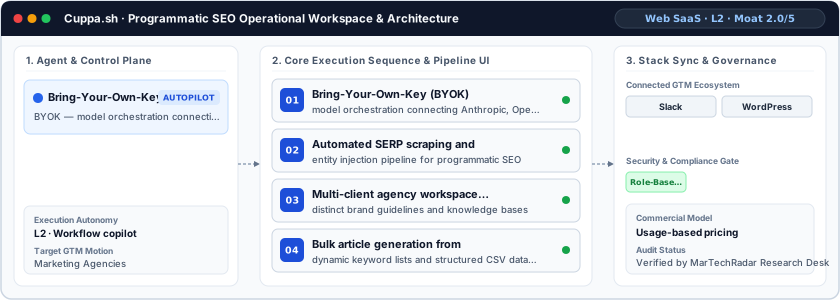
- Bring-Your-Own-Key (BYOK): model orchestration connecting Anthropic, OpenAI, and OpenRouter
- Automated SERP scraping and entity injection pipeline for programmatic SEO
- Multi-client agency workspace supporting: distinct brand guidelines and knowledge bases
- Bulk article generation from dynamic keyword lists and structured CSV datasets
Cons: operational limitations & risks
- API Rate Limiting Bottlenecks: Because generation relies directly on user-provided API credentials, large-scale concurrent batches are constrained by upstream provider tier limits, resulting in job throttling or failures during high-volume executions.
- Downstream Publishing Schema Drift: Direct publishing to external web platforms requires ongoing manual synchronization of custom field taxonomies and headless schema mappings across varying content architectures.
- SERP Extraction Lag: Real-time competitive search scraping introduces operational latency into bulk batch jobs, occasionally degrading throughput when search engine defensive heuristics trigger extraction retries.
Cuppa.sh TCO & deal-breaker stress test
Simulate 12-month stepped TCO, hidden cost multipliers, contract lock-in exposure, and stack failure modes using only facts verified by MarTechRadar Research Desk on 2026-10-15 · Capture SHA 9280a75c.
Cuppa.sh triggers high-severity friction under your 5-seat / $800/mo constraints. Benchmark the verified subtrack alternatives below before committing.
- Moat Score
- 2.0 / 5.0
- AI Autonomy
- L2
- Free Tier / Trial
- None disclosed
Triggered audit signals & failure modes
- Opaque Enterprise Quoting vs. SMB/Mid-Market BudgetVerified Pricing Ledger
Cuppa.sh does not disclose a public self-serve floor (Usage-based pricing). Buyers with a $800/mo cap face high sales-qualification friction.
- Sales-Gated Contract TermsFact-checked by MarTechRadar Research Desk
Cuppa.sh operates on a recurring software subscription structure separate from LLM consumption expenses.
- Usage / Credit Burn VolatilityCommercial Model Audit
Cuppa.sh uses credit or usage-metered billing (Usage-based pricing). High-volume automated workflows across 5 seats can trigger mid-cycle overage charges.
- Primary Operational Bottleneck: API Rate Limiting BottlenecksAudit by MarTechRadar Research Desk
Because generation relies directly on user-provided API credentials, large-scale concurrent batches are constrained by upstream provider tier limits, resulting in job throttling or failures during high-volume executions.
Test a custom Cuppa.sh budget or stack constraint
Lower 5-seat floor (~$99/mo vs. Custom Quote) · Transparent self-serve entry without mandatory annual lock-in
Lower 5-seat floor (~$19/mo vs. Custom Quote) · Transparent self-serve entry without mandatory annual lock-in
Cuppa.sh integrations, API, security & compliance stack
BYOK — model orchestration connecting Anthropic, OpenAI, and OpenRouter
Cuppa.sh AI moat & Programmatic SEO positioning
Cuppa.sh isolates its architectural defensibility by separating software orchestration from model token consumption via a BYOK infrastructure, preventing model margin inflation while integrating programmatic SERP extraction and multi-tenant brand governance.
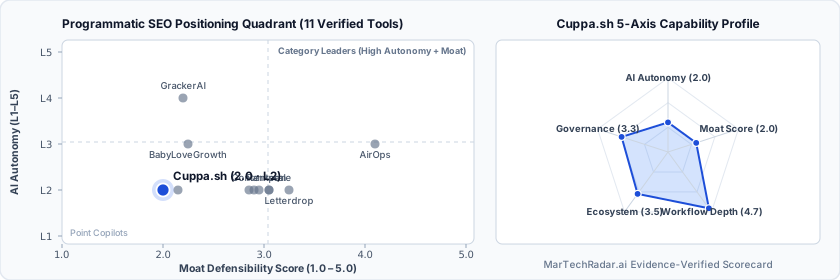
Cuppa.sh in-depth review, pricing & architecture analysis
Editor sign-off: Oct 15, 2026. How profiles are made.
What is Cuppa.sh? Overview & background
Headquartered in the United States, Cuppa.sh targets SEO engineers, programmatic growth operators, and digital marketing agencies tasked with producing large volumes of search-indexed content without incurring commercial platform markups. By decoupling software orchestration from model inference costs, the platform serves content teams requiring structured, repeatable output pipelines across multiple domain properties and client workspaces.
How Cuppa.sh works: architecture & workflow
Architecturally, Cuppa.sh functions as an L3 programmatic orchestration layer operating on a bring-your-own-key model. Users supply direct API credentials for foundation model providers including OpenAI, Anthropic, and OpenRouter, eliminating third-party per-word surcharges. The generation engine ingests bulk keyword clusters or CSV datasets, executes real-time SERP research to parse competitor headings, generates structured multi-tier outlines, and systematically injects domain entities into markdown drafts before dispatching pages to connected content management systems, alongside native workflow integrations for Slack and WordPress.
Cuppa.sh limitations, drawbacks & risks
Operational considerations and platform boundaries include:
- API Rate Limiting Bottlenecks: Because generation relies directly on user-provided API credentials, large-scale concurrent batches are constrained by upstream provider tier limits, resulting in job throttling or failures during high-volume executions.
- Downstream Publishing Schema Drift: Direct publishing to external web platforms requires ongoing manual synchronization of custom field taxonomies and headless schema mappings across varying content architectures.
- SERP Extraction Lag: Real-time competitive search scraping introduces operational latency into bulk batch jobs, occasionally degrading throughput when search engine defensive heuristics trigger extraction retries.
Cuppa.sh pricing, plans & cost breakdown
Cuppa.sh operates on a recurring software subscription structure separate from LLM consumption expenses. Customers license the workspace via recurring subscription tiers (pricing not publicly rendered on the static solo pricing page) while paying raw LLM token usage directly to their configured API providers via bring-your-own-key billing. Higher operational tiers expand workspace quotas, team seats, and multi-tenant agency management capabilities.
How Cuppa.sh compares vs. competitors & alternatives
Within the programmatic generation category, Cuppa.sh competes against solutions like Byword.ai and AirOps. While Byword.ai packages model inference and research into an all-inclusive credit system, Cuppa.sh offers significantly lower total operating expense through direct token consumption. Conversely, AirOps provides more advanced multi-modal orchestration and database integrations, making Cuppa.sh the preferred choice for cost-conscious search operators focused on programmatic long-form publishing.
Frequently asked questions about Cuppa.sh
How does Cuppa.sh usage pricing work in 2026?
Cuppa.sh pricing: Usage-based pricing. No free plan is publicly disclosed. Cuppa.sh operates on a recurring software subscription structure separate from LLM consumption expenses.
What are the top Cuppa.sh alternatives in Programmatic SEO?
Verified Programmatic SEO alternatives include Byword.ai (Usage-based pricing), AirOps (Custom / enterprise pricing), Drift (Custom / enterprise pricing), Peec AI ($95–$495/mo · Enterprise plan). Within the programmatic generation category, Cuppa.sh competes against solutions like Byword.ai and AirOps.
What are the main limitations and trade-offs of Cuppa.sh?
Operational considerations and platform boundaries include: API Rate Limiting Bottlenecks: Because generation relies directly on user-provided API credentials, large-scale concurrent batches are constrained by upstream provider tier limits, resulting in job throttling or failures during high-volume executions. Walk away if you need published self-serve pricing: Cuppa.sh is sold by custom quote.
Verified sources & evidence trail
- Official product domain: https://cuppa.sh
- Commercial pricing verification: https://cuppa.ai/pricing/solo
- First-party governance & documentation links: Changelog · Terms · Privacy
- Editor sign-off: Oct 15, 2026 (how profiles are made).
