Constructor Review (2026): Product Feed Management Pricing, Pros & Cons
Bottom line
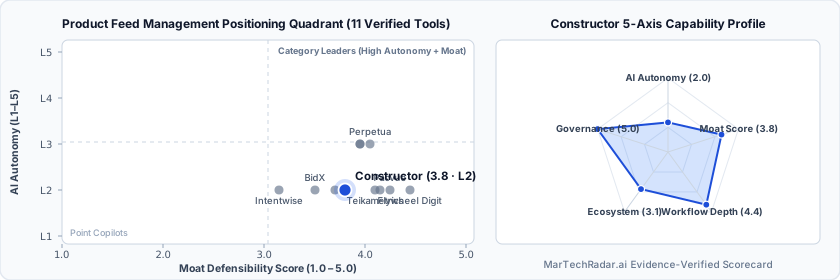
Constructor is a Web SaaS tool for Product Feed Management (Retail Media & Product Feed Management) in AdTech & Paid Media. Pricing: Pricing not disclosed. Editor ratings: AI autonomy L2 (workflow copilot); moat score 3.8/5.0 (Proprietary moat). Fact-checked by MarTechRadar Research Desk on Oct 26, 2026.
AI-native e-commerce product discovery, conversational shopping agent, and retail media platform powered by a central Commerce Reasoning Engine.
Is Constructor worth it in 2026? Buyer fit & when to walk away
Choose Constructor if (Best Fit)
- Target ICP & Stack Fit: You operate as Product Feed Management teams requiring a Web SaaS deployment for Product Feed Management.
- L2 Architecture & Defensibility: Constructor holds a strong enterprise e-commerce discovery moat through its clickstream-trained Commerce Reasoning Engine, conversational AI Shopping Agents, and $86.1M in Series B backing from Sapphire Ventures and Silversmith Capital Partners.
- Commercial Model Fit: Your procurement budget aligns with Pricing not disclosed.
Walk away from Constructor if (Deal-Breakers)
- Walk away if you require transparent self-serve monthly billing or your budget ceiling is under $1,000/mo (Constructor requires sales-gated custom quoting).
- Walk away if your workflow cannot tolerate primary operational trade-off: In practical enterprise deployments, the primary trade-off is that Constructor's behavioral ranking models require substantial clickstream traffic volume and clean SKU catalog feeds to train effectively, making it over-engineered for low-traffic boutiques.
- Walk away if functional scope boundary is a deal-breaker for your team: Constructor is not built for B2B outbound cold email sequences, top-of-funnel social media ad video rendering, or off-site PR media monitoring.
Constructor pricing, free plan & scorecard at a glance
| Pricing | Pricing not disclosed |
|---|---|
| Free plan | No / not disclosed |
| Delivery | Web SaaS |
| Audience | — |
| AI autonomy level | L2 · Workflow copilotEditor-verified |
| Moat tier & score | 3.8 / 5.0 · Proprietary moatEditor-verified |
| Funding | Series B |
| Total funding | $86.1MBacked by Sapphire Ventures, Silversmith Capital Partners, Fusion Fund, Zetta Venture Partners, SAP.iO |
| Founders | Dan McCormick, Eli Finkelshteyn |
| Company size | 201-500 employees |
| Compliance & governance | SOC 2, GDPR, HIPAA, ISO 27001 |
| Headquarters | San Francisco, California, United States |
| Founded | 2015 |
| Last verified | Oct 26, 2026 |
Constructor pros & cons: strengths vs. operational limitations
Pros: core strengths & capabilities
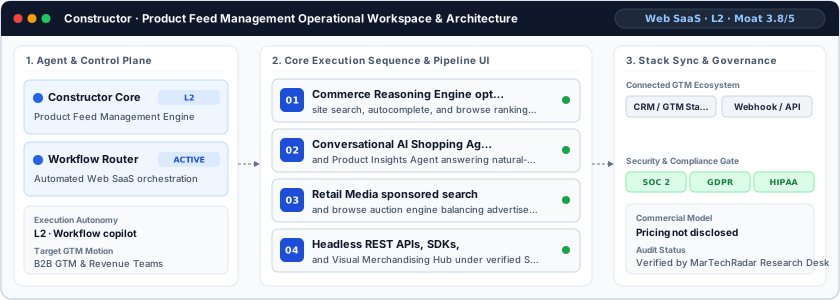
- Commerce Reasoning Engine optimizing: site search, autocomplete, and browse rankings directly for revenue per session and conversion rate
- Conversational AI Shopping Agent: and Product Insights Agent answering natural-language shopper queries with real-time catalog reasoning
- Retail Media sponsored search: and browse auction engine balancing advertiser ROAS with individualized shopper relevance
- Headless REST APIs, SDKs,: and Visual Merchandising Hub under verified SOC 2 Type II, ISO 27001, GDPR, and HIPAA compliance
Cons: operational limitations & risks
- Primary Operational Trade-Off: In practical enterprise deployments, the primary trade-off is that Constructor's behavioral ranking models require substantial clickstream traffic volume and clean SKU catalog feeds to train effectively, making it over-engineered for low-traffic boutiques.
- Functional Scope Boundary: Constructor is not built for B2B outbound cold email sequences, top-of-funnel social media ad video rendering, or off-site PR media monitoring.
- Deployment & Governance Considerations: Additionally, migrating legacy site search indexes, autocomplete widgets, and browse category pages onto Constructor's headless APIs introduces cold start calibration and frontend engineering overhead during initial rollout.
Constructor TCO & deal-breaker stress test
Simulate 12-month stepped TCO, hidden cost multipliers, contract lock-in exposure, and stack failure modes using only facts verified by MarTechRadar Research Desk on 2026-10-26.
Constructor triggers high-severity friction under your 5-seat / $800/mo constraints. Benchmark the verified subtrack alternatives below before committing.
- Moat Score
- 3.8 / 5.0
- AI Autonomy
- L2
- Free Tier / Trial
- None disclosed
Triggered audit signals & failure modes
- Opaque Enterprise Quoting vs. SMB/Mid-Market BudgetVerified Pricing Ledger
Constructor does not disclose a public self-serve floor (Pricing not disclosed). Buyers with a $800/mo cap face high sales-qualification friction.
- Sales-Gated Contract TermsFact-checked by MarTechRadar Research Desk
Pricing available on request.
- Primary Operational Bottleneck: Primary Operational Trade-OffAudit by MarTechRadar Research Desk
In practical enterprise deployments, the primary trade-off is that Constructor's behavioral ranking models require substantial clickstream traffic volume and clean SKU catalog feeds to train effectively, making it over-engineered for low-traffic boutiques.
Test a custom Constructor budget or stack constraint
Lower 5-seat floor (~$695/mo vs. Custom Quote) · Transparent self-serve entry without mandatory annual lock-in
Lower 5-seat floor (~$64/mo vs. Custom Quote) · Transparent self-serve entry without mandatory annual lock-in
Constructor integrations, API, security & compliance stack
Constructor AI moat & Product Feed Management positioning
Constructor holds a strong enterprise e-commerce discovery moat through its clickstream-trained Commerce Reasoning Engine, conversational AI Shopping Agents, and $86.1M in Series B backing from Sapphire Ventures and Silversmith Capital Partners.
Constructor in-depth review, pricing & architecture analysis
Audited by MarTechRadar Research Desk (Evidence-Ledger Verified) on Oct 26, 2026.
What is Constructor? Overview & background
Constructor is an AI-native e-commerce search, product discovery, and retail media platform built for VP of Digital Commerce leaders, head of merchandising teams, and retail media directors at enterprise retail brands. Founded in 2015 by Eli Finkelshteyn and Dan McCormick and headquartered in San Francisco, California, the company operates with 201 to 500 employees and has raised $86.1M in venture funding through Series B backed by Sapphire Ventures, Silversmith Capital Partners, Fusion Fund, Zetta Venture Partners, and SAP.iO. It replaces brittle keyword-matching search bars with a central Commerce Reasoning Engine that interprets shopper behavior, session context, and purchase intent across every digital touchpoint.
How Constructor works: architecture & workflow
At the technical core of Constructor is a central Commerce Reasoning Engine architecture that combines behavioral clickstream machine learning with transformer-based LLM reasoning inside a unified cloud discovery pipeline. Rather than optimizing merely for click-through rate or requiring manual synonym rules, the platform's ranking algorithm ingests live catalog attributes, inventory availability, profit margins, and individual shopper affinities to optimize directly for revenue per session. Its suite of Shopping Agents—including a conversational AI Shopping Agent and a Product Insights Agent—enables shoppers to ask natural-language questions and receive personalized product comparisons in real time. Developers integrate the workflow via headless REST APIs, SDKs, and pre-built e-commerce integration connectors under verified SOC 2 Type II, ISO 27001, GDPR, and HIPAA security controls.
Constructor limitations, drawbacks & risks
Operational considerations and platform boundaries include:
- Primary Operational Trade-Off: In practical enterprise deployments, the primary trade-off is that Constructor's behavioral ranking models require substantial clickstream traffic volume and clean SKU catalog feeds to train effectively, making it over-engineered for low-traffic boutiques.
- Functional Scope Boundary: Constructor is not built for B2B outbound cold email sequences, top-of-funnel social media ad video rendering, or off-site PR media monitoring.
- Deployment & Governance Considerations: Additionally, migrating legacy site search indexes, autocomplete widgets, and browse category pages onto Constructor's headless APIs introduces cold start calibration and frontend engineering overhead during initial rollout.
Constructor pricing, plans & cost breakdown
Pricing available on request. Constructor does not publish fixed self-serve subscription tiers on its website, structuring its commercial contracts as custom annual enterprise licenses tailored to annual search and browse query volume, active SKU catalog size, and selected modules across Search, Browse, Recommendations, Shopping Agents, and Retail Media, with a complimentary Search Experience Audit available on request.
| Plan / Tier | Verified Price & Billing | Target Seat / Scale Fit | Included Scope & Contract Terms |
|---|---|---|---|
| Enterprise / Custom | Custom quote | 15–50+ seats (Enterprise SLA) | Sales-negotiated annual contract for custom volume, SSO/RBAC governance, and dedicated SLA. |
| Contract Watchout: Primary Operational Trade-Off | In practical enterprise deployments, the primary trade-off is that Constructor's behavioral ranking models require substantial clickstream traffic volume and clean SKU catalog feeds to train effectively, making it over-engineered for low-traffic boutiques. | ||
How Constructor compares vs. competitors & alternatives
In the enterprise e-commerce search and product discovery market, Constructor competes with Algolia, Bloomreach Discovery, Coveo, and Nosto within the eCommerce Discovery & Personalization segment, alongside verified subtrack peers such as Dynamic Yield and Mutiny. Compared to developer-centric search engines vs. legacy rule-based merchandisers that require manual boost-and-bury maintenance, Constructor differentiates itself through KPI-first revenue optimization and conversational AI Shopping Agents. Mid-market and enterprise retailers should evaluate Constructor to eliminate zero-result searches and maximize onsite conversion and retail media revenue.
Frequently asked questions about Constructor
Does Constructor publish pricing or require an enterprise quote?
Constructor pricing: Pricing not disclosed. No free plan is publicly disclosed. Pricing available on request.
What are the top Constructor alternatives in Product Feed Management?
Verified Product Feed Management alternatives include Nosto (Pricing not disclosed), Channel3 (Pricing not disclosed), Omnidock (Custom / enterprise pricing), Mutiny (Custom / enterprise pricing). In the enterprise e-commerce search and product discovery market, Constructor competes with Algolia, Bloomreach Discovery, Coveo, and Nosto within the eCommerce Discovery & Personalization segment, alongside verified subtrack peers such as Dynamic Yield and Mutiny.
Verified sources & evidence trail
- Official product domain: https://constructor.io
- Commercial pricing verification: Verified against official vendor pricing policy (Pricing not disclosed)
- Verified corporate entity profiles (
sameAs): LinkedIn Company Profile · Crunchbase Entity Record - Editorial audit sign-off: Audited by MarTechRadar Research Desk (Evidence-Ledger Verified) on Oct 26, 2026.
