Claygent Review (2026): Sales Intelligence Pricing, Pros & Cons
Bottom line
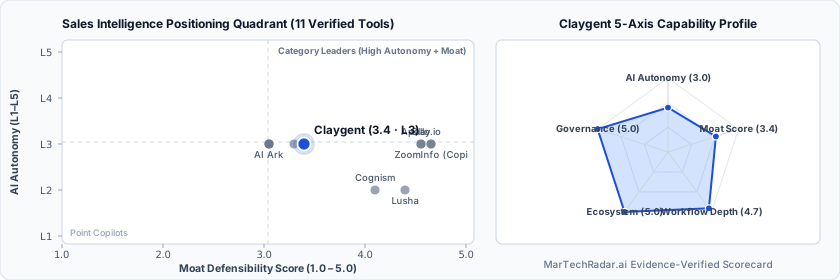
Claygent is a Web SaaS tool for Sales Intelligence (Lead Enrichment & Waterfall Orchestration) in AI SDR & Outbound. Pricing: Usage-based pricing. Best suited to B2B SaaS. Editor ratings: AI autonomy L3 (conditional automation); moat score 3.4/5.0 (Workflow-embedded (strong)). Fact-checked by MarTechRadar Research Desk on Oct 14, 2026.
Autonomous GTM web research agent within the Clay ecosystem executing real-time web navigation, scraping, and qualitative attribute extraction for B2B lists.
Is Claygent worth it in 2026? Buyer fit & when to walk away
Choose Claygent if (Best Fit)
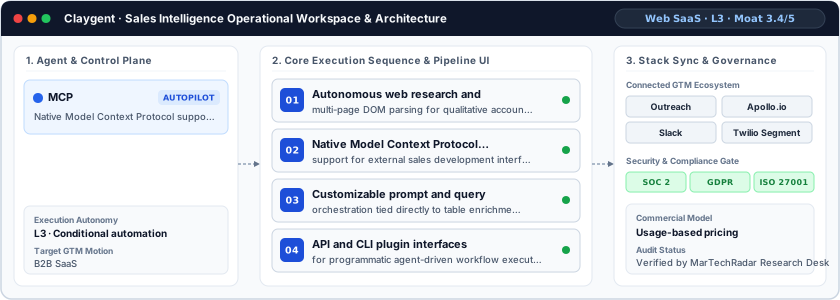
- Target ICP & Stack Fit: You operate as B2B SaaS requiring a Web SaaS deployment for Sales Intelligence, with verified ecosystem connectivity for Outreach, Apollo.io, Slack, Twilio Segment.
- L3 Architecture & Defensibility: Embedded deeply into Clay's multi-provider waterfall orchestration pipeline with programmatic web scraping, dynamic query synthesis, and native Model Context Protocol support.
- Commercial Model Fit: Your procurement budget aligns with Usage-based pricing.
Walk away from Claygent if (Deal-Breakers)
- Walk away if you need published self-serve pricing: Claygent is sold by custom quote.
- Walk away if your workflow cannot tolerate non-deterministic extraction latency: Multi-hop web browsing and real-time page evaluation introduce variable processing latency per record, causing throughput bottlenecks across large batch tables.
- Walk away if bot detection and anti-scraping defenses is a deal-breaker for your team: Target domains utilizing aggressive CAPTCHA challenges or dynamic JavaScript obfuscation can block headless requests, leading to null field outputs.
Claygent pricing, free plan & scorecard at a glance
| Pricing | Usage-based pricingVendor pricing page |
|---|---|
| Free plan | No / not disclosed |
| Delivery | Web SaaS |
| Audience | B2B SaaS |
| AI autonomy level | L3 · Conditional automationEditor-verified |
| Moat tier & score | 3.4 / 5.0 · Workflow-embedded (strong)Editor-verified |
| Funding | Venture-backed |
| Ecosystem integrations | Outreach, Apollo.io, Slack, Twilio Segment, Intercom, Model Context Protocol (MCP) |
| Compliance & governance | SOC 2, GDPR, ISO 27001 |
| Governance & docs | System Status ↗ · API & Docs ↗ · Changelog ↗ · Terms ↗ · Privacy ↗ |
| Headquarters | United States |
| Last verified | Oct 14, 2026 |
Claygent pros & cons: strengths vs. operational limitations
Pros: core strengths & capabilities
- Autonomous web research and multi-page DOM parsing for qualitative account signals
- Native Model Context Protocol (MCP): support for external sales development interfaces
- Customizable prompt and query: orchestration tied directly to table enrichment columns
- API and CLI plugin interfaces: for programmatic agent-driven workflow execution
Cons: operational limitations & risks
- Non-Deterministic Extraction Latency: Multi-hop web browsing and real-time page evaluation introduce variable processing latency per record, causing throughput bottlenecks across large batch tables.
- Bot Detection and Anti-Scraping Defenses: Target domains utilizing aggressive CAPTCHA challenges or dynamic JavaScript obfuscation can block headless requests, leading to null field outputs.
- Credit Burn Velocity: Unconstrained multi-step agent iterations consume high platform credit volumes rapidly when prompts require deep hierarchical domain navigation.
Claygent TCO & deal-breaker stress test
Simulate 12-month stepped TCO, hidden cost multipliers, contract lock-in exposure, and stack failure modes using only facts verified by MarTechRadar Research Desk on 2026-10-14 · Capture SHA 0ff7e365.
Claygent triggers high-severity friction under your 5-seat / $800/mo constraints. Benchmark the verified subtrack alternatives below before committing.
- Moat Score
- 3.4 / 5.0
- AI Autonomy
- L3
- Free Tier / Trial
- None disclosed
Triggered audit signals & failure modes
- Opaque Enterprise Quoting vs. SMB/Mid-Market BudgetVerified Pricing Ledger
Claygent does not disclose a public self-serve floor (Usage-based pricing). Buyers with a $800/mo cap face high sales-qualification friction.
- Sales-Gated Contract TermsFact-checked by MarTechRadar Research Desk
Claygent utilizes a usage-based credit consumption model anchored to the parent platform's infrastructure tiers across metered workspace credit pools. Individual research queries draw micro-credits based on search depth, page navigation complexity, and token utilization.
- Usage / Credit Burn VolatilityCommercial Model Audit
Claygent uses credit or usage-metered billing (Usage-based pricing). High-volume automated workflows across 5 seats can trigger mid-cycle overage charges.
- Primary Operational Bottleneck: Credit Burn VelocityAudit by MarTechRadar Research Desk
Unconstrained multi-step agent iterations consume high platform credit volumes rapidly when prompts require deep hierarchical domain navigation.
Test a custom Claygent budget or stack constraint
Lower 5-seat floor (~$41/mo vs. Custom Quote) · Transparent self-serve entry without mandatory annual lock-in
Lower 5-seat floor (~$159/mo vs. Custom Quote) · Transparent self-serve entry without mandatory annual lock-in
Claygent integrations, API, security & compliance stack
Native Model Context Protocol support for external sales development interfaces
Claygent AI moat & Sales Intelligence positioning
Embedded deeply into Clay's multi-provider waterfall orchestration pipeline with programmatic web scraping, dynamic query synthesis, and native Model Context Protocol support.
Claygent in-depth review, pricing & architecture analysis
Editor sign-off: Oct 14, 2026. How profiles are made.
What is Claygent? Overview & background
Operating out of the United States as an autonomous research agent embedded within the Clay ecosystem, Claygent resolves complex qualitative account profiling that static enrichment databases fail to capture. Engineered for revenue operations architects and outbound growth teams, the system replaces manual research loops by navigating the live web to extract custom buyer signals. By converting natural-language prompts into automated research tasks, Claygent shifts enrichment from deterministic API lookups to dynamic intelligence retrieval.
How Claygent works: architecture & workflow
Operating at an L3 autonomy tier, Claygent functions through an iterative query and extraction architecture. When triggered within a table workflow, the agent synthesizes target search queries, commands headless browsing sessions across public domain endpoints, and parses unstructured HTML DOM structures. An underlying LLM orchestrator synthesizes the scraped textual payload against user-defined constraints, outputting structured attributes back into table cells alongside attribution source URLs, alongside native workflow integrations for Slack and Intercom under verified SOC 2 Type II, GDPR, and ISO 27001 governance controls.
Claygent limitations, drawbacks & risks
Operational considerations and platform boundaries include:
- Non-Deterministic Extraction Latency: Multi-hop web browsing and real-time page evaluation introduce variable processing latency per record, causing throughput bottlenecks across large batch tables.
- Bot Detection and Anti-Scraping Defenses: Target domains utilizing aggressive CAPTCHA challenges or dynamic JavaScript obfuscation can block headless requests, leading to null field outputs.
- Credit Burn Velocity: Unconstrained multi-step agent iterations consume high platform credit volumes rapidly when prompts require deep hierarchical domain navigation.
Claygent pricing, plans & cost breakdown
Claygent utilizes a usage-based credit consumption model anchored to the parent platform's infrastructure tiers across metered workspace credit pools. Individual research queries draw micro-credits based on search depth, page navigation complexity, and token utilization. Enterprise teams scale compute through shared workspace capacity with centralized billing governance.
How Claygent compares vs. competitors & alternatives
Against static B2B database providers such as Apollo.io, Claygent trades query speed for the capability to extract nuanced, real-time website signals that pre-indexed databases miss within the Sales Intelligence segment. While standalone automated outbound engines like AI Ark emphasize all-in-one outreach, Claygent operates within the broader Clay orchestration environment. This design delivers maximum value to technically mature growth engineering teams that require custom web scraping integrated with multi-vendor waterfall workflows.
Frequently asked questions about Claygent
How does Claygent usage pricing work in 2026?
Claygent pricing: Usage-based pricing. No free plan is publicly disclosed. Claygent utilizes a usage-based credit consumption model anchored to the parent platform's infrastructure tiers across metered workspace credit pools.
What are the top Claygent alternatives in Sales Intelligence?
Verified Sales Intelligence alternatives include Hexomatic (From $40.83/mo), Pond (Custom / enterprise pricing), Dokwise (From $159/mo), Anymail Finder (Custom / enterprise pricing). Against static B2B database providers such as Apollo.io, Claygent trades query speed for the capability to extract nuanced, real-time website signals that pre-indexed databases miss within the Sales Intelligence segment.
What are the main limitations and trade-offs of Claygent?
Operational considerations and platform boundaries include: Non-Deterministic Extraction Latency: Multi-hop web browsing and real-time page evaluation introduce variable processing latency per record, causing throughput bottlenecks across large batch tables. Walk away if you need published self-serve pricing: Claygent is sold by custom quote.
Verified sources & evidence trail
- Official product domain: https://clay.com/claygent
- Commercial pricing verification: https://www.clay.com/pricing
- Verified corporate entity profiles (
sameAs): LinkedIn Company Profile · Crunchbase Entity Record - First-party governance & documentation links: System Status · API & Docs · Changelog · Terms · Privacy
- Editor sign-off: Oct 14, 2026 (how profiles are made).
