Breakout Review (2026): Email Marketing Pricing, Limits & Alternatives
Bottom line
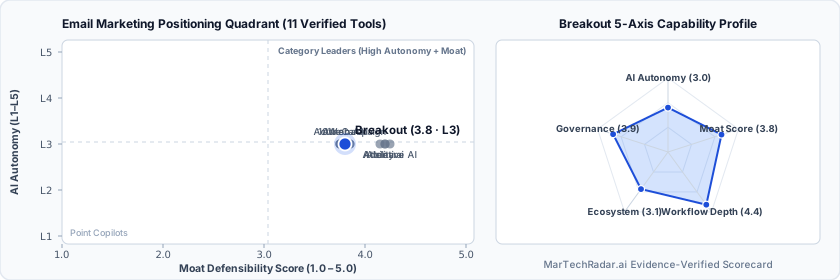
Breakout is a Web SaaS tool for Email Marketing (AI Email Marketing & Lifecycle Journeys) in Lifecycle & CDP. Pricing: From $500/mo. Best suited to CRM & Lifecycle Marketers, eCommerce Growth Teams and Customer Experience Directors. Editor ratings: AI autonomy L3 (conditional automation); moat score 3.8/5.0 (Proprietary moat). Fact-checked by Julie Brot on Oct 11, 2026.
Autonomous inbound AI SDR platform that deanonymizes website traffic, executes multi-vendor waterfall enrichment, and engages inbound accounts to generate.
Breakout buyer fit verdict: when to choose vs. when to walk away
Choose Breakout if (Best Fit)
- Target ICP & Stack Fit: You operate as CRM & Lifecycle Marketers, eCommerce Growth Teams and Customer Experience Directors requiring a Web SaaS deployment for Email Marketing.
- L3 Architecture & Defensibility: Defensibility stems from real-time waterfall data enrichment paired with low-latency LLM agent orchestration directly embedded into browser sessions, bridging anonymous intent with personalized outbound and inbound workflows.
- Commercial Model Fit: Your procurement budget aligns with From $500/mo.
Walk away from Breakout if (Deal-Breakers)
- Walk away if your team is at early validation stage with a <$250/mo tool budget (Breakout starts at From $500/mo before seat or usage expansion).
- Walk away if your workflow cannot tolerate deanonymization coverage gaps: Match rates decline sharply when target accounts utilize commercial VPNs, distributed remote networks, or strict browser-level cookie prevention policies.
- Walk away if enrichment latency constraints is a deal-breaker for your team: Cascading waterfall queries across third-party data vendors can introduce multi-second latencies, occasionally delaying personalized conversational triggers past initial page engagement.
Breakout key facts & scorecard
| Pricing | From $500/moVendor pricing page |
|---|---|
| Free plan | No / not disclosed |
| Delivery | Web SaaS |
| Audience | CRM & Lifecycle Marketers, eCommerce Growth Teams, Customer Experience Directors |
| AI autonomy level | L3 · Conditional automationEditor-verified |
| Moat tier & score | 3.8 / 5.0 · Proprietary moatEditor-verified |
| Funding | Seed |
| Total funding | $3.3MBacked by Village Global, z21 Ventures |
| Founders | Hitesh Aggarwal, Sachin Gupta |
| Company size | 11-50 employees |
| Governance & docs | Trust & Security ↗ · Terms ↗ · Privacy ↗ |
| Headquarters | San Francisco Bay Area |
| Founded | 2024 |
| Last verified |
Breakout pros & cons: strengths vs. operational limitations
Pros: core strengths & capabilities
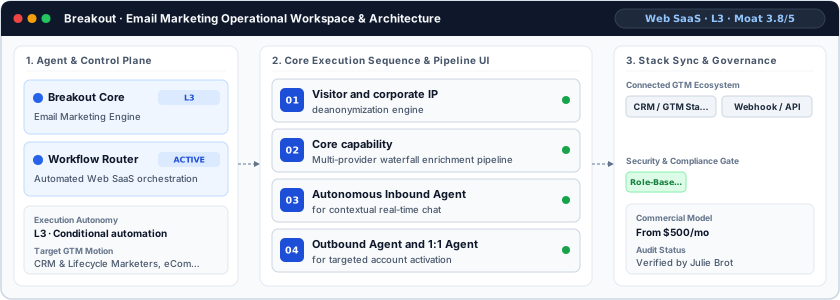
- Visitor and corporate IP: deanonymization engine
- Core capability: Multi-provider waterfall enrichment pipeline
- Autonomous Inbound Agent: for contextual real-time chat
- Outbound Agent and 1:1 Agent: for targeted account activation
Cons: operational limitations & risks
- Deanonymization Coverage Gaps: Match rates decline sharply when target accounts utilize commercial VPNs, distributed remote networks, or strict browser-level cookie prevention policies.
- Enrichment Latency Constraints: Cascading waterfall queries across third-party data vendors can introduce multi-second latencies, occasionally delaying personalized conversational triggers past initial page engagement.
- Downstream Schema Drift: Pushing autonomously parsed buying group data into complex enterprise CRM environments requires ongoing mapping maintenance to avoid contact duplication.
Breakout TCO & deal-breaker stress test
Simulate 12-month stepped TCO, hidden cost multipliers, contract lock-in exposure, and stack failure modes using only facts verified by Julie Brot on · Capture SHA 3f3ec3f6.
Breakout aligns with your 5-seat / $800/mo profile. Review the walk-away triggers and contract levers below before deployment.
| Plan / Tier | Verified Rate | Scale Fit | Scope & Quota Notes |
|---|---|---|---|
| Entry / Starter | $500/mo | 1–2 seats | Visitor deanonymization |
- Moat Score
- 3.8 / 5.0
- AI Autonomy
- L3
- Free Tier / Trial
- None disclosed
Triggered audit signals & failure modes
- Published Self-Serve Entry FloorVerified Pricing Ledger
Breakout publishes a transparent entry point (From $500/mo) for initial validation before committing.
- Primary Operational Bottleneck: Deanonymization Coverage GapsAudit by Julie Brot
Match rates decline sharply when target accounts utilize commercial VPNs, distributed remote networks, or strict browser-level cookie prevention policies.
Hidden TCO Multipliers & Quota Gates
- Credit & Usage Burn Multiplier: Automated workflows consume metered credits/usage quotas; multi-step enrichment, voice minutes, or high-frequency agent runs can trigger mid-cycle top-up packs.
- Enterprise Governance & Add-On Gating: Advanced capabilities such as Single Sign-On (SSO), custom role permissions, or specialized analytics modules are gated behind upper tiers or paid add-ons.
When to Walk Away & Negotiation Levers
- Walk away if your team is at early validation stage with a <$250/mo tool budget (Breakout starts at From $500/mo before seat or usage expansion).
- Walk away if your workflow cannot tolerate deanonymization coverage gaps: Match rates decline sharply when target accounts utilize commercial VPNs, distributed remote networks, or strict browser-level cookie prevention policies.
- Walk away if enrichment latency constraints is a deal-breaker for your team: Cascading waterfall queries across third-party data vendors can introduce multi-second latencies, occasionally delaying personalized conversational triggers past initial page engagement.
- Negotiate price-lock protection on additional seats and overage credits above the From $500/mo entry tier.
- Require a sandbox proof-of-concept testing deanonymization coverage gaps against your live CRM/data schema before annual sign-off.
Ask a custom procurement or TCO stress-test question about Breakout
Lower 5-seat floor (~$10/mo vs. From $500 / mo)
Lower 5-seat floor (~$15/mo vs. From $500 / mo)
Breakout moat & subtrack positioning
Defensibility stems from real-time waterfall data enrichment paired with low-latency LLM agent orchestration directly embedded into browser sessions, bridging anonymous intent with personalized outbound and inbound workflows.
Editorial review
Fact-checked by Julie Brot (Enterprise SaaS Governance & Procurement Editor) on .
Background
Architected as an autonomous inbound pipeline engine, Breakout was established in 2024 in the San Francisco Bay Area to resolve the conversion drop-off between anonymous web pageviews and verified sales pipeline. Backed by $3.3M in venture funding, the company targets revenue operations leads, demand generation executives, and inbound sales teams struggling with manual lead triage. Rather than relying on static lead capture forms, the platform deploys autonomous agents directly onto digital storefronts to qualify and convert visiting accounts.
How Breakout works
At the architectural layer, the system autonomy, Breakout pairs client-side tracking scripts with a backend identity-resolution graph. The ingestion pipeline captures digital footprints, triggering real-time company and visitor deanonymization. It routes unresolved records through a waterfall enrichment sequence to pinpoint buying group members. When high-fit accounts land on key pages, the engine deploys its Inbound Agent, utilizing dynamic context from session behavior and enriched firmographic attributes to drive conversational discovery and book qualified meetings.
Limitations
Operational considerations and platform boundaries include:
- Deanonymization Coverage Gaps: Match rates decline sharply when target accounts utilize commercial VPNs, distributed remote networks, or strict browser-level cookie prevention policies.
- Enrichment Latency Constraints: Cascading waterfall queries across third-party data vendors can introduce multi-second latencies, occasionally delaying personalized conversational triggers past initial page engagement.
- Downstream Schema Drift: Pushing autonomously parsed buying group data into complex enterprise CRM environments requires ongoing mapping maintenance to avoid contact duplication.
Breakout pricing
Breakout deploys a tiered software-as-a-service licensing structure tied to enrichment volume and autonomous agent features. Direct access begins at $500 per month on entry tiers focused on website deanonymization and waterfall enrichment data pipelines, with scaled pricing tiers accommodating expanded agent interactions, higher lead throughput, and direct team coordination.
How Breakout compares
Within pipeline activation ecosystems, Breakout occupies a specialized niche contrasting against broader optimization or automation suites like 10Web AI, AB Tasty, and Ability.ai. While AB Tasty prioritizes client-side experimentation and testing, Breakout centers on autonomous identity resolution and inbound SDR engagement. It represents an ideal architecture for mid-market and enterprise B2B software vendors seeking to automate account discovery and qualification without expanding headcount.
Direct competitors & market radar
Top algorithmic competitors based on category positioning, capability overlap, and ICP alignment.
Frequently asked questions about Breakout
How much does Breakout cost and what pricing tiers are available?
Published pricing summary for Breakout: From $500/mo. A permanent free plan is not disclosed for Breakout. Breakout deploys a tiered software-as-a-service licensing structure tied to enrichment volume and autonomous agent features.
How does Breakout work and how autonomous is its AI architecture?
Autonomous inbound AI SDR platform that deanonymizes website traffic, executes multi-vendor waterfall enrichment, and engages inbound accounts to generate. Within Email Marketing (AI Email Marketing & Lifecycle Journeys), MarTechRadar rates its execution architecture at L3 · Conditional automation with a verified Moat Score of 3.8 / 5.0 (Proprietary moat). Defensibility stems from real-time waterfall data enrichment paired with low-latency LLM agent orchestration directly embedded into browser sessions, bridging anonymous intent with personalized outbound and inbound workflows. Corporate profile: Founded by Hitesh Aggarwal, Sachin Gupta, operating at 11-50 employees scale.
What are the main limitations of Breakout and when should buyers walk away?
Based on our editorial technical audit, key operational considerations and boundaries for Breakout include: (1) Deanonymization Coverage Gaps: Match rates decline sharply when target accounts utilize commercial VPNs, distributed remote networks, or strict browser-level cookie prevention policies. (2) Enrichment Latency Constraints: Cascading waterfall queries across third-party data vendors can introduce multi-second latencies, occasionally delaying personalized conversational triggers past initial page engagement. (3) Downstream Schema Drift: Pushing autonomously parsed buying group data into complex enterprise CRM environments requires ongoing mapping maintenance to avoid contact duplication. Primary procurement walk-away rule: Walk away if your team is at early validation stage with a <$250/mo tool budget (Breakout starts at From $500/mo before seat or usage expansion).
What integrations, compliance certifications, and contract terms apply to Breakout?
First-party governance and developer endpoints verified on domain include: Trust/Security (https://trust.getbreakout.ai). Key TCO multiplier to watch: Credit & Usage Burn Multiplier (Automated workflows consume metered credits/usage quotas; multi-step enrichment, voice minutes, or high-frequency agent runs can trigger mid-cycle top-up packs.) Before signing a contract, procurement teams should negotiate price-lock protection on additional seats and overage credits above the From $500/mo entry tier.
What are the best Breakout alternatives and head-to-head competitors in 2026?
Top fact-checked alternatives to Breakout in Email Marketing (AI Email Marketing & Lifecycle Journeys) include Qualified (Custom / enterprise pricing), Dynamic Yield (Custom / enterprise pricing), Benchmark Email (From $15/mo), Sendlane (From $10/mo). Within pipeline activation ecosystems, Breakout occupies a specialized niche contrasting against broader optimization or automation suites like 10Web AI, AB Tasty, and Ability.ai.
Verified sources & evidence trail
- Official product domain: https://www.getbreakout.ai
- Commercial pricing verification: https://getbreakout.ai/pricing
- Verified corporate entity profiles (
sameAs): LinkedIn Company Profile · Crunchbase Entity Record - First-party governance & documentation links: Trust & Security · Terms · Privacy
- Editorial audit sign-off: Fact-checked by Julie Brot on under the MarTechRadar Evidence-Ledger Protocol.