Borr AI Review (2026): ChatGPT for Marketing Pricing, Limits & Alternatives
Bottom line
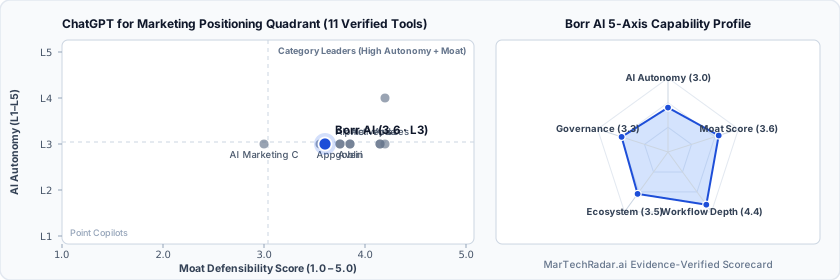
Borr AI is a Web SaaS tool for ChatGPT for Marketing (Open-Source Marketing Agents & Prompts) in Agent & Marketing Ops. Pricing: Custom / enterprise pricing. Best suited to B2B SaaS. Editor ratings: AI autonomy L3 (conditional automation); moat score 3.6/5.0 (Proprietary moat). Fact-checked by Anthony Hay on Oct 16, 2026.
Autonomous agent framework for orchestrating open-source marketing prompt pipelines and campaign execution loops.
Borr AI buyer fit verdict: when to choose vs. when to walk away
Choose Borr AI if (Best Fit)
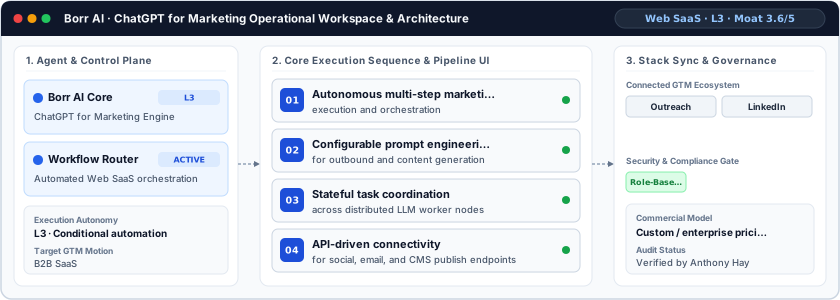
- Target ICP & Stack Fit: You operate as B2B SaaS requiring a Web SaaS deployment for ChatGPT for Marketing, with verified ecosystem connectivity for Outreach, LinkedIn.
- L3 Architecture & Defensibility: Defensibility centers on agent state persistence, customizable multi-agent role graphs, and specialized marketing task prompting schemas.
- Commercial Model Fit: Your procurement budget aligns with Custom / enterprise pricing.
Walk away from Borr AI if (Deal-Breakers)
- Walk away if you require transparent self-serve monthly billing or your budget ceiling is under $1,000/mo (Borr AI requires sales-gated custom quoting).
- Walk away if your workflow cannot tolerate state drift and context bloat: Users encounter operational friction and integration bottlenecks, as the pipeline struggles with Prolonged multi-step execution runs accumulate unpruned conversational tokens, leading to degraded prompt adherence and occasional hallucinated messaging angles.
- Walk away if downstream rate limiting is a deal-breaker for your team: Users encounter operational friction and integration bottlenecks, as the pipeline struggles with Unregulated concurrent agent dispatches trigger strict API rate-limiting thresholds on target distribution platforms such as LinkedIn, X, and email service providers.
Borr AI key facts & scorecard
| Pricing | Custom / enterprise pricing |
|---|---|
| Free plan | No / not disclosed |
| Delivery | Web SaaS |
| Audience | B2B SaaS |
| AI autonomy level | L3 · Conditional automationEditor-verified |
| Moat tier & score | 3.6 / 5.0 · Proprietary moatEditor-verified |
| Funding | Venture-backed |
| Ecosystem integrations | Outreach, LinkedIn |
| Headquarters | United States |
| Last verified |
Borr AI pros & cons: strengths vs. operational limitations
Pros: core strengths & capabilities
- Autonomous multi-step marketing campaign: execution and orchestration
- Configurable prompt engineering libraries: for outbound and content generation
- Stateful task coordination: across distributed LLM worker nodes
- API-driven connectivity: for social, email, and CMS publish endpoints
Cons: operational limitations & risks
- State drift and context bloat: Users encounter operational friction and integration bottlenecks, as the pipeline struggles with Prolonged multi-step execution runs accumulate unpruned conversational tokens, leading to degraded prompt adherence and occasional hallucinated messaging angles.
- Downstream rate limiting: Users encounter operational friction and integration bottlenecks, as the pipeline struggles with Unregulated concurrent agent dispatches trigger strict API rate-limiting thresholds on target distribution platforms such as LinkedIn, X, and email service providers.
- Schema fragility: Users encounter operational friction and integration bottlenecks, as the pipeline struggles with Agentic output parsers frequently fail when downstream third-party REST endpoints alter payload structures, requiring manual remediation by technical administrators.
Borr AI TCO & deal-breaker stress test
Simulate 12-month stepped TCO, hidden cost multipliers, contract lock-in exposure, and stack failure modes using only facts verified by Anthony Hay on .
Borr AI triggers high-severity friction under your 5-seat / $800/mo constraints. Benchmark the verified subtrack alternatives below before committing.
| Plan / Tier | Verified Rate | Scale Fit | Scope & Quota Notes |
|---|---|---|---|
| Enterprise / Custom | Custom quote | 15–50+ seats (Enterprise SLA) | Sales-negotiated annual contract for custom volume, SSO/RBAC governance, and dedicated SLA. |
- Moat Score
- 3.6 / 5.0
- AI Autonomy
- L3
- Free Tier / Trial
- None disclosed
Triggered audit signals & failure modes
- Opaque Enterprise Quoting vs. SMB/Mid-Market BudgetVerified Pricing Ledger
Borr AI does not disclose a public self-serve floor (Custom / enterprise pricing). Buyers with a $800/mo cap face high sales-qualification friction.
- Sales-Gated Contract TermsFact-checked by Anthony Hay
Commercial procurement for the software is structured around custom enterprise contracts, with pricing details available exclusively through tailored enterprise sales quotes based on organizational scale, compute throughput, and seat allocation.
- Primary Operational Bottleneck: State drift and context bloatAudit by Anthony Hay
Users encounter operational friction and integration bottlenecks, as the pipeline struggles with Prolonged multi-step execution runs accumulate unpruned conversational tokens, leading to degraded prompt adherence and occasional hallucinated messaging angles.
Hidden TCO Multipliers & Quota Gates
- State drift and context bloat: Users encounter operational friction and integration bottlenecks, as the pipeline struggles with Prolonged multi-step execution runs accumulate unpruned conversational tokens, leading to degraded prompt adherence and occasional hallucinated messaging angles.
- Downstream rate limiting: Users encounter operational friction and integration bottlenecks, as the pipeline struggles with Unregulated concurrent agent dispatches trigger strict API rate-limiting thresholds on target distribution platforms such as LinkedIn, X, and email service providers.
When to Walk Away & Negotiation Levers
- Walk away if you require transparent self-serve monthly billing or your budget ceiling is under $1,000/mo (Borr AI requires sales-gated custom quoting).
- Walk away if your workflow cannot tolerate state drift and context bloat: Users encounter operational friction and integration bottlenecks, as the pipeline struggles with Prolonged multi-step execution runs accumulate unpruned conversational tokens, leading to degraded prompt adherence and occasional hallucinated messaging angles.
- Walk away if downstream rate limiting is a deal-breaker for your team: Users encounter operational friction and integration bottlenecks, as the pipeline struggles with Unregulated concurrent agent dispatches trigger strict API rate-limiting thresholds on target distribution platforms such as LinkedIn, X, and email service providers.
- Demand a 30- to 60-day paid pilot opt-out clause in the Borr AI order form before signing a 12-month enterprise commitment.
- Require a sandbox proof-of-concept testing state drift and context bloat against your live CRM/data schema before annual sign-off.
Ask a custom procurement or TCO stress-test question about Borr AI
Lower 5-seat floor (~$99/mo vs. Custom Quote) · Transparent self-serve entry without mandatory annual lock-in
Lower 5-seat floor (~$99/mo vs. Custom Quote) · Transparent self-serve entry without mandatory annual lock-in
Borr AI key entities, modules & ecosystem stack
Borr AI moat & subtrack positioning
Defensibility centers on agent state persistence, customizable multi-agent role graphs, and specialized marketing task prompting schemas.
Editorial review
Fact-checked by Anthony Hay (Senior SEO, Search Intelligence & Content Operations Editor) on .
Background
Borr AI, headquartered in the United States, operates as a specialized orchestration engine designed to automate complex marketing execution loops through configurable agentic workflows. Built for growth engineering teams and technical digital marketers, the system coordinates programmatic copywriting, audience segmentation, and scheduled asset delivery without manual micro-prompting. Within the open-source marketing agent ecosystem, Borr AI occupies the middle tier between static prompt registries and fully autonomous production frameworks.
How Borr AI works
At its technical core, the platform leverages an autonomous task graph that parses high-level campaign parameters into atomic sub-tasks executed by coordinated agent nodes. The runtime ingests brand context documents, past campaign metrics, and structured channel constraints, converting them into dynamic vector representations. Operating at an autonomous execution standard, individual agents poll live APIs, draft structured copy variants, validate outputs against deterministic safety filters, and trigger external webhooks to publish collateral or dispatch outreach.
Limitations
Operational considerations and platform boundaries include:
- State drift and context bloat: Users encounter operational friction and integration bottlenecks, as the pipeline struggles with Prolonged multi-step execution runs accumulate unpruned conversational tokens, leading to degraded prompt adherence and occasional hallucinated messaging angles.
- Downstream rate limiting: Users encounter operational friction and integration bottlenecks, as the pipeline struggles with Unregulated concurrent agent dispatches trigger strict API rate-limiting thresholds on target distribution platforms such as LinkedIn, X, and email service providers.
- Schema fragility: Users encounter operational friction and integration bottlenecks, as the pipeline struggles with Agentic output parsers frequently fail when downstream third-party REST endpoints alter payload structures, requiring manual remediation by technical administrators.
Borr AI pricing
Commercial procurement for the software is structured around custom enterprise contracts, with pricing details available exclusively through tailored enterprise sales quotes based on organizational scale, compute throughput, and seat allocation. The platform offers customized onboarding packages that scale according to dedicated infrastructure provisioning, custom agent containerization, and enterprise SLA requirements rather than standardized off-the-shelf monthly tiers. Pricing is available on request through tailored enterprise sales quotes, with custom enterprise tiers, subscription plans, and seat licenses structured around organizational scale and monthly workflow volume.
How Borr AI compares
In contrast to alternative tooling such as Alphie, Appgoblin, and Arda, which often prioritize fixed-template prompt libraries or single-channel automation scripts, Borr AI distinguishes itself through multi-node autonomous execution and dynamic goal re-planning. While competitors like Arda lean heavily into rigid deterministic rules, Borr AI trades off simplicity for granular programmatic control, making it well-suited for technical growth teams requiring flexible, programmatic marketing agent pipelines. It is best suited for enterprise marketing teams and growth practitioners seeking disciplined workflow orchestration.
Frequently asked questions about Borr AI
How much does Borr AI cost and does it require a custom enterprise quote?
Published pricing summary for Borr AI: Custom / enterprise pricing. A permanent free plan is not disclosed for Borr AI. Commercial procurement for the software is structured around custom enterprise contracts, with pricing details available exclusively through tailored enterprise sales quotes based on organizational scale, compute throughput, and seat allocation.
How does Borr AI work and how autonomous is its AI architecture?
Autonomous agent framework for orchestrating open-source marketing prompt pipelines and campaign execution loops. Within ChatGPT for Marketing (Open-Source Marketing Agents & Prompts), MarTechRadar rates its execution architecture at L3 · Conditional automation with a verified Moat Score of 3.6 / 5.0 (Proprietary moat). Defensibility centers on agent state persistence, customizable multi-agent role graphs, and specialized marketing task prompting schemas.
What are the main limitations of Borr AI and when should buyers walk away?
Based on our editorial technical audit, key operational considerations and boundaries for Borr AI include: (1) State drift and context bloat: Users encounter operational friction and integration bottlenecks, as the pipeline struggles with Prolonged multi-step execution runs accumulate unpruned conversational tokens, leading to degraded prompt adherence and occasional hallucinated messaging angles. (2) Downstream rate limiting: Users encounter operational friction and integration bottlenecks, as the pipeline struggles with Unregulated concurrent agent dispatches trigger strict API rate-limiting thresholds on target distribution platforms such as LinkedIn, X, and email service providers. (3) Schema fragility: Users encounter operational friction and integration bottlenecks, as the pipeline struggles with Agentic output parsers frequently fail when downstream third-party REST endpoints alter payload structures, requiring manual remediation by technical administrators. Primary procurement walk-away rule: Walk away if you require transparent self-serve monthly billing or your budget ceiling is under $1,000/mo (Borr AI requires sales-gated custom quoting).
What integrations, compliance certifications, and contract terms apply to Borr AI?
Verified ecosystem and stack integrations include Outreach, LinkedIn. Key TCO multiplier to watch: State drift and context bloat (Users encounter operational friction and integration bottlenecks, as the pipeline struggles with Prolonged multi-step execution runs accumulate unpruned conversational tokens, leading to degraded prompt adherence and occasional hallucinated messaging angles.) Before signing a contract, procurement teams should demand a 30- to 60-day paid pilot opt-out clause in the Borr AI order form before signing a 12-month enterprise commitment.
What are the best Borr AI alternatives and head-to-head competitors in 2026?
Top fact-checked alternatives to Borr AI in ChatGPT for Marketing (Open-Source Marketing Agents & Prompts) include HelloDeck (Custom / enterprise pricing), Trinity Claw (Custom / enterprise pricing), VoiceGremlin (Custom / enterprise pricing), Wave (Custom / enterprise pricing). In contrast to alternative tooling such as Alphie, Appgoblin, and Arda, which often prioritize fixed-template prompt libraries or single-channel automation scripts, Borr AI distinguishes itself through multi-node autonomous execution and dynamic goal re-planning.
Verified sources & evidence trail
- Official product domain: https://www.borr.ai
- Commercial pricing verification: Verified against official vendor pricing policy (Custom / enterprise pricing)
- Editorial audit sign-off: Fact-checked by Anthony Hay on under the MarTechRadar Evidence-Ledger Protocol.