Alethea Review (2026): PR Pricing, Pros & Cons
Bottom line
Alethea is a Web SaaS tool for PR (PR Intelligence & Media Relations) in Social & Influencer. Pricing: Pricing not disclosed. Editor ratings: AI autonomy L3 (conditional automation); moat score 3.2/5.0 (Workflow-embedded (strong)). Fact-checked by MarTechRadar Research Desk on Oct 26, 2026.
AI narrative risk intelligence, disinformation detection, and brand crisis protection platform powered by Artemis and Agentic Takedown Agent.
Is Alethea worth it in 2026? Buyer fit & when to walk away
Choose Alethea if (Best Fit)
- Target ICP & Stack Fit: You operate as PR teams requiring a Web SaaS deployment for PR, with verified ecosystem connectivity for Outreach.
- L3 Architecture & Defensibility: Alethea commands a specialized enterprise brand security and communications moat through its Artemis graph-analytics detection engine, autonomous Agentic Takedown Agent, and $30M in Series B backing from Google Ventures and Ballistic Ventures.
- Commercial Model Fit: Your procurement budget aligns with Pricing not disclosed.
Walk away from Alethea if (Deal-Breakers)
- Walk away if you require transparent self-serve monthly billing or your budget ceiling is under $1,000/mo (Alethea requires sales-gated custom quoting).
- Walk away if your workflow cannot tolerate primary operational trade-off: In practical enterprise deployments, the primary trade-off is that Alethea is purpose-built for adversarial narrative detection, disinformation forensics, and brand crisis mitigation rather than routine PR media outreach, meaning communications teams still require a separate journalist database for press release distribution.
- Walk away if functional scope boundary is a deal-breaker for your team: Alethea is not designed for routine social media post scheduling, influencer affiliate link tracking, or B2C e-commerce customer support ticketing.
Alethea pricing, free plan & scorecard at a glance
| Pricing | Pricing not disclosed |
|---|---|
| Free plan | No / not disclosed |
| Delivery | Web SaaS |
| Audience | — |
| AI autonomy level | L3 · Conditional automationEditor-verified |
| Moat tier & score | 3.2 / 5.0 · Workflow-embedded (strong)Editor-verified |
| Funding | Series B |
| Total funding | $30MBacked by Ballistic Ventures, Google Ventures, The Perkins Fund, Hakluyt Capital |
| Founders | Lisa Kaplan |
| Company size | 11-50 employees |
| Ecosystem integrations | Outreach |
| Headquarters | Washington, District of Columbia, United States |
| Founded | 2019 |
| Last verified | Oct 26, 2026 |
Alethea pros & cons: strengths vs. operational limitations
Pros: core strengths & capabilities
- Artemis AI risk intelligence: engine detecting coordinated disinformation, botnet amplification, and narrative threats across mainstream and fringe platforms
- Autonomous Agentic Takedown Agent: compiling policy-violation evidence and automating takedowns of fake executive profiles and malicious domains
- Early-warning crisis radar separating: organic consumer criticism from synthetic media manipulation and coordinated boycott campaigns
- Forensic threat intelligence briefings: and cross-platform link-sharing graph analysis for CCOs, brand safety, and corporate security teams
Cons: operational limitations & risks
- Primary Operational Trade-Off: In practical enterprise deployments, the primary trade-off is that Alethea is purpose-built for adversarial narrative detection, disinformation forensics, and brand crisis mitigation rather than routine PR media outreach, meaning communications teams still require a separate journalist database for press release distribution.
- Functional Scope Boundary: Alethea is not designed for routine social media post scheduling, influencer affiliate link tracking, or B2C e-commerce customer support ticketing.
- Deployment & Governance Considerations: Additionally, interpreting early-warning threat telemetry from fringe forums and coordinating rapid takedown or crisis response playbooks requires close alignment between corporate communications, legal counsel, and information security stakeholders.
Alethea TCO & deal-breaker stress test
Simulate 12-month stepped TCO, hidden cost multipliers, contract lock-in exposure, and stack failure modes using only facts verified by MarTechRadar Research Desk on 2026-10-26.
Alethea triggers high-severity friction under your 5-seat / $800/mo constraints. Benchmark the verified subtrack alternatives below before committing.
- Moat Score
- 3.2 / 5.0
- AI Autonomy
- L3
- Free Tier / Trial
- None disclosed
Triggered audit signals & failure modes
- Opaque Enterprise Quoting vs. SMB/Mid-Market BudgetVerified Pricing Ledger
Alethea does not disclose a public self-serve floor (Pricing not disclosed). Buyers with a $800/mo cap face high sales-qualification friction.
- Sales-Gated Contract TermsFact-checked by MarTechRadar Research Desk
Pricing available on request.
- Primary Operational Bottleneck: Primary Operational Trade-OffAudit by MarTechRadar Research Desk
In practical enterprise deployments, the primary trade-off is that Alethea is purpose-built for adversarial narrative detection, disinformation forensics, and brand crisis mitigation rather than routine PR media outreach, meaning communications teams still require a separate journalist database for press release distribution.
Test a custom Alethea budget or stack constraint
Lower 5-seat floor (~$149/mo vs. Custom Quote) · Transparent self-serve entry without mandatory annual lock-in
Offers a free tier (Custom / enterprise pricing) · Transparent self-serve entry without mandatory annual lock-in
Alethea integrations, API, security & compliance stack
Alethea AI moat & PR positioning
Alethea commands a specialized enterprise brand security and communications moat through its Artemis graph-analytics detection engine, autonomous Agentic Takedown Agent, and $30M in Series B backing from Google Ventures and Ballistic Ventures.
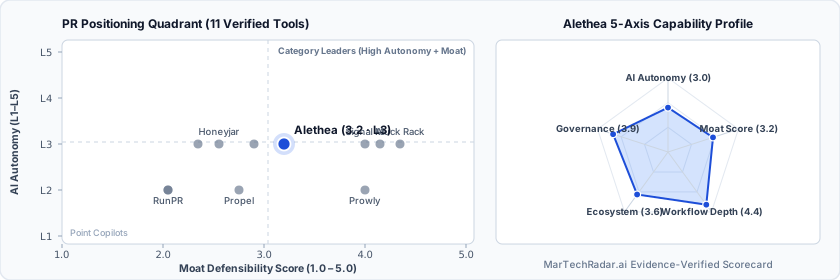
Alethea in-depth review, pricing & architecture analysis
Audited by MarTechRadar Research Desk (Evidence-Ledger Verified) on Oct 26, 2026.
What is Alethea? Overview & background
Alethea (The Alethea Group) is an AI-driven narrative risk intelligence, disinformation detection, and brand crisis protection platform built for Chief Communications Officers, VP of Corporate Affairs leaders, brand safety directors, and Fortune 500 security teams. Founded in 2019 by Lisa Kaplan and headquartered in Washington, District of Columbia, the company operates with 11 to 50 employees and has raised $30M across two funding rounds through Series B backed by Ballistic Ventures, Google Ventures, The Perkins Fund, and Hakluyt Capital. Unlike conventional social listening tools that simply count keyword mentions, Alethea detects coordinated manipulation campaigns, synthetic media attacks, and executive impersonation before they escalate into financial or reputational crises, addressing enterprise demand for AI PR crisis communications software, narrative risk intelligence platform, brand disinformation detection tool, and Blackbird.AI alternatives.
How Alethea works: architecture & workflow
At the technical core of Alethea is Artemis, a machine learning and graph-analytics detection architecture that continuously ingests and correlates public discourse across mainstream social networks, fringe forums, alternative messaging channels, and web domains. Rather than treating every post as an isolated data point, the Artemis model and anomaly-detection algorithm analyze behavioral metadata, posting cadence patterns, cross-platform link-sharing graphs, and synthetic LLM generation signatures to separate organic customer criticism from coordinated botnet or state-sponsored influence operations. Complementing Artemis, Alethea deploys an autonomous Agentic Takedown Agent workflow that compiles platform-specific policy violation evidence and automates the reporting and removal of fraudulent brand impersonations and phishing domains via official API and trust-and-safety integration channels.
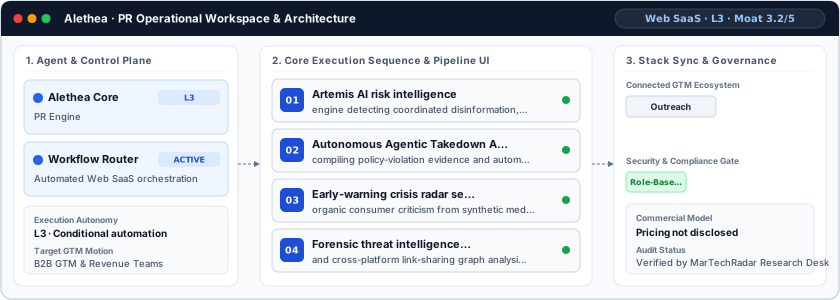
Alethea limitations, drawbacks & risks
Operational considerations and platform boundaries include:
- Primary Operational Trade-Off: In practical enterprise deployments, the primary trade-off is that Alethea is purpose-built for adversarial narrative detection, disinformation forensics, and brand crisis mitigation rather than routine PR media outreach, meaning communications teams still require a separate journalist database for press release distribution.
- Functional Scope Boundary: Alethea is not designed for routine social media post scheduling, influencer affiliate link tracking, or B2C e-commerce customer support ticketing.
- Deployment & Governance Considerations: Additionally, interpreting early-warning threat telemetry from fringe forums and coordinating rapid takedown or crisis response playbooks requires close alignment between corporate communications, legal counsel, and information security stakeholders.
Alethea pricing, plans & cost breakdown
Pricing available on request. Alethea does not disclose public self-serve subscription tiers or rate cards on its website, structuring its commercial contracts as custom annual enterprise licenses scoped via a Request a Demo consultation based on monitored brand entities, executive profiles, geographic threat coverage, and active Artemis and Agentic Takedown Agent modules.
| Plan / Tier | Verified Price & Billing | Target Seat / Scale Fit | Included Scope & Contract Terms |
|---|---|---|---|
| Enterprise / Custom | Custom quote | 15–50+ seats (Enterprise SLA) | Sales-negotiated annual contract for custom volume, SSO/RBAC governance, and dedicated SLA. |
| Contract Watchout: Primary Operational Trade-Off | In practical enterprise deployments, the primary trade-off is that Alethea is purpose-built for adversarial narrative detection, disinformation forensics, and brand crisis mitigation rather than routine PR media outreach, meaning communications teams still require a separate journalist database for press release distribution. | ||
How Alethea compares vs. competitors & alternatives
In the AI crisis communications, media monitoring, and narrative risk intelligence market, Alethea competes with Blackbird.AI, Meltwater, Brandwatch, and PeakMetrics within the Brand PR & Crisis Comms segment, alongside verified subtrack peers such as Muck Rack and Prowly. Compared to traditional PR clipping services vs. generic social sentiment trackers that cannot distinguish synthetic botnet swarms from authentic consumer backlash, Alethea differentiates itself through forensic graph analysis and automated Agentic Takedown remediation. High-profile enterprises, financial institutions, and public-sector organizations should evaluate Alethea to neutralize narrative threats before they impact corporate reputation.
Frequently asked questions about Alethea
Does Alethea publish pricing or require an enterprise quote?
Alethea pricing: Pricing not disclosed. No free plan is publicly disclosed. Pricing available on request.
What are the top Alethea alternatives in PR?
Verified PR alternatives include PeakMetrics (Pricing not disclosed), Blackbird.AI (Custom / enterprise pricing), Onclusive (Pricing not disclosed), PRophet (Custom / enterprise pricing). In the AI crisis communications, media monitoring, and narrative risk intelligence market, Alethea competes with Blackbird.AI, Meltwater, Brandwatch, and PeakMetrics within the Brand PR & Crisis Comms segment, alongside verified subtrack peers such as Muck Rack and Prowly.
Verified sources & evidence trail
- Official product domain: https://alethea.com
- Commercial pricing verification: Verified against official vendor pricing policy (Pricing not disclosed)
- Verified corporate entity profiles (
sameAs): LinkedIn Company Profile · Crunchbase Entity Record - Editorial audit sign-off: Audited by MarTechRadar Research Desk (Evidence-Ledger Verified) on Oct 26, 2026.
