Rox vs YaVendio
Reviewed by MarTechRadar Research Desk. Pricing & entity snapshots verified Oct 12, 2026.
Rox (Web SaaS) and YaVendio (Web SaaS) both compete in Autonomous B2B Sales Agents & AI BDRs. On pricing, Rox lists $100–$255/mo (no free plan disclosed), whereas YaVendio lists $39–$291/mo (no free plan disclosed). Technically, Rox is rated L3 · Conditional automation with a 4.1/5.0 (Proprietary moat) moat, while YaVendio is rated L3 · Conditional automation with a 3.2/5.0 (Workflow-embedded (strong)) moat. Corporate profile: Rox (founded 2024, HQ San Francisco, California, $50M funding) vs. YaVendio (founded 2024, HQ São Paulo, SP, $1.1M funding). Verified by the MarTechRadar Research Desk (Oct 10, 2026 for Rox; Oct 12, 2026 for YaVendio). At a 5-seat team baseline, Rox starts at ~$100/mo (base) vs YaVendio at ~$39/mo (base).
Rox
Autonomous revenue agents designed for the Global 2000 and growth-stage sales teams to automate pipeline discovery, account research, and multi-channel.
5-User Team Cost: ~$100/mo (base) ($100–$255/mo) · Autonomy: L3 · Conditional automation · Moat: 4.1/5.0 (Proprietary moat)
Target fit: B2B Sales Leaders, SDR/BDR Teams, Revenue Operations (RevOps) (Web SaaS)
YaVendio
Autonomous conversational commerce and sales agent automating catalog-driven transactions across WhatsApp, Instagram, and web storefronts.
5-User Team Cost: ~$39/mo (base) ($39–$291/mo) · Autonomy: L3 · Conditional automation · Moat: 3.2/5.0 (Workflow-embedded (strong))
Target fit: B2B Sales Leaders, SDR/BDR Teams, Revenue Operations (RevOps) (Web SaaS)
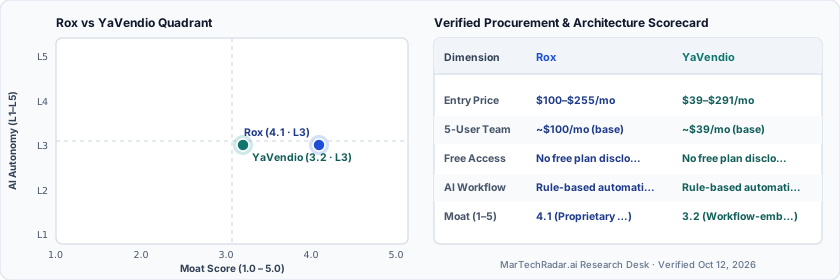
How Rox and YaVendio differ
- Entry price: YaVendio starts lower ($39–$291/mo) than Rox ($100–$255/mo).
- Moat tier: Rox is rated Proprietary moat, YaVendio Workflow-embedded (strong).
- Headquarters: Rox in San Francisco, California, YaVendio in São Paulo, SP.
- Verified backing: Rox records $50M (General Catalyst, Sequoia Capital, South Park Commons); YaVendio records $1.1M (Magma Partners, Semilla Ventures, iThink VC).
- Company headcount: Rox is 51-200 employees; YaVendio is 11-50 employees.
Computed from the fields below. Only editor-verified ratings and vendor-sourced prices are compared.
When to choose Rox vs YaVendio (and when to walk away)
Choose Rox if
- Target ICP & Stack Fit: You operate as B2B Sales Leaders, SDR/BDR Teams and Revenue Operations (RevOps) requiring a Web SaaS deployment for AI SDR, with verified ecosystem connectivity for Salesforce, HubSpot, Slack.
- L3 Architecture & Defensibility: Proprietary multi-agent orchestration architecture coupled with fine-grained account signal graphs and $50M in venture capitalization backing enterprise-grade compliance layers.
- Commercial Model Fit: Your procurement budget aligns with $100–$255/mo.
Walk away from Rox if
- Walk away if your workflow requires uncapped enterprise volume on the $100–$255/mo entry plan without upgrading tiers.
- Walk away if your workflow cannot tolerate domain warming and reputation overhead: High-volume autonomous outbound generation introduces severe domain reputation hazards, requiring teams to continuously maintain external secondary domains, DNS records, and warming schedules.
- Walk away if CRM schema drift is a deal-breaker for your team: Unannounced field modifications or validation rule adjustments within connected Salesforce or HubSpot instances can disrupt agent write-back routines, causing silent queue failures.
Choose YaVendio if
- Target ICP & Stack Fit: You operate as B2B Sales Leaders, SDR/BDR Teams and Revenue Operations (RevOps) requiring a Web SaaS deployment for AI SDR.
- L3 Architecture & Defensibility: Defensibility centers on localized conversational sales flows tailored for Latin American e-commerce platforms, integrating native WhatsApp workflows with product catalogs.
- Commercial Model Fit: Your procurement budget aligns with $39–$291/mo.
Walk away from YaVendio if
- Walk away if your workflow requires uncapped enterprise volume on the $39–$291/mo entry plan without upgrading tiers.
- Walk away if your workflow cannot tolerate catalog synchronization latency: Dynamic inventory changes in external e-commerce backends require tight webhook synchronization; delays risk recommending stock that is unavailable during high-frequency promotional bursts.
- Walk away if messaging provider rate boundaries is a deal-breaker for your team: Throughput remains bound to WhatsApp Business Cloud API limits and Meta messaging policy tiers, creating conversational delivery bottlenecks during unthrottled viral spikes.
Side-by-side facts
| Field | Rox | YaVendio |
|---|---|---|
| Subtrack | Autonomous B2B Sales Agents & AI BDRs | Autonomous B2B Sales Agents & AI BDRs |
| Pricing | $100–$255/mo | $39–$291/mo |
| Pricing model | Subscription | Subscription |
| Published pricing tiers | — | Starter ($39/mo) · Pro ($99/mo) · Business ($291/mo) |
| Free access | No free plan disclosed | No free plan disclosed |
| Enterprise plan | Not recorded | Not recorded |
| AI autonomy level | L3 · Conditional automation | L3 · Conditional automation |
| Moat tier & score | 4.1 / 5.0 · Proprietary moat | 3.2 / 5.0 · Workflow-embedded (strong) |
| Delivery | Web SaaS | Web SaaS |
| Audience | B2B Sales Leaders, SDR/BDR Teams, Revenue Operations (RevOps) | B2B Sales Leaders, SDR/BDR Teams, Revenue Operations (RevOps) |
| Ecosystem integrations | Salesforce, HubSpot, Slack | — |
| Compliance & governance | GDPR | — |
| Funding & backing | $50M · Backed by General Catalyst, Sequoia Capital, South Park Commons | $1.1M · Backed by Magma Partners, Semilla Ventures, iThink VC |
| Founders | Avanika Narayan, Chris R., Diogo Ribeiro, Ishan Mukherjee | David Tafur, Sebastian Gonzalez, Terry Cruz Melo, Yashac Palacios |
| Company size | 51-200 employees | 11-50 employees |
| Founded | 2024 | 2024 |
| Headquarters | San Francisco, California | São Paulo, SP |
| Fact-checked | MarTechRadar Research Desk, Oct 10, 2026 | MarTechRadar Research Desk, Oct 12, 2026 |
| Governance & docs | Trust & Security ↗ · System Status ↗ · API & Docs ↗ · Privacy ↗ | System Status ↗ · Changelog ↗ · Terms ↗ · Privacy ↗ |
Rox vs YaVendio: TCO & constraint stress test
Test how both tools behave under your team size, monthly budget ceiling, CRM ecosystem, and governance guardrails.
Rox
Low Procurement Risk · Strong Fit- Published Self-Serve Entry Floor: Rox publishes a transparent entry point ($100–$255/mo) for initial validation before committing.
- Primary Operational Bottleneck: Domain Warming and Reputation Overhead: High-volume autonomous outbound generation introduces severe domain reputation hazards, requiring teams to continuously maintain external secondary domains, DNS records, and warming schedules.
Walk-Away Rule: Walk away if your workflow requires uncapped enterprise volume on the $100–$255/mo entry plan without upgrading tiers.
Negotiation Lever: Validate exact quota thresholds (seats, credits, or API calls) included in Rox's $100–$255/mo tier before converting from monthly to annual billing.
YaVendio
Low Procurement Risk · Strong Fit- Published Self-Serve Entry Floor: YaVendio publishes a transparent entry point ($39–$291/mo) for initial validation before committing.
- Tier Fit for 5-Seat Scale: Pro ($99/mo): US$ 495 billed every 6 months
- Primary Operational Bottleneck: Catalog Synchronization Latency: Dynamic inventory changes in external e-commerce backends require tight webhook synchronization; delays risk recommending stock that is unavailable during high-frequency promotional bursts.
Walk-Away Rule: Walk away if your workflow requires uncapped enterprise volume on the $39–$291/mo entry plan without upgrading tiers.
Negotiation Lever: Validate exact quota thresholds (seats, credits, or API calls) included in YaVendio's $39–$291/mo tier before converting from monthly to annual billing.
Limitations
Rox
Operational considerations and platform boundaries include: Domain Warming and Reputation Overhead: High-volume autonomous outbound generation introduces severe domain reputation hazards, requiring teams to continuously maintain external secondary domains, DNS records, and warming schedules.Full limitations in the Rox review
YaVendio
Operational considerations and platform boundaries include: Catalog Synchronization Latency: Dynamic inventory changes in external e-commerce backends require tight webhook synchronization; delays risk recommending stock that is unavailable during high-frequency promotional bursts.Full limitations in the YaVendio review
Official vendor architectural differentiators & migration proof
To help buyers evaluate real-world switching costs, verified founders, solutions architects, and PMMs at both Rox and YaVendio can submit up to 3 evidence-backed architectural differentiators or verified customer migration case studies.
Why teams choose Rox over YaVendio
Work at Rox? Verify your official domain email to publish 3 technical differentiators, migration benchmarks, or a head-to-head buyer sandbox offer on this comparison page:
+ Submit Rox Official Differentiators & Case Study →Why teams choose YaVendio over Rox
Work at YaVendio? Verify your official domain email to publish 3 technical differentiators, migration benchmarks, or a head-to-head buyer sandbox offer on this comparison page:
+ Submit YaVendio Official Differentiators & Case Study →Pricing notes & tier schedules
Rox: $100–$255/mo
Commercial access to Rox follows a tier-based software subscription model tied directly to monthly agent operational quotas. Entry-level deployment for individual sales professionals starts at $100 per month, granting access to core research tools and up to 10,000 monthly actions.
- Profile / Workspace Quota Ceilings: Base tiers cap the number of connected profiles, workspaces, or contact records, forcing tier upgrades before seat limits are reached.
- Enterprise Governance & Add-On Gating: Advanced capabilities such as Single Sign-On (SSO), custom role permissions, or specialized analytics modules are gated behind upper tiers or paid add-ons.
YaVendio: $39–$291/mo
The commercial structure scales via tiered subscription bands tied to conversational volume and feature limits. Public pricing starts at $4.99 per month for the entry Light tier, which provides up to 150 monthly conversations.
- Starter ($39/mo, 1–2 seats): US$ 195 billed every 6 months
- Pro ($99/mo, 5 seats): US$ 495 billed every 6 months
- Business ($291/mo, 15 seats): From US$ 1,745 billed every 6 months
- Annual Billing Headline vs. Monthly Premium: Headline entry rates reflect annual billing commitments (Save 6%); month-to-month flexibility carries a higher effective monthly rate or requires annual prepayment.
- Credit & Usage Burn Multiplier: Workflows on YaVendio consume metered credits or usage quotas; high-volume AI generation, batch queries, or recurring automation runs can exhaust base allocations and trigger mid-cycle top-up packs.
Frequently asked questions: Rox vs YaVendio
How does Rox pricing compare to YaVendio in 2026?
Rox is listed at $100–$255/mo (subscription, no free plan disclosed), whereas YaVendio is listed at $39–$291/mo (subscription, no free plan disclosed).
How do Rox and YaVendio compare on AI autonomy and moat depth?
On the MarTechRadar L1–L5 scale, Rox is rated L3 · Conditional automation with a Proprietary moat moat (4.1/5.0), while YaVendio is rated L3 · Conditional automation with a Workflow-embedded (strong) moat (3.2/5.0).
Which teams are Rox and YaVendio built for?
Rox is a Web SaaS product in Autonomous B2B Sales Agents & AI BDRs designed for B2B Sales Leaders, SDR/BDR Teams, Revenue Operations (RevOps). YaVendio is a Web SaaS product in Autonomous B2B Sales Agents & AI BDRs designed for B2B Sales Leaders, SDR/BDR Teams, Revenue Operations (RevOps).
What are the main limitations of Rox vs YaVendio?
For Rox: Operational considerations and platform boundaries include: Domain Warming and Reputation Overhead: High-volume autonomous outbound generation introduces severe domain reputation hazards, requiring teams to continuously maintain external secondary domains, DNS records, and warming schedules. For YaVendio: Operational considerations and platform boundaries include: Catalog Synchronization Latency: Dynamic inventory changes in external e-commerce backends require tight webhook synchronization; delays risk recommending stock that is unavailable during high-frequency promotional bursts.
What are the hidden TCO drivers and contract negotiation levers for Rox vs YaVendio?
For Rox: Profile / Workspace Quota Ceilings (Base tiers cap the number of connected profiles, workspaces, or contact records, forcing tier upgrades before seat limits are reached.) Negotiation lever: Validate exact quota thresholds (seats, credits, or API calls) included in Rox's $100–$255/mo tier before converting from monthly to annual billing. For YaVendio: Annual Billing Headline vs. Monthly Premium (Headline entry rates reflect annual billing commitments (Save 6%); month-to-month flexibility carries a higher effective monthly rate or requires annual prepayment.) Negotiation lever: Validate exact quota thresholds (seats, credits, or API calls) included in YaVendio's $39–$291/mo tier before converting from monthly to annual billing.
Excerpts are quoted verbatim from each fact-checked review. Last updated Oct 12, 2026.