WPP Open Review (2026): Enterprise AI Marketing Pricing, Pros & Cons
Bottom line
WPP Open is a Web SaaS tool for Enterprise AI Marketing (Enterprise Marketing OS & Ecosystem Agents) in Agent & Marketing Ops. Pricing: Custom / enterprise pricing. Best suited to DTC / eCommerce and Enterprise Brands. Editor ratings: AI autonomy L3 (conditional automation); moat score 1.8/5.0 (Thin wrapper). Fact-checked by MarTechRadar Research Desk on Oct 15, 2026.
Agentic enterprise marketing operating system coordinating autonomous multi-agent workflows, brand governance, and end-to-end content production.
Is WPP Open worth it in 2026? Buyer fit & when to walk away
Choose WPP Open if (Best Fit)
- Target ICP & Stack Fit: You operate as DTC / eCommerce and Enterprise Brands requiring a Web SaaS deployment for Enterprise AI Marketing, with verified ecosystem connectivity for Salesforce, HubSpot.
- L3 Architecture & Defensibility: Proprietary agent hub combining WPP agency IP, brand intelligence graphs, multi-model generative pipelines, and deep agency operational workflows that are difficult for standalone software platforms to replicate.
- Commercial Model Fit: Your procurement budget aligns with Custom / enterprise pricing.
Walk away from WPP Open if (Deal-Breakers)
- Walk away if you need published self-serve pricing: WPP Open is sold by custom quote.
- Walk away if your workflow cannot tolerate cross-system integration overhead: Ingesting heterogeneous brand taxonomies and legacy digital asset management metadata across diverse corporate subsidiaries introduces substantial synchronization latency and manual pipeline maintenance.
- Walk away if multi-agent error cascades is a deal-breaker for your team: Sequential agentic handoffs between strategy, copywriting, and visual asset generation run the risk of compounding drift if intermediate outputs miss strict semantic guardrails.
WPP Open pricing, free plan & scorecard at a glance
| Pricing | Custom / enterprise pricing |
|---|---|
| Free plan | No / not disclosed |
| Delivery | Web SaaS |
| Audience | DTC / eCommerce, Enterprise Brands |
| AI autonomy level | L3 · Conditional automationEditor-verified |
| Moat tier & score | 1.8 / 5.0 · Thin wrapperEditor-verified |
| Funding | Venture-backed |
| Ecosystem integrations | Salesforce, HubSpot |
| Governance & docs | Privacy ↗ |
| Headquarters | United States |
| Last verified | Oct 15, 2026 |
WPP Open pros & cons: strengths vs. operational limitations
Pros: core strengths & capabilities
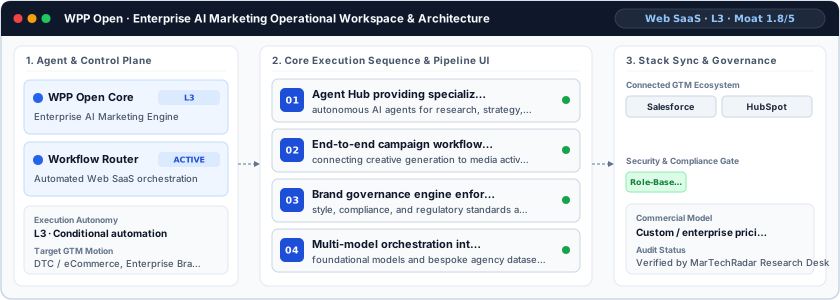
- Agent Hub providing specialized: autonomous AI agents for research, strategy, and execution
- End-to-end campaign workflow automation: connecting creative generation to media activation
- Brand governance engine enforcing: style, compliance, and regulatory standards across outputs
- Multi-model orchestration integrating third-party: foundational models and bespoke agency datasets
Cons: operational limitations & risks
- Cross-System Integration Overhead: Ingesting heterogeneous brand taxonomies and legacy digital asset management metadata across diverse corporate subsidiaries introduces substantial synchronization latency and manual pipeline maintenance.
- Multi-Agent Error Cascades: Sequential agentic handoffs between strategy, copywriting, and visual asset generation run the risk of compounding drift if intermediate outputs miss strict semantic guardrails.
- Agency Ecosystem Coupling: Architectural workflows and process designs remain heavily anchored around WPP partner networks and agency service workflows, constraining enterprises seeking fully vendor-neutral or self-hosted deployments.
WPP Open TCO & deal-breaker stress test
Simulate 12-month stepped TCO, hidden cost multipliers, contract lock-in exposure, and stack failure modes using only facts verified by MarTechRadar Research Desk on 2026-10-15.
WPP Open triggers high-severity friction under your 5-seat / $800/mo constraints. Benchmark the verified subtrack alternatives below before committing.
- Moat Score
- 1.8 / 5.0
- AI Autonomy
- L3
- Free Tier / Trial
- None disclosed
Triggered audit signals & failure modes
- Opaque Enterprise Quoting vs. SMB/Mid-Market BudgetVerified Pricing Ledger
WPP Open does not disclose a public self-serve floor (Custom / enterprise pricing). Buyers with a $800/mo cap face high sales-qualification friction.
- Sales-Gated Contract TermsFact-checked by MarTechRadar Research Desk
Pricing is available on request through tailored enterprise sales quotes, with custom enterprise tiers structured around organizational scale, user seats, and workflow volume.
- Primary Operational Bottleneck: Cross-System Integration OverheadAudit by MarTechRadar Research Desk
Ingesting heterogeneous brand taxonomies and legacy digital asset management metadata across diverse corporate subsidiaries introduces substantial synchronization latency and manual pipeline maintenance.
Test a custom WPP Open budget or stack constraint
Offers a free tier (Custom / enterprise pricing) · Transparent self-serve entry without mandatory annual lock-in
WPP Open integrations, API, security & compliance stack
WPP Open AI moat & Enterprise AI Marketing positioning
Proprietary agent hub combining WPP agency IP, brand intelligence graphs, multi-model generative pipelines, and deep agency operational workflows that are difficult for standalone software platforms to replicate.
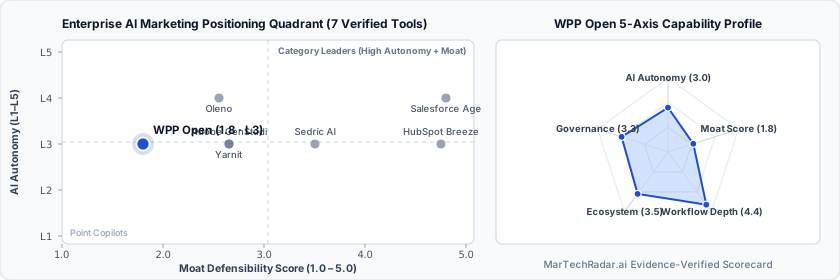
WPP Open in-depth review, pricing & architecture analysis
Editor sign-off: Oct 15, 2026. How profiles are made.
What is WPP Open? Overview & background
Within fragmented holding-company architectures and global enterprise operations, decentralized creative production creates high coordination drag. Operating from the United States as the technology backbone of WPP, WPP Open functions as an enterprise marketing operating system tailored for chief marketing officers, global brand directors, and procurement leaders. By organizing agency domain knowledge and generative intelligence into an integrated operating environment, the platform coordinates multi-tier brand operations across distributed regional teams.
How WPP Open works: architecture & workflow
At its architectural core, the system executes an agentic orchestration layer designed for Level 3 operational autonomy. The platform ingests enterprise brand guidelines, historical campaign assets, and performance telemetry into a centralized brand memory graph. Through its specialized Agent Hub, autonomous agents parse briefs, coordinate creative ideation, execute asset generation, and apply deterministic compliance checks prior to final human sign-off. Workflows link foundational language and diffusion models directly to downstream media planning and enterprise digital asset management systems.
WPP Open limitations, drawbacks & risks
Operational considerations and platform boundaries include:
- Cross-System Integration Overhead: Ingesting heterogeneous brand taxonomies and legacy digital asset management metadata across diverse corporate subsidiaries introduces substantial synchronization latency and manual pipeline maintenance.
- Multi-Agent Error Cascades: Sequential agentic handoffs between strategy, copywriting, and visual asset generation run the risk of compounding drift if intermediate outputs miss strict semantic guardrails.
- Agency Ecosystem Coupling: Architectural workflows and process designs remain heavily anchored around WPP partner networks and agency service workflows, constraining enterprises seeking fully vendor-neutral or self-hosted deployments.
WPP Open pricing, plans & cost breakdown
Pricing is available on request through tailored enterprise sales quotes, with custom enterprise tiers structured around organizational scale, user seats, and workflow volume.
| Plan / Tier | Verified Price & Billing | Included Scope & Contract Terms |
|---|---|---|
| Enterprise / Custom | Custom quote | Custom-quoted plan; terms come from the vendor's sales team. |
How WPP Open compares vs. competitors & alternatives
WPP Open competes in the enterprise marketing operating system track against platforms like Salesforce Agentforce, Adobe GenStudio, and HubSpot Breeze. While Salesforce Agentforce emphasizes CRM-driven operational routing and Adobe GenStudio focuses on creative asset authoring pipelines, WPP Open prioritizes agency-grade creative strategy combined with automated marketing workflows. It serves large multinational enterprises running multi-brand portfolios that require centralized brand governance combined with agency-orchestrated delivery.
Frequently asked questions about WPP Open
Does WPP Open publish pricing or require an enterprise quote?
WPP Open pricing: Custom / enterprise pricing. No free plan is publicly disclosed. Pricing is available on request through tailored enterprise sales quotes, with custom enterprise tiers structured around organizational scale, user seats, and workflow volume.
What are the top WPP Open alternatives in Enterprise AI Marketing?
Verified Enterprise AI Marketing alternatives include Salesforce Agentforce (Custom / enterprise pricing), HubSpot Breeze (Custom / enterprise pricing), Adobe GenStudio (Custom / enterprise pricing), Workato (Free plan · $100/mo · Enterprise plan). WPP Open competes in the enterprise marketing operating system track against platforms like Salesforce Agentforce, Adobe GenStudio, and HubSpot Breeze.
What are the main limitations and trade-offs of WPP Open?
Operational considerations and platform boundaries include: Cross-System Integration Overhead: Ingesting heterogeneous brand taxonomies and legacy digital asset management metadata across diverse corporate subsidiaries introduces substantial synchronization latency and manual pipeline maintenance. Walk away if you need published self-serve pricing: WPP Open is sold by custom quote.
Verified sources & evidence trail
- Official product domain: https://wpp.com/open
- Commercial pricing verification: Verified against official vendor pricing policy (Custom / enterprise pricing)
- First-party governance & documentation links: Privacy
- Editor sign-off: Oct 15, 2026 (how profiles are made).
