Wordware Review (2026): AI Marketing Agent Pricing, Pros & Cons
Bottom line
Wordware is a Web SaaS tool for AI Marketing Agent (Autonomous Marketing Agents & Digital Coworkers) in Agent & Marketing Ops. Pricing: Custom / enterprise pricing. Best suited to B2B SaaS. Editor ratings: AI autonomy L3 (conditional automation); moat score 1.8/5.0 (Thin wrapper). Fact-checked by MarTechRadar Research Desk on Oct 15, 2026.
Agentic IDE and workflow engine enabling growth and marketing operations teams to design, iterate, and deploy compound AI agents.
Is Wordware worth it in 2026? Buyer fit & when to walk away
Choose Wordware if (Best Fit)
- Target ICP & Stack Fit: You operate as B2B SaaS requiring a Web SaaS deployment for AI Marketing Agent.
- L3 Architecture & Defensibility: Wordware differentiates through a hybrid markdown-like integrated development environment that bridges the gap between software engineers and non-technical domain operators, speeding up multi-agent iteration cycles without hardcoding backend infrastructure.
- Commercial Model Fit: Your procurement budget aligns with Custom / enterprise pricing.
Walk away from Wordware if (Deal-Breakers)
- Walk away if you need published self-serve pricing: Wordware is sold by custom quote.
- Walk away if your workflow cannot tolerate upstream API rate limiting: Compound agent workflows triggering multiple concurrent LLM calls frequently encounter token-per-minute throttles during high-volume batch executions.
- Walk away if schema drift vulnerability is a deal-breaker for your team: Agent steps relying on dynamic third-party web endpoints suffer runtime exceptions whenever external data formats or response structures shift without notice.
Wordware pricing, free plan & scorecard at a glance
| Pricing | Custom / enterprise pricing |
|---|---|
| Free plan | No / not disclosed |
| Delivery | Web SaaS |
| Audience | B2B SaaS |
| AI autonomy level | L3 · Conditional automationEditor-verified |
| Moat tier & score | 1.8 / 5.0 · Thin wrapperEditor-verified |
| Funding | Seed |
| Headquarters | United States |
| Last verified | Oct 15, 2026 |
Wordware pros & cons: strengths vs. operational limitations
Pros: core strengths & capabilities
- Collaborative IDE: combining natural language prompting with deterministic logic branches
- Multi-model routing supporting frontier LLMs: for multi-step reasoning tasks
- Deterministic API tool integration and webhook triggers for automated data ingestion
- Native observability and tracing suite: for debugging agentic execution chains
Cons: operational limitations & risks
- Upstream API Rate Limiting: Compound agent workflows triggering multiple concurrent LLM calls frequently encounter token-per-minute throttles during high-volume batch executions.
- Schema Drift Vulnerability: Agent steps relying on dynamic third-party web endpoints suffer runtime exceptions whenever external data formats or response structures shift without notice.
- Evaluation Trace Overhead: Maintaining comprehensive tracing and validation across non-deterministic multi-agent chains introduces measurable compute latency into real-time campaign pipelines.
Wordware TCO & deal-breaker stress test
Simulate 12-month stepped TCO, hidden cost multipliers, contract lock-in exposure, and stack failure modes using only facts verified by MarTechRadar Research Desk on 2026-10-15.
Wordware triggers high-severity friction under your 5-seat / $800/mo constraints. Benchmark the verified subtrack alternatives below before committing.
- Moat Score
- 1.8 / 5.0
- AI Autonomy
- L3
- Free Tier / Trial
- None disclosed
Triggered audit signals & failure modes
- Opaque Enterprise Quoting vs. SMB/Mid-Market BudgetVerified Pricing Ledger
Wordware does not disclose a public self-serve floor (Custom / enterprise pricing). Buyers with a $800/mo cap face high sales-qualification friction.
- Sales-Gated Contract TermsFact-checked by MarTechRadar Research Desk
Pricing is available on request through tailored enterprise sales quotes, with custom enterprise tiers structured around organizational scale, user seats, and workflow volume.
- Usage / Credit Burn VolatilityCommercial Model Audit
Wordware uses credit or usage-metered billing (Custom / enterprise pricing). High-volume automated workflows across 5 seats can trigger mid-cycle overage charges.
- Primary Operational Bottleneck: Upstream API Rate LimitingAudit by MarTechRadar Research Desk
Compound agent workflows triggering multiple concurrent LLM calls frequently encounter token-per-minute throttles during high-volume batch executions.
Test a custom Wordware budget or stack constraint
Lower 5-seat floor (~$100/mo vs. Custom Quote) · Transparent self-serve entry without mandatory annual lock-in
Wordware AI moat & AI Marketing Agent positioning
Wordware differentiates through a hybrid markdown-like integrated development environment that bridges the gap between software engineers and non-technical domain operators, speeding up multi-agent iteration cycles without hardcoding backend infrastructure.
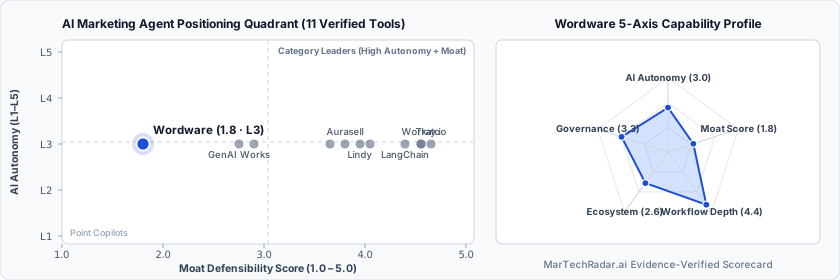
Wordware in-depth review, pricing & architecture analysis
Editor sign-off: Oct 15, 2026. How profiles are made.
What is Wordware? Overview & background
Architectured as an agentic operating layer, United States-based Wordware provides a collaborative programming and execution environment designed to build compound AI workflows. Instead of locking teams into fixed functional silos, the platform equips growth engineers, digital marketing leads, and operations architects with an interface that unifies prompt engineering, API orchestration, and logic branching. Operating within the autonomous marketing agent ecosystem, the system converts complex multi-step campaign tasks into structured programmatic procedures.
How Wordware works: architecture & workflow
Wordware operates as a human-directed autonomous system where natural language instructions execute alongside deterministic code. The runtime ingests third-party telemetry, CRM records, and scraping feeds via webhooks and REST endpoints. An orchestration pipeline decomposes high-level marketing prompts into modular subtasks, leveraging frontier language models to dynamically parse unstructured context, synthesize tailored copy, or extract target variables. Tool calling mechanisms invoke downstream execution endpoints, returning validated payloads back into corporate data layers through structured JSON schemas.
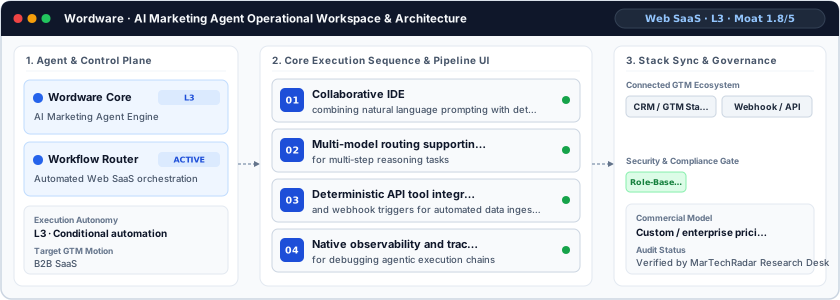
Wordware limitations, drawbacks & risks
Operational considerations and platform boundaries include:
- Upstream API Rate Limiting: Compound agent workflows triggering multiple concurrent LLM calls frequently encounter token-per-minute throttles during high-volume batch executions.
- Schema Drift Vulnerability: Agent steps relying on dynamic third-party web endpoints suffer runtime exceptions whenever external data formats or response structures shift without notice.
- Evaluation Trace Overhead: Maintaining comprehensive tracing and validation across non-deterministic multi-agent chains introduces measurable compute latency into real-time campaign pipelines.
Wordware pricing, plans & cost breakdown
Pricing is available on request through tailored enterprise sales quotes, with custom enterprise tiers structured around organizational scale, user seats, and workflow volume.
| Plan / Tier | Verified Price & Billing | Included Scope & Contract Terms |
|---|---|---|
| Enterprise / Custom | Custom quote | Custom-quoted plan; terms come from the vendor's sales team. |
How Wordware compares vs. competitors & alternatives
Within the autonomous marketing stack, Wordware contrasts with vertical point solutions like ai-marketing-claude, allGood, and AskElephant. While competitors package opinionated, pre-built conversational agents or rigid copy generation loops, Wordware delivers an open workbench optimized for customized multi-agent pipelines and granular logic control. It is best suited for technical growth operations teams requiring modular architecture to engineer domain-specific automations rather than organizations seeking plug-and-play marketing automation templates.
Frequently asked questions about Wordware
Does Wordware publish pricing or require an enterprise quote?
Wordware pricing: Custom / enterprise pricing. No free plan is publicly disclosed. Pricing is available on request through tailored enterprise sales quotes, with custom enterprise tiers structured around organizational scale, user seats, and workflow volume.
What are the top Wordware alternatives in AI Marketing Agent?
Verified AI Marketing Agent alternatives include Workato (Free plan · $100/mo · Enterprise plan), Drift (Custom / enterprise pricing), LangChain (Custom / enterprise pricing), AskElephant ($99–$119/seat/mo). Within the autonomous marketing stack, Wordware contrasts with vertical point solutions like ai-marketing-claude, allGood, and AskElephant.
What are the main limitations and trade-offs of Wordware?
Operational considerations and platform boundaries include: Upstream API Rate Limiting: Compound agent workflows triggering multiple concurrent LLM calls frequently encounter token-per-minute throttles during high-volume batch executions. Walk away if you need published self-serve pricing: Wordware is sold by custom quote.
Verified sources & evidence trail
- Official product domain: https://wordware.ai
- Commercial pricing verification: Verified against official vendor pricing policy (Custom / enterprise pricing)
- Editor sign-off: Oct 15, 2026 (how profiles are made).
