Trapica Review (2026): AI PPC Pricing, Pros & Cons
Bottom line
Trapica is a Web SaaS tool for AI PPC (Autonomous Bidding & Budget Management) in AdTech & Paid Media. Pricing: Custom / enterprise pricing. Best suited to DTC / eCommerce and Enterprise Brands. Editor ratings: AI autonomy L3 (conditional automation); moat score 3.3/5.0 (Workflow-embedded (strong)). Fact-checked by MarTechRadar Research Desk on Oct 14, 2026.
Autonomous cross-channel advertising optimization platform that automates bidding, budget pacing, and audience targeting across major social and search ad.
Is Trapica worth it in 2026? Buyer fit & when to walk away
Choose Trapica if (Best Fit)
- Target ICP & Stack Fit: You operate as DTC / eCommerce and Enterprise Brands requiring a Web SaaS deployment for AI PPC, with verified ecosystem connectivity for Twilio Segment, Google Ads, Meta Ads.
- L3 Architecture & Defensibility: Algorithmic cross-platform conversion optimization using continuous closed-loop feedback across social and search APIs, reducing manual intervention in audience discovery and media buying.
- Commercial Model Fit: Your procurement budget aligns with Custom / enterprise pricing.
Walk away from Trapica if (Deal-Breakers)
- Walk away if you need published self-serve pricing: Trapica is sold by custom quote.
- Walk away if your workflow cannot tolerate API rate limits and ad network latency: Autonomous execution cadences are fundamentally bound by external ad network API throughput and reporting delays, sometimes causing temporary misalignment during volatile flash-sale pacing.
- Walk away if algorithmic cold-start dependency is a deal-breaker for your team: The underlying predictive models require significant baseline conversion events per ad set to establish statistical confidence, degrading optimization efficiency on low-volume micro-campaigns.
Trapica pricing, free plan & scorecard at a glance
| Pricing | Custom / enterprise pricing |
|---|---|
| Free plan | No / not disclosed |
| Delivery | Web SaaS |
| Audience | DTC / eCommerce, Enterprise Brands |
| AI autonomy level | L3 · Conditional automationEditor-verified |
| Moat tier & score | 3.3 / 5.0 · Workflow-embedded (strong)Editor-verified |
| Funding | Series A |
| Total funding | $70K |
| Founders | Michael Teitelman, Yoav Melamed |
| Company size | 11-50 employees |
| Ecosystem integrations | Twilio Segment, Google Ads, Meta Ads |
| Headquarters | New York |
| Founded | 2017 |
| Last verified | Oct 14, 2026 |
Trapica pros & cons: strengths vs. operational limitations
Pros: core strengths & capabilities
- Cross-channel programmatic budget re-allocation: across Meta, Google, TikTok, and programmatic networks
- Autonomous algorithmic bidding adjustments: based on target CPA and ROAS thresholds
- Automated dynamic audience discovery and lookalike segmentation refinement
- Anomaly detection and real-time: performance alerting across active digital ad campaigns
Cons: operational limitations & risks
- API Rate Limits and Ad Network Latency: Autonomous execution cadences are fundamentally bound by external ad network API throughput and reporting delays, sometimes causing temporary misalignment during volatile flash-sale pacing.
- Algorithmic Cold-Start Dependency: The underlying predictive models require significant baseline conversion events per ad set to establish statistical confidence, degrading optimization efficiency on low-volume micro-campaigns.
- Attribution Signal Drift: Privacy frameworks and restricted cross-platform tracking introduce signal loss, forcing the bidding engine to rely on modeled proxy metrics rather than deterministic conversion data.
Trapica TCO & deal-breaker stress test
Simulate 12-month stepped TCO, hidden cost multipliers, contract lock-in exposure, and stack failure modes using only facts verified by MarTechRadar Research Desk on 2026-10-14.
Trapica triggers high-severity friction under your 5-seat / $800/mo constraints. Benchmark the verified subtrack alternatives below before committing.
- Moat Score
- 3.3 / 5.0
- AI Autonomy
- L3
- Free Tier / Trial
- None disclosed
Triggered audit signals & failure modes
- Opaque Enterprise Quoting vs. SMB/Mid-Market BudgetVerified Pricing Ledger
Trapica does not disclose a public self-serve floor (Custom / enterprise pricing). Buyers with a $800/mo cap face high sales-qualification friction.
- Sales-Gated Contract TermsFact-checked by MarTechRadar Research Desk
Commercial pricing is available on request through tailored enterprise sales quotes based on organizational scale and seats.
- Primary Operational Bottleneck: API Rate Limits and Ad Network LatencyAudit by MarTechRadar Research Desk
Autonomous execution cadences are fundamentally bound by external ad network API throughput and reporting delays, sometimes causing temporary misalignment during volatile flash-sale pacing.
Test a custom Trapica budget or stack constraint
Lower 5-seat floor (~$500/mo vs. Custom Quote) · Transparent self-serve entry without mandatory annual lock-in
Trapica integrations, API, security & compliance stack
Trapica AI moat & AI PPC positioning
Algorithmic cross-platform conversion optimization using continuous closed-loop feedback across social and search APIs, reducing manual intervention in audience discovery and media buying.
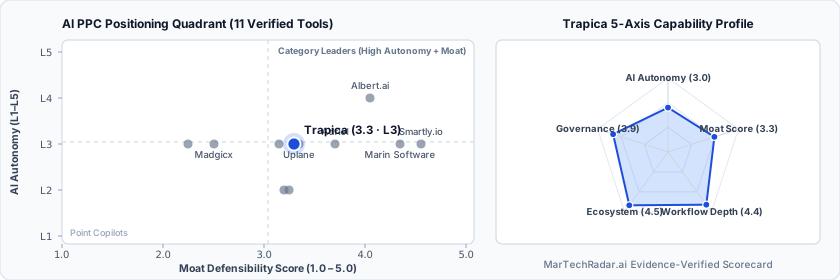
Trapica in-depth review, pricing & architecture analysis
Editor sign-off: Oct 14, 2026. How profiles are made.
What is Trapica? Overview & background
Performance media buyers face operational overhead when manually reallocating spend and calibrating bids across disparate ad networks. Established in 2017 in New York with $70K in recorded capital, Trapica automates paid media workflows for performance marketing directors, digital agencies, and enterprise growth teams. The platform functions as a programmatic media allocation layer that continually reconciles budget distributions across social and search networks to maximize aggregate return on ad spend.
How Trapica works: architecture & workflow
Trapica operates via direct API connectors to platforms including Meta Ads, Google Ads, TikTok, and programmatic exchanges. Its continuous algorithmic pipeline polls campaign telemetry, conversion webhooks, and attribution signals to construct real-time performance curves. When conversion velocity or marginal cost metrics cross defined thresholds, the machine learning engine programmatically executes bid recalibrations, rotates audience target sets, and shifts fluid budget balances without requiring manual intervention from campaign operators.
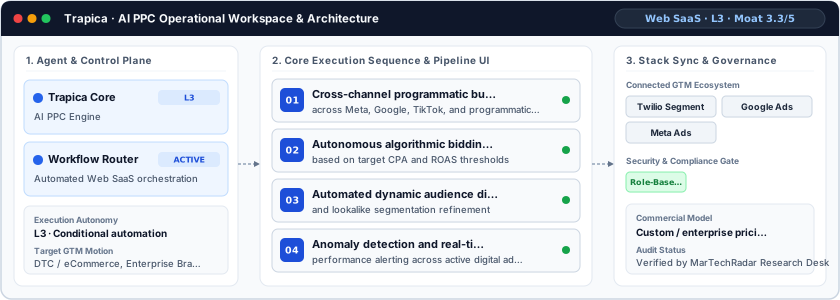
Trapica limitations, drawbacks & risks
Operational considerations and platform boundaries include:
- API Rate Limits and Ad Network Latency: Autonomous execution cadences are fundamentally bound by external ad network API throughput and reporting delays, sometimes causing temporary misalignment during volatile flash-sale pacing.
- Algorithmic Cold-Start Dependency: The underlying predictive models require significant baseline conversion events per ad set to establish statistical confidence, degrading optimization efficiency on low-volume micro-campaigns.
- Attribution Signal Drift: Privacy frameworks and restricted cross-platform tracking introduce signal loss, forcing the bidding engine to rely on modeled proxy metrics rather than deterministic conversion data.
Trapica pricing, plans & cost breakdown
Commercial pricing is available on request through tailored enterprise sales quotes based on organizational scale and seats. Contracts typically tier based on monthly managed advertising volume, aggregate connected ad accounts, and feature access spanning baseline single-channel automation up to full cross-platform intelligence with predictive testing modules.
| Plan / Tier | Verified Price & Billing | Included Scope & Contract Terms |
|---|---|---|
| Enterprise / Custom | Custom quote | Custom-quoted plan; terms come from the vendor's sales team. |
How Trapica compares vs. competitors & alternatives
Within the autonomous bidding sector, Trapica contends with Adriel, Albert.ai, and Smartly.io within the AI PPC segment. While Adriel emphasizes unified dashboard aggregation with manual workflow controls, and Albert.ai offers fully autonomous creative-plus-media execution for enterprise conglomerates, Trapica isolates its mechanics on cross-platform budget and bid shifts. It suits multi-channel performance teams requiring hands-off spend pacing across diverse social channels without outsourcing creative orchestration.
Direct competitors & market radar
Top algorithmic competitors based on category positioning, capability overlap, and ICP alignment.
Frequently asked questions about Trapica
Does Trapica publish pricing or require an enterprise quote?
Trapica pricing: Custom / enterprise pricing. No free plan is publicly disclosed. Commercial pricing is available on request through tailored enterprise sales quotes based on organizational scale and seats.
What are the top Trapica alternatives in AI PPC?
Verified AI PPC alternatives include AdsGency AI (Custom / enterprise pricing), Advolve AI (Custom / enterprise pricing), Optmyzr (Custom / enterprise pricing), Quartile (Custom / enterprise pricing). Within the autonomous bidding sector, Trapica contends with Adriel, Albert.ai, and Smartly.io within the AI PPC segment.
What are the main limitations and trade-offs of Trapica?
Operational considerations and platform boundaries include: API Rate Limits and Ad Network Latency: Autonomous execution cadences are fundamentally bound by external ad network API throughput and reporting delays, sometimes causing temporary misalignment during volatile flash-sale pacing. Walk away if you need published self-serve pricing: Trapica is sold by custom quote.
Verified sources & evidence trail
- Official product domain: https://trapica.com
- Commercial pricing verification: Verified against official vendor pricing policy (Custom / enterprise pricing)
- Verified corporate entity profiles (
sameAs): LinkedIn Company Profile · Crunchbase Entity Record - Editor sign-off: Oct 14, 2026 (how profiles are made).
