StoryKit Review (2026): Social Media Scheduling Pricing, Pros & Cons
Bottom line
StoryKit is a Web SaaS tool for Social Media Scheduling (Social Media Scheduling & Auto-Publishing) in Social & Influencer. Pricing: Custom / enterprise pricing. Best suited to DTC / eCommerce and Enterprise Brands. Editor ratings: AI autonomy L3 (conditional automation); moat score 3.5/5.0 (Proprietary moat). Fact-checked by MarTechRadar Research Desk on Oct 15, 2026.
Enterprise text-to-video automation platform converting corporate editorial copy into branded motion assets through deterministic design systems.
Is StoryKit worth it in 2026? Buyer fit & when to walk away
Choose StoryKit if (Best Fit)
- Target ICP & Stack Fit: You operate as DTC / eCommerce and Enterprise Brands requiring a Web SaaS deployment for Social Media Scheduling.
- L3 Architecture & Defensibility: Defensibility stems from a proprietary text-to-motion layout engine that maps enterprise brand guidelines directly into deterministic rendering templates, reducing corporate compliance friction.
- Commercial Model Fit: Your procurement budget aligns with Custom / enterprise pricing.
Walk away from StoryKit if (Deal-Breakers)
- Walk away if you need published self-serve pricing: StoryKit is sold by custom quote.
- Walk away if your workflow cannot tolerate narrative pacing rigidity: The algorithmic storyboard parser enforces rigid slide-based timing structures, struggling with complex non-linear narrative transitions or subtle audio-visual cues required in cinematic storytelling.
- Walk away if design system inflexibility is a deal-breaker for your team: Creative teams cannot perform micro-adjustments to individual keyframes, motion curves, or canvas coordinates outside of pre-programmed design governance parameters.
StoryKit pricing, free plan & scorecard at a glance
| Pricing | Custom / enterprise pricing |
|---|---|
| Free plan | No / not disclosed |
| Delivery | Web SaaS |
| Audience | DTC / eCommerce, Enterprise Brands |
| AI autonomy level | L3 · Conditional automationEditor-verified |
| Moat tier & score | 3.5 / 5.0 · Proprietary moatEditor-verified |
| Funding | Series A |
| Founders | Fredrik Strömberg, Peder Bonnier |
| Company size | 51-200 employees |
| Headquarters | Stockholm, Stockholm County |
| Founded | 2013 |
| Last verified | Oct 15, 2026 |
StoryKit pros & cons: strengths vs. operational limitations
Pros: core strengths & capabilities
- Core capability: Algorithmic text-to-video storyboard compilation
- Centralized brand governance: with locked design systems and assets
- Automated semantic text parsing: for scene sequencing
- Multi-format social video rendering and cross-channel distribution
Cons: operational limitations & risks
- Narrative pacing rigidity: The algorithmic storyboard parser enforces rigid slide-based timing structures, struggling with complex non-linear narrative transitions or subtle audio-visual cues required in cinematic storytelling.
- Design system inflexibility: Creative teams cannot perform micro-adjustments to individual keyframes, motion curves, or canvas coordinates outside of pre-programmed design governance parameters.
- Video rendering latency: Heavy asset queuing during large-scale batch generation workflows introduces measurable export latency across concurrent high-definition video rendering tasks.
StoryKit TCO & deal-breaker stress test
Simulate 12-month stepped TCO, hidden cost multipliers, contract lock-in exposure, and stack failure modes using only facts verified by MarTechRadar Research Desk on 2026-10-15.
StoryKit triggers high-severity friction under your 5-seat / $800/mo constraints. Benchmark the verified subtrack alternatives below before committing.
- Moat Score
- 3.5 / 5.0
- AI Autonomy
- L3
- Free Tier / Trial
- None disclosed
Triggered audit signals & failure modes
- Opaque Enterprise Quoting vs. SMB/Mid-Market BudgetVerified Pricing Ledger
StoryKit does not disclose a public self-serve floor (Custom / enterprise pricing). Buyers with a $800/mo cap face high sales-qualification friction.
- Sales-Gated Contract TermsFact-checked by MarTechRadar Research Desk
Pricing is available on request through tailored enterprise sales quotes, with custom enterprise tiers based on organizational scale, workspace volume, and user seats.
- Primary Operational Bottleneck: Narrative pacing rigidityAudit by MarTechRadar Research Desk
The algorithmic storyboard parser enforces rigid slide-based timing structures, struggling with complex non-linear narrative transitions or subtle audio-visual cues required in cinematic storytelling.
Test a custom StoryKit budget or stack constraint
Lower 5-seat floor (~$60/mo vs. Custom Quote) · Transparent self-serve entry without mandatory annual lock-in
StoryKit AI moat & Social Media Scheduling positioning
Defensibility stems from a proprietary text-to-motion layout engine that maps enterprise brand guidelines directly into deterministic rendering templates, reducing corporate compliance friction.
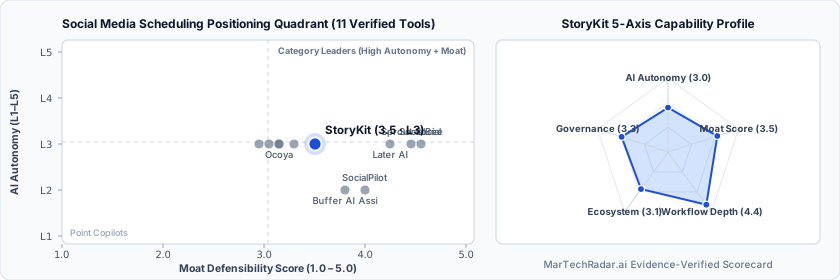
StoryKit in-depth review, pricing & architecture analysis
Editor sign-off: Oct 15, 2026. How profiles are made.
What is StoryKit? Overview & background
For distributed corporate communications units seeking to transform editorial copy into motion assets without agency retainers, StoryKit functions as a dedicated text-to-video generation platform. Established in 2013 and headquartered in Stockholm, Stockholm County, the organization addresses enterprise communications leaders, internal brand managers, and corporate public relations teams. The platform solves the resource bottleneck of creative studios by programmatically transforming white papers, press releases, and articles into standardized video formats that adhere to strict brand frameworks.
How StoryKit works: architecture & workflow
At its operational core, StoryKit deploys a deterministic text-to-video compiler functioning at Level 3 autonomy. Enterprise users ingest raw editorial manuscripts, internal documentation, or press statements into the workspace. The ingestion pipeline segments textual input into semantic scenes, applying natural language parsing to extract core headlines, narrative blocks, and pacing metrics. These extracted text fragments automatically populate pre-configured enterprise storyboard templates. The rendering engine compiles vector typography, locked corporate color profiles, motion graphics, and integrated stock or proprietary media without manual timeline editing, alongside native workflow integrations for HubSpot.
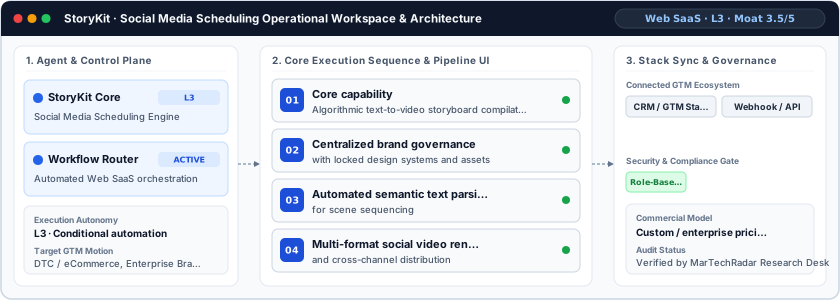
StoryKit limitations, drawbacks & risks
Operational considerations and platform boundaries include:
- Narrative pacing rigidity: The algorithmic storyboard parser enforces rigid slide-based timing structures, struggling with complex non-linear narrative transitions or subtle audio-visual cues required in cinematic storytelling.
- Design system inflexibility: Creative teams cannot perform micro-adjustments to individual keyframes, motion curves, or canvas coordinates outside of pre-programmed design governance parameters.
- Video rendering latency: Heavy asset queuing during large-scale batch generation workflows introduces measurable export latency across concurrent high-definition video rendering tasks.
StoryKit pricing, plans & cost breakdown
Pricing is available on request through tailored enterprise sales quotes, with custom enterprise tiers based on organizational scale, workspace volume, and user seats. Enterprise contracts typically grant customized workspace governance, centralized template configuration, prioritized cloud rendering pipelines, and dedicated brand onboarding services. Potential buyers must contact sales directly to establish contractual agreements, as public self-serve tiers are unavailable.
| Plan / Tier | Verified Price & Billing | Included Scope & Contract Terms |
|---|---|---|
| Enterprise / Custom | Custom quote | Custom-quoted plan; terms come from the vendor's sales team. |
How StoryKit compares vs. competitors & alternatives
Compared to direct category competitors like Sprout Social AI and Agorapulse, StoryKit functions as an alternative focused on reliable workflow execution and transparent unit economics within the Social Media Scheduling segment.
Frequently asked questions about StoryKit
Does StoryKit publish pricing or require an enterprise quote?
StoryKit pricing: Custom / enterprise pricing. No free plan is publicly disclosed. Pricing is available on request through tailored enterprise sales quotes, with custom enterprise tiers based on organizational scale, workspace volume, and user seats.
What are the top StoryKit alternatives in Social Media Scheduling?
Verified Social Media Scheduling alternatives include Topline Pro (Custom / enterprise pricing), Fermat Commerce (Custom / enterprise pricing), Flmlnk (From $60/mo), Dash Hudson (Custom / enterprise pricing). Compared to direct category competitors like Sprout Social AI and Agorapulse, StoryKit functions as an alternative focused on reliable workflow execution and transparent unit economics within the Social Media Scheduling segment.
What are the main limitations and trade-offs of StoryKit?
Operational considerations and platform boundaries include: Narrative pacing rigidity: The algorithmic storyboard parser enforces rigid slide-based timing structures, struggling with complex non-linear narrative transitions or subtle audio-visual cues required in cinematic storytelling. Walk away if you need published self-serve pricing: StoryKit is sold by custom quote.
Verified sources & evidence trail
- Official product domain: https://storykit.io
- Commercial pricing verification: Verified against official vendor pricing policy (Custom / enterprise pricing)
- Verified corporate entity profiles (
sameAs): LinkedIn Company Profile · Crunchbase Entity Record - Editor sign-off: Oct 15, 2026 (how profiles are made).
