Spekit Review (2026): AI Content Marketing Pricing, Limits & Alternatives
Bottom line
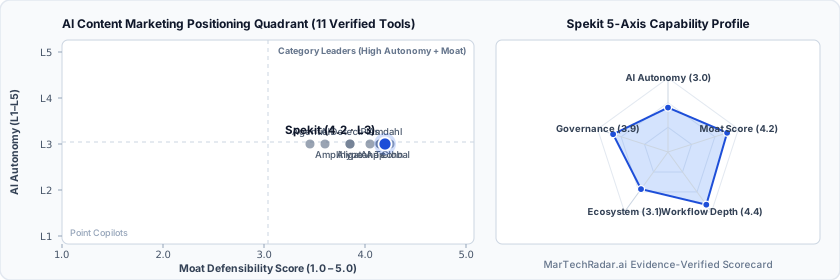
Spekit is a Web SaaS tool for AI Content Marketing (Enterprise & Long-Form Brand Content) in Copy & Content. Pricing: Custom / enterprise pricing. Best suited to Enterprise Content Teams, Brand Marketers and Global Copywriters. Editor ratings: AI autonomy L3 (conditional automation); moat score 4.2/5.0 (Proprietary moat). Fact-checked by Sarah Per on Oct 11, 2026.
Spekit is an AI-powered sales enablement and knowledge orchestration engine that embeds contextual collateral, automated deal rooms, and real-time rep.
Spekit buyer fit verdict: when to choose vs. when to walk away
Choose Spekit if (Best Fit)
- Target ICP & Stack Fit: You operate as Enterprise Content Teams, Brand Marketers and Global Copywriters requiring a Web SaaS deployment for AI Content Marketing.
- L3 Architecture & Defensibility: Spekit maintains defensibility through deep contextual overlay telemetry, integrating proprietary DOM-level user awareness within web tools to trigger relevant playbooks, backed by significant capital and entrenched enterprise CRM data connections.
- Commercial Model Fit: Your procurement budget aligns with Custom / enterprise pricing.
Walk away from Spekit if (Deal-Breakers)
- Walk away if you require transparent self-serve monthly billing or your budget ceiling is under $1,000/mo (Spekit requires sales-gated custom quoting).
- Walk away if your workflow cannot tolerate browser extension dependency: In-app enablement triggers rely heavily on DOM parsing within web extensions, risking silent rendering failures whenever target SaaS applications push minor interface updates.
- Walk away if metadata synchronization overhead is a deal-breaker for your team: Automated deal room generation demands pristine CRM data cleanliness; missing opportunity stages or unmapped opportunity fields result in misaligned document suggestions.
Spekit key facts & scorecard
| Pricing | Custom / enterprise pricing |
|---|---|
| Free plan | No / not disclosed |
| Delivery | Web SaaS |
| Audience | Enterprise Content Teams, Brand Marketers, Global Copywriters |
| AI autonomy level | L3 · Conditional automationEditor-verified |
| Moat tier & score | 4.2 / 5.0 · Proprietary moatEditor-verified |
| Funding | Series B |
| Total funding | $60.6MBacked by Craft Ventures, Bonfire Ventures |
| Founders | Melanie Fellay |
| Company size | 51-200 employees |
| Governance & docs | Trust & Security ↗ · System Status ↗ · Privacy ↗ |
| Headquarters | Denver, Colorado |
| Founded | 2018 |
| Last verified |
Spekit pros & cons: strengths vs. operational limitations
Pros: core strengths & capabilities
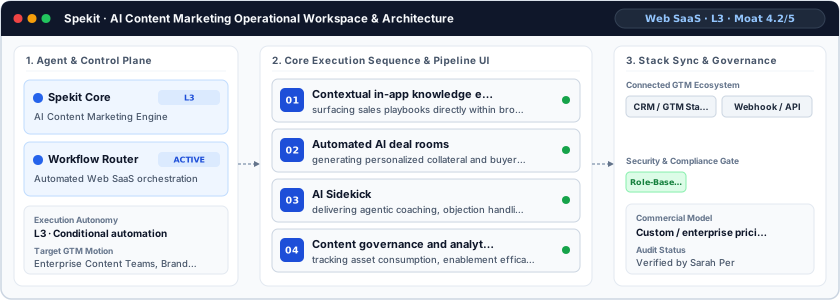
- Contextual in-app knowledge engine: surfacing sales playbooks directly within browser workflows
- Automated AI deal rooms: generating personalized collateral and buyer experiences from opportunity records
- AI Sidekick: delivering agentic coaching, objection handling, and real-time response generation
- Content governance and analytics: tracking asset consumption, enablement efficacy, and buyer engagement
Cons: operational limitations & risks
- Browser Extension Dependency: In-app enablement triggers rely heavily on DOM parsing within web extensions, risking silent rendering failures whenever target SaaS applications push minor interface updates.
- Metadata Synchronization Overhead: Automated deal room generation demands pristine CRM data cleanliness; missing opportunity stages or unmapped opportunity fields result in misaligned document suggestions.
- Governance Latency: Generative content adaptations require continuous administrative auditing to prevent stale compliance guidelines or superseded pricing logic from circulating in buyer-facing rooms.
Spekit TCO & deal-breaker stress test
Simulate 12-month stepped TCO, hidden cost multipliers, contract lock-in exposure, and stack failure modes using only facts verified by Sarah Per on · Capture SHA fc5b0b4d.
Spekit triggers high-severity friction under your 5-seat / $800/mo constraints. Benchmark the verified subtrack alternatives below before committing.
| Plan / Tier | Verified Rate | Scale Fit | Scope & Quota Notes |
|---|---|---|---|
| Enterprise / Custom | Custom quote | 15–50+ seats (Enterprise SLA) | Sales-negotiated annual contract for custom volume, SSO/RBAC governance, and dedicated SLA. |
- Moat Score
- 4.2 / 5.0
- AI Autonomy
- L3
- Free Tier / Trial
- None disclosed
Triggered audit signals & failure modes
- Opaque Enterprise Quoting vs. SMB/Mid-Market BudgetVerified Pricing Ledger
Spekit does not disclose a public self-serve floor (Custom / enterprise pricing). Buyers with a $800/mo cap face high sales-qualification friction.
- Sales-Gated Contract TermsFact-checked by Sarah Per
Commercial procurement for Spekit is available on request through tailored enterprise sales quotes based on organizational scale and seats.
- Primary Operational Bottleneck: Browser Extension DependencyAudit by Sarah Per
In-app enablement triggers rely heavily on DOM parsing within web extensions, risking silent rendering failures whenever target SaaS applications push minor interface updates.
Hidden TCO Multipliers & Quota Gates
- Enterprise Governance & Add-On Gating: Advanced capabilities such as Single Sign-On (SSO), custom role permissions, or specialized analytics modules are gated behind upper tiers or paid add-ons.
- Browser Extension Dependency: In-app enablement triggers rely heavily on DOM parsing within web extensions, risking silent rendering failures whenever target SaaS applications push minor interface updates.
- Metadata Synchronization Overhead: Automated deal room generation demands pristine CRM data cleanliness; missing opportunity stages or unmapped opportunity fields result in misaligned document suggestions.
When to Walk Away & Negotiation Levers
- Walk away if you require transparent self-serve monthly billing or your budget ceiling is under $1,000/mo (Spekit requires sales-gated custom quoting).
- Walk away if your workflow cannot tolerate browser extension dependency: In-app enablement triggers rely heavily on DOM parsing within web extensions, risking silent rendering failures whenever target SaaS applications push minor interface updates.
- Walk away if metadata synchronization overhead is a deal-breaker for your team: Automated deal room generation demands pristine CRM data cleanliness; missing opportunity stages or unmapped opportunity fields result in misaligned document suggestions.
- Demand a 30- to 60-day paid pilot opt-out clause in the Spekit order form before signing a 12-month enterprise commitment.
- Require a sandbox proof-of-concept testing browser extension dependency against your live CRM/data schema before annual sign-off.
Ask a custom procurement or TCO stress-test question about Spekit
Lower 5-seat floor (~$15/mo vs. Custom Quote) · Transparent self-serve entry without mandatory annual lock-in
Lower 5-seat floor (~$99/mo vs. Custom Quote) · Transparent self-serve entry without mandatory annual lock-in
Spekit moat & subtrack positioning
Spekit maintains defensibility through deep contextual overlay telemetry, integrating proprietary DOM-level user awareness within web tools to trigger relevant playbooks, backed by significant capital and entrenched enterprise CRM data connections.
Editorial review
Fact-checked by Sarah Per (Principal Content Systems & Generative Media Editor) on .
Background
Architected as a contextual layer across enterprise revenue tech stacks, Spekit solves the chronic disconnect between static content repositories and active buyer interactions. Established in 2018 in Denver, Colorado, the company has raised $60.6M in venture backing to target revenue operations leaders, sales enablement directors, and commercial line-of-business executives. Rather than isolating collateral inside standalone learning management systems or disconnected wikis, the software serves as an embedded go-to-market knowledge engine that automatically aligns rep activities with institutional playbooks.
How Spekit works
Spekit functions via an agentic enablement pipeline calibrated for autonomous context matching. The platform monitors CRM opportunity stage transitions, email activity, and active browser DOM elements to infer deal state. When an account executive navigates an opportunity record, Spekit dynamically retrieves verified corporate collateral, competitive battle cards, and objection-handling prompts via vector semantic search. In parallel, its generative pipeline automates digital deal room creation, assembling customized asset libraries and collateral sequences directly tailored to identified stakeholder profiles.
Limitations
Operational considerations and platform boundaries include:
- Browser Extension Dependency: In-app enablement triggers rely heavily on DOM parsing within web extensions, risking silent rendering failures whenever target SaaS applications push minor interface updates.
- Metadata Synchronization Overhead: Automated deal room generation demands pristine CRM data cleanliness; missing opportunity stages or unmapped opportunity fields result in misaligned document suggestions.
- Governance Latency: Generative content adaptations require continuous administrative auditing to prevent stale compliance guidelines or superseded pricing logic from circulating in buyer-facing rooms.
Spekit pricing
Commercial procurement for Spekit is available on request through tailored enterprise sales quotes based on organizational scale and seats. Contracts operate on an annual software-as-a-service licensing structure scoped to active representative headcount and selected modular capabilities, such as advanced analytics, embedded coaching, and digital deal rooms. Enterprise agreements include dedicated onboarding tiers, customer success management, security audits, and administrative governance modules.
How Spekit compares
Within enterprise content ecosystems, Spekit occupies an operational niche distinct from specialized peers. While AIDetectPlus focuses strictly on AI text attribution verification, Agentio automates creator ad placements, and Aha Global manages strategic product portfolios, Spekit focuses entirely on downstream commercial execution. Its structural advantage lies in just-in-time contextual delivery inside daily tools, making it optimal for enterprise sales organizations seeking to eliminate collateral search time and standardize revenue execution.
Direct competitors & market radar
Top algorithmic competitors based on category positioning, capability overlap, and ICP alignment.
Frequently asked questions about Spekit
How much does Spekit cost and does it require a custom enterprise quote?
Published pricing summary for Spekit: Custom / enterprise pricing. A permanent free plan is not disclosed for Spekit. Commercial procurement for Spekit is available on request through tailored enterprise sales quotes based on organizational scale and seats.
How does Spekit work and how autonomous is its AI architecture?
Spekit is an AI-powered sales enablement and knowledge orchestration engine that embeds contextual collateral, automated deal rooms, and real-time rep. Within AI Content Marketing (Enterprise & Long-Form Brand Content), MarTechRadar rates its execution architecture at L3 · Conditional automation with a verified Moat Score of 4.2 / 5.0 (Proprietary moat). Spekit maintains defensibility through deep contextual overlay telemetry, integrating proprietary DOM-level user awareness within web tools to trigger relevant playbooks, backed by significant capital and entrenched enterprise CRM data connections. Corporate profile: Founded by Melanie Fellay, operating at 51-200 employees scale.
What are the main limitations of Spekit and when should buyers walk away?
Based on our editorial technical audit, key operational considerations and boundaries for Spekit include: (1) Browser Extension Dependency: In-app enablement triggers rely heavily on DOM parsing within web extensions, risking silent rendering failures whenever target SaaS applications push minor interface updates. (2) Metadata Synchronization Overhead: Automated deal room generation demands pristine CRM data cleanliness; missing opportunity stages or unmapped opportunity fields result in misaligned document suggestions. (3) Governance Latency: Generative content adaptations require continuous administrative auditing to prevent stale compliance guidelines or superseded pricing logic from circulating in buyer-facing rooms. Primary procurement walk-away rule: Walk away if you require transparent self-serve monthly billing or your budget ceiling is under $1,000/mo (Spekit requires sales-gated custom quoting).
What integrations, compliance certifications, and contract terms apply to Spekit?
First-party governance and developer endpoints verified on domain include: Trust/Security (https://trust.spekit.com), Status (https://status.spekit.com). Key TCO multiplier to watch: Enterprise Governance & Add-On Gating (Advanced capabilities such as Single Sign-On (SSO), custom role permissions, or specialized analytics modules are gated behind upper tiers or paid add-ons.) Before signing a contract, procurement teams should demand a 30- to 60-day paid pilot opt-out clause in the Spekit order form before signing a 12-month enterprise commitment.
What are the best Spekit alternatives and head-to-head competitors in 2026?
Top fact-checked alternatives to Spekit in AI Content Marketing (Enterprise & Long-Form Brand Content) include Pepper Content (Custom / enterprise pricing), Sett (Custom / enterprise pricing), Dashword (From $99/mo), Junia AI (From $15/mo). Within enterprise content ecosystems, Spekit occupies an operational niche distinct from specialized peers.
Verified sources & evidence trail
- Official product domain: https://www.spekit.com
- Commercial pricing verification: Verified against official vendor pricing policy (Custom / enterprise pricing)
- Verified corporate entity profiles (
sameAs): LinkedIn Company Profile · Crunchbase Entity Record - First-party governance & documentation links: Trust & Security · System Status · Privacy
- Editorial audit sign-off: Fact-checked by Sarah Per on under the MarTechRadar Evidence-Ledger Protocol.