Dashword Review (2026): Content Optimization Pricing, Pros & Cons
Bottom line
Dashword is a Web SaaS tool for Content Optimization (Content Optimization & SERP Intelligence) in GEO & AI SEO. Pricing: From $99/mo. Best suited to B2B SaaS. Editor ratings: AI autonomy L2 (workflow copilot); moat score 2.2/5.0 (Workflow-embedded). Fact-checked by MarTechRadar Research Desk on Oct 14, 2026.
SEO content optimization platform that creates data-driven briefs, interfaces with AI agents via MCP, and programmatically scores drafts against SERP.
Is Dashword worth it in 2026? Buyer fit & when to walk away
Choose Dashword if (Best Fit)
- Target ICP & Stack Fit: You operate as B2B SaaS requiring a Web SaaS deployment for Content Optimization, with verified ecosystem connectivity for Twilio Segment, Model Context Protocol (MCP).
- L2 Architecture & Defensibility: Dashword combines real-time SERP competitive extraction with an MCP-native integration layer, enabling coding agents and LLM orchestration frameworks to generate, validate, and iterate on structured long-form content autonomously.
- Commercial Model Fit: Your procurement budget aligns with From $99/mo.
Walk away from Dashword if (Deal-Breakers)
- Walk away if your workflow cannot tolerate algorithmic homogenization: The heuristic scoring engine relies heavily on SERP pattern replication, creating risks of producing derivative copy if editors do not inject primary research or distinct brand perspectives.
- Walk away if agent prompt calibration is a deal-breaker for your team: Interfacing the MCP server with disparate coding agents requires ongoing engineering overhead to prevent model hallucination and ensure adherence to precise heading structures.
Dashword pricing, free plan & scorecard at a glance
| Pricing | From $99/moVendor pricing page |
|---|---|
| Free plan | No / not disclosed |
| Delivery | Web SaaS |
| Audience | B2B SaaS |
| AI autonomy level | L2 · Workflow copilotEditor-verified |
| Moat tier & score | 2.2 / 5.0 · Workflow-embeddedEditor-verified |
| Funding | Bootstrapped |
| Ecosystem integrations | Twilio Segment, Model Context Protocol (MCP) |
| Governance & docs | API & Docs ↗ · Terms ↗ · Privacy ↗ |
| Headquarters | United States |
| Last verified | Oct 14, 2026 |
Dashword pros & cons: strengths vs. operational limitations
Pros: core strengths & capabilities
- Automated SERP competitive analysis and content brief generation
- Model Context Protocol (MCP): server for direct AI agent integration
- Real-time content scoring against: top-ranking search results
- REST API access: for programmatic editorial pipelines
Cons: operational limitations & risks
- Algorithmic Homogenization: The heuristic scoring engine relies heavily on SERP pattern replication, creating risks of producing derivative copy if editors do not inject primary research or distinct brand perspectives.
- Agent Prompt Calibration: Interfacing the MCP server with disparate coding agents requires ongoing engineering overhead to prevent model hallucination and ensure adherence to precise heading structures.
- Search Volatility Latency: Sudden ranking updates and shifts in search intent necessitate manual report recalculations, which can cause historical briefs to diverge from live algorithmic realities.
Dashword TCO & deal-breaker stress test
Simulate 12-month stepped TCO, hidden cost multipliers, contract lock-in exposure, and stack failure modes using only facts verified by MarTechRadar Research Desk on 2026-10-14 · Capture SHA 0932d2f9.
Dashword aligns with your 5-seat / $800/mo profile. Review the walk-away triggers and contract levers below before deployment.
- Moat Score
- 2.2 / 5.0
- AI Autonomy
- L2
- Free Tier / Trial
- None disclosed
Triggered audit signals & failure modes
- Published Self-Serve Entry FloorVerified Pricing Ledger
Dashword publishes a transparent entry point (From $99/mo) for initial validation before committing.
- Tier Fit for 5-Seat Scale: Startup ($99/mo)Verified Tier Schedule
For individuals and small teams working on new content
- Primary Operational Bottleneck: Algorithmic HomogenizationAudit by MarTechRadar Research Desk
The heuristic scoring engine relies heavily on SERP pattern replication, creating risks of producing derivative copy if editors do not inject primary research or distinct brand perspectives.
Test a custom Dashword budget or stack constraint
Lower 5-seat floor (~$49/mo vs. $99 / mo)
Dashword integrations, API, security & compliance stack
Model Context Protocol server for direct AI agent integration
Dashword AI moat & Content Optimization positioning
Dashword combines real-time SERP competitive extraction with an MCP-native integration layer, enabling coding agents and LLM orchestration frameworks to generate, validate, and iterate on structured long-form content autonomously.
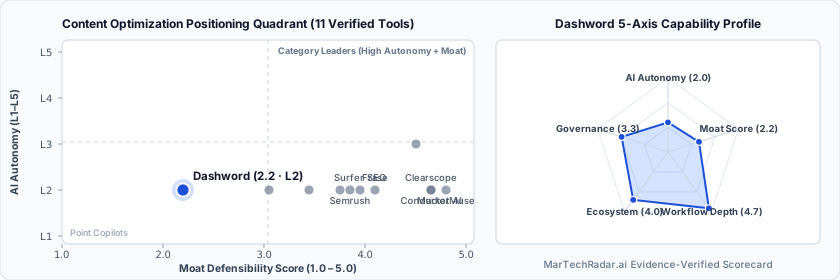
Dashword in-depth review, pricing & architecture analysis
Editor sign-off: Oct 14, 2026. How profiles are made.
What is Dashword? Overview & background
Content teams operating programmatic editorial operations face systemic friction when aligning autonomous generation models with competitive search standards. Headquartered in the United States, Dashword addresses this gap by supplying a programmatic research and scoring pipeline designed specifically for SEO strategists and editorial automation engineers. Instead of relying on manual SERP evaluations, the platform extracts top-ranking competitive structures and feeds algorithmic guidelines directly to external agents to accelerate long-form production across organic search campaigns.
How Dashword works: architecture & workflow
Dashword operates at Level 2 autonomy by pairing real-time search engine analysis with direct model interaction protocols. When an operator inputs a target keyphrase, the engine scrapes and clusters high-ranking competitor documents, extracting keyword frequencies, topical entities, and heading hierarchies. These signals compile into a standardized content brief. Via an embedded Model Context Protocol server and REST API, Dashword interfaces with autonomous agents such as Claude, Cursor, and Codex, feeding programmatic constraints and continuously evaluating draft outputs against an algorithmic content score until benchmark thresholds are satisfied.
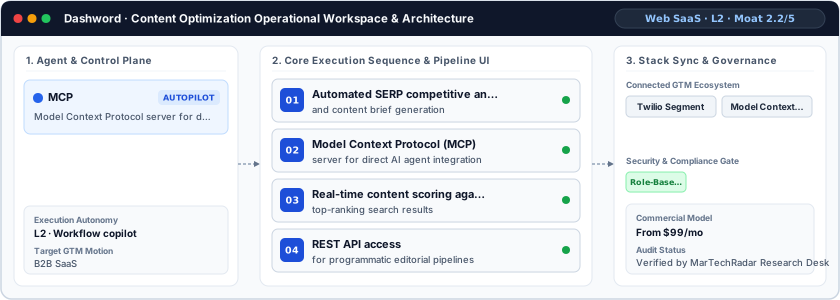
Dashword limitations, drawbacks & risks
Operational considerations and platform boundaries include:
- Algorithmic Homogenization: The heuristic scoring engine relies heavily on SERP pattern replication, creating risks of producing derivative copy if editors do not inject primary research or distinct brand perspectives.
- Agent Prompt Calibration: Interfacing the MCP server with disparate coding agents requires ongoing engineering overhead to prevent model hallucination and ensure adherence to precise heading structures.
- Search Volatility Latency: Sudden ranking updates and shifts in search intent necessitate manual report recalculations, which can cause historical briefs to diverge from live algorithmic realities.
Dashword pricing, plans & cost breakdown
Dashword licenses its software through recurring tiers centered on report frequency and feature access. Entry into the platform begins at $99 per month for the Startup plan, which provisions 30 content reports, 5 user seats, and API and MCP server connectivity. Scaled editorial environments transition to the Business tier from $349 per month, which increases monthly report allocations to 100 for continuous monitoring across larger enterprise domains.
| Plan / Tier | Verified Price & Billing | Included Scope & Contract Terms |
|---|---|---|
| Startup | $99/mo | For individuals and small teams working on new content |
| Business | $349/mo | For teams working on new content and maintaining legacy content |
How Dashword compares vs. competitors & alternatives
Within the content optimization ecosystem, Dashword differentiates through developer-focused connectivity such as MCP integration rather than isolated graphic user interfaces within the AI Content Marketing segment. While Amdahl concentrates strictly on synthetic text classification, and platforms like Typeface and AndromedAI focus on creator marketplace execution and distributed workflows, Dashword focuses on algorithmic search alignment. The platform is best matched for technical SEO teams and digital publishers running automated, agentic drafting pipelines that demand strict keyword parity.
Direct competitors & market radar
Top algorithmic competitors based on category positioning, capability overlap, and ICP alignment.
Frequently asked questions about Dashword
How much does Dashword cost in 2026?
Dashword pricing: From $99/mo. No free plan is publicly disclosed. Published tiers: Startup ($99/mo); Business ($349/mo). Dashword licenses its software through recurring tiers centered on report frequency and feature access.
What are the top Dashword alternatives in Content Optimization?
Verified Content Optimization alternatives include Content at Scale (Custom / enterprise pricing), Digital Udyami (Custom / enterprise pricing), InLinks (Custom / enterprise pricing), Outranking (Custom / enterprise pricing). Within the content optimization ecosystem, Dashword differentiates through developer-focused connectivity such as MCP integration rather than isolated graphic user interfaces within the AI Content Marketing segment.
What are the main limitations and trade-offs of Dashword?
Operational considerations and platform boundaries include: Algorithmic Homogenization: The heuristic scoring engine relies heavily on SERP pattern replication, creating risks of producing derivative copy if editors do not inject primary research or distinct brand perspectives. Walk away if your workflow cannot tolerate algorithmic homogenization: The heuristic scoring engine relies heavily on SERP pattern replication, creating risks of producing derivative copy if editors do not inject primary research or distinct brand perspectives.
Verified sources & evidence trail
- Official product domain: https://dashword.com
- Commercial pricing verification: https://www.dashword.com/pricing
- Verified corporate entity profiles (
sameAs): Crunchbase Entity Record - First-party governance & documentation links: API & Docs · Terms · Privacy
- Editor sign-off: Oct 14, 2026 (how profiles are made).
