Ryte Review (2026): Technical SEO Pricing, Pros & Cons
Bottom line
Ryte is a Web SaaS tool for Technical SEO (Technical SEO Auditing & Indexing) in GEO & AI SEO. Pricing: Custom / enterprise pricing. Best suited to DTC / eCommerce and Enterprise Brands. Editor ratings: AI autonomy L2 (workflow copilot); moat score 4.1/5.0 (Proprietary moat). Fact-checked by MarTechRadar Research Desk on Oct 15, 2026.
Enterprise website quality management platform delivering automated cloud crawling, technical SEO auditing, Core Web Vitals monitoring, and accessibility.
Is Ryte worth it in 2026? Buyer fit & when to walk away
Choose Ryte if (Best Fit)
- Target ICP & Stack Fit: You operate as DTC / eCommerce and Enterprise Brands requiring a Web SaaS deployment for Technical SEO, with verified ecosystem connectivity for Google Search Console.
- L2 Architecture & Defensibility: Proprietary cloud crawler architecture integrated with automated accessibility validation (WCAG) and enterprise data aggregation, now fortified by SEMrush's broader search intelligence distribution network.
- Commercial Model Fit: Your procurement budget aligns with Custom / enterprise pricing.
Walk away from Ryte if (Deal-Breakers)
- Walk away if you need published self-serve pricing: Ryte is sold by custom quote.
- Walk away if your workflow cannot tolerate crawl budget and cloud resource caps: High-frequency crawls on multi-million URL architectures require strict scheduling rules and rate limiting to prevent backend origin server degradation during concurrent headless browser renderings.
- Walk away if dynamic single-page rendering latency is a deal-breaker for your team: Heavy client-side JavaScript applications introduce parsing overhead, slowing enterprise crawl execution speeds compared to static HTML processing passes.
Ryte pricing, free plan & scorecard at a glance
| Pricing | Custom / enterprise pricing |
|---|---|
| Free plan | No / not disclosed |
| Delivery | Web SaaS |
| Audience | DTC / eCommerce, Enterprise Brands |
| AI autonomy level | L2 · Workflow copilotEditor-verified |
| Moat tier & score | 4.1 / 5.0 · Proprietary moatEditor-verified |
| Funding | AcquiredAcquired by SEMrush |
| Total funding | €13.4M |
| Founders | Andy Bruckschloegl, Jan Hendrik Merlin Reichenbacher, Marcus Tandler, Niels Doerje |
| Company size | 51-200 employees |
| Ecosystem integrations | Google Search Console |
| Compliance & governance | GDPR |
| Governance & docs | Trust & Security ↗ · Terms ↗ · Privacy ↗ |
| Headquarters | München, Bayern, Germany |
| Founded | 2012 |
| Last verified | Oct 15, 2026 |
Ryte pros & cons: strengths vs. operational limitations
Pros: core strengths & capabilities
- High-speed distributed cloud crawler: auditing indexability, status codes, and canonical configurations
- Real-time Core Web Vitals and frontend user experience performance telemetry
- Automated WCAG accessibility compliance: scanning to reduce digital legal risk
- Google Search Console integration: for layered search performance analysis and anomaly detection
Cons: operational limitations & risks
- Crawl Budget and Cloud Resource Caps: High-frequency crawls on multi-million URL architectures require strict scheduling rules and rate limiting to prevent backend origin server degradation during concurrent headless browser renderings.
- Dynamic Single-Page Rendering Latency: Heavy client-side JavaScript applications introduce parsing overhead, slowing enterprise crawl execution speeds compared to static HTML processing passes.
- Remediation Workflow Decoupling: While the platform automatically flags indexing and accessibility failures, direct CMS synchronization is missing, requiring manual engineering orchestration to deploy production code patches.
Ryte TCO & deal-breaker stress test
Simulate 12-month stepped TCO, hidden cost multipliers, contract lock-in exposure, and stack failure modes using only facts verified by MarTechRadar Research Desk on 2026-10-15.
Ryte triggers high-severity friction under your 5-seat / $800/mo constraints. Benchmark the verified subtrack alternatives below before committing.
- Moat Score
- 4.1 / 5.0
- AI Autonomy
- L2
- Free Tier / Trial
- None disclosed
Triggered audit signals & failure modes
- Opaque Enterprise Quoting vs. SMB/Mid-Market BudgetVerified Pricing Ledger
Ryte does not disclose a public self-serve floor (Custom / enterprise pricing). Buyers with a $800/mo cap face high sales-qualification friction.
- Sales-Gated Contract TermsFact-checked by MarTechRadar Research Desk
Ryte follows an enterprise subscription structure. Commercial pricing is available on request through tailored enterprise sales quotes based on organizational scale and seats.
- Primary Operational Bottleneck: Crawl Budget and Cloud Resource CapsAudit by MarTechRadar Research Desk
High-frequency crawls on multi-million URL architectures require strict scheduling rules and rate limiting to prevent backend origin server degradation during concurrent headless browser renderings.
Test a custom Ryte budget or stack constraint
Lower 5-seat floor (~$349/mo vs. Custom Quote) · Transparent self-serve entry without mandatory annual lock-in
Lower 5-seat floor (~$99/mo vs. Custom Quote) · Transparent self-serve entry without mandatory annual lock-in
Ryte integrations, API, security & compliance stack
Ryte AI moat & Technical SEO positioning
Proprietary cloud crawler architecture integrated with automated accessibility validation (WCAG) and enterprise data aggregation, now fortified by SEMrush's broader search intelligence distribution network.
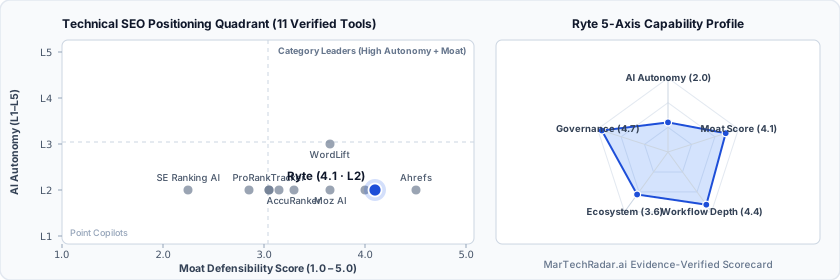
Ryte in-depth review, pricing & architecture analysis
Editor sign-off: Oct 15, 2026. How profiles are made.
What is Ryte? Overview & background
Established in 2012 in München, Bayern, Germany, Ryte developed a website quality management platform uniting technical search optimization with regulatory accessibility auditing. Prior to its acquisition by SEMrush, the company secured €13.4M in venture capital to engineer enterprise-grade cloud auditing infrastructure. Targeted at enterprise digital marketing directors, web engineering leads, and compliance officers, the system shifts technical SEO away from ad-hoc site queries into an integrated operational regime governing performance, search engine crawlability, and user experience.
How Ryte works: architecture & workflow
At its architectural core, Ryte operates a distributed cloud crawler capable of parsing complex single-page applications and multi-domain web properties. The engine captures technical telemetry including status codes, canonical structures, robots directives, and DOM-rendered assets. Operating at an L3 conditional automation level, the platform continuously cross-references server logs and API-ingested Google Search Console metrics against internal health indices, automatically generating prioritized technical remediation tickets across Core Web Vitals, metadata hygiene, and WCAG accessibility standards under verified GDPR governance controls.
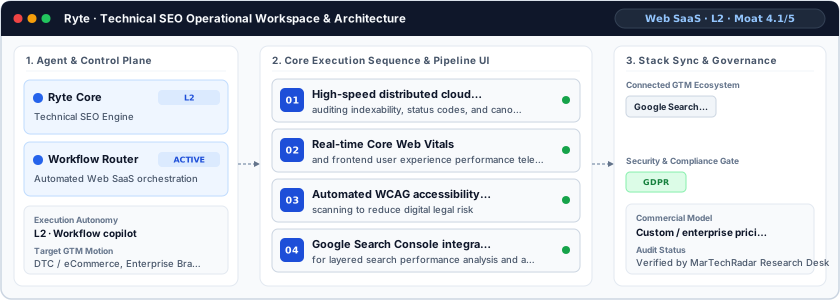
Ryte limitations, drawbacks & risks
Operational considerations and platform boundaries include:
- Crawl Budget and Cloud Resource Caps: High-frequency crawls on multi-million URL architectures require strict scheduling rules and rate limiting to prevent backend origin server degradation during concurrent headless browser renderings.
- Dynamic Single-Page Rendering Latency: Heavy client-side JavaScript applications introduce parsing overhead, slowing enterprise crawl execution speeds compared to static HTML processing passes.
- Remediation Workflow Decoupling: While the platform automatically flags indexing and accessibility failures, direct CMS synchronization is missing, requiring manual engineering orchestration to deploy production code patches.
Ryte pricing, plans & cost breakdown
Ryte follows an enterprise subscription structure. Commercial pricing is available on request through tailored enterprise sales quotes based on organizational scale and seats. Contracts scale primarily on monthly crawl URL capacity, audited domain counts, and dedicated accessibility testing modules without public self-serve tiers.
| Plan / Tier | Verified Price & Billing | Target Seat / Scale Fit | Included Scope & Contract Terms |
|---|---|---|---|
| Enterprise / Custom | Custom quote | Unlimited seats | Custom-quoted plan; terms come from the vendor's sales team. |
How Ryte compares vs. competitors & alternatives
Within enterprise technical site auditing, Ryte competes against Botify, Screaming Frog SEO, and Sitebulb. While Screaming Frog and Sitebulb deliver deep desktop-based raw crawl debugging favored by technical practitioners, Ryte runs an entirely cloud-native architecture that avoids local compute constraints. Conversely, Botify offers deeper raw log-file analysis for substantial e-commerce architectures, whereas Ryte differentiates through unified WCAG accessibility compliance and user experience scoring, making it ideal for multinational brands needing integrated compliance governance.
Frequently asked questions about Ryte
Does Ryte publish pricing or require an enterprise quote?
Ryte pricing: Custom / enterprise pricing. No free plan is publicly disclosed. Ryte follows an enterprise subscription structure. Commercial pricing is available on request through tailored enterprise sales quotes based on organizational scale and seats.
What are the top Ryte alternatives in Technical SEO?
Verified Technical SEO alternatives include Nightwatch (€79–€399/mo), BrandRank.ai (Custom / enterprise pricing), JetOctopus ($349–$2,069/mo), SearchAtlas ($99–$999/mo). Within enterprise technical site auditing, Ryte competes against Botify, Screaming Frog SEO, and Sitebulb.
What are the main limitations and trade-offs of Ryte?
Operational considerations and platform boundaries include: Crawl Budget and Cloud Resource Caps: High-frequency crawls on multi-million URL architectures require strict scheduling rules and rate limiting to prevent backend origin server degradation during concurrent headless browser renderings. Walk away if you need published self-serve pricing: Ryte is sold by custom quote.
Verified sources & evidence trail
- Official product domain: https://ryte.com
- Commercial pricing verification: Verified against official vendor pricing policy (Custom / enterprise pricing)
- Verified corporate entity profiles (
sameAs): LinkedIn Company Profile · Crunchbase Entity Record - First-party governance & documentation links: Trust & Security · Terms · Privacy
- Editor sign-off: Oct 15, 2026 (how profiles are made).
