RudderStack Review (2026): CDP Pricing, Limits & Alternatives
Bottom line
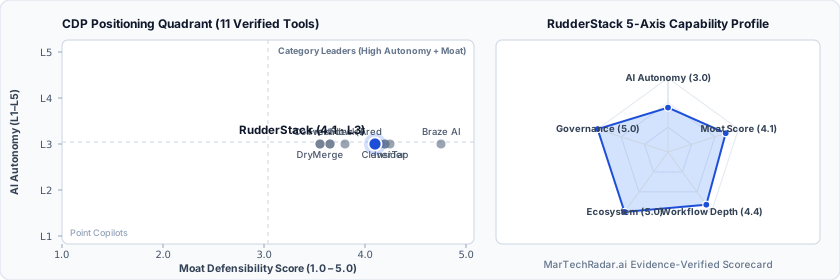
RudderStack is a SaaS Platform tool for CDP (Customer Data Platform & Journey Orchestration) in Lifecycle & CDP. Pricing: Free plan · $0/mo · Enterprise plan. Best suited to B2B Marketing & GTM Teams. Editor ratings: AI autonomy L3 (conditional automation); moat score 4.1/5.0 (Proprietary moat). Fact-checked by Sarah Per on Oct 26, 2026.
Warehouse-native CDP unifying event streaming, identity resolution, and Reverse ETL directly on your cloud data warehouse.
RudderStack buyer fit verdict: when to choose vs. when to walk away
Choose RudderStack if (Best Fit)
- Target ICP & Stack Fit: You operate as B2B Marketing & GTM Teams requiring a SaaS Platform deployment for CDP, with verified ecosystem connectivity for Salesforce, HubSpot, Slack, Snowflake.
- L3 Architecture & Defensibility: Warehouse-native Customer Data Platform that builds unified identity graphs, event pipelines, and predictive AI features directly inside cloud data warehouses without storing a proprietary copy of customer data.
- Commercial Model Fit: Your procurement budget aligns with Free plan · $0/mo · Enterprise plan and want a self-serve free tier for zero-cost initial validation.
Walk away from RudderStack if (Deal-Breakers)
- Walk away if your workflow requires uncapped enterprise volume on the Free plan · $0/mo · Enterprise plan entry plan without upgrading tiers.
- Walk away if your workflow cannot tolerate primary operational constraint: In day-to-day enterprise deployment, the primary trade-off is the technical engineering proficiency required to configure warehouse permissions, schema tracking plans, and custom SQL or JavaScript transformation payloads.
- Walk away if integration & scaling friction is a deal-breaker for your team: RudderStack is not built for non-technical marketing teams that lack dedicated data engineering support or a cloud data warehouse infrastructure.
RudderStack key facts & scorecard
| Pricing | Free plan · $0/mo · Enterprise planVendor pricing page |
|---|---|
| Free plan | Yes |
| Delivery | SaaS Platform |
| Audience | B2B Marketing & GTM Teams |
| AI autonomy level | L3 · Conditional automationEditor-verified |
| Moat tier & score | 4.1 / 5.0 · Proprietary moatEditor-verified |
| Funding | Series B |
| Total funding | $82MBacked by Insight Partners, Kleiner Perkins, 468 Capital, Salil Deshpande, Augusto Marietti |
| Founders | Shvet Jain, Soumyadeb Mitra |
| Company size | 51-200 employees |
| Ecosystem integrations | Salesforce, HubSpot, Slack, Snowflake, Google BigQuery, Databricks |
| Compliance & governance | SOC 2, GDPR, HIPAA |
| Headquarters | San Francisco, California, United States |
| Founded | 2019 |
| Last verified |
RudderStack pros & cons: strengths vs. operational limitations
Pros: core strengths & capabilities
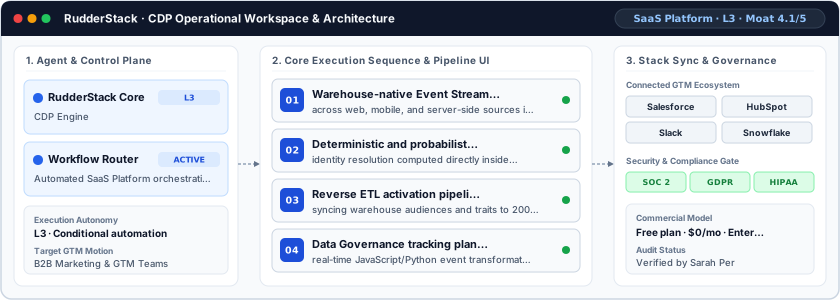
- Warehouse-native Event Stream SDKs: across web, mobile, and server-side sources into Snowflake, BigQuery, Databricks, and Redshift
- Deterministic and probabilistic Profiles: identity resolution computed directly inside the customer's cloud data warehouse
- Reverse ETL activation pipelines: syncing warehouse audiences and traits to 200+ downstream CRM, ad, and marketing tools
- Data Governance tracking plans,: real-time JavaScript/Python event transformations, and predictive churn/LTV ML models
Cons: operational limitations & risks
- Primary Operational Constraint: In day-to-day enterprise deployment, the primary trade-off is the technical engineering proficiency required to configure warehouse permissions, schema tracking plans, and custom SQL or JavaScript transformation payloads.
- Integration & Scaling Friction: RudderStack is not built for non-technical marketing teams that lack dedicated data engineering support or a cloud data warehouse infrastructure.
- Governance & Cost Boundary: Additionally, organizations running high-frequency warehouse syncs face compute credit overhead on their underlying Snowflake, Databricks, or BigQuery bills, alongside a steeper initial learning curve when debugging multi-source identity resolution rules across web, mobile, and server-side SDKs.
Are you a founder, co-founder, or product/growth lead at RudderStack? Verify your official @rudderstack.com email to publish a factual architectural response or 2026 roadmap update below these limitations.
RudderStack TCO & deal-breaker stress test
Simulate 12-month stepped TCO, hidden cost multipliers, contract lock-in exposure, and stack failure modes using only facts verified by Sarah Per on · Capture SHA faa88809.
RudderStack triggers high-severity friction under your 5-seat / $800/mo constraints. Benchmark the verified subtrack alternatives below before committing.
| Plan / Tier | Verified Rate | Scale Fit | Scope & Quota Notes |
|---|---|---|---|
| Free / Sandbox | $0 | 1–2 seats (Evaluation) | Entry free tier with capped usage or feature quotas for initial workflow testing. |
| Entry / Starter | $265/mo | 1–2 seats | Verified $265/mo published rate on vendor pricing schedule. |
| Enterprise / Custom | Custom quote | 15–50+ seats (Enterprise SLA) | Sales-negotiated annual contract for custom volume, SSO/RBAC governance, and dedicated SLA. |
- Moat Score
- 4.1 / 5.0
- AI Autonomy
- L3
- Free Tier / Trial
- Free plan
Triggered audit signals & failure modes
- Opaque Enterprise Quoting vs. SMB/Mid-Market BudgetVerified Pricing Ledger
RudderStack does not disclose a public self-serve floor (Free plan · $0/mo · Enterprise plan). Buyers with a $800/mo cap face high sales-qualification friction.
- Published Self-Serve Entry FloorVerified Pricing Ledger
RudderStack publishes a transparent entry point (Free plan · $0/mo · Enterprise plan) with a free tier for initial validation before committing.
- Usage / Credit Burn VolatilityCommercial Model Audit
RudderStack uses credit or usage-metered billing (Free plan · $0/mo · Enterprise plan). High-volume automated workflows across 5 seats can trigger mid-cycle overage charges.
- Primary Operational Bottleneck: Governance & Cost BoundaryAudit by Sarah Per
Additionally, organizations running high-frequency warehouse syncs face compute credit overhead on their underlying Snowflake, Databricks, or BigQuery bills, alongside a steeper initial learning curve when debugging multi-source identity resolution rules across web, mobile, and server-side SDKs.
Hidden TCO Multipliers & Quota Gates
- Credit & Usage Burn Multiplier: Automated workflows consume metered credits/usage quotas; multi-step enrichment, voice minutes, or high-frequency agent runs can trigger mid-cycle top-up packs.
- Primary Operational Constraint: In day-to-day enterprise deployment, the primary trade-off is the technical engineering proficiency required to configure warehouse permissions, schema tracking plans, and custom SQL or JavaScript transformation payloads.
- Integration & Scaling Friction: RudderStack is not built for non-technical marketing teams that lack dedicated data engineering support or a cloud data warehouse infrastructure.
When to Walk Away & Negotiation Levers
- Walk away if your workflow requires uncapped enterprise volume on the Free plan · $0/mo · Enterprise plan entry plan without upgrading tiers.
- Walk away if your workflow cannot tolerate primary operational constraint: In day-to-day enterprise deployment, the primary trade-off is the technical engineering proficiency required to configure warehouse permissions, schema tracking plans, and custom SQL or JavaScript transformation payloads.
- Walk away if integration & scaling friction is a deal-breaker for your team: RudderStack is not built for non-technical marketing teams that lack dedicated data engineering support or a cloud data warehouse infrastructure.
- Validate exact quota thresholds (seats, credits, or API calls) included in RudderStack's Free plan · $0/mo · Enterprise plan tier before converting from monthly to annual billing.
- Require a sandbox proof-of-concept testing primary operational constraint against your live CRM/data schema before annual sign-off.
4 hard questions to ask on a RudderStack sales or technical demo
“Between RudderStack's Free / Sandbox ($0) and Entry / Starter ($265/mo) tiers, what exact seat, workspace, or credit ceiling triggers a mandatory upgrade—and are mid-cycle overages billed at the base unit rate or forced onto an annual Entry / Starter commitment?”
Contract / Technical Proof to Require: Validate exact quota thresholds (seats, credits, or API calls) included in RudderStack's Free plan · $0/mo · Enterprise plan tier before converting from monthly to annual billing.
“Our technical audit of RudderStack flagged "Primary Operational Constraint" (In day-to-day enterprise deployment, the primary trade-off is the technical engineering proficiency required to configure warehouse permissions, schema tracking plans, and custom SQL or JavaScript transformation payloads.). Can you demonstrate how RudderStack handles this scenario live against Salesforce without manual CSV workarounds or webhook latency?”
Contract / Technical Proof to Require: Walk away if your workflow requires uncapped enterprise volume on the Free plan · $0/mo · Enterprise plan entry plan without upgrading tiers.
“Because RudderStack operates at L3 · Conditional automation (CDP), how do operators prevent "Integration & Scaling Friction" (RudderStack is not built for non-technical marketing teams that lack dedicated data engineering support or a cloud data warehouse infrastructure.) during high-volume campaigns, and what human-in-the-loop approval gates are configurable?”
Contract / Technical Proof to Require: Require a sandbox proof-of-concept testing primary operational constraint against your live CRM/data schema before annual sign-off.
“We see RudderStack documents SOC 2, GDPR, HIPAA. Can you provide the current audit report, sub-processor list, and written confirmation that customer inputs in RudderStack are never used to train shared foundation models?”
Contract / Technical Proof to Require: Attach a signed DPA with zero model-training rights and 30-day data deletion SLA upon contract termination.
Ask a custom procurement or TCO stress-test question about RudderStack
Generate your 4-role approval packet or request a custom RudderStack sandbox & CDP quote
Active spec: 5 Seats · ≤ $800/mo ceiling · Any Stack · No Annual Lock-in
Lower 5-seat floor (~$12/mo vs. Custom Quote)
Lower 5-seat floor (~$82/mo vs. Custom Quote)
No public buyer quote requests logged in the current window for RudderStack. Be the first to lock a verified procurement specification above.
RudderStack key entities, modules & ecosystem stack
RudderStack moat & subtrack positioning
Warehouse-native Customer Data Platform that builds unified identity graphs, event pipelines, and predictive AI features directly inside cloud data warehouses without storing a proprietary copy of customer data.
Editorial review
Fact-checked by Sarah Per (Principal Content Systems & Generative Media Editor) on .
Background
RudderStack is a warehouse-native Customer Data Platform (CDP) designed for data engineering and marketing operations teams that want real-time event collection, identity resolution, and Reverse ETL activation without locking customer records inside a black-box SaaS database. Founded in 2019 by Shvet Jain and Soumyadeb Mitra and headquartered in San Francisco, California, the company operates with 51 to 200 employees and has raised $82M through Series B funding backed by Insight Partners, Kleiner Perkins, 468 Capital, Salil Deshpande, and Augusto Marietti. It serves growth, product, and analytics organizations that treat Snowflake, BigQuery, Databricks, or Redshift as their primary system of record.
How RudderStack works
At the technical core of RudderStack is a modular data pipeline infrastructure combining real-time Event Stream SDKs, ELT cloud extractors, warehouse-native Profiles for deterministic and probabilistic identity stitching, and Reverse ETL connectors across more than 200 downstream marketing, CRM, and ad destinations. Unlike traditional packaged CDPs that store duplicate copies of personally identifiable information on vendor servers, RudderStack executes identity graph computation and feature table generation directly inside the customer's existing cloud warehouse. The platform also includes real-time JavaScript and Python transformations, Data Governance schema validation APIs that quarantine malformed tracking payloads at ingestion, and RudderStack Predictions, which trains churn and lifetime-value propensity models directly on warehouse tables, alongside native workflow integrations for Salesforce, HubSpot, and Slack under verified GDPR governance controls.
Limitations
Operational limitations and deployment trade-offs include:
- Primary Operational Constraint: In day-to-day enterprise deployment, the primary trade-off is the technical engineering proficiency required to configure warehouse permissions, schema tracking plans, and custom SQL or JavaScript transformation payloads.
- Integration & Scaling Friction: RudderStack is not built for non-technical marketing teams that lack dedicated data engineering support or a cloud data warehouse infrastructure.
- Governance & Cost Boundary: Additionally, organizations running high-frequency warehouse syncs face compute credit overhead on their underlying Snowflake, Databricks, or BigQuery bills, alongside a steeper initial learning curve when debugging multi-source identity resolution rules across web, mobile, and server-side SDKs.
RudderStack pricing
RudderStack follows a usage-based freemium pricing model anchored by event volume and activation tiers. The Free Cloud plan starts at $0 per month and includes up to 1 million monthly events with core Event Stream, warehouse loading, and Reverse ETL capabilities, while also offering an open-source self-hosted edition on GitHub. Paid cloud tiers begin with the Starter plan at $265 per month for up to 2.5 million monthly events and faster warehouse sync intervals. Growth and Enterprise plans use custom annual contracts tailored to organizations requiring HIPAA and SOC 2 compliance, warehouse-native Profiles identity graphs, Data Governance schemas, and predictive ML modeling.
How RudderStack works
Compared to traditional bundled CDPs such as Twilio Segment and mParticle, RudderStack eliminates double data storage taxes and strict PII vendor lock-in by running directly atop the customer's cloud data warehouse. Against pure-play Reverse ETL tools like Hightouch and Census, RudderStack provides native first-party web and mobile event streaming SDKs alongside warehouse activation in a single unified architecture. Data-mature B2B SaaS, e-commerce, and fintech enterprises should evaluate RudderStack when consolidating real-time event collection and warehouse activation under strict security and governance controls, alongside verified subtrack peers such as Braze AI and CleverTap.
Frequently asked questions about RudderStack
How much does RudderStack cost and what pricing tiers are available?
Published pricing summary for RudderStack: Free plan · $0/mo · Enterprise plan. RudderStack includes a free tier or sandbox entry point. Verified tier schedule: Free / Sandbox ($0 for 1–2 seats (Evaluation)); Entry / Starter ($265/mo for 1–2 seats); Enterprise / Custom (Custom quote for 15–50+ seats (Enterprise SLA)). RudderStack follows a usage-based freemium pricing model anchored by event volume and activation tiers.
How does RudderStack work and how autonomous is its AI architecture?
Warehouse-native CDP unifying event streaming, identity resolution, and Reverse ETL directly on your cloud data warehouse. Within CDP (Customer Data Platform & Journey Orchestration), MarTechRadar rates its execution architecture at L3 · Conditional automation with a verified Moat Score of 4.1 / 5.0 (Proprietary moat). Warehouse-native Customer Data Platform that builds unified identity graphs, event pipelines, and predictive AI features directly inside cloud data warehouses without storing a proprietary copy of customer data. Corporate profile: Founded by Shvet Jain, Soumyadeb Mitra, operating at 51-200 employees scale.
What are the main limitations of RudderStack and when should buyers walk away?
Based on our editorial technical audit, key operational considerations and boundaries for RudderStack include: (1) Primary Operational Constraint: In day-to-day enterprise deployment, the primary trade-off is the technical engineering proficiency required to configure warehouse permissions, schema tracking plans, and custom SQL or JavaScript transformation payloads. (2) Integration & Scaling Friction: RudderStack is not built for non-technical marketing teams that lack dedicated data engineering support or a cloud data warehouse infrastructure. (3) Governance & Cost Boundary: Additionally, organizations running high-frequency warehouse syncs face compute credit overhead on their underlying Snowflake, Databricks, or BigQuery bills, alongside a steeper initial learning curve when debugging multi-source identity resolution rules across web, mobile, and server-side SDKs. Primary procurement walk-away rule: Walk away if your workflow requires uncapped enterprise volume on the Free plan · $0/mo · Enterprise plan entry plan without upgrading tiers.
What integrations, compliance certifications, and contract terms apply to RudderStack?
Verified ecosystem and stack integrations include Salesforce, HubSpot, Slack, Snowflake, Google BigQuery, Databricks, Amazon Redshift, Twilio Segment, Braze. Documented security and governance attestations include SOC 2, GDPR, HIPAA. Key TCO multiplier to watch: Credit & Usage Burn Multiplier (Automated workflows consume metered credits/usage quotas; multi-step enrichment, voice minutes, or high-frequency agent runs can trigger mid-cycle top-up packs.) Before signing a contract, procurement teams should validate exact quota thresholds (seats, credits, or API calls) included in RudderStack's Free plan · $0/mo · Enterprise plan tier before converting from monthly to annual billing.
What are the best RudderStack alternatives and head-to-head competitors in 2026?
Top fact-checked alternatives to RudderStack in CDP (Customer Data Platform & Journey Orchestration) include ConvertFlow (AI) (From $12/mo), Socialinsider (From $82/mo), GrowthLoop (Pricing not disclosed), Meiro (Pricing not disclosed).
RudderStack profile completeness & verified buyer trust checklist
Our analysts verified the first 5 baseline facts below from public captures. Founders and growth leads at RudderStack can reach 100% Gold Verified Transparency (and unlock priority buyer sandbox inquiries) by supplying workflow screenshots, customer ROI case studies, and direct support SLA contacts:
- 1. Corporate Identity & HQ: Founded 2019 · San Francisco, California, United States · Founders: Shvet Jain, Soumyadeb Mitra
- 2. Team Scale & Backing: 51-200 employees · $82M
- 3. Published Pricing Floor: Free plan · $0/mo · Enterprise plan (Sentinel S7 verified)
- 4. Free Trial & Onboarding: Free-forever tier available
- 5. Stack & Compliance Signals: Salesforce, HubSpot, Slack, Snowflake · SOC 2, GDPR, HIPAA
- 6. Product Workflow Screenshots & Customer Case Studies: Upload 3 UI screenshots & verified ROI case study (+15% completeness) →
- 7. Direct Support SLA, Hotline & Reader Perk Code: Add official support email/phone, SLA & exclusive buyer trial perk (+10% completeness) →
Verified sources & evidence trail
- Official product domain: https://rudderstack.com
- Commercial pricing verification: https://www.rudderstack.com/pricing/
- Verified corporate entity profiles (
sameAs): LinkedIn Company Profile · Crunchbase Entity Record - Editorial audit sign-off: Fact-checked by Sarah Per on under the MarTechRadar Evidence-Ledger Protocol.