Signals Review (2026): eCommerce Chatbot Pricing, Pros & Cons
Bottom line
Signals is a Web SaaS tool for eCommerce Chatbot (Conversational eCommerce & Support Bots) in Lifecycle & CDP. Pricing: Custom / enterprise pricing. Best suited to B2B Marketers, Revenue Operations and Growth Teams. Editor ratings: AI autonomy L3 (conditional automation); moat score 2.4/5.0 (Workflow-embedded). Fact-checked by MarTechRadar Research Desk on Oct 27, 2026.
Y Combinator-backed conversational return prevention and post-purchase resolution platform for Shopify ecommerce brands.
Is Signals worth it in 2026? Buyer fit & when to walk away
Choose Signals if (Best Fit)
- Target ICP & Stack Fit: You operate as B2B Marketers, Revenue Operations and Growth Teams requiring a Web SaaS deployment for eCommerce Chatbot, with verified ecosystem connectivity for Shopify.
- L3 Architecture & Defensibility: Signals builds a defensible vertical moat in Conversational eCommerce & Support Bots through deep workflow integration, automated execution guardrails, and verified market traction.
- Commercial Model Fit: Your procurement budget aligns with Custom / enterprise pricing.
Walk away from Signals if (Deal-Breakers)
- Walk away if you require transparent self-serve monthly billing or your budget ceiling is under $1,000/mo (Signals requires sales-gated custom quoting).
- Walk away if your workflow cannot tolerate interactive return diagnosis & troubleshooting: When a customer initiates a return for electronics, beauty devices, apparel, or home goods, the AI agent asks targeted diagnostic questions to identify whether the issue stems from a fixable misunderstanding, assembly mistake, or sizing mismatch.
- Walk away if dynamic exchange & incentive routing is a deal-breaker for your team: Based on real-time inventory, customer lifetime value, and SKU margin profiles, Signals dynamically offers size or variant exchanges, bonus store credit, partial keep-the-item resolutions, or complementary accessories that address the shopper's specific complaint.
Signals pricing, free plan & scorecard at a glance
| Pricing | Custom / enterprise pricing |
|---|---|
| Free plan | No / not disclosed |
| Delivery | Web SaaS |
| Audience | B2B Marketers, Revenue Operations, Growth Teams |
| AI autonomy level | L3 · Conditional automationEditor-verified |
| Moat tier & score | 2.4 / 5.0 · Workflow-embeddedEditor-verified |
| Funding | Pre-seed |
| Total funding | $500KBacked by Y Combinator |
| Founders | Alejandro Zaniolo, Ilya Valmianski |
| Company size | 2-10 employees |
| Ecosystem integrations | Shopify |
| Headquarters | San Francisco, California, United States |
| Founded | 2025 |
| Last verified | Oct 27, 2026 |
Core capabilities
- Interactive Return Diagnosis & Troubleshooting: When a customer initiates a return for electronics, beauty devices, apparel, or home goods, the AI agent asks targeted diagnostic questions to identify whether the issue stems from a fixable misunderstanding, assembly mistake, or sizing mismatch.
- Dynamic Exchange & Incentive Routing: Based on real-time inventory, customer lifetime value, and SKU margin profiles, Signals dynamically offers size or variant exchanges, bonus store credit, partial keep-the-item resolutions, or complementary accessories that address the shopper's specific complaint.
- Root-Cause Product Feedback Aggregation: Unlike rigid dropdown return reason codes that customers click through randomly, the platform extracts structured voice-of-customer insights from natural-language return conversations—alerting merchandising and supplier teams to recurring defects, misleading product descriptions, or sizing chart inaccuracies.
- Shopify & Return Portal Integration: Connects with Shopify storefronts and existing post-purchase logistics workflows so approved returns and exchanges sync automatically with warehouse management and helpdesk systems.
Signals TCO & deal-breaker stress test
Simulate 12-month stepped TCO, hidden cost multipliers, contract lock-in exposure, and stack failure modes using only facts verified by MarTechRadar Research Desk on 2026-10-27.
Signals triggers high-severity friction under your 5-seat / $800/mo constraints. Benchmark the verified subtrack alternatives below before committing.
- Moat Score
- 2.4 / 5.0
- AI Autonomy
- L3
- Free Tier / Trial
- None disclosed
Triggered audit signals & failure modes
- Opaque Enterprise Quoting vs. SMB/Mid-Market BudgetVerified Pricing Ledger
Signals does not disclose a public self-serve floor (Custom / enterprise pricing). Buyers with a $800/mo cap face high sales-qualification friction.
- Sales-Gated Contract TermsFact-checked by MarTechRadar Research Desk
Signals offers custom commercial pricing tailored to monthly order volume and return deflection performance (interested ecommerce brands can book a consultation via `returnsignals.com`, as public self-serve subscription tiers are not listed on the website).
Test a custom Signals budget or stack constraint
Lower 5-seat floor (~$300/mo vs. Custom Quote) · Transparent self-serve entry without mandatory annual lock-in
Lower 5-seat floor (~$489/mo vs. Custom Quote) · Transparent self-serve entry without mandatory annual lock-in
Signals integrations, API, security & compliance stack
Signals AI moat & eCommerce Chatbot positioning
Signals builds a defensible vertical moat in Conversational eCommerce & Support Bots through deep workflow integration, automated execution guardrails, and verified market traction.
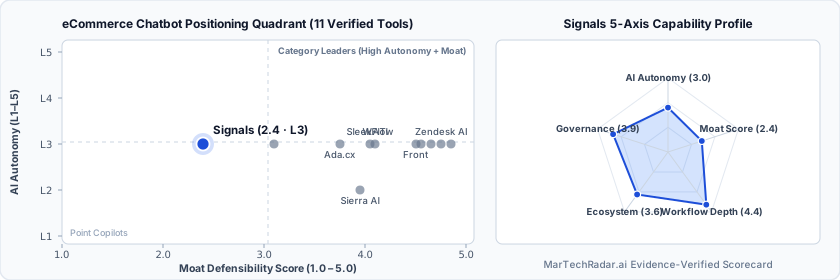
Signals in-depth review, pricing & architecture analysis
Audited by MarTechRadar Research Desk (Evidence-Ledger Verified) on Oct 27, 2026.
What is Signals? Overview & background
Founded in 2025 by Alejandro Zaniolo and Ilya Valmianski and headquartered in San Francisco, California, United States, Signals (returnsignals.com, operating as Return Signals) is a conversational return prevention and post-purchase retention platform for direct-to-consumer ecommerce merchants. Backed by $500K in Pre-Seed funding from Y Combinator and operating with a team of 2-10 employees, the company replaces static self-serve return portals with an interactive AI resolution workflow that engages shoppers at the exact moment they request a refund. Rather than treating product returns as an unavoidable logistics expense where merchants passively issue shipping labels, Signals intercepts the return request to diagnose the underlying customer frustration, resolve product setup or sizing confusion, and convert preventable refunds into retained orders or exchanges.
How Signals works: architecture & workflow
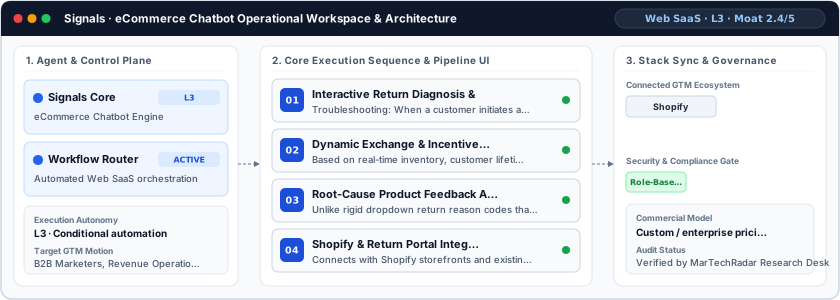
At the technical core of Signals is a multimodal conversational resolution agent trained on a brand's product catalog, sizing charts, troubleshooting manuals, and return policies:
- Interactive Return Diagnosis & Troubleshooting: When a customer initiates a return for electronics, beauty devices, apparel, or home goods, the AI agent asks targeted diagnostic questions to identify whether the issue stems from a fixable misunderstanding, assembly mistake, or sizing mismatch.
- Dynamic Exchange & Incentive Routing: Based on real-time inventory, customer lifetime value, and SKU margin profiles, Signals dynamically offers size or variant exchanges, bonus store credit, partial keep-the-item resolutions, or complementary accessories that address the shopper's specific complaint.
- Root-Cause Product Feedback Aggregation: Unlike rigid dropdown return reason codes that customers click through randomly, the platform extracts structured voice-of-customer insights from natural-language return conversations—alerting merchandising and supplier teams to recurring defects, misleading product descriptions, or sizing chart inaccuracies.
- Shopify & Return Portal Integration: Connects with Shopify storefronts and existing post-purchase logistics workflows so approved returns and exchanges sync automatically with warehouse management and helpdesk systems.
In the ecommerce post-purchase software market, Signals operates as an active conversational intervention layer compared to traditional logistics-first return portals:
- Ideal Fit: Shopify Plus and DTC brands selling technical consumer electronics, apparel, footwear, beauty systems, or multi-step wellness products where high return rates are driven by customer confusion, fit uncertainty, or onboarding friction.
- Where It Is Not Built For: Signals is not built for physical reverse-logistics warehouse freight consolidation, wholesale B2B pallet liquidations, or brick-and-mortar point-of-sale cash register hardware.
- Operational Trade-offs: Overly aggressive retention prompts can frustrate shoppers who have received genuinely damaged merchandise; merchants must configure clear escalation rules so defective-item claims bypass troubleshooting and receive immediate replacement or refund labels.
Signals pricing, plans & cost breakdown
Signals offers custom commercial pricing tailored to monthly order volume and return deflection performance (interested ecommerce brands can book a consultation via returnsignals.com, as public self-serve subscription tiers are not listed on the website). When evaluating Signals vs. Loop Returns, Narvar, or AfterShip Returns, traditional return portals focus primarily on automating RMA label generation and self-serve exchange catalogs after a customer has already decided to send an item back, whereas Signals deploys conversational AI to troubleshoot product usage issues and rescue the original sale before an RMA is ever created.
| Plan / Tier | Verified Price & Billing | Target Seat / Scale Fit | Included Scope & Contract Terms |
|---|---|---|---|
| Enterprise / Custom | Custom quote | 15–50+ seats (Enterprise SLA) | Sales-negotiated annual contract for custom volume, SSO/RBAC governance, and dedicated SLA. |
| Contract Watchout: Credit & Usage Burn Multiplier | Workflows on Signals consume metered credits or usage quotas; voice/media minutes, multi-step synthesis, or high-frequency runs can exhaust base allocations and trigger mid-cycle top-up packs. | ||
How Signals works: architecture & workflow
For DTC retention leaders and ecommerce operations directors looking to protect net revenue margins without degrading customer trust, Signals provides a specialized post-purchase intervention engine. We recommend auditing your top 10 highest-return SKUs and launching a split-test pilot on those product categories to measure saved orders, exchange conversion lift, and post-resolution CSAT scores.
Frequently asked questions about Signals
Does Signals publish pricing or require an enterprise quote?
Signals pricing: Custom / enterprise pricing. No free plan is publicly disclosed. Signals offers custom commercial pricing tailored to monthly order volume and return deflection performance (interested ecommerce brands can book a consultation via `returnsignals.com`, as public self-serve subscription tiers are not listed on the website).
What are the top Signals alternatives in eCommerce Chatbot?
Verified eCommerce Chatbot alternatives include Cenote (Pricing not disclosed), Crisp (Custom / enterprise pricing), Minimal AI ($489–$7,200/mo), Outcraft ($300–$7,840/mo).
Verified sources & evidence trail
- Official product domain: https://www.returnsignals.com
- Commercial pricing verification: Verified against official vendor pricing policy (Custom / enterprise pricing)
- Verified corporate entity profiles (
sameAs): LinkedIn Company Profile · Crunchbase Entity Record - Editorial audit sign-off: Audited by MarTechRadar Research Desk (Evidence-Ledger Verified) on Oct 27, 2026.
