QuickVid Review (2026): Social Media Scheduling Pricing, Pros & Cons
Bottom line
QuickVid is a Web SaaS tool for Social Media Scheduling (Social Media Scheduling & Auto-Publishing) in Social & Influencer. Pricing: Custom / enterprise pricing. Best suited to Creators / Solo. Editor ratings: AI autonomy L3 (conditional automation); moat score 1.9/5.0 (Thin wrapper). Fact-checked by MarTechRadar Research Desk on Oct 16, 2026.
Programmatic video generation and automated social media distribution platform for multi-channel publishing workflows.
Is QuickVid worth it in 2026? Buyer fit & when to walk away
Choose QuickVid if (Best Fit)
- Target ICP & Stack Fit: You operate as Creators / Solo requiring a Web SaaS deployment for Social Media Scheduling.
- L3 Architecture & Defensibility: Maintains an automated multi-channel publishing pipeline integrating media rendering microservices with social scheduling protocols, though limited by early-stage capitalization and platform API dependencies.
- Commercial Model Fit: Your procurement budget aligns with Custom / enterprise pricing.
Walk away from QuickVid if (Deal-Breakers)
- Walk away if you need published self-serve pricing: QuickVid is sold by custom quote.
- Walk away if your workflow cannot tolerate API rate limits: Network-enforced hourly request throttles cause publication delays during high-volume syndication spikes across concurrent client accounts.
- Walk away if token expiration overhead is a deal-breaker for your team: Social platform OAuth refreshes frequently invalidate active connections, requiring manual session re-authentication to prevent failed delivery attempts.
QuickVid pricing, free plan & scorecard at a glance
| Pricing | Custom / enterprise pricing |
|---|---|
| Free plan | No / not disclosed |
| Delivery | Web SaaS |
| Audience | Creators / Solo |
| AI autonomy level | L3 · Conditional automationEditor-verified |
| Moat tier & score | 1.9 / 5.0 · Thin wrapperEditor-verified |
| Funding | Pre-seed |
| Total funding | $125K |
| Headquarters | Mountain View, California, United States |
| Founded | 2020 |
| Last verified | Oct 16, 2026 |
QuickVid pros & cons: strengths vs. operational limitations
Pros: core strengths & capabilities
- Automated social queue scheduling and distribution across major network APIs
- Template-driven synthetic video rendering and format transcoding
- Centralized multi-channel outbound content: orchestration dashboard
- Core capability: Webhook-triggered programmatic publishing pipelines
Cons: operational limitations & risks
- API Rate Limits: Network-enforced hourly request throttles cause publication delays during high-volume syndication spikes across concurrent client accounts.
- Token Expiration Overhead: Social platform OAuth refreshes frequently invalidate active connections, requiring manual session re-authentication to prevent failed delivery attempts.
- Transcoding Latency: Video encoding queues introduce processing lag when multiple high-resolution rendering tasks execute concurrently before scheduled publication windows.
QuickVid TCO & deal-breaker stress test
Simulate 12-month stepped TCO, hidden cost multipliers, contract lock-in exposure, and stack failure modes using only facts verified by MarTechRadar Research Desk on 2026-10-16.
QuickVid triggers high-severity friction under your 5-seat / $800/mo constraints. Benchmark the verified subtrack alternatives below before committing.
- Moat Score
- 1.9 / 5.0
- AI Autonomy
- L3
- Free Tier / Trial
- None disclosed
Triggered audit signals & failure modes
- Opaque Enterprise Quoting vs. SMB/Mid-Market BudgetVerified Pricing Ledger
QuickVid does not disclose a public self-serve floor (Custom / enterprise pricing). Buyers with a $800/mo cap face high sales-qualification friction.
- Sales-Gated Contract TermsFact-checked by MarTechRadar Research Desk
Pricing is available on request through tailored enterprise sales quotes, with custom enterprise tiers structured around organizational scale, user seats, and workflow volume.
- Primary Operational Bottleneck: API Rate LimitsAudit by MarTechRadar Research Desk
Network-enforced hourly request throttles cause publication delays during high-volume syndication spikes across concurrent client accounts.
Test a custom QuickVid budget or stack constraint
Lower 5-seat floor (~$24/mo vs. Custom Quote) · Transparent self-serve entry without mandatory annual lock-in
QuickVid AI moat & Social Media Scheduling positioning
Maintains an automated multi-channel publishing pipeline integrating media rendering microservices with social scheduling protocols, though limited by early-stage capitalization and platform API dependencies.
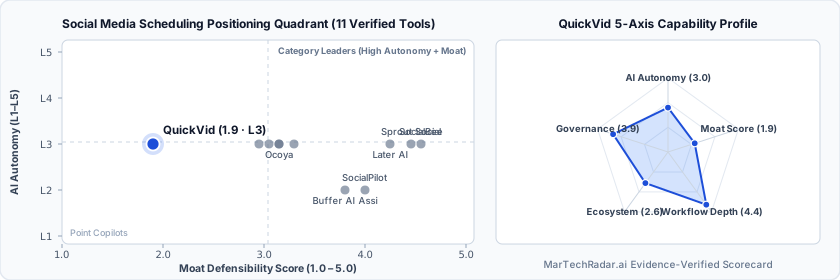
QuickVid in-depth review, pricing & architecture analysis
Editor sign-off: Oct 16, 2026. How profiles are made.
What is QuickVid? Overview & background
Architectured to decouple social content production from manual operational overhead, QuickVid provides programmatic automation for multi-channel social media scheduling and distribution. Established in 2020 and headquartered in Mountain View, California, United States, the company completed an initial capitalization phase of $125K in venture funding. The platform targets growth marketers, digital agency operators, and content distribution teams seeking to automate repetitive cross-network publication pipelines through centralized scheduling logic.
How QuickVid works: architecture & workflow
Under the hood, QuickVid orchestrates automated publishing pipelines through asynchronous worker queues and direct REST API integrations across connected social endpoints. Content payloads—encompassing media assets, post copy, and scheduling metadata—are ingested via dashboard inputs or upstream webhooks. The system executes media formatting, handles required aspect-ratio conversions, and stages assets within a centralized dispatch queue. At scheduled execution timestamps, dispatch workers transmit authenticated payload requests through network endpoints, logging HTTP responses and platform delivery confirmations.
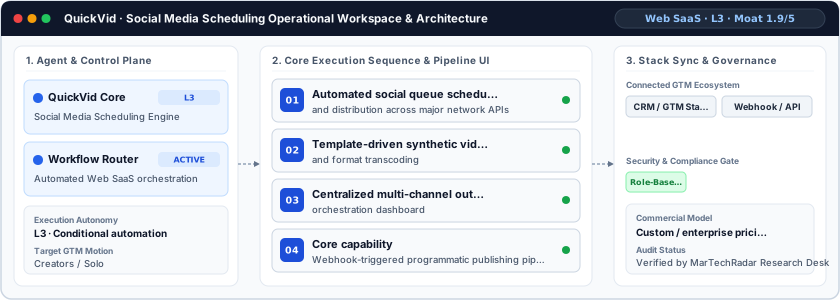
QuickVid limitations, drawbacks & risks
Operational considerations and platform boundaries include:
- API Rate Limits: Network-enforced hourly request throttles cause publication delays during high-volume syndication spikes across concurrent client accounts.
- Token Expiration Overhead: Social platform OAuth refreshes frequently invalidate active connections, requiring manual session re-authentication to prevent failed delivery attempts.
- Transcoding Latency: Video encoding queues introduce processing lag when multiple high-resolution rendering tasks execute concurrently before scheduled publication windows.
QuickVid pricing, plans & cost breakdown
Pricing is available on request through tailored enterprise sales quotes, with custom enterprise tiers structured around organizational scale, user seats, and workflow volume.
| Plan / Tier | Verified Price & Billing | Included Scope & Contract Terms |
|---|---|---|
| Enterprise / Custom | Custom quote | Custom-quoted plan; terms come from the vendor's sales team. |
How QuickVid compares vs. competitors & alternatives
Within social automation, QuickVid contrasts directly with traditional suites like Agorapulse, which emphasize unified engagement inboxes, CRM tagging, and team approval hierarchies over programmatic asset rendering. Compared to emerging automation platforms like Antela.ai, Inc. and Apaya, QuickVid focuses on scripted dispatching workflows rather than conversational inbound management or transactional intelligence. The platform suits growth marketing teams requiring automated, schedule-driven syndication across multi-channel environments without legacy collaboration bloat.
Frequently asked questions about QuickVid
Does QuickVid publish pricing or require an enterprise quote?
QuickVid pricing: Custom / enterprise pricing. No free plan is publicly disclosed. Pricing is available on request through tailored enterprise sales quotes, with custom enterprise tiers structured around organizational scale, user seats, and workflow volume.
What are the top QuickVid alternatives in Social Media Scheduling?
Verified Social Media Scheduling alternatives include Sprout Social AI ($199–$399/seat/mo), Buffer AI Assistant (Free plan · $5–$10/mo), Agorapulse (From $79/seat/mo), GRIN (From $200/mo). Within social automation, QuickVid contrasts directly with traditional suites like Agorapulse, which emphasize unified engagement inboxes, CRM tagging, and team approval hierarchies over programmatic asset rendering.
What are the main limitations and trade-offs of QuickVid?
Operational considerations and platform boundaries include: API Rate Limits: Network-enforced hourly request throttles cause publication delays during high-volume syndication spikes across concurrent client accounts. Walk away if you need published self-serve pricing: QuickVid is sold by custom quote.
Verified sources & evidence trail
- Official product domain: https://quickvid.ai
- Commercial pricing verification: Verified against official vendor pricing policy (Custom / enterprise pricing)
- Editor sign-off: Oct 16, 2026 (how profiles are made).
