Positional.ai Review (2026): Content Optimization Pricing, Pros & Cons
Bottom line
Positional.ai is a Web SaaS tool for Content Optimization (Content Optimization & SERP Intelligence) in GEO & AI SEO. Pricing: Custom / enterprise pricing. Best suited to B2B SaaS. Editor ratings: AI autonomy L2 (workflow copilot); moat score 2.2/5.0 (Workflow-embedded). Fact-checked by MarTechRadar Research Desk on Oct 6, 2026.
Autonomous SEO and SERP intelligence agent orchestrating end-to-end organic search strategy, content drafting, and internal linking workflows.
Is Positional.ai worth it in 2026? Buyer fit & when to walk away
Choose Positional.ai if (Best Fit)
- Target ICP & Stack Fit: You operate as B2B SaaS requiring a Web SaaS deployment for Content Optimization.
- L2 Architecture & Defensibility: Proprietary autonomous agent framework (Sunbeam) combining continuous SERP crawling, automated semantic link insertion, and adaptive organic search strategy generation.
- Commercial Model Fit: Your procurement budget aligns with Custom / enterprise pricing.
Walk away from Positional.ai if (Deal-Breakers)
- Walk away if you need published self-serve pricing: Positional.ai is sold by custom quote.
- Walk away if your workflow cannot tolerate CMS write latency: Automated internal link synchronization requires direct headless or plugin access, introducing update lag during high-frequency editorial publishing cycles.
- Walk away if vector hallucination in niche domains is a deal-breaker for your team: Autonomous topic generation can misinterpret specialized technical terminology when corpus training lacks deep vertical-specific documentation.
Positional.ai pricing, free plan & scorecard at a glance
| Pricing | Custom / enterprise pricing |
|---|---|
| Free plan | No / not disclosed |
| Delivery | Web SaaS |
| Audience | B2B SaaS |
| AI autonomy level | L2 · Workflow copilotEditor-verified |
| Moat tier & score | 2.2 / 5.0 · Workflow-embeddedEditor-verified |
| Funding | Seed |
| Total funding | $2.6MBacked by Lachy Groom, Y Combinator |
| Founders | Matt Lenhard, Nate Matherson |
| Company size | 1-10 employees |
| Governance & docs | Terms ↗ · Privacy ↗ |
| Headquarters | Charleston, SC, United States |
| Founded | 2023 |
| Last verified | Oct 6, 2026 |
Positional.ai pros & cons: strengths vs. operational limitations
Pros: core strengths & capabilities
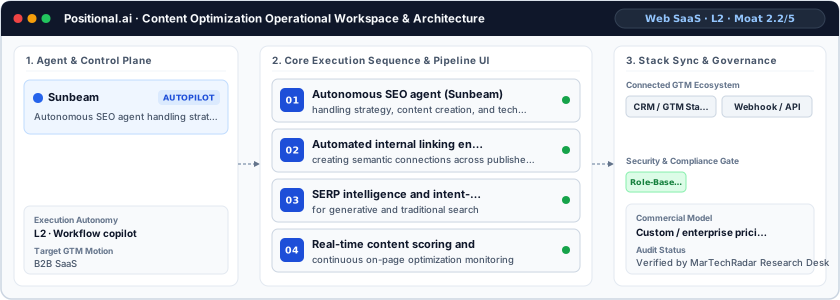
- Autonomous SEO agent (Sunbeam): handling strategy, content creation, and technical optimization
- Automated internal linking engine: creating semantic connections across published content
- SERP intelligence and intent-mapping pipeline: for generative and traditional search
- Real-time content scoring and continuous on-page optimization monitoring
Cons: operational limitations & risks
- CMS write latency: Automated internal link synchronization requires direct headless or plugin access, introducing update lag during high-frequency editorial publishing cycles.
- Vector hallucination in niche domains: Autonomous topic generation can misinterpret specialized technical terminology when corpus training lacks deep vertical-specific documentation.
- SERP volatility calibration: Rapid fluctuations in generative search layouts create delays in the agent's algorithmic recalculation of ranking signals and intent shifts.
Positional.ai TCO & deal-breaker stress test
Simulate 12-month stepped TCO, hidden cost multipliers, contract lock-in exposure, and stack failure modes using only facts verified by MarTechRadar Research Desk on 2026-10-06.
Positional.ai triggers high-severity friction under your 5-seat / $800/mo constraints. Benchmark the verified subtrack alternatives below before committing.
- Moat Score
- 2.2 / 5.0
- AI Autonomy
- L2
- Free Tier / Trial
- None disclosed
Triggered audit signals & failure modes
- Opaque Enterprise Quoting vs. SMB/Mid-Market BudgetVerified Pricing Ledger
Positional.ai does not disclose a public self-serve floor (Custom / enterprise pricing). Buyers with a $800/mo cap face high sales-qualification friction.
- Sales-Gated Contract TermsFact-checked by MarTechRadar Research Desk
Positional.ai delivers its software through custom direct enterprise agreements. Commercial pricing is available on request through tailored enterprise sales quotes based on organizational scale and seats.
- Primary Operational Bottleneck: CMS write latencyAudit by MarTechRadar Research Desk
Automated internal link synchronization requires direct headless or plugin access, introducing update lag during high-frequency editorial publishing cycles.
Test a custom Positional.ai budget or stack constraint
Lower 5-seat floor (~$5/mo vs. Custom Quote) · Transparent self-serve entry without mandatory annual lock-in
Lower 5-seat floor (~$23/mo vs. Custom Quote) · Transparent self-serve entry without mandatory annual lock-in
Positional.ai integrations, API, security & compliance stack
Autonomous SEO agent handling strategy, content creation, and technical optimization
Positional.ai AI moat & Content Optimization positioning
Proprietary autonomous agent framework (Sunbeam) combining continuous SERP crawling, automated semantic link insertion, and adaptive organic search strategy generation.
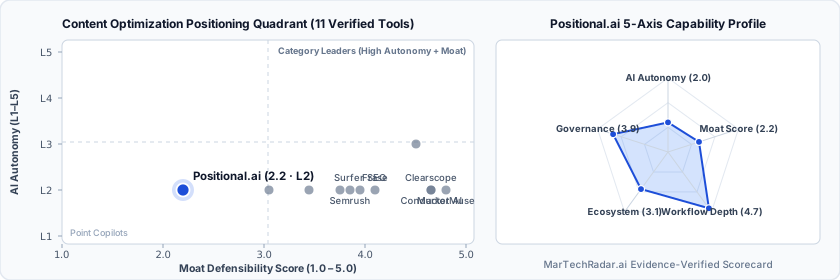
Positional.ai in-depth review, pricing & architecture analysis
Editor sign-off: Oct 6, 2026. How profiles are made.
What is Positional.ai? Overview & background
Rather than assembling an ad-hoc pipeline of disconnected keyword trackers, content editors, and indexing crawlers, software engineering and growth teams increasingly rely on end-to-end agentic platforms. Established in 2023 in Charleston, SC, United States, Positional.ai addresses this operational fragmentation. Supported by $2.6M in seed capital, the company engineers autonomous systems for content operations leaders, organic growth directors, and search marketing specialists tasked with sustaining visibility across traditional and generative search engines.
How Positional.ai works: architecture & workflow
At its core, Positional.ai operates Sunbeam, an agentic engine functioning at Level 2 autonomy that synthesizes SERP intelligence with live content operations. The pipeline continuously crawls search intent indices and competitor footprints to generate strategic topic clusters. Once content parameters are established, the engine analyzes on-page corpus data through vector representations to automate contextual internal linking, technical health tracking, and draft composition without manual keyword stitching.
Positional.ai limitations, drawbacks & risks
Operational considerations and platform boundaries include:
- CMS write latency: Automated internal link synchronization requires direct headless or plugin access, introducing update lag during high-frequency editorial publishing cycles.
- Vector hallucination in niche domains: Autonomous topic generation can misinterpret specialized technical terminology when corpus training lacks deep vertical-specific documentation.
- SERP volatility calibration: Rapid fluctuations in generative search layouts create delays in the agent's algorithmic recalculation of ranking signals and intent shifts.
Positional.ai pricing, plans & cost breakdown
Positional.ai delivers its software through custom direct enterprise agreements. Commercial pricing is available on request through tailored enterprise sales quotes based on organizational scale and seats. Contracts scale according to site footprint, crawled page volume, and the breadth of autonomous agents deployed across digital properties, with procurement teams accessing implementation support via guided software demonstrations.
| Plan / Tier | Verified Price & Billing | Included Scope & Contract Terms |
|---|---|---|
| Enterprise / Custom | Custom quote | Custom-quoted plan; terms come from the vendor's sales team. |
How Positional.ai compares vs. competitors & alternatives
Within the search intelligence category, Positional.ai competes against legacy analytics suites like Ahrefs, as well as specialized operational tools like Surfer SEO and Clearscope within the Content Optimization segment. While Ahrefs provides superior historical backlink indexes and keyword databases, it functions strictly as a diagnostic tool requiring manual human execution. Positional.ai trades substantial static web indexes for closed-loop agentic content generation and automated technical updates, serving scaling digital publishers needing autonomous organic execution.
Frequently asked questions about Positional.ai
Does Positional.ai publish pricing or require an enterprise quote?
Positional.ai pricing: Custom / enterprise pricing. No free plan is publicly disclosed. Positional.ai delivers its software through custom direct enterprise agreements. Commercial pricing is available on request through tailored enterprise sales quotes based on organizational scale and seats.
What are the top Positional.ai alternatives in Content Optimization?
Verified Content Optimization alternatives include Hall (Custom / enterprise pricing), Quattr (Custom / enterprise pricing), FastFix (From $997/mo), SEO Tools MCP by CrakSEO (Free plan · From $5 usage-based). Within the search intelligence category, Positional.ai competes against legacy analytics suites like Ahrefs, as well as specialized operational tools like Surfer SEO and Clearscope within the Content Optimization segment.
What are the main limitations and trade-offs of Positional.ai?
Operational considerations and platform boundaries include: CMS write latency: Automated internal link synchronization requires direct headless or plugin access, introducing update lag during high-frequency editorial publishing cycles. Walk away if you need published self-serve pricing: Positional.ai is sold by custom quote.
Verified sources & evidence trail
- Official product domain: https://positional.com
- Commercial pricing verification: Verified against official vendor pricing policy (Custom / enterprise pricing)
- Verified corporate entity profiles (
sameAs): Crunchbase Entity Record - First-party governance & documentation links: Terms · Privacy
- Editor sign-off: Oct 6, 2026 (how profiles are made).
