Pepper Content Review (2026): AI Content Marketing Pricing, Pros & Cons
Bottom line
Pepper Content is a Web SaaS tool for AI Content Marketing (Enterprise & Long-Form Brand Content) in Copy & Content. Pricing: Custom / enterprise pricing. Best suited to DTC / eCommerce and Enterprise Brands. Editor ratings: AI autonomy L3 (conditional automation); moat score 4.0/5.0 (Proprietary moat). Fact-checked by MarTechRadar Research Desk on Oct 15, 2026.
Agentic content marketing platform pairing autonomous editorial workflows with an integrated human talent network to scale governed long-form enterprise.
Is Pepper Content worth it in 2026? Buyer fit & when to walk away
Choose Pepper Content if (Best Fit)
- Target ICP & Stack Fit: You operate as DTC / eCommerce and Enterprise Brands requiring a Web SaaS deployment for AI Content Marketing.
- L3 Architecture & Defensibility: Pepper Content combines proprietary agentic execution (Agent Atlas) with a vetted global talent marketplace, creating a hybrid operational moat that balances algorithmic speed with human domain verification.
- Commercial Model Fit: Your procurement budget aligns with Custom / enterprise pricing.
Walk away from Pepper Content if (Deal-Breakers)
- Walk away if you need published self-serve pricing: Pepper Content is sold by custom quote.
- Walk away if your workflow cannot tolerate talent matching latency: Hybrid workflows reliant on the talent marketplace introduce variable review lag, creating throughput fluctuations when creator availability fails to match sudden enterprise brief surges.
- Walk away if taxonomy ingestion overhead is a deal-breaker for your team: Calibrating the engine to niche technical vertical vocabularies requires extensive prompt tuning and manual brief structuring during initial enterprise configuration.
Pepper Content pricing, free plan & scorecard at a glance
| Pricing | Custom / enterprise pricing |
|---|---|
| Free plan | No / not disclosed |
| Delivery | Web SaaS |
| Audience | DTC / eCommerce, Enterprise Brands |
| AI autonomy level | L3 · Conditional automationEditor-verified |
| Moat tier & score | 4.0 / 5.0 · Proprietary moatEditor-verified |
| Funding | Venture-backed |
| Total funding | $18.7M |
| Founders | Anirudh Singla, Rishabh Shekhar |
| Company size | 201-500 employees |
| Governance & docs | Terms ↗ · Privacy ↗ |
| Headquarters | San Francisco, California |
| Founded | 2017 |
| Last verified | Oct 15, 2026 |
Pepper Content pros & cons: strengths vs. operational limitations
Pros: core strengths & capabilities
- Agent Atlas autonomous execution engine: for end-to-end content production workflows
- Governed talent marketplace connecting: brand briefs directly to specialized industry creators
- Brand voice enforcement models: calibrating style, tone, and compliance across drafts
- Programmatic brief-to-publish pipelines: with direct content management system integrations
Cons: operational limitations & risks
- Talent Matching Latency: Hybrid workflows reliant on the talent marketplace introduce variable review lag, creating throughput fluctuations when creator availability fails to match sudden enterprise brief surges.
- Taxonomy Ingestion Overhead: Calibrating the engine to niche technical vertical vocabularies requires extensive prompt tuning and manual brief structuring during initial enterprise configuration.
- CMS Serialization Boundaries: Complex multi-layered content payloads experience serialization edge cases when pushing advanced formatting or dynamic schema components into legacy enterprise CMS endpoints.
Pepper Content TCO & deal-breaker stress test
Simulate 12-month stepped TCO, hidden cost multipliers, contract lock-in exposure, and stack failure modes using only facts verified by MarTechRadar Research Desk on 2026-10-15.
Pepper Content triggers high-severity friction under your 5-seat / $800/mo constraints. Benchmark the verified subtrack alternatives below before committing.
- Moat Score
- 4.0 / 5.0
- AI Autonomy
- L3
- Free Tier / Trial
- None disclosed
Triggered audit signals & failure modes
- Opaque Enterprise Quoting vs. SMB/Mid-Market BudgetVerified Pricing Ledger
Pepper Content does not disclose a public self-serve floor (Custom / enterprise pricing). Buyers with a $800/mo cap face high sales-qualification friction.
- Sales-Gated Contract TermsFact-checked by MarTechRadar Research Desk
Pricing is available on request through tailored enterprise sales quotes, with custom enterprise tiers structured around organizational scale, user seats, and workflow volume.
- Primary Operational Bottleneck: Talent Matching LatencyAudit by MarTechRadar Research Desk
Hybrid workflows reliant on the talent marketplace introduce variable review lag, creating throughput fluctuations when creator availability fails to match sudden enterprise brief surges.
Test a custom Pepper Content budget or stack constraint
Lower 5-seat floor (~$149/mo vs. Custom Quote) · Transparent self-serve entry without mandatory annual lock-in
Lower 5-seat floor (~$50/mo vs. Custom Quote) · Transparent self-serve entry without mandatory annual lock-in
Pepper Content AI moat & AI Content Marketing positioning
Pepper Content combines proprietary agentic execution (Agent Atlas) with a vetted global talent marketplace, creating a hybrid operational moat that balances algorithmic speed with human domain verification.
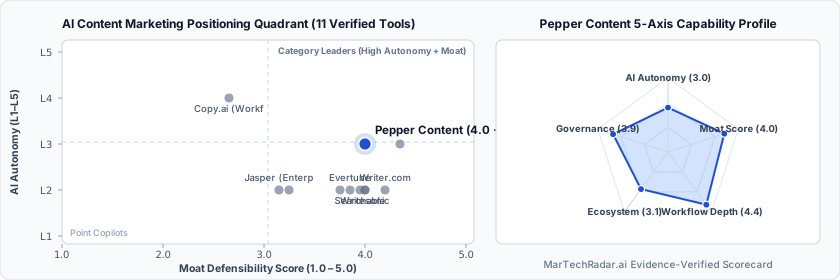
Pepper Content in-depth review, pricing & architecture analysis
Editor sign-off: Oct 15, 2026. How profiles are made.
What is Pepper Content? Overview & background
Architected to solve programmatic scaling constraints in editorial operations, Pepper Content operates as a hybrid content generation platform for corporate marketing teams. Headquartered in San Francisco, California, and established in 2017, the company has raised $18.7M in venture funding to unify autonomous generation with managed creative labor. The system targets content directors and organic growth leaders seeking to bypass standard agency production bottlenecks through direct, governed editorial orchestration.
How Pepper Content works: architecture & workflow
At its architectural core, Pepper Content leverages Agent Atlas, an autonomous workflow engine that translates brand briefs into long-form editorial drafts using tuned generative models. Content pipelines ingest stylistic parameters and technical briefs, parsing them through validation filters before routing drafts through human editors in the built-in talent marketplace. This conditional execution framework continuously scores copy for brand voice coherence, factual density, and editorial structure prior to triggering final publication webhooks.
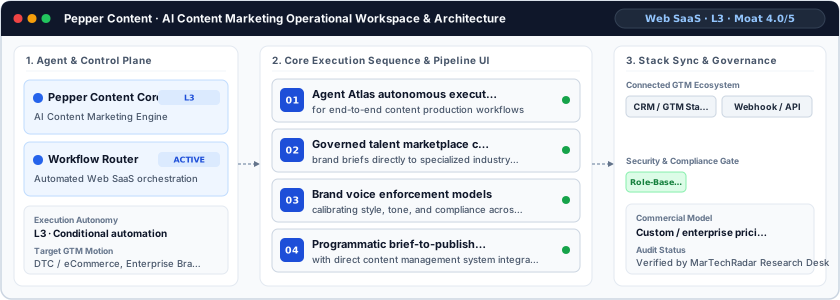
Pepper Content limitations, drawbacks & risks
Operational considerations and platform boundaries include:
- Talent Matching Latency: Hybrid workflows reliant on the talent marketplace introduce variable review lag, creating throughput fluctuations when creator availability fails to match sudden enterprise brief surges.
- Taxonomy Ingestion Overhead: Calibrating the engine to niche technical vertical vocabularies requires extensive prompt tuning and manual brief structuring during initial enterprise configuration.
- CMS Serialization Boundaries: Complex multi-layered content payloads experience serialization edge cases when pushing advanced formatting or dynamic schema components into legacy enterprise CMS endpoints.
Pepper Content pricing, plans & cost breakdown
Pricing is available on request through tailored enterprise sales quotes, with custom enterprise tiers structured around organizational scale, user seats, and workflow volume.
| Plan / Tier | Verified Price & Billing | Included Scope & Contract Terms |
|---|---|---|
| Enterprise / Custom | Custom quote | Custom-quoted plan; terms come from the vendor's sales team. |
How Pepper Content compares vs. competitors & alternatives
Compared to direct category competitors like Typeface and Amdahl, Pepper Content functions as an alternative focused on reliable workflow execution and transparent unit economics within the AI Content Marketing segment.
Frequently asked questions about Pepper Content
Does Pepper Content publish pricing or require an enterprise quote?
Pepper Content pricing: Custom / enterprise pricing. No free plan is publicly disclosed. Pricing is available on request through tailored enterprise sales quotes, with custom enterprise tiers structured around organizational scale, user seats, and workflow volume.
What are the top Pepper Content alternatives in AI Content Marketing?
Verified AI Content Marketing alternatives include NoDesk AI (Custom / enterprise pricing), OmniSignal AI (From $149/mo), Semji (Custom / enterprise pricing), Serpier (Free plan · From €199/mo). Compared to direct category competitors like Typeface and Amdahl, Pepper Content functions as an alternative focused on reliable workflow execution and transparent unit economics within the AI Content Marketing segment.
What are the main limitations and trade-offs of Pepper Content?
Operational considerations and platform boundaries include: Talent Matching Latency: Hybrid workflows reliant on the talent marketplace introduce variable review lag, creating throughput fluctuations when creator availability fails to match sudden enterprise brief surges. Walk away if you need published self-serve pricing: Pepper Content is sold by custom quote.
Verified sources & evidence trail
- Official product domain: https://peppercontent.io
- Commercial pricing verification: Verified against official vendor pricing policy (Custom / enterprise pricing)
- Verified corporate entity profiles (
sameAs): LinkedIn Company Profile · Crunchbase Entity Record - First-party governance & documentation links: Terms · Privacy
- Editor sign-off: Oct 15, 2026 (how profiles are made).
