Pavoot Review (2026): AI SDR Pricing, Limits & Alternatives
Bottom line
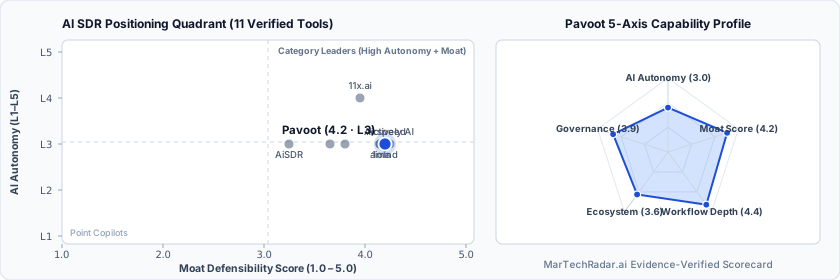
Pavoot is a Web SaaS tool for AI SDR (Autonomous B2B Sales Agents & AI BDRs) in AI SDR & Outbound. Pricing: Custom / enterprise pricing. Best suited to B2B Sales Leaders, SDR/BDR Teams and Revenue Operations (RevOps). Editor ratings: AI autonomy L3 (conditional automation); moat score 4.2/5.0 (Proprietary moat). Fact-checked by Julie Brot on Oct 11, 2026.
Autonomous event curation and outreach platform that identifies target attendees, secures venues, and drives executive attendance for enterprise B2B sales.
Pavoot buyer fit verdict: when to choose vs. when to walk away
Choose Pavoot if (Best Fit)
- Target ICP & Stack Fit: You operate as B2B Sales Leaders, SDR/BDR Teams and Revenue Operations (RevOps) requiring a Web SaaS deployment for AI SDR, with verified ecosystem connectivity for Outreach.
- L3 Architecture & Defensibility: Pavoot builds defensibility through its dual digital-physical execution layer, linking autonomous algorithmic audience curation with real-world venue logistics and tailored executive invitations, creating high-touch executive networking loops that digital-only outreach tools cannot replicate.
- Commercial Model Fit: Your procurement budget aligns with Custom / enterprise pricing.
Walk away from Pavoot if (Deal-Breakers)
- Walk away if you require transparent self-serve monthly billing or your budget ceiling is under $1,000/mo (Pavoot requires sales-gated custom quoting).
- Walk away if your workflow cannot tolerate audience availability ceiling: The autonomous agent depends on target executive density within localized geographic areas, causing invite delivery and attendance rates to degrade sharply outside primary commercial metropolitan hubs.
- Walk away if lead time rigidity is a deal-breaker for your team: Real-world venue booking and executive calendar saturation enforce rigid operational lead times that prevent sudden scope shifts or compressed timeline adjustments once automated outreach commences.
Pavoot key facts & scorecard
| Pricing | Custom / enterprise pricing |
|---|---|
| Free plan | No / not disclosed |
| Delivery | Web SaaS |
| Audience | B2B Sales Leaders, SDR/BDR Teams, Revenue Operations (RevOps) |
| AI autonomy level | L3 · Conditional automationEditor-verified |
| Moat tier & score | 4.2 / 5.0 · Proprietary moatEditor-verified |
| Funding | Pre-seed |
| Total funding | $500KBacked by Y Combinator |
| Founders | Ana Yoon Faria de Lima, Gohar Tamrazyan |
| Company size | 2-10 employees |
| Ecosystem integrations | Outreach |
| Governance & docs | Privacy ↗ |
| Headquarters | San Francisco, California |
| Founded | 2026 |
| Last verified |
Pavoot pros & cons: strengths vs. operational limitations
Pros: core strengths & capabilities
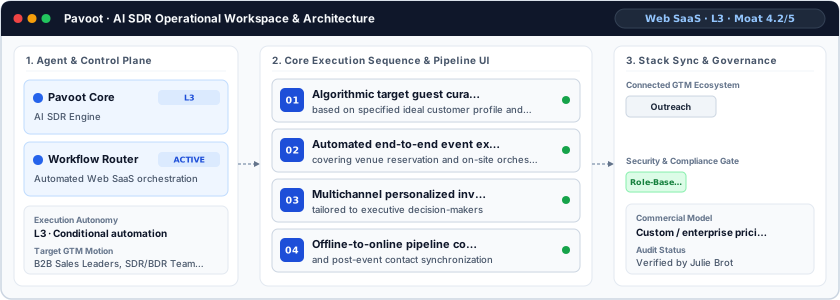
- Algorithmic target guest curation: based on specified ideal customer profile and buyer seniority
- Automated end-to-end event execution: covering venue reservation and on-site orchestration
- Multichannel personalized invitation sequencing: tailored to executive decision-makers
- Offline-to-online pipeline conversion tracking: and post-event contact synchronization
Cons: operational limitations & risks
- Audience Availability Ceiling: The autonomous agent depends on target executive density within localized geographic areas, causing invite delivery and attendance rates to degrade sharply outside primary commercial metropolitan hubs.
- Lead Time Rigidity: Real-world venue booking and executive calendar saturation enforce rigid operational lead times that prevent sudden scope shifts or compressed timeline adjustments once automated outreach commences.
- Enrichment Data Gaps: Guest matching mechanisms rely on external professional identity providers, exposing users to profile misclassification or deliverability drops when targeting niche technical leadership niches.
Pavoot TCO & deal-breaker stress test
Simulate 12-month stepped TCO, hidden cost multipliers, contract lock-in exposure, and stack failure modes using only facts verified by Julie Brot on · Capture SHA 646b77d3.
Pavoot triggers high-severity friction under your 5-seat / $800/mo constraints. Benchmark the verified subtrack alternatives below before committing.
| Plan / Tier | Verified Rate | Scale Fit | Scope & Quota Notes |
|---|---|---|---|
| Enterprise / Custom | Custom quote | 15–50+ seats (Enterprise SLA) | Sales-negotiated annual contract for custom volume, SSO/RBAC governance, and dedicated SLA. |
- Moat Score
- 4.2 / 5.0
- AI Autonomy
- L3
- Free Tier / Trial
- None disclosed
Triggered audit signals & failure modes
- Opaque Enterprise Quoting vs. SMB/Mid-Market BudgetVerified Pricing Ledger
Pavoot does not disclose a public self-serve floor (Custom / enterprise pricing). Buyers with a $800/mo cap face high sales-qualification friction.
- Sales-Gated Contract TermsFact-checked by Julie Brot
Pavoot provides custom enterprise pricing available on request through tailored enterprise sales quotes based on organizational scale, target event volume, and user seats.
- Primary Operational Bottleneck: Audience Availability CeilingAudit by Julie Brot
The autonomous agent depends on target executive density within localized geographic areas, causing invite delivery and attendance rates to degrade sharply outside primary commercial metropolitan hubs.
Hidden TCO Multipliers & Quota Gates
- Audience Availability Ceiling: The autonomous agent depends on target executive density within localized geographic areas, causing invite delivery and attendance rates to degrade sharply outside primary commercial metropolitan hubs.
- Lead Time Rigidity: Real-world venue booking and executive calendar saturation enforce rigid operational lead times that prevent sudden scope shifts or compressed timeline adjustments once automated outreach commences.
When to Walk Away & Negotiation Levers
- Walk away if you require transparent self-serve monthly billing or your budget ceiling is under $1,000/mo (Pavoot requires sales-gated custom quoting).
- Walk away if your workflow cannot tolerate audience availability ceiling: The autonomous agent depends on target executive density within localized geographic areas, causing invite delivery and attendance rates to degrade sharply outside primary commercial metropolitan hubs.
- Walk away if lead time rigidity is a deal-breaker for your team: Real-world venue booking and executive calendar saturation enforce rigid operational lead times that prevent sudden scope shifts or compressed timeline adjustments once automated outreach commences.
- Demand a 30- to 60-day paid pilot opt-out clause in the Pavoot order form before signing a 12-month enterprise commitment.
- Require a sandbox proof-of-concept testing audience availability ceiling against your live CRM/data schema before annual sign-off.
Ask a custom procurement or TCO stress-test question about Pavoot
Lower 5-seat floor (~$49/mo vs. Custom Quote) · Transparent self-serve entry without mandatory annual lock-in
Lower 5-seat floor (~$39/mo vs. Custom Quote) · Transparent self-serve entry without mandatory annual lock-in
Pavoot key entities, modules & ecosystem stack
Pavoot moat & subtrack positioning
Pavoot builds defensibility through its dual digital-physical execution layer, linking autonomous algorithmic audience curation with real-world venue logistics and tailored executive invitations, creating high-touch executive networking loops that digital-only outreach tools cannot replicate.
Editorial review
Fact-checked by Julie Brot (Enterprise SaaS Governance & Procurement Editor) on .
Background
Field marketing teams and enterprise sales leaders often invest heavily in executive roundtables and VIP dinners yet struggle with the operational drag of guest list curation, venue logistics, and low conversion rates. Pavoot, founded in 2026 and headquartered in San Francisco, California, develops an autonomous pipeline generation platform designed to resolve this coordination overhead. Having raised $500K in early-stage financing, the company combines targeted prospecting automation with physical gathering management to help revenue teams turn executive networking into measurable pipeline.
How Pavoot works
Operating at an L3 autonomy profile, Pavoot shifts event orchestration from manual coordination to supervised execution. Revenue teams input target account lists, buyer personas, and geographic constraints. Pavoot’s agentic pipeline parses the ideal customer profile, queries business identity databases, matches verified executives, and autonomously issues customized multi-touch outreach sequences. Simultaneously, the platform manages venue sourcing and attendance confirmation workflows. Once an event concludes, attendee interactions and engagement metadata sync directly back to central customer data environments for structured pipeline attribution.
Limitations
Operational considerations and platform boundaries include:
- Audience Availability Ceiling: The autonomous agent depends on target executive density within localized geographic areas, causing invite delivery and attendance rates to degrade sharply outside primary commercial metropolitan hubs.
- Lead Time Rigidity: Real-world venue booking and executive calendar saturation enforce rigid operational lead times that prevent sudden scope shifts or compressed timeline adjustments once automated outreach commences.
- Enrichment Data Gaps: Guest matching mechanisms rely on external professional identity providers, exposing users to profile misclassification or deliverability drops when targeting niche technical leadership niches.
Pavoot pricing
Pavoot provides custom enterprise pricing available on request through tailored enterprise sales quotes based on organizational scale, target event volume, and user seats. Engagements typically reflect contracted event tiers and bespoke logistical scopes, with no open self-serve recurring subscription published.
How Pavoot compares
Within the autonomous outreach ecosystem, competitors such as 11x.ai, 1mind, and Actively AI concentrate on fully digital inbound qualification, digital SDR workflows, and automated email inbox outreach. Pavoot differentiates by coupling agentic prospecting with in-person event execution, transforming raw prospect interaction into intimate executive roundtables. This makes the platform ideal for enterprise revenue organizations pursuing high-contract-value accounts where digital messaging alone fails to engage executive decision-makers.
Frequently asked questions about Pavoot
How much does Pavoot cost and does it require a custom enterprise quote?
Published pricing summary for Pavoot: Custom / enterprise pricing. A permanent free plan is not disclosed for Pavoot. Pavoot provides custom enterprise pricing available on request through tailored enterprise sales quotes based on organizational scale, target event volume, and user seats. Engagements typically reflect contracted event tiers and bespoke logistical scopes, with no open self-serve recurring subscription published.
How does Pavoot work and how autonomous is its AI architecture?
Autonomous event curation and outreach platform that identifies target attendees, secures venues, and drives executive attendance for enterprise B2B sales. Within AI SDR (Autonomous B2B Sales Agents & AI BDRs), MarTechRadar rates its execution architecture at L3 · Conditional automation with a verified Moat Score of 4.2 / 5.0 (Proprietary moat). Pavoot builds defensibility through its dual digital-physical execution layer, linking autonomous algorithmic audience curation with real-world venue logistics and tailored executive invitations, creating high-touch executive networking loops that digital-only outreach tools cannot replicate. Corporate profile: Founded by Ana Yoon Faria de Lima, Gohar Tamrazyan, operating at 2-10 employees scale.
What are the main limitations of Pavoot and when should buyers walk away?
Based on our editorial technical audit, key operational considerations and boundaries for Pavoot include: (1) Audience Availability Ceiling: The autonomous agent depends on target executive density within localized geographic areas, causing invite delivery and attendance rates to degrade sharply outside primary commercial metropolitan hubs. (2) Lead Time Rigidity: Real-world venue booking and executive calendar saturation enforce rigid operational lead times that prevent sudden scope shifts or compressed timeline adjustments once automated outreach commences. (3) Enrichment Data Gaps: Guest matching mechanisms rely on external professional identity providers, exposing users to profile misclassification or deliverability drops when targeting niche technical leadership niches. Primary procurement walk-away rule: Walk away if you require transparent self-serve monthly billing or your budget ceiling is under $1,000/mo (Pavoot requires sales-gated custom quoting).
What integrations, compliance certifications, and contract terms apply to Pavoot?
Verified ecosystem and stack integrations include Outreach. Key TCO multiplier to watch: Audience Availability Ceiling (The autonomous agent depends on target executive density within localized geographic areas, causing invite delivery and attendance rates to degrade sharply outside primary commercial metropolitan hubs.) Before signing a contract, procurement teams should demand a 30- to 60-day paid pilot opt-out clause in the Pavoot order form before signing a 12-month enterprise commitment.
What are the best Pavoot alternatives and head-to-head competitors in 2026?
Top fact-checked alternatives to Pavoot in AI SDR (Autonomous B2B Sales Agents & AI BDRs) include Orange Slice (Custom / enterprise pricing), Letter AI (Custom / enterprise pricing), Nex.ai (From $49/mo), Pepper (Custom / enterprise pricing). Within the autonomous outreach ecosystem, competitors such as 11x.ai, 1mind, and Actively AI concentrate on fully digital inbound qualification, digital SDR workflows, and automated email inbox outreach.
Verified sources & evidence trail
- Official product domain: https://pavoot.com
- Commercial pricing verification: Verified against official vendor pricing policy (Custom / enterprise pricing)
- Verified corporate entity profiles (
sameAs): LinkedIn Company Profile · Crunchbase Entity Record - First-party governance & documentation links: Privacy
- Editorial audit sign-off: Fact-checked by Julie Brot on under the MarTechRadar Evidence-Ledger Protocol.