Sapien Review (2026): Predictive AI Pricing, Limits & Alternatives
Bottom line
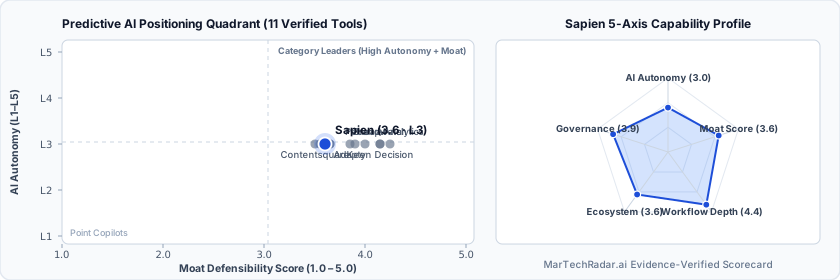
Sapien is a Web SaaS tool for Predictive AI (Predictive LTV, Churn & Customer Analytics) in Analytics & Attribution. Pricing: Pricing not disclosed. Best suited to B2B SaaS and Marketing & Growth Teams. Editor ratings: AI autonomy L3 (conditional automation); moat score 3.6/5.0 (Proprietary moat). Fact-checked by Anthony Hay on Oct 16, 2026.
Synthetic population simulation platform using calibrated behavioral AI agent populations to predict audience responses to products, prices, and campaigns.
Sapien buyer fit verdict: when to choose vs. when to walk away
Choose Sapien if (Best Fit)
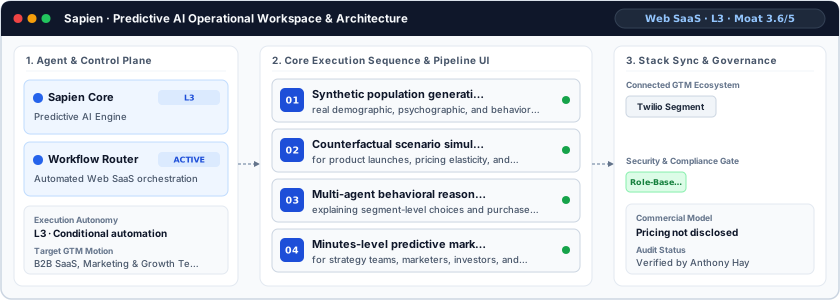
- Target ICP & Stack Fit: You operate as B2B SaaS and Marketing & Growth Teams requiring a Web SaaS deployment for Predictive AI, with verified ecosystem connectivity for Twilio Segment.
- L3 Architecture & Defensibility: Calibrating large-scale multi-agent synthetic populations against census, psychographic, and behavioral datasets enables instant counterfactual market testing without human panel latency.
- Commercial Model Fit: Your procurement budget aligns with Pricing not disclosed.
Walk away from Sapien if (Deal-Breakers)
- Walk away if you require transparent self-serve monthly billing or your budget ceiling is under $1,000/mo (Sapien requires sales-gated custom quoting).
- Walk away if your workflow cannot tolerate out-of-distribution behavioral hallucination risk: A fundamental modeling limitation of synthetic populations is that LLM-driven agents anchored on historical data struggle with novel cultural trends or unprecedented product categories, creating a hallucination and calibration boundary compared to live human buyers.
- Walk away if niche B2B persona cold start bottleneck is a deal-breaker for your team: Simulating specialized enterprise technical buyers where public psychographic training data is sparse introduces a calibration cold start bottleneck and validation friction.
Sapien key facts & scorecard
| Pricing | Pricing not disclosed |
|---|---|
| Free plan | No / not disclosed |
| Delivery | Web SaaS |
| Audience | B2B SaaS, Marketing & Growth Teams |
| AI autonomy level | L3 · Conditional automationEditor-verified |
| Moat tier & score | 3.6 / 5.0 · Proprietary moatEditor-verified |
| Funding | Pre-seed |
| Total funding | $500K |
| Founders | Ahmed ElShireef, Saif Elhager |
| Company size | 2-10 employees |
| Ecosystem integrations | Twilio Segment |
| Governance & docs | Terms ↗ · Privacy ↗ |
| Headquarters | San Francisco, California |
| Founded | 2025 |
| Last verified |
Sapien pros & cons: strengths vs. operational limitations
Pros: core strengths & capabilities
- Synthetic population generation modeling: real demographic, psychographic, and behavioral distributions
- Counterfactual scenario simulation: for product launches, pricing elasticity, and advertising campaigns
- Multi-agent behavioral reasoning engine: explaining segment-level choices and purchase drivers
- Minutes-level predictive market readouts: for strategy teams, marketers, investors, and policy analysts
Cons: operational limitations & risks
- Out-of-Distribution Behavioral Hallucination Risk: A fundamental modeling limitation of synthetic populations is that LLM-driven agents anchored on historical data struggle with novel cultural trends or unprecedented product categories, creating a hallucination and calibration boundary compared to live human buyers.
- Niche B2B Persona Cold Start Bottleneck: Simulating specialized enterprise technical buyers where public psychographic training data is sparse introduces a calibration cold start bottleneck and validation friction.
- Executive Trust Governance Barrier: Enterprise insight leaders accustomed to audited human sample panels often face an internal governance barrier and methodological learning curve before relying on synthetic predictions for high-budget media commitments.
Sapien TCO & deal-breaker stress test
Simulate 12-month stepped TCO, hidden cost multipliers, contract lock-in exposure, and stack failure modes using only facts verified by Anthony Hay on · Capture SHA 15eb570d.
Sapien triggers high-severity friction under your 5-seat / $800/mo constraints. Benchmark the verified subtrack alternatives below before committing.
| Plan / Tier | Verified Rate | Scale Fit | Scope & Quota Notes |
|---|---|---|---|
| Enterprise / Custom | Custom quote | 15–50+ seats (Enterprise SLA) | Sales-negotiated annual contract for custom volume, SSO/RBAC governance, and dedicated SLA. |
- Moat Score
- 3.6 / 5.0
- AI Autonomy
- L3
- Free Tier / Trial
- None disclosed
Triggered audit signals & failure modes
- Opaque Enterprise Quoting vs. SMB/Mid-Market BudgetVerified Pricing Ledger
Sapien does not disclose a public self-serve floor (Pricing not disclosed). Buyers with a $800/mo cap face high sales-qualification friction.
- Sales-Gated Contract TermsFact-checked by Anthony Hay
Pricing is available on request through enterprise sales quotes, with customized tiers based on seat counts or usage volume. Organizations can book a live demonstration directly through the Sapien website to scope custom synthetic population calibration and simulation capacity.
- Primary Operational Bottleneck: Executive Trust Governance BarrierAudit by Anthony Hay
Enterprise insight leaders accustomed to audited human sample panels often face an internal governance barrier and methodological learning curve before relying on synthetic predictions for high-budget media commitments.
Hidden TCO Multipliers & Quota Gates
- Out-of-Distribution Behavioral Hallucination Risk: A fundamental modeling limitation of synthetic populations is that LLM-driven agents anchored on historical data struggle with novel cultural trends or unprecedented product categories, creating a hallucination and calibration boundary compared to live human buyers.
- Niche B2B Persona Cold Start Bottleneck: Simulating specialized enterprise technical buyers where public psychographic training data is sparse introduces a calibration cold start bottleneck and validation friction.
When to Walk Away & Negotiation Levers
- Walk away if you require transparent self-serve monthly billing or your budget ceiling is under $1,000/mo (Sapien requires sales-gated custom quoting).
- Walk away if your workflow cannot tolerate out-of-distribution behavioral hallucination risk: A fundamental modeling limitation of synthetic populations is that LLM-driven agents anchored on historical data struggle with novel cultural trends or unprecedented product categories, creating a hallucination and calibration boundary compared to live human buyers.
- Walk away if niche B2B persona cold start bottleneck is a deal-breaker for your team: Simulating specialized enterprise technical buyers where public psychographic training data is sparse introduces a calibration cold start bottleneck and validation friction.
- Demand a 30- to 60-day paid pilot opt-out clause in the Sapien order form before signing a 12-month enterprise commitment.
- Require a sandbox proof-of-concept testing out-of-distribution behavioral hallucination risk against your live CRM/data schema before annual sign-off.
Ask a custom procurement or TCO stress-test question about Sapien
Offers a free tier (Free plan · $0/mo · Enterprise plan) · Transparent self-serve entry without mandatory annual lock-in
Verified Predictive AI peer (Pricing not disclosed · Moat 4.0/5.0)
Sapien key entities, modules & ecosystem stack
Sapien moat & subtrack positioning
Calibrating large-scale multi-agent synthetic populations against census, psychographic, and behavioral datasets enables instant counterfactual market testing without human panel latency.
Editorial review
Fact-checked by Anthony Hay (Senior SEO, Search Intelligence & Content Operations Editor) on .
Background
Founded in 2025 by Saif Elhager and Ahmed ElShireef and headquartered in San Francisco, California, Sapien (usesapien.com, originally launched as Outrove) is an AI-powered market research and synthetic population simulation platform built for brand strategists, product marketers, institutional investors, and policy decision-makers. Operating with a team of 2 to 10 employees and backed by $500K in Pre-Seed funding from Y Combinator (S25), the company replaces traditional self-reported surveys and small focus groups with large-scale behavioral simulations that predict how entire target markets will react before a decision goes live.
How Sapien works
Sapien operates at Level 3 autonomy through a multi-agent simulation architecture anchored on census distributions, socioeconomic telemetry, and behavioral conditioning pipelines. Rather than asking a small sample of human respondents to speculate on their future behavior, the platform instantiates thousands of calibrated AI agents that model specific audience personas and decision heuristics. Users submit a concrete scenario—such as testing a new subscription price tier, comparing two ad campaign positioning angles, or evaluating a product launch—and Sapien executes parallel agent simulations to generate a quantitative and qualitative prediction of segment adoption, switching behavior, and underlying objections within minutes.
Limitations
Operational limitations and technical trade-offs include:
- Out-of-Distribution Behavioral Hallucination Risk: A fundamental modeling limitation of synthetic populations is that LLM-driven agents anchored on historical data struggle with novel cultural trends or unprecedented product categories, creating a hallucination and calibration boundary compared to live human buyers.
- Niche B2B Persona Cold Start Bottleneck: Simulating specialized enterprise technical buyers where public psychographic training data is sparse introduces a calibration cold start bottleneck and validation friction.
- Executive Trust Governance Barrier: Enterprise insight leaders accustomed to audited human sample panels often face an internal governance barrier and methodological learning curve before relying on synthetic predictions for high-budget media commitments.
Sapien pricing
Pricing is available on request through enterprise sales quotes, with customized tiers based on seat counts or usage volume. Organizations can book a live demonstration directly through the Sapien website to scope custom synthetic population calibration and simulation capacity.
How Sapien compares
Within the Market Intelligence, Competitive & Consumer Research category, Sapien competes against consumer insight alternatives such as Conveo, Motives, and Voicepanel. Versus human-in-the-loop interviewing platforms like Conveo and Motives that use AI to moderate calls with real people, Sapien differentiates itself by simulating entire synthetic populations to deliver zero-latency counterfactual predictions on pricing, product, and campaign decisions. Strategy teams and investors requiring instant pre-launch scenario modeling choose Sapien, while teams needing verbatim human video testimonials pair it with live interview tools.
Frequently asked questions about Sapien
How much does Sapien cost and does it require a custom enterprise quote?
Published pricing summary for Sapien: Pricing not disclosed. A permanent free plan is not disclosed for Sapien. Pricing is available on request through enterprise sales quotes, with customized tiers based on seat counts or usage volume. Organizations can book a live demonstration directly through the Sapien website to scope custom synthetic population calibration and simulation capacity.
How does Sapien work and how autonomous is its AI architecture?
Synthetic population simulation platform using calibrated behavioral AI agent populations to predict audience responses to products, prices, and campaigns. Within Predictive AI (Predictive LTV, Churn & Customer Analytics), MarTechRadar rates its execution architecture at L3 · Conditional automation with a verified Moat Score of 3.6 / 5.0 (Proprietary moat). Calibrating large-scale multi-agent synthetic populations against census, psychographic, and behavioral datasets enables instant counterfactual market testing without human panel latency. Corporate profile: Founded by Ahmed ElShireef, Saif Elhager, operating at 2-10 employees scale.
What are the main limitations of Sapien and when should buyers walk away?
Based on our editorial technical audit, key operational considerations and boundaries for Sapien include: (1) Out-of-Distribution Behavioral Hallucination Risk: A fundamental modeling limitation of synthetic populations is that LLM-driven agents anchored on historical data struggle with novel cultural trends or unprecedented product categories, creating a hallucination and calibration boundary compared to live human buyers. (2) Niche B2B Persona Cold Start Bottleneck: Simulating specialized enterprise technical buyers where public psychographic training data is sparse introduces a calibration cold start bottleneck and validation friction. (3) Executive Trust Governance Barrier: Enterprise insight leaders accustomed to audited human sample panels often face an internal governance barrier and methodological learning curve before relying on synthetic predictions for high-budget media commitments. Primary procurement walk-away rule: Walk away if you require transparent self-serve monthly billing or your budget ceiling is under $1,000/mo (Sapien requires sales-gated custom quoting).
What integrations, compliance certifications, and contract terms apply to Sapien?
Verified ecosystem and stack integrations include Twilio Segment. Key TCO multiplier to watch: Out-of-Distribution Behavioral Hallucination Risk (A fundamental modeling limitation of synthetic populations is that LLM-driven agents anchored on historical data struggle with novel cultural trends or unprecedented product categories, creating a hallucination and calibration boundary compared to live human buyers.) Before signing a contract, procurement teams should demand a 30- to 60-day paid pilot opt-out clause in the Sapien order form before signing a 12-month enterprise commitment.
What are the best Sapien alternatives and head-to-head competitors in 2026?
Top fact-checked alternatives to Sapien in Predictive AI (Predictive LTV, Churn & Customer Analytics) include Motives (Pricing not disclosed), Conveo (Pricing not disclosed), Voicepanel (Pricing not disclosed), Gainsight (Pricing not disclosed). Within the Market Intelligence, Competitive & Consumer Research category, Sapien competes against consumer insight alternatives such as Conveo, Motives, and Voicepanel.
Verified sources & evidence trail
- Official product domain: https://www.asksapien.ai/
- Commercial pricing verification: Verified against official vendor pricing policy (Pricing not disclosed)
- Verified corporate entity profiles (
sameAs): LinkedIn Company Profile · Crunchbase Entity Record - First-party governance & documentation links: Terms · Privacy
- Editorial audit sign-off: Fact-checked by Anthony Hay on under the MarTechRadar Evidence-Ledger Protocol.