Origami Review (2026): AI SDR Pricing, Limits & Alternatives
Bottom line
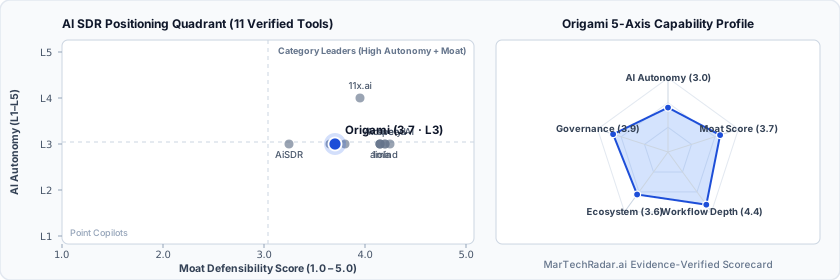
Origami is a Web SaaS tool for AI SDR (Autonomous B2B Sales Agents & AI BDRs) in AI SDR & Outbound. Pricing: $0/mo. Best suited to B2B SaaS and Marketing & Growth Teams. Editor ratings: AI autonomy L3 (conditional automation); moat score 3.7/5.0 (Proprietary moat). Fact-checked by Jagmeet Sine on Oct 16, 2026.
Domain-driven autonomous customer acquisition agent that researches ideal buyers, builds enriched lead lists, and executes self-improving outbound campaigns.
Origami buyer fit verdict: when to choose vs. when to walk away
Choose Origami if (Best Fit)
- Target ICP & Stack Fit: You operate as B2B SaaS and Marketing & Growth Teams requiring a Web SaaS deployment for AI SDR, with verified ecosystem connectivity for Outreach.
- L3 Architecture & Defensibility: Training self-improving buyer discovery and outbound campaign models across more than 10,000 active businesses compounds conversion feedback loops from a single domain input.
- Commercial Model Fit: Your procurement budget aligns with $0/mo and want trial evaluation before contract sign-off.
Walk away from Origami if (Deal-Breakers)
- Walk away if your workflow requires uncapped enterprise volume on the $0/mo entry plan without upgrading tiers.
- Walk away if your workflow cannot tolerate auto top-up credit consumption risk: Because deep buyer discovery, contact exports, and AI model reasoning consume monthly credits (with optional auto top-up), broad unsegmented searches can deplete credit allowances rapidly if spending caps are not configured.
- Walk away if complex multi-stakeholder enterprise boundary is a deal-breaker for your team: While one-click domain-to-outbound automation excels for SMB and mid-market B2B sales, seven-figure enterprise procurement cycles involving custom RFPs require human multi-threading beyond automated email sequences.
Origami key facts & scorecard
| Pricing | $0/moVendor pricing page |
|---|---|
| Free plan | No / not disclosed |
| Delivery | Web SaaS |
| Audience | B2B SaaS, Marketing & Growth Teams |
| AI autonomy level | L3 · Conditional automationEditor-verified |
| Moat tier & score | 3.7 / 5.0 · Proprietary moatEditor-verified |
| Funding | Undisclosed |
| Total funding | $2.5M |
| Founders | Finn Mallery, Kenson Chung |
| Company size | 11-50 employees |
| Ecosystem integrations | Outreach |
| Governance & docs | API & Docs ↗ · Changelog ↗ · Terms ↗ · Privacy ↗ |
| Headquarters | San Francisco, California |
| Founded | 2024 |
| Last verified |
Origami pros & cons: strengths vs. operational limitations
Pros: core strengths & capabilities
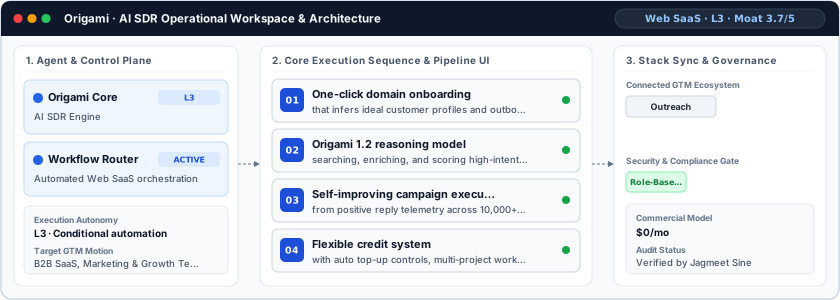
- One-click domain onboarding: that infers ideal customer profiles and outbound angles automatically
- Origami 1.2 reasoning model: searching, enriching, and scoring high-intent B2B buyer contacts
- Self-improving campaign execution learning: from positive reply telemetry across 10,000+ businesses
- Flexible credit system: with auto top-up controls, multi-project workspaces, and CRM exports
Cons: operational limitations & risks
- Auto Top-Up Credit Consumption Risk: Because deep buyer discovery, contact exports, and AI model reasoning consume monthly credits (with optional auto top-up), broad unsegmented searches can deplete credit allowances rapidly if spending caps are not configured.
- Complex Multi-Stakeholder Enterprise Boundary: While one-click domain-to-outbound automation excels for SMB and mid-market B2B sales, seven-figure enterprise procurement cycles involving custom RFPs require human multi-threading beyond automated email sequences.
- Deliverability & Domain Reputation Governance: Launching autonomous campaigns from newly registered domains without warm-up discipline introduces inbox placement friction and a sender-reputation governance barrier.
Origami TCO & deal-breaker stress test
Simulate 12-month stepped TCO, hidden cost multipliers, contract lock-in exposure, and stack failure modes using only facts verified by Jagmeet Sine on · Capture SHA bf37a0c9.
Origami is viable for 5 seats, but requires commercial or technical verification on the flagged items below.
| Plan / Tier | Verified Rate | Scale Fit | Scope & Quota Notes |
|---|---|---|---|
| Unlimited | $2/mo | 1–2 seats | 5 email + 3 LinkedIn senders included |
| Growth / Professional | $3.2/mo | 5 seats | Top-up credits · $18 per 1,000 |
| Scale / Advanced | $3.6/mo | 15 seats | Top-up credits · $20 per 1,000 |
- Moat Score
- 3.7 / 5.0
- AI Autonomy
- L3
- Free Tier / Trial
- Free trial
Triggered audit signals & failure modes
- Opaque Enterprise Quoting vs. SMB/Mid-Market BudgetVerified Pricing Ledger
Origami does not disclose a public self-serve floor ($0/mo). Buyers with a $800/mo cap face high sales-qualification friction.
- Published Self-Serve Entry FloorVerified Pricing Ledger
Origami publishes a transparent entry point ($0/mo) with a free trial for initial validation before committing.
- Tier Fit for 5-Seat Scale: Unlimited ($2/mo)Verified Tier Schedule
5 email + 3 LinkedIn senders included
- Primary Operational Bottleneck: Auto Top-Up Credit Consumption RiskAudit by Jagmeet Sine
Because deep buyer discovery, contact exports, and AI model reasoning consume monthly credits (with optional auto top-up), broad unsegmented searches can deplete credit allowances rapidly if spending caps are not configured.
Hidden TCO Multipliers & Quota Gates
- Per-Seat Linear Scaling: Origami prices licenses on a per-user/seat basis ($0/mo); expanding from 2 to 15+ operators multiplies base recurring spend linearly.
- Credit & Usage Burn Multiplier: Automated workflows consume metered credits/usage quotas; multi-step enrichment, voice minutes, or high-frequency agent runs can trigger mid-cycle top-up packs.
- Enterprise Governance & Add-On Gating: Advanced capabilities such as Single Sign-On (SSO), custom role permissions, or specialized analytics modules are gated behind upper tiers or paid add-ons.
When to Walk Away & Negotiation Levers
- Walk away if your workflow requires uncapped enterprise volume on the $0/mo entry plan without upgrading tiers.
- Walk away if your workflow cannot tolerate auto top-up credit consumption risk: Because deep buyer discovery, contact exports, and AI model reasoning consume monthly credits (with optional auto top-up), broad unsegmented searches can deplete credit allowances rapidly if spending caps are not configured.
- Walk away if complex multi-stakeholder enterprise boundary is a deal-breaker for your team: While one-click domain-to-outbound automation excels for SMB and mid-market B2B sales, seven-figure enterprise procurement cycles involving custom RFPs require human multi-threading beyond automated email sequences.
- Validate exact quota thresholds (seats, credits, or API calls) included in Origami's $0/mo tier before converting from monthly to annual billing.
- Require a sandbox proof-of-concept testing auto top-up credit consumption risk against your live CRM/data schema before annual sign-off.
Ask a custom procurement or TCO stress-test question about Origami
Lower 5-seat floor (~$25/mo vs. Custom Quote)
Lower 5-seat floor (~$404/mo vs. Custom Quote)
Origami key entities, modules & ecosystem stack
Origami moat & subtrack positioning
Training self-improving buyer discovery and outbound campaign models across more than 10,000 active businesses compounds conversion feedback loops from a single domain input.
Editorial review
Fact-checked by Jagmeet Sine (Senior MarTech Infrastructure & Agentic Workflow Architect) on .
Background
Founded in 2024 by Finn Mallery and Kenson Chung and headquartered in San Francisco, California, Origami (origami.chat, tracked as origami-2) is an autonomous AI customer acquisition and outbound prospecting platform built for B2B founders, growth marketers, and sales teams. Operating with a team of 11 to 50 employees and backed by $2.5M in funding from Y Combinator (F24), Pioneer Fund, Vijay Krishnan, and Matt Wetrich, the platform serves more than 10,000 businesses by turning a simple website domain input into live, self-improving customer acquisition campaigns.
How Origami works
Origami operates at Level 3 autonomy through its proprietary Origami 1.2 reasoning model, multi-source B2B contact graph, and closed-loop campaign optimization engine. A user enters their company domain or describes a target customer profile in plain English, and Origami automatically analyzes the product offering, identifies the highest-propensity buyer segments, sources verified contact data, and drafts tailored outreach campaigns. Once approved with a single click, Origami executes the outreach and continuously refines its targeting and messaging angles based on real-time reply sentiment.
Limitations
Operational limitations and technical trade-offs include:
- Auto Top-Up Credit Consumption Risk: Because deep buyer discovery, contact exports, and AI model reasoning consume monthly credits (with optional auto top-up), broad unsegmented searches can deplete credit allowances rapidly if spending caps are not configured.
- Complex Multi-Stakeholder Enterprise Boundary: While one-click domain-to-outbound automation excels for SMB and mid-market B2B sales, seven-figure enterprise procurement cycles involving custom RFPs require human multi-threading beyond automated email sequences.
- Deliverability & Domain Reputation Governance: Launching autonomous campaigns from newly registered domains without warm-up discipline introduces inbox placement friction and a sender-reputation governance barrier.
Origami pricing
Origami offers a Free starting tier ($0/mo) alongside credit-based monthly subscriptions (origami.chat/pricing). The Starter plan is priced at $99/mo and includes 7,500 monthly credits, 3 projects, and access to the Origami 1.2 Lite model, while higher-volume plans scale at $199/mo, $250/mo, and $399/mo with expanded credit allowances, contact exports, and advanced reasoning models.
How Origami compares
Within the Autonomous B2B Sales Agents & AI BDRs category, Origami competes against AI prospecting and BDR alternatives such as Fuse AI, Artisan, and Clay. Versus manual enrichment spreadsheets like Clay or high-ticket annual AI BDR contracts like Artisan, Origami differentiates itself by offering a zero-setup "enter your domain" workflow starting at $99/mo that learns from campaign replies automatically. Founders and lean B2B growth teams choose Origami for rapid pipeline generation.
Frequently asked questions about Origami
How much does Origami cost and what pricing tiers are available?
Published pricing summary for Origami: $0/mo. Origami does not list a permanent free tier, though trial evaluation options may be offered. Verified tier schedule: Unlimited ($2/mo for 1–2 seats); Growth / Professional ($3.2/mo for 5 seats); Scale / Advanced ($3.6/mo for 15 seats). Origami offers a Free starting tier ($0/mo) alongside credit-based monthly subscriptions (`origami.chat/pricing`).
How does Origami work and how autonomous is its AI architecture?
Domain-driven autonomous customer acquisition agent that researches ideal buyers, builds enriched lead lists, and executes self-improving outbound campaigns. Within AI SDR (Autonomous B2B Sales Agents & AI BDRs), MarTechRadar rates its execution architecture at L3 · Conditional automation with a verified Moat Score of 3.7 / 5.0 (Proprietary moat). Training self-improving buyer discovery and outbound campaign models across more than 10,000 active businesses compounds conversion feedback loops from a single domain input. Corporate profile: Founded by Finn Mallery, Kenson Chung, operating at 11-50 employees scale.
What are the main limitations of Origami and when should buyers walk away?
Based on our editorial technical audit, key operational considerations and boundaries for Origami include: (1) Auto Top-Up Credit Consumption Risk: Because deep buyer discovery, contact exports, and AI model reasoning consume monthly credits (with optional auto top-up), broad unsegmented searches can deplete credit allowances rapidly if spending caps are not configured. (2) Complex Multi-Stakeholder Enterprise Boundary: While one-click domain-to-outbound automation excels for SMB and mid-market B2B sales, seven-figure enterprise procurement cycles involving custom RFPs require human multi-threading beyond automated email sequences. (3) Deliverability & Domain Reputation Governance: Launching autonomous campaigns from newly registered domains without warm-up discipline introduces inbox placement friction and a sender-reputation governance barrier. Primary procurement walk-away rule: Walk away if your workflow requires uncapped enterprise volume on the $0/mo entry plan without upgrading tiers.
What integrations, compliance certifications, and contract terms apply to Origami?
Verified ecosystem and stack integrations include Outreach. First-party governance and developer endpoints verified on domain include: API Docs (https://origami.chat/docs/crm-integrations). Key TCO multiplier to watch: Per-Seat Linear Scaling (Origami prices licenses on a per-user/seat basis ($0/mo); expanding from 2 to 15+ operators multiplies base recurring spend linearly.) Before signing a contract, procurement teams should validate exact quota thresholds (seats, credits, or API calls) included in Origami's $0/mo tier before converting from monthly to annual billing.
What are the best Origami alternatives and head-to-head competitors in 2026?
Top fact-checked alternatives to Origami in AI SDR (Autonomous B2B Sales Agents & AI BDRs) include Fuse AI (Free plan · $0/mo), Moil AI (From $25/mo), Operator (Custom / enterprise pricing), R[AI]SING SUN (From $404/mo). Within the Autonomous B2B Sales Agents & AI BDRs category, Origami competes against AI prospecting and BDR alternatives such as Fuse AI, Artisan, and Clay.
Verified sources & evidence trail
- Official product domain: https://origami.chat/
- Commercial pricing verification: https://origami.chat/pricing
- Verified corporate entity profiles (
sameAs): LinkedIn Company Profile · Crunchbase Entity Record - First-party governance & documentation links: API & Docs · Changelog · Terms · Privacy
- Editorial audit sign-off: Fact-checked by Jagmeet Sine on under the MarTechRadar Evidence-Ledger Protocol.