Lumar (DeepCrawl) Review (2026): Technical SEO Pricing, Pros & Cons
Bottom line
Lumar (DeepCrawl) is a Web SaaS tool for Technical SEO (Technical SEO Auditing & Indexing) in GEO & AI SEO. Pricing: Custom / enterprise pricing. Best suited to DTC / eCommerce and Enterprise Brands. Editor ratings: AI autonomy L2 (workflow copilot); moat score 2.0/5.0 (Workflow-embedded). Fact-checked by MarTechRadar Research Desk on Oct 15, 2026.
Enterprise cloud website intelligence platform automating technical SEO crawls, web accessibility audits, and GEO visibility tracking.
Is Lumar (DeepCrawl) worth it in 2026? Buyer fit & when to walk away
Choose Lumar (DeepCrawl) if (Best Fit)
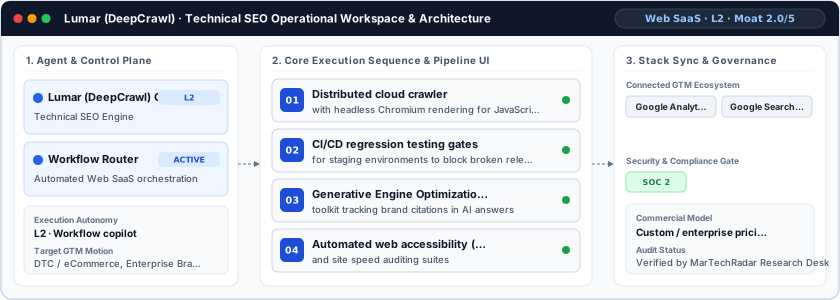
- Target ICP & Stack Fit: You operate as DTC / eCommerce and Enterprise Brands requiring a Web SaaS deployment for Technical SEO, with verified ecosystem connectivity for Google Analytics 4 (GA4), Google Search Console.
- L2 Architecture & Defensibility: High-throughput cloud crawling pipeline capable of rendering millions of JavaScript pages, paired with automated CI/CD SEO regression testing gates.
- Commercial Model Fit: Your procurement budget aligns with Custom / enterprise pricing.
Walk away from Lumar (DeepCrawl) if (Deal-Breakers)
- Walk away if you need published self-serve pricing: Lumar (DeepCrawl) is sold by custom quote.
- Walk away if your workflow cannot tolerate javascript render credit burn: Rendering millions of JavaScript pages in the cloud burns crawl credits faster and adds queue latency compared with raw HTML crawls.
- Walk away if staging firewall setup friction is a deal-breaker for your team: Running automated CI/CD crawls against private staging servers requires IP allowlisting or tunnel setup across enterprise firewalls.
Lumar (DeepCrawl) pricing, free plan & scorecard at a glance
| Pricing | Custom / enterprise pricing |
|---|---|
| Free plan | No / not disclosed |
| Delivery | Web SaaS |
| Audience | DTC / eCommerce, Enterprise Brands |
| AI autonomy level | L2 · Workflow copilotEditor-verified |
| Moat tier & score | 2.0 / 5.0 · Workflow-embeddedEditor-verified |
| Funding | Undisclosed |
| Ecosystem integrations | Google Analytics 4 (GA4), Google Search Console |
| Compliance & governance | SOC 2 |
| Governance & docs | System Status ↗ · Terms ↗ · Privacy ↗ |
| Headquarters | New York, NY |
| Founded | 2010 |
| Last verified | Oct 15, 2026 |
Lumar (DeepCrawl) pros & cons: strengths vs. operational limitations
Pros: core strengths & capabilities
- Distributed cloud crawler: with headless Chromium rendering for JavaScript apps
- CI/CD regression testing gates: for staging environments to block broken releases
- Generative Engine Optimization (GEO): toolkit tracking brand citations in AI answers
- Automated web accessibility (a11y) and site speed auditing suites
Cons: operational limitations & risks
- JavaScript Render Credit Burn: Rendering millions of JavaScript pages in the cloud burns crawl credits faster and adds queue latency compared with raw HTML crawls.
- Staging Firewall Setup Friction: Running automated CI/CD crawls against private staging servers requires IP allowlisting or tunnel setup across enterprise firewalls.
- GEO Score Variance: AI visibility scores depend on shifting LLM answers, which show more run-to-run model drift than deterministic HTML crawl rules.
Lumar (DeepCrawl) TCO & deal-breaker stress test
Simulate 12-month stepped TCO, hidden cost multipliers, contract lock-in exposure, and stack failure modes using only facts verified by MarTechRadar Research Desk on 2026-10-15.
Lumar (DeepCrawl) triggers high-severity friction under your 5-seat / $800/mo constraints. Benchmark the verified subtrack alternatives below before committing.
- Moat Score
- 2.0 / 5.0
- AI Autonomy
- L2
- Free Tier / Trial
- None disclosed
Triggered audit signals & failure modes
- Opaque Enterprise Quoting vs. SMB/Mid-Market BudgetVerified Pricing Ledger
Lumar (DeepCrawl) does not disclose a public self-serve floor (Custom / enterprise pricing). Buyers with a $800/mo cap face high sales-qualification friction.
- Sales-Gated Contract TermsFact-checked by MarTechRadar Research Desk
Lumar sells through custom annual enterprise contracts with pricing available on request. Quotes scale with monthly crawl URL volume, JavaScript rendering credits, included modules (Technical SEO, GEO Toolkit, Accessibility, Site Speed), and user seats.
- Usage / Credit Burn VolatilityCommercial Model Audit
Lumar (DeepCrawl) uses credit or usage-metered billing (Custom / enterprise pricing). High-volume automated workflows across 5 seats can trigger mid-cycle overage charges.
- Primary Operational Bottleneck: JavaScript Render Credit BurnAudit by MarTechRadar Research Desk
Rendering millions of JavaScript pages in the cloud burns crawl credits faster and adds queue latency compared with raw HTML crawls.
Test a custom Lumar (DeepCrawl) budget or stack constraint
Lower 5-seat floor (~$55/mo vs. Custom Quote) · Transparent self-serve entry without mandatory annual lock-in
Lumar (DeepCrawl) integrations, API, security & compliance stack
Lumar (DeepCrawl) AI moat & Technical SEO positioning
High-throughput cloud crawling pipeline capable of rendering millions of JavaScript pages, paired with automated CI/CD SEO regression testing gates.
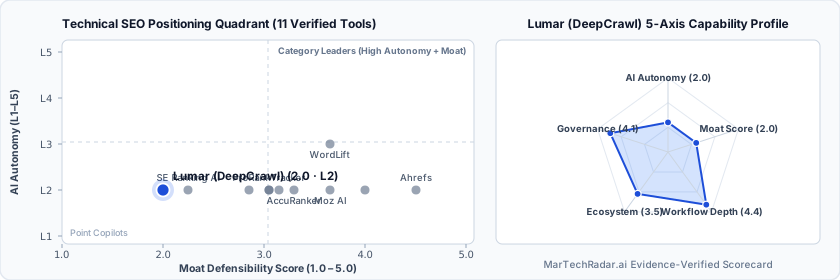
Lumar (DeepCrawl) in-depth review, pricing & architecture analysis
Editor sign-off: Oct 15, 2026. How profiles are made.
What is Lumar (DeepCrawl)? Overview & background
Established in 2010 and based in New York, NY, Lumar (formerly DeepCrawl, lumar.io) is an enterprise website intelligence and technical SEO audit tool. Built for technical SEO directors, web engineers, and digital ops leads, the tool crawls millions of dynamic, JavaScript-rendered URLs. It helps large sites stay indexable, fast, and healthy across classic search and AI answer engines.
How Lumar (DeepCrawl) works: architecture & workflow
Operating at Level 2 (L2) autonomy, Lumar runs a cloud crawler paired with headless browser rendering to parse single-page apps. The engine inspects DOM trees, flags render-blocking scripts, and maps internal link graphs at scale. Through its CI/CD QA plugins, Lumar runs staging checks that block code deploys when severe SEO or accessibility bugs appear. Crawl results feed dashboards for technical SEO, Generative Engine Optimization (GEO/AEO), site speed, and web accessibility (a11y). Teams can also connect Google Search Console and Google Analytics under SOC 2 Type II security rules.
Lumar (DeepCrawl) limitations, drawbacks & risks
Limitations and trade-offs to weigh before choosing Lumar (DeepCrawl):
- JavaScript Render Credit Burn: Rendering millions of JavaScript pages in the cloud burns crawl credits faster and adds queue latency compared with raw HTML crawls.
- Staging Firewall Setup Friction: Running automated CI/CD crawls against private staging servers requires IP allowlisting or tunnel setup across enterprise firewalls.
- GEO Score Variance: AI visibility scores depend on shifting LLM answers, which show more run-to-run model drift than deterministic HTML crawl rules.
Lumar (DeepCrawl) pricing, plans & cost breakdown
Lumar sells through custom annual enterprise contracts with pricing available on request. Quotes scale with monthly crawl URL volume, JavaScript rendering credits, included modules (Technical SEO, GEO Toolkit, Accessibility, Site Speed), and user seats. Buyers contact sales to scope a custom package.
| Plan / Tier | Verified Price & Billing | Included Scope & Contract Terms |
|---|---|---|
| Enterprise / Custom | Custom quote | Custom-quoted plan; terms come from the vendor's sales team. |
How Lumar (DeepCrawl) compares vs. competitors & alternatives
In technical SEO crawling and site intelligence, Lumar competes against Botify, OnCrawl, Screaming Frog SEO, and Sitebulb. Unlike desktop crawlers such as Screaming Frog SEO and Sitebulb—which are limited by local machine RAM—Lumar runs large-scale crawls in the cloud and blocks bad code in CI/CD pipelines. Compared with Botify, which focuses on log-file warehousing and edge SEO, Lumar stands out for combining cloud SEO crawling with web accessibility (a11y) and GEO visibility toolkits.
Frequently asked questions about Lumar (DeepCrawl)
Does Lumar (DeepCrawl) publish pricing or require an enterprise quote?
Lumar (DeepCrawl) pricing: Custom / enterprise pricing. No free plan is publicly disclosed. Lumar sells through custom annual enterprise contracts with pricing available on request.
What are the top Lumar (DeepCrawl) alternatives in Technical SEO?
Verified Technical SEO alternatives include Sitebulb ($11–$125/mo), Screaming Frog SEO (Free plan · £169–£199/yr), OnCrawl (Custom / enterprise pricing), Marketgoo AI (Custom / enterprise pricing). In technical SEO crawling and site intelligence, Lumar competes against Botify, OnCrawl, Screaming Frog SEO, and Sitebulb.
What are the main limitations and trade-offs of Lumar (DeepCrawl)?
Limitations and trade-offs to weigh before choosing Lumar (DeepCrawl): JavaScript Render Credit Burn: Rendering millions of JavaScript pages in the cloud burns crawl credits faster and adds queue latency compared with raw HTML crawls. Walk away if you need published self-serve pricing: Lumar (DeepCrawl) is sold by custom quote.
Verified sources & evidence trail
- Official product domain: https://lumar.io
- Commercial pricing verification: Verified against official vendor pricing policy (Custom / enterprise pricing)
- First-party governance & documentation links: System Status · Terms · Privacy
- Editor sign-off: Oct 15, 2026 (how profiles are made).
