Gangly Review (2026): Sales Intelligence Pricing, Pros & Cons
Bottom line
Gangly is a Web SaaS tool for Sales Intelligence (Lead Enrichment & Waterfall Orchestration) in AI SDR & Outbound. Pricing: $99–$299/seat/mo · Enterprise plan. Editor ratings: AI autonomy L2 (workflow copilot); moat score 1.8/5.0 (Thin wrapper). Fact-checked by MarTechRadar Research Desk on Oct 28, 2026.
Connected B2B sales workflow platform uniting account signal detection, outreach drafting, call prep, live call coaching, and human-approved CRM updates.
Is Gangly worth it in 2026? Buyer fit & when to walk away
Choose Gangly if (Best Fit)
- Target ICP & Stack Fit: You operate as Sales Intelligence teams requiring a Web SaaS deployment for Sales Intelligence, with verified ecosystem connectivity for Salesforce, HubSpot, Pipedrive, Outreach.
- Warmth-ranked Signal Detection feed: aggregating hiring, funding, job-change, and CRM champion triggers
- Commercial Model Fit: Your procurement budget aligns with $99–$299/seat/mo · Enterprise plan.
Walk away from Gangly if (Deal-Breakers)
- Walk away if your workflow requires uncapped enterprise volume on the $99–$299/seat/mo · Enterprise plan entry plan without upgrading tiers.
- Walk away if you lack internal RevOps bandwidth to configure and monitor Gangly across your Sales Intelligence stack.
- Walk away if you require deep proprietary data defensibility (Gangly scores 1.8/5.0 on the Moat Index).
Gangly pricing, free plan & scorecard at a glance
| Pricing | $99–$299/seat/mo · Enterprise planVendor pricing page |
|---|---|
| Free plan | No / not disclosed |
| Delivery | Web SaaS |
| Audience | — |
| AI autonomy level | L2 · Workflow copilotEditor-verified |
| Moat tier & score | 1.8 / 5.0 · Thin wrapperEditor-verified |
| Funding | Bootstrapped |
| Company size | 1-10 employees |
| Ecosystem integrations | Salesforce, HubSpot, Pipedrive, Outreach, Gong, Zoom |
| Headquarters | Jaipur, India |
| Founded | 2026 |
| Last verified | Oct 28, 2026 |
Gangly pros & cons: strengths vs. operational limitations
Pros: core strengths & capabilities
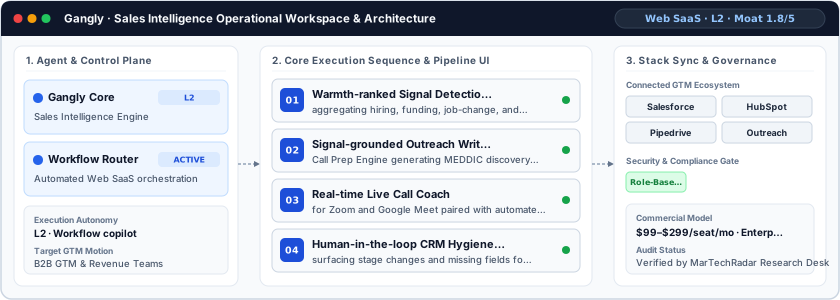
- Warmth-ranked Signal Detection feed: aggregating hiring, funding, job-change, and CRM champion triggers
- Signal-grounded Outreach Writer and: Call Prep Engine generating MEDDIC discovery briefs before meetings
- Real-time Live Call Coach: for Zoom and Google Meet paired with automated Post-Call Notes and follow-ups
- Human-in-the-loop CRM Hygiene Engine: surfacing stage changes and missing fields for rep approval before writeback
Cons: operational limitations & risks
- Primary constraint: The primary limitation and operational trade-off of Gangly is that it requires disciplined CRM schema mapping and calendar/call integration permissions to deliver full value, and is not built for fully autonomous, unreviewed bulk cold-email blasting or B2C high-volume dialer operations.
- Operational trade-off: Teams on the entry tier face a structural drawback because live call coaching (Zoom and Google Meet) and full CRM-plus-public signal correlation are gated to the Growth and Scale tiers.
- Deployment boundary: Additionally, as an emerging platform launched in 2026, enterprise buyers should validate custom signal connectors, SSO/SAML controls, and SLA commitments during a scoped pilot before rolling out across large multi-region revenue organizations.
Gangly TCO & deal-breaker stress test
Simulate 12-month stepped TCO, hidden cost multipliers, contract lock-in exposure, and stack failure modes using only facts verified by MarTechRadar Research Desk on 2026-10-28 · Capture SHA 91f669f5.
Gangly aligns with your 5-seat / $800/mo profile. Review the walk-away triggers and contract levers below before deployment.
- Moat Score
- 1.8 / 5.0
- AI Autonomy
- L2
- Free Tier / Trial
- None disclosed
Triggered audit signals & failure modes
- Published Self-Serve Entry FloorVerified Pricing Ledger
Gangly publishes a transparent entry point ($99–$299/seat/mo · Enterprise plan) for initial validation before committing.
- Linear Per-Seat Scaling (5 Seats × $99/seat/mo)Commercial Model Audit
Base license scales linearly with operator headcount ($495/mo for 5 seats on Entry Per-Seat Tier).
- Primary Operational Bottleneck: Operational trade-offAudit by MarTechRadar Research Desk
Teams on the entry tier face a structural drawback because live call coaching (Zoom and Google Meet) and full CRM-plus-public signal correlation are gated to the Growth and Scale tiers.
Test a custom Gangly budget or stack constraint
Gangly integrations, API, security & compliance stack
Gangly in-depth review, pricing & architecture analysis
Audited by MarTechRadar Research Desk (Evidence-Ledger Verified) on Oct 28, 2026.
What is Gangly? Overview & background
Gangly (getgangly.com, operated by GetGangly, a sub-organization of theStacc founded in 2026 and headquartered in Jaipur, India) is a connected B2B sales workflow platform built to eliminate context switching across prospecting, meeting execution, and CRM administration. Instead of forcing account executives and SDRs to stitch together separate point tools for buyer intent alerts, cold email sequencing, call recording, and manual Salesforce or HubSpot note entry, Gangly links six operational stages inside one interface: Signal Detection, Outreach Writer, Call Prep Engine, Live Call Coach, Post-Call Notes, and a human-in-the-loop CRM Hygiene Engine.
How Gangly works: architecture & workflow
Architecturally, Gangly operates as a semi-autonomous workflow copilot (L2) anchored to the customer's existing CRM as the system of record. Its Signal Detection feed aggregates public and CRM-linked triggers—such as executive job changes, hiring posts, funding announcements, and champion role shifts—ranking accounts by warmth score. From any signal, the Outreach Writer drafts evidence-backed messages using the rep's voice profile, while the Call Prep Engine compiles account history, tech stack context, and MEDDIC discovery prompts before scheduled meetings. During live Zoom or Google Meet conversations, the Live Call Coach surfaces real-time objection handling and talking points, followed by automated Post-Call Notes and Workflow Sequencer follow-ups. Crucially, proposed CRM updates—such as stage changes, missing field completion, and stale-deal alerts—are queued for explicit rep review and approval before writing back to HubSpot, Salesforce, or Pipedrive.
Gangly limitations, drawbacks & risks
The primary limitation and operational trade-off of Gangly is that it requires disciplined CRM schema mapping and calendar/call integration permissions to deliver full value, and is not built for fully autonomous, unreviewed bulk cold-email blasting or B2C high-volume dialer operations. Teams on the entry tier face a structural drawback because live call coaching (Zoom and Google Meet) and full CRM-plus-public signal correlation are gated to the Growth and Scale tiers. Additionally, as an emerging platform launched in 2026, enterprise buyers should validate custom signal connectors, SSO/SAML controls, and SLA commitments during a scoped pilot before rolling out across large multi-region revenue organizations.
Gangly pricing, plans & cost breakdown
On commercial unit economics (getgangly.com/pricing), Gangly publishes indicative per-seat tiers with a 20% discount for annual billing: Starter at $99/seat/month (basic public signal detection, Outreach Writer, Call Prep Engine, Post-Call Notes, Workflow Sequencer, and 1 CRM integration), Growth at $199/seat/month (adding full CRM + public signals, Live Call Coach for Zoom and Google Meet, Full CRM Hygiene Engine, and 2 CRM integrations), and Scale at $299/seat/month (custom signals, multi-CRM integrations, custom voice training, SSO/SAML, and a dedicated customer success manager).
| Plan / Tier | Verified Price & Billing | Target Seat / Scale Fit | Included Scope & Contract Terms |
|---|---|---|---|
| Enterprise / Custom | Custom quote | 15–50+ seats (Enterprise SLA) | Sales-negotiated annual contract for custom volume, SSO/RBAC governance, and dedicated SLA. |
| Contract Watchout: Per-Seat Linear Scaling | Gangly prices licenses on a per-user/seat basis ($99–$299/seat/mo · Enterprise plan); expanding from 2 to 15+ operators multiplies base recurring spend linearly. | ||
How Gangly compares vs. competitors & alternatives
In the B2B revenue technology landscape, Gangly competes against point combinations of Gong or Chorus (conversation intelligence), Outreach or Salesloft (sales engagement), and Apollo or Clay (signal prospecting). While Gong offers deep enterprise revenue analytics at high multi-seat contract minimums, Gangly provides a unified, rep-centric workflow from initial buying signal to post-call CRM hygiene at transparent per-seat pricing.
How Gangly works: architecture & workflow
Ultimately, Gangly is a strong fit for B2B SaaS, fintech, and cybersecurity sales teams running HubSpot, Salesforce, or Pipedrive who want one connected workspace for signal-led outreach, live call prep, and human-verified CRM updates.
Frequently asked questions about Gangly
How much does Gangly cost in 2026?
Gangly pricing: $99–$299/seat/mo · Enterprise plan. No free plan is publicly disclosed. On commercial unit economics (`getgangly.com/pricing`), Gangly publishes indicative per-seat tiers with a 20% discount for annual billing: Starter at $99/seat/month (basic public signal detection, Outreach Writer, Call Prep Engine, Post-Call Notes, Workflow Sequencer, and 1 CRM integration), Growth at $199/seat/month (adding full CRM + public signals, Live Call Coach for Zoom and Google Meet, Full CRM Hygiene Engine, and 2 CRM integrations), and Scale at $299/seat/month (custom signals, multi-CRM integrations, custom voice training, SSO/SAML, and a dedicated customer success manager).
What are the top Gangly alternatives in Sales Intelligence?
Verified Sales Intelligence alternatives include Coach (Custom / enterprise pricing), One IA (Custom / enterprise pricing), Findymail (Custom / enterprise pricing), Iceflower (Custom / enterprise pricing). In the B2B revenue technology landscape, Gangly competes against point combinations of Gong or Chorus (conversation intelligence), Outreach or Salesloft (sales engagement), and Apollo or Clay (signal prospecting).
Verified sources & evidence trail
- Official product domain: https://getgangly.com
- Commercial pricing verification: https://getgangly.com/pricing
- Verified corporate entity profiles (
sameAs): Crunchbase Entity Record - Editorial audit sign-off: Audited by MarTechRadar Research Desk (Evidence-Ledger Verified) on Oct 28, 2026.
