Dreamlit AI Review (2026): AI Content Marketing Pricing, Limits & Alternatives
Bottom line
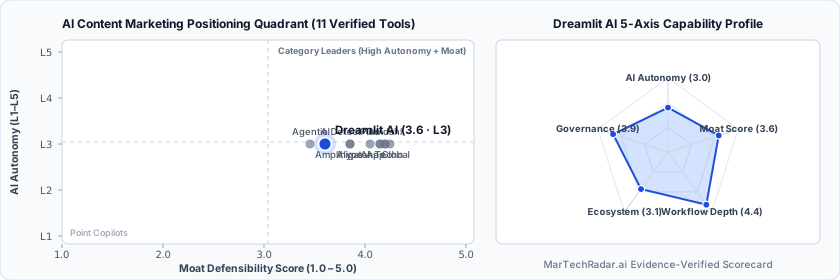
Dreamlit AI is a Web SaaS tool for AI Content Marketing (Enterprise & Long-Form Brand Content) in Copy & Content. Pricing: Custom / enterprise pricing. Best suited to Enterprise Content Teams, Brand Marketers and Global Copywriters. Editor ratings: AI autonomy L3 (conditional automation); moat score 3.6/5.0 (Proprietary moat). Fact-checked by Julie Brot on Oct 14, 2026.
Autonomous user activation and lifecycle email management platform combining domain-adapted AI generation with human expert oversight to convert software.
Dreamlit AI buyer fit verdict: when to choose vs. when to walk away
Choose Dreamlit AI if (Best Fit)
- Target ICP & Stack Fit: You operate as Enterprise Content Teams, Brand Marketers and Global Copywriters requiring a Web SaaS deployment for AI Content Marketing.
- L3 Architecture & Defensibility: Combines managed execution with automated lifecycle email playbooks, creating operational lock-in by pairing proprietary behavioral trigger schemas with full accountability for conversion outcomes.
- Commercial Model Fit: Your procurement budget aligns with Custom / enterprise pricing.
Walk away from Dreamlit AI if (Deal-Breakers)
- Walk away if you require transparent self-serve monthly billing or your budget ceiling is under $1,000/mo (Dreamlit AI requires sales-gated custom quoting).
- Walk away if your workflow cannot tolerate traffic volume thresholds: The system mandates a operational minimum of five hundred monthly signups, rendering statistical optimization ineffective for early-stage applications with low-density event streams.
- Walk away if integration depth is a deal-breaker for your team: Because the service relies on managed zero-code deployment, complex custom product telemetry requiring bidirectional database synchronization requires manual structural intervention.
Dreamlit AI key facts & scorecard
| Pricing | Custom / enterprise pricing |
|---|---|
| Free plan | No / not disclosed |
| Delivery | Web SaaS |
| Audience | Enterprise Content Teams, Brand Marketers, Global Copywriters |
| AI autonomy level | L3 · Conditional automationEditor-verified |
| Moat tier & score | 3.6 / 5.0 · Proprietary moatEditor-verified |
| Funding | Pre-seed |
| Total funding | $600K |
| Founders | Ajay Sohmshetty, Andrew Kim |
| Company size | 2-10 employees |
| Governance & docs | System Status ↗ · API & Docs ↗ · Changelog ↗ · Terms ↗ · Privacy ↗ |
| Headquarters | New York, NY |
| Founded | 2024 |
| Last verified |
Dreamlit AI pros & cons: strengths vs. operational limitations
Pros: core strengths & capabilities
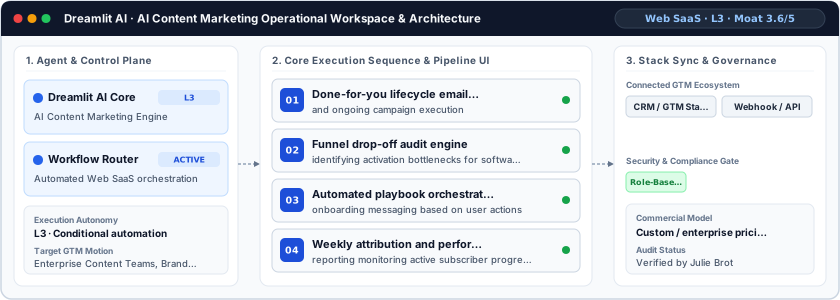
- Done-for-you lifecycle email management: and ongoing campaign execution
- Funnel drop-off audit engine: identifying activation bottlenecks for software products
- Automated playbook orchestration triggering: onboarding messaging based on user actions
- Weekly attribution and performance: reporting monitoring active subscriber progression
Cons: operational limitations & risks
- Traffic Volume Thresholds: The system mandates a operational minimum of five hundred monthly signups, rendering statistical optimization ineffective for early-stage applications with low-density event streams.
- Integration Depth: Because the service relies on managed zero-code deployment, complex custom product telemetry requiring bidirectional database synchronization requires manual structural intervention.
- Human Oversight Bottlenecks: Combining programmatic delivery with assigned human experts restricts rapid multi-brand onboarding, creating operational capacity limits during rapid expansion cycles.
Dreamlit AI TCO & deal-breaker stress test
Simulate 12-month stepped TCO, hidden cost multipliers, contract lock-in exposure, and stack failure modes using only facts verified by Julie Brot on · Capture SHA e68c50d3.
Dreamlit AI triggers high-severity friction under your 5-seat / $800/mo constraints. Benchmark the verified subtrack alternatives below before committing.
| Plan / Tier | Verified Rate | Scale Fit | Scope & Quota Notes |
|---|---|---|---|
| Enterprise / Custom | Custom quote | 15–50+ seats (Enterprise SLA) | Sales-negotiated annual contract for custom volume, SSO/RBAC governance, and dedicated SLA. |
- Moat Score
- 3.6 / 5.0
- AI Autonomy
- L3
- Free Tier / Trial
- None disclosed
Triggered audit signals & failure modes
- Opaque Enterprise Quoting vs. SMB/Mid-Market BudgetVerified Pricing Ledger
Dreamlit AI does not disclose a public self-serve floor (Custom / enterprise pricing). Buyers with a $800/mo cap face high sales-qualification friction.
- Sales-Gated Contract TermsFact-checked by Julie Brot
Dreamlit AI operates an enterprise managed-service licensing framework. Commercial pricing is available on request through tailored enterprise sales quotes based on organizational scale and seats.
- Primary Operational Bottleneck: Traffic Volume ThresholdsAudit by Julie Brot
The system mandates a operational minimum of five hundred monthly signups, rendering statistical optimization ineffective for early-stage applications with low-density event streams.
Hidden TCO Multipliers & Quota Gates
- Traffic Volume Thresholds: The system mandates a operational minimum of five hundred monthly signups, rendering statistical optimization ineffective for early-stage applications with low-density event streams.
- Integration Depth: Because the service relies on managed zero-code deployment, complex custom product telemetry requiring bidirectional database synchronization requires manual structural intervention.
When to Walk Away & Negotiation Levers
- Walk away if you require transparent self-serve monthly billing or your budget ceiling is under $1,000/mo (Dreamlit AI requires sales-gated custom quoting).
- Walk away if your workflow cannot tolerate traffic volume thresholds: The system mandates a operational minimum of five hundred monthly signups, rendering statistical optimization ineffective for early-stage applications with low-density event streams.
- Walk away if integration depth is a deal-breaker for your team: Because the service relies on managed zero-code deployment, complex custom product telemetry requiring bidirectional database synchronization requires manual structural intervention.
- Demand a 30- to 60-day paid pilot opt-out clause in the Dreamlit AI order form before signing a 12-month enterprise commitment.
- Require a sandbox proof-of-concept testing traffic volume thresholds against your live CRM/data schema before annual sign-off.
Ask a custom procurement or TCO stress-test question about Dreamlit AI
Verified AI Content Marketing peer (Custom / enterprise pricing · Moat 3.8/5.0)
Verified AI Content Marketing peer (Custom / enterprise pricing · Moat 3.6/5.0)
Dreamlit AI moat & subtrack positioning
Combines managed execution with automated lifecycle email playbooks, creating operational lock-in by pairing proprietary behavioral trigger schemas with full accountability for conversion outcomes.
Editorial review
Fact-checked by Julie Brot (Enterprise SaaS Governance & Procurement Editor) on .
Background
Product-led growth teams often struggle with onboarding conversion when engineering constraints delay lifecycle messaging. Founded in 2024 in New York, NY, Dreamlit AI addresses this gap by operating a managed activation and retention platform. Backed by $600K in venture capital funding, the company targets growth marketing leads and product managers seeking to convert trial accounts into retained customers without expanding internal operational headcount.
How Dreamlit AI works
Dreamlit AI couples an algorithmic engagement engine with human-in-the-loop services to execute automated onboarding communications. The platform ingests behavioral product triggers via zero-code webhooks, mapping user milestones against pre-configured activation templates. Domain-specific language models generate contextual email copy aligned to product touchpoints, while an autonomous workflow layer schedules cadence delivery. Operating at an L3 autonomy profile, Dreamlit AI executes trigger logic and content generation programmatically while internal operators supervise deliverability thresholds and campaign governance.
Limitations
Operational considerations and platform boundaries include:
- Traffic Volume Thresholds: The system mandates a operational minimum of five hundred monthly signups, rendering statistical optimization ineffective for early-stage applications with low-density event streams.
- Integration Depth: Because the service relies on managed zero-code deployment, complex custom product telemetry requiring bidirectional database synchronization requires manual structural intervention.
- Human Oversight Bottlenecks: Combining programmatic delivery with assigned human experts restricts rapid multi-brand onboarding, creating operational capacity limits during rapid expansion cycles.
Dreamlit AI pricing
Dreamlit AI operates an enterprise managed-service licensing framework. Commercial pricing is available on request through tailored enterprise sales quotes based on organizational scale and seats. Contracts typically begin with an activation funnel audit before transitioning into recurring service commitments tied to signup volume and managed communication infrastructure.
How Dreamlit AI compares
Within enterprise lifecycle and activation operations, Dreamlit AI differentiates itself by absorbing execution responsibilities rather than providing raw authoring software. While Agentio targets algorithmic ad placement across creator channels, and Aha Global or AIDetectPlus address content production and integrity workflows, Dreamlit AI focuses narrowly on user onboarding pipelines. It trades raw end-user interface flexibility for outsourced activation accountability, suiting lean software teams wanting managed funnel outcomes over complex software suites.
Direct competitors & market radar
Top algorithmic competitors based on category positioning, capability overlap, and ICP alignment.
Frequently asked questions about Dreamlit AI
How much does Dreamlit AI cost and does it require a custom enterprise quote?
Published pricing summary for Dreamlit AI: Custom / enterprise pricing. A permanent free plan is not disclosed for Dreamlit AI. Dreamlit AI operates an enterprise managed-service licensing framework. Commercial pricing is available on request through tailored enterprise sales quotes based on organizational scale and seats.
How does Dreamlit AI work and how autonomous is its AI architecture?
Autonomous user activation and lifecycle email management platform combining domain-adapted AI generation with human expert oversight to convert software. Within AI Content Marketing (Enterprise & Long-Form Brand Content), MarTechRadar rates its execution architecture at L3 · Conditional automation with a verified Moat Score of 3.6 / 5.0 (Proprietary moat). Combines managed execution with automated lifecycle email playbooks, creating operational lock-in by pairing proprietary behavioral trigger schemas with full accountability for conversion outcomes. Corporate profile: Founded by Ajay Sohmshetty, Andrew Kim, operating at 2-10 employees scale.
What are the main limitations of Dreamlit AI and when should buyers walk away?
Based on our editorial technical audit, key operational considerations and boundaries for Dreamlit AI include: (1) Traffic Volume Thresholds: The system mandates a operational minimum of five hundred monthly signups, rendering statistical optimization ineffective for early-stage applications with low-density event streams. (2) Integration Depth: Because the service relies on managed zero-code deployment, complex custom product telemetry requiring bidirectional database synchronization requires manual structural intervention. (3) Human Oversight Bottlenecks: Combining programmatic delivery with assigned human experts restricts rapid multi-brand onboarding, creating operational capacity limits during rapid expansion cycles. Primary procurement walk-away rule: Walk away if you require transparent self-serve monthly billing or your budget ceiling is under $1,000/mo (Dreamlit AI requires sales-gated custom quoting).
What integrations, compliance certifications, and contract terms apply to Dreamlit AI?
First-party governance and developer endpoints verified on domain include: Status (https://status.dreamlit.ai), API Docs (https://dreamlit.ai/docs/introduction). Key TCO multiplier to watch: Traffic Volume Thresholds (The system mandates a operational minimum of five hundred monthly signups, rendering statistical optimization ineffective for early-stage applications with low-density event streams.) Before signing a contract, procurement teams should demand a 30- to 60-day paid pilot opt-out clause in the Dreamlit AI order form before signing a 12-month enterprise commitment.
What are the best Dreamlit AI alternatives and head-to-head competitors in 2026?
Top fact-checked alternatives to Dreamlit AI in AI Content Marketing (Enterprise & Long-Form Brand Content) include Sonatoria (Custom / enterprise pricing), Bluntpage (Custom / enterprise pricing), Copymatic (Custom / enterprise pricing), Mark OS (Custom / enterprise pricing). Within enterprise lifecycle and activation operations, Dreamlit AI differentiates itself by absorbing execution responsibilities rather than providing raw authoring software.
Verified sources & evidence trail
- Official product domain: https://dreamlit.ai/
- Commercial pricing verification: Verified against official vendor pricing policy (Custom / enterprise pricing)
- Verified corporate entity profiles (
sameAs): LinkedIn Company Profile · Crunchbase Entity Record - First-party governance & documentation links: System Status · API & Docs · Changelog · Terms · Privacy
- Editorial audit sign-off: Fact-checked by Julie Brot on under the MarTechRadar Evidence-Ledger Protocol.