Bluntpage Review (2026): AI Content Marketing Pricing, Limits & Alternatives
Bottom line
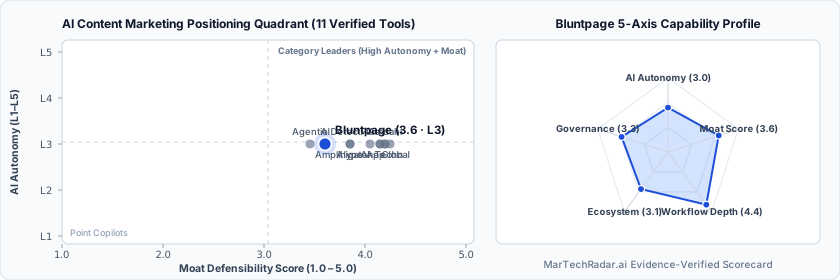
Bluntpage is a Web SaaS tool for AI Content Marketing (Enterprise & Long-Form Brand Content) in Copy & Content. Pricing: Custom / enterprise pricing. Best suited to Enterprise Content Teams, Brand Marketers and Global Copywriters. Editor ratings: AI autonomy L3 (conditional automation); moat score 3.6/5.0 (Proprietary moat). Fact-checked by Jagmeet Sine on Oct 15, 2026.
Enterprise long-form brand content engine combining structured retrieval-augmented generation, brand guideline grounding, and governed editorial workflows.
Bluntpage buyer fit verdict: when to choose vs. when to walk away
Choose Bluntpage if (Best Fit)
- Target ICP & Stack Fit: You operate as Enterprise Content Teams, Brand Marketers and Global Copywriters requiring a Web SaaS deployment for AI Content Marketing.
- L3 Architecture & Defensibility: Moderate defensibility built on deeply indexed proprietary brand taxonomies, persistent tone-of-voice grounding pipelines, and structured multi-stakeholder enterprise compliance workflows.
- Commercial Model Fit: Your procurement budget aligns with Custom / enterprise pricing.
Walk away from Bluntpage if (Deal-Breakers)
- Walk away if you require transparent self-serve monthly billing or your budget ceiling is under $1,000/mo (Bluntpage requires sales-gated custom quoting).
- Walk away if your workflow cannot tolerate vector index drift: Users encounter operational friction and integration bottlenecks, as the pipeline struggles with Enterprise repos that update brand guidelines frequently require programmatic re-indexing, as stale embeddings introduce obsolete corporate terminology into newly generated drafts.
- Walk away if long-form contextual coherence is a deal-breaker for your team: Users encounter operational friction and integration bottlenecks, as the pipeline struggles with Drafting technical assets beyond four thousand words risks thematic degradation across section transitions, necessitating human editorial stitching to maintain logical narrative progression.
Bluntpage key facts & scorecard
| Pricing | Custom / enterprise pricing |
|---|---|
| Free plan | No / not disclosed |
| Delivery | Web SaaS |
| Audience | Enterprise Content Teams, Brand Marketers, Global Copywriters |
| AI autonomy level | L3 · Conditional automationEditor-verified |
| Moat tier & score | 3.6 / 5.0 · Proprietary moatEditor-verified |
| Funding | Pre-seed |
| Company size | 11-50 employees |
| Governance & docs | Trust & Security ↗ · System Status ↗ · Changelog ↗ · Terms ↗ · Privacy ↗ |
| Headquarters | United States |
| Founded | 2024 |
| Last verified |
Bluntpage pros & cons: strengths vs. operational limitations
Pros: core strengths & capabilities
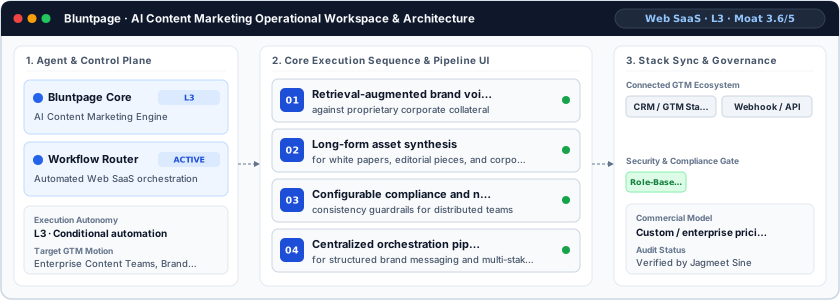
- Retrieval-augmented brand voice grounding: against proprietary corporate collateral
- Long-form asset synthesis: for white papers, editorial pieces, and corporate communications
- Configurable compliance and narrative: consistency guardrails for distributed teams
- Centralized orchestration pipeline: for structured brand messaging and multi-stakeholder editing
Cons: operational limitations & risks
- Vector Index Drift: Users encounter operational friction and integration bottlenecks, as the pipeline struggles with Enterprise repos that update brand guidelines frequently require programmatic re-indexing, as stale embeddings introduce obsolete corporate terminology into newly generated drafts.
- Long-Form Contextual Coherence: Users encounter operational friction and integration bottlenecks, as the pipeline struggles with Drafting technical assets beyond four thousand words risks thematic degradation across section transitions, necessitating human editorial stitching to maintain logical narrative progression.
- Integration Pipeline Scaffolding: Users encounter operational friction and integration bottlenecks, as the pipeline struggles with Connecting to disparate headless CMS stacks or legacy digital asset repositories requires custom ingestion orchestration, limiting out-of-the-box bidirectional publishing efficiency.
Bluntpage TCO & deal-breaker stress test
Simulate 12-month stepped TCO, hidden cost multipliers, contract lock-in exposure, and stack failure modes using only facts verified by Jagmeet Sine on · Capture SHA 4806fd84.
Bluntpage triggers high-severity friction under your 5-seat / $800/mo constraints. Benchmark the verified subtrack alternatives below before committing.
| Plan / Tier | Verified Rate | Scale Fit | Scope & Quota Notes |
|---|---|---|---|
| Entry / Starter | $15/mo | 1–2 seats | Unlimited re-checks with score delta |
| Agency | $49/mo | 5 seats | Roast client pages. Bill accordingly. |
| Enterprise / Custom | Custom quote | 15–50+ seats (Enterprise SLA) | Sales-negotiated annual contract for custom volume, SSO/RBAC governance, and dedicated SLA. |
- Moat Score
- 3.6 / 5.0
- AI Autonomy
- L3
- Free Tier / Trial
- None disclosed
Triggered audit signals & failure modes
- Opaque Enterprise Quoting vs. SMB/Mid-Market BudgetVerified Pricing Ledger
Bluntpage does not disclose a public self-serve floor (Custom / enterprise pricing). Buyers with a $800/mo cap face high sales-qualification friction.
- Sales-Gated Contract TermsFact-checked by Jagmeet Sine
Pricing is available on request through tailored enterprise sales quotes, with custom enterprise tiers structured around organizational scale, user seats, and workflow volume.
- Tier Fit for 5-Seat Scale: Entry / Starter ($15/mo)Verified Tier Schedule
Unlimited re-checks with score delta
- Primary Operational Bottleneck: Vector Index DriftAudit by Jagmeet Sine
Users encounter operational friction and integration bottlenecks, as the pipeline struggles with Enterprise repos that update brand guidelines frequently require programmatic re-indexing, as stale embeddings introduce obsolete corporate terminology into newly generated drafts.
Hidden TCO Multipliers & Quota Gates
- Annual Billing Headline vs. Monthly Premium: Headline entry rates reflect annual billing commitments (SAVE 20%); month-to-month flexibility carries a higher effective monthly rate or requires annual prepayment.
- Vector Index Drift: Users encounter operational friction and integration bottlenecks, as the pipeline struggles with Enterprise repos that update brand guidelines frequently require programmatic re-indexing, as stale embeddings introduce obsolete corporate terminology into newly generated drafts.
- Long-Form Contextual Coherence: Users encounter operational friction and integration bottlenecks, as the pipeline struggles with Drafting technical assets beyond four thousand words risks thematic degradation across section transitions, necessitating human editorial stitching to maintain logical narrative progression.
When to Walk Away & Negotiation Levers
- Walk away if you require transparent self-serve monthly billing or your budget ceiling is under $1,000/mo (Bluntpage requires sales-gated custom quoting).
- Walk away if your workflow cannot tolerate vector index drift: Users encounter operational friction and integration bottlenecks, as the pipeline struggles with Enterprise repos that update brand guidelines frequently require programmatic re-indexing, as stale embeddings introduce obsolete corporate terminology into newly generated drafts.
- Walk away if long-form contextual coherence is a deal-breaker for your team: Users encounter operational friction and integration bottlenecks, as the pipeline struggles with Drafting technical assets beyond four thousand words risks thematic degradation across section transitions, necessitating human editorial stitching to maintain logical narrative progression.
- Demand a 30- to 60-day paid pilot opt-out clause in the Bluntpage order form before signing a 12-month enterprise commitment.
- Require a sandbox proof-of-concept testing vector index drift against your live CRM/data schema before annual sign-off.
Ask a custom procurement or TCO stress-test question about Bluntpage
Verified AI Content Marketing peer (Custom / enterprise pricing · Moat 3.8/5.0)
Verified AI Content Marketing peer (Custom / enterprise pricing · Moat 3.8/5.0)
Bluntpage moat & subtrack positioning
Moderate defensibility built on deeply indexed proprietary brand taxonomies, persistent tone-of-voice grounding pipelines, and structured multi-stakeholder enterprise compliance workflows.
Editorial review
Fact-checked by Jagmeet Sine (Senior MarTech Infrastructure & Agentic Workflow Architect) on .
Background
Bluntpage solves the operational friction of maintaining brand fidelity and messaging consistency across distributed corporate communications teams. Established in 2024 and headquartered in the United States, the platform addresses enterprise editorial directors, corporate communications leaders, and brand strategists managing complex collateral pipelines. Rather than relying on generic copy prompts or ad-hoc drafting cycles, the platform provides a centralized generation environment that standardizes brand voice across long-form thought leadership and corporate documentation.
How Bluntpage works
The platform functions via an orchestration pipeline that couples large language model generation with retrieval-augmented generation architectures grounded in corporate identity assets. Bluntpage ingests brand handbooks, strategic positioning documents, and internal technical glossaries into an enterprise vector indexing layer. When users initiate long-form composition workflows, the system dynamically retrieves contextual narrative fragments to steer generation prompts, enforcing syntactic patterns and terminological constraints. The engine evaluates intermediate outputs against pre-configured editorial guardrails before presenting reviewed drafts for human editorial approval.
Limitations
Operational considerations and platform boundaries include:
- Vector Index Drift: Users encounter operational friction and integration bottlenecks, as the pipeline struggles with Enterprise repos that update brand guidelines frequently require programmatic re-indexing, as stale embeddings introduce obsolete corporate terminology into newly generated drafts.
- Long-Form Contextual Coherence: Users encounter operational friction and integration bottlenecks, as the pipeline struggles with Drafting technical assets beyond four thousand words risks thematic degradation across section transitions, necessitating human editorial stitching to maintain logical narrative progression.
- Integration Pipeline Scaffolding: Users encounter operational friction and integration bottlenecks, as the pipeline struggles with Connecting to disparate headless CMS stacks or legacy digital asset repositories requires custom ingestion orchestration, limiting out-of-the-box bidirectional publishing efficiency.
Bluntpage pricing
Pricing is available on request through tailored enterprise sales quotes, with custom enterprise tiers structured around organizational scale, user seats, and workflow volume.
How Bluntpage compares
Bluntpage competes in the enterprise content track alongside Typeface, Writer, and Jasper. While Jasper focuses predominantly on high-velocity marketing copy and Writer provides proprietary frontier models with deep programmatic API governance, Bluntpage emphasizes contextual grounding for long-form brand publishing. Typeface delivers multimodal asset generation across imagery and text, whereas Bluntpage prioritizes textual coherence for complex corporate communications. The solution best fits mid-to-large enterprises seeking standardized long-form publication pipelines without managing bespoke prompt infrastructure. It is best suited for enterprise marketing teams and growth practitioners seeking disciplined workflow orchestration.
Frequently asked questions about Bluntpage
How much does Bluntpage cost and does it require a custom enterprise quote?
Published pricing summary for Bluntpage: Custom / enterprise pricing. A permanent free plan is not disclosed for Bluntpage. Verified tier schedule: Entry / Starter ($15/mo for 1–2 seats); Agency ($49/mo for 5 seats); Enterprise / Custom (Custom quote for 15–50+ seats (Enterprise SLA)). Pricing is available on request through tailored enterprise sales quotes, with custom enterprise tiers structured around organizational scale, user seats, and workflow volume.
How does Bluntpage work and how autonomous is its AI architecture?
Enterprise long-form brand content engine combining structured retrieval-augmented generation, brand guideline grounding, and governed editorial workflows. Within AI Content Marketing (Enterprise & Long-Form Brand Content), MarTechRadar rates its execution architecture at L3 · Conditional automation with a verified Moat Score of 3.6 / 5.0 (Proprietary moat). Moderate defensibility built on deeply indexed proprietary brand taxonomies, persistent tone-of-voice grounding pipelines, and structured multi-stakeholder enterprise compliance workflows. Corporate profile: operating at 11-50 employees scale.
What are the main limitations of Bluntpage and when should buyers walk away?
Based on our editorial technical audit, key operational considerations and boundaries for Bluntpage include: (1) Vector Index Drift: Users encounter operational friction and integration bottlenecks, as the pipeline struggles with Enterprise repos that update brand guidelines frequently require programmatic re-indexing, as stale embeddings introduce obsolete corporate terminology into newly generated drafts. (2) Long-Form Contextual Coherence: Users encounter operational friction and integration bottlenecks, as the pipeline struggles with Drafting technical assets beyond four thousand words risks thematic degradation across section transitions, necessitating human editorial stitching to maintain logical narrative progression. (3) Integration Pipeline Scaffolding: Users encounter operational friction and integration bottlenecks, as the pipeline struggles with Connecting to disparate headless CMS stacks or legacy digital asset repositories requires custom ingestion orchestration, limiting out-of-the-box bidirectional publishing efficiency. Primary procurement walk-away rule: Walk away if you require transparent self-serve monthly billing or your budget ceiling is under $1,000/mo (Bluntpage requires sales-gated custom quoting).
What integrations, compliance certifications, and contract terms apply to Bluntpage?
First-party governance and developer endpoints verified on domain include: Trust/Security (https://bluntpage.com/security), Status (https://bluntpage.com/status). Key TCO multiplier to watch: Annual Billing Headline vs. Monthly Premium (Headline entry rates reflect annual billing commitments (SAVE 20%); month-to-month flexibility carries a higher effective monthly rate or requires annual prepayment.) Before signing a contract, procurement teams should demand a 30- to 60-day paid pilot opt-out clause in the Bluntpage order form before signing a 12-month enterprise commitment.
What are the best Bluntpage alternatives and head-to-head competitors in 2026?
Top fact-checked alternatives to Bluntpage in AI Content Marketing (Enterprise & Long-Form Brand Content) include MilanAura AI Studio (Custom / enterprise pricing), Sonatoria (Custom / enterprise pricing), Copymatic (Custom / enterprise pricing), Dreamlit AI (Custom / enterprise pricing). Bluntpage competes in the enterprise content track alongside Typeface, Writer, and Jasper. While Jasper focuses predominantly on high-velocity marketing copy and Writer provides proprietary frontier models with deep programmatic API governance, Bluntpage emphasizes contextual grounding for long-form brand publishing.
Verified sources & evidence trail
- Official product domain: https://bluntpage.com/
- Commercial pricing verification: Verified against official vendor pricing policy (Custom / enterprise pricing)
- Verified corporate entity profiles (
sameAs): LinkedIn Company Profile · Crunchbase Entity Record - First-party governance & documentation links: Trust & Security · System Status · Changelog · Terms · Privacy
- Editorial audit sign-off: Fact-checked by Jagmeet Sine on under the MarTechRadar Evidence-Ledger Protocol.