Dench Review (2026): AI SDR Pricing, Pros & Cons
Bottom line
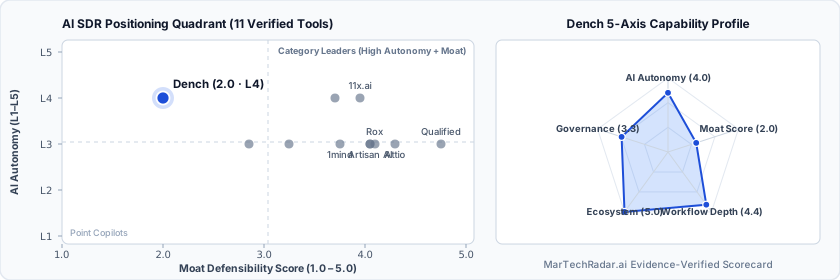
Dench is a Web SaaS tool for AI SDR (Autonomous B2B Sales Agents & AI BDRs) in AI SDR & Outbound. Pricing: $99–$200/seat/mo · Enterprise plan. Best suited to B2B Marketers, Revenue Operations and Growth Teams. Editor ratings: AI autonomy L4 (autonomous agent); moat score 2.0/5.0 (Workflow-embedded). Fact-checked by MarTechRadar Research Desk on Oct 27, 2026.
Autonomous AI revenue engine and agentic CRM workspace automating B2B lead enrichment, outbound follow-ups, and pipeline management.
Is Dench worth it in 2026? Buyer fit & when to walk away
Choose Dench if (Best Fit)
- Target ICP & Stack Fit: You operate as B2B Marketers, Revenue Operations and Growth Teams requiring a Web SaaS deployment for AI SDR, with verified ecosystem connectivity for Salesforce, HubSpot, Outreach, Slack.
- L4 Architecture & Defensibility: Dench builds a differentiated agentic revenue moat by combining a built-in headless-API CRM with autonomous overnight agents across email, iMessage, Slack, and SMS, plus sandbox computer use across 1,500+ apps at $99/seat/month.
- Commercial Model Fit: Your procurement budget aligns with $99–$200/seat/mo · Enterprise plan and want trial evaluation before contract sign-off.
Walk away from Dench if (Deal-Breakers)
- Walk away if your workflow requires uncapped enterprise volume on the $99–$200/seat/mo · Enterprise plan entry plan without upgrading tiers.
- Walk away if your workflow cannot tolerate primary operational trade-off: In practical enterprise deployments, the primary trade-off is that while Dench Cloud Max ($99/seat/month) includes $200 in monthly AI model credits per workspace and five connected mailboxes, high-volume outbound teams running heavy sandboxed computer-use automations across dozens of domains must monitor workspace credit consumption or engage on a White-Glove Enterprise plan.
- Walk away if functional scope boundary is a deal-breaker for your team: Dench is not built for B2C retail POS checkout, 3D video ad rendering, or traditional print media buying.
Dench pricing, free plan & scorecard at a glance
| Pricing | $99–$200/seat/mo · Enterprise planVendor pricing page |
|---|---|
| Free plan | No / not disclosed |
| Delivery | Web SaaS |
| Audience | B2B Marketers, Revenue Operations, Growth Teams |
| AI autonomy level | L4 · Autonomous agentEditor-verified |
| Moat tier & score | 2.0 / 5.0 · Workflow-embeddedEditor-verified |
| Funding | Seed |
| Company size | 2-10 employees |
| Ecosystem integrations | Salesforce, HubSpot, Outreach, Slack, LinkedIn |
| Headquarters | San Francisco, California |
| Founded | 2025 |
| Last verified | Oct 27, 2026 |
Dench pros & cons: strengths vs. operational limitations
Pros: core strengths & capabilities
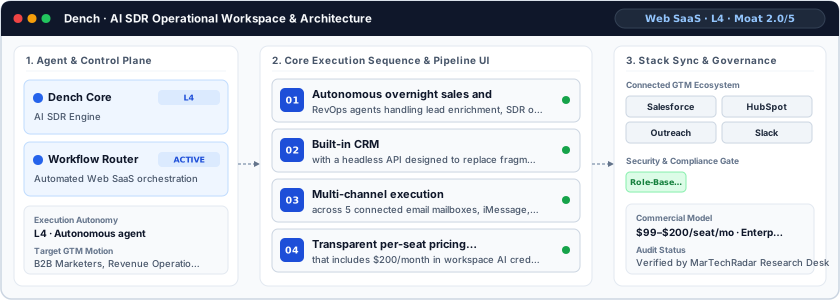
- Autonomous overnight sales and: RevOps agents handling lead enrichment, SDR outreach, deal scoring, meeting booking, and pipeline forecasting
- Built-in CRM: with a headless API designed to replace fragmented legacy CRM licenses and manual data-entry workflows
- Multi-channel execution: across 5 connected email mailboxes, iMessage, Slack, and SMS with sandboxed computer use across 1,500+ apps
- Transparent per-seat pricing ($99/seat/month): that includes $200/month in workspace AI credits across frontier LLM models
Cons: operational limitations & risks
- Primary Operational Trade-Off: In practical enterprise deployments, the primary trade-off is that while Dench Cloud Max ($99/seat/month) includes $200 in monthly AI model credits per workspace and five connected mailboxes, high-volume outbound teams running heavy sandboxed computer-use automations across dozens of domains must monitor workspace credit consumption or engage on a White-Glove Enterprise plan.
- Functional Scope Boundary: Dench is not built for B2C retail POS checkout, 3D video ad rendering, or traditional print media buying.
- Deployment & Governance Considerations: Additionally, revenue teams migrating off deeply entrenched Salesforce or HubSpot instances should leverage Dench's headless CRM API or White-Glove Enterprise partnership to map historical deal schemas cleanly.
Dench TCO & deal-breaker stress test
Simulate 12-month stepped TCO, hidden cost multipliers, contract lock-in exposure, and stack failure modes using only facts verified by MarTechRadar Research Desk on 2026-10-27 · Capture SHA 6408d405.
Dench aligns with your 5-seat / $800/mo profile. Review the walk-away triggers and contract levers below before deployment.
- Moat Score
- 2.0 / 5.0
- AI Autonomy
- L4
- Free Tier / Trial
- Free trial
Triggered audit signals & failure modes
- Published Self-Serve Entry FloorVerified Pricing Ledger
Dench publishes a transparent entry point ($99–$200/seat/mo · Enterprise plan) with a free trial for initial validation before committing.
- Linear Per-Seat Scaling (5 Seats × $99/seat/mo)Commercial Model Audit
Base license scales linearly with operator headcount ($495/mo for 5 seats on Entry Per-Seat Tier).
- Primary Operational Bottleneck: Primary Operational Trade-OffAudit by MarTechRadar Research Desk
In practical enterprise deployments, the primary trade-off is that while Dench Cloud Max ($99/seat/month) includes $200 in monthly AI model credits per workspace and five connected mailboxes, high-volume outbound teams running heavy sandboxed computer-use automations across dozens of domains must monitor workspace credit consumption or engage on a White-Glove Enterprise plan.
Test a custom Dench budget or stack constraint
Lower 5-seat floor (~$45/mo vs. $495 / mo)
Dench integrations, API, security & compliance stack
Dench AI moat & AI SDR positioning
Dench builds a differentiated agentic revenue moat by combining a built-in headless-API CRM with autonomous overnight agents across email, iMessage, Slack, and SMS, plus sandbox computer use across 1,500+ apps at $99/seat/month.
Dench in-depth review, pricing & architecture analysis
Audited by MarTechRadar Research Desk (Evidence-Ledger Verified) on Oct 27, 2026.
What is Dench? Overview & background
Dench (operating at dench.com) is an autonomous AI revenue engine and agentic GTM workspace built to find, reach, and close B2B customers without manual CRM upkeep. Headquartered in San Francisco, California (with Y Combinator Summer 2024 roots and 2025 LinkedIn incorporation) and operating with 2 to 10 employees, Dench is used by teams inside organizations such as Charles River Labs, MarketAxess, Bio-Techne, Invesco, Greptile, and Browser Use, alongside more than 1,700 GitHub stars on its developer tooling. Positioned to replace bloated legacy CRMs and disconnected outbound tools, Dench captures buyer searches for dench ai revenue engine, dench pricing, and autonomous ai crm and sdr agents.
How Dench works: architecture & workflow
At the technical core of Dench is an integrated agentic workspace that pairs a built-in, headless-API CRM with autonomous background agents that work overnight across a team's inbox, calendar, and pipeline. While human reps are offline, Dench's specialized agents—spanning Lead Enrichment, SDR Outreach, Deal Scoring, Meeting Booker, and Pipeline Forecasting—enrich new prospects, send personalized follow-ups across up to five connected email mailboxes, iMessage, Slack, and SMS, and move deals forward so sellers wake up to booked meetings and prepared deal-desk briefs. Each workspace also includes sandboxed computer-use capabilities connecting to over 1,500 business applications.
Dench limitations, drawbacks & risks
Operational considerations and platform boundaries include:
- Primary Operational Trade-Off: In practical enterprise deployments, the primary trade-off is that while Dench Cloud Max ($99/seat/month) includes $200 in monthly AI model credits per workspace and five connected mailboxes, high-volume outbound teams running heavy sandboxed computer-use automations across dozens of domains must monitor workspace credit consumption or engage on a White-Glove Enterprise plan.
- Functional Scope Boundary: Dench is not built for B2C retail POS checkout, 3D video ad rendering, or traditional print media buying.
- Deployment & Governance Considerations: Additionally, revenue teams migrating off deeply entrenched Salesforce or HubSpot instances should leverage Dench's headless CRM API or White-Glove Enterprise partnership to map historical deal schemas cleanly.
Dench pricing, plans & cost breakdown
Dench Cloud Max at $99/seat/month (3-day free trial, 16% annual discount; includes $200 monthly AI credits per workspace, unlimited agents, built-in CRM, 5 mailboxes, and 1,500+ app integrations) and Custom White-Glove Enterprise. On its official pricing page (dench.com/pricing), Dench contrasts the $8,000/month cost of a human assistant with its self-serve Dench Cloud Max plan at $99 per seat per month (3 days free, save 16% annually), which includes $200 in monthly AI credits per workspace, unlimited agents, the built-in headless CRM, five connected mailboxes, iMessage/Slack/email/SMS channels, and 1,500+ app integrations.
| Plan / Tier | Verified Price & Billing | Target Seat / Scale Fit | Included Scope & Contract Terms |
|---|---|---|---|
| Enterprise / Custom | Custom quote | 15–50+ seats (Enterprise SLA) | Sales-negotiated annual contract for custom volume, SSO/RBAC governance, and dedicated SLA. |
| Contract Watchout: Per-Seat Linear Scaling | Dench prices licenses on a per-user/seat basis ($99–$200/seat/mo · Enterprise plan); expanding from 2 to 15+ operators multiplies base recurring spend linearly. | ||
How Dench compares vs. competitors & alternatives
In the autonomous B2B sales agent and agentic revenue platform market (CAT-04-01), Dench competes with Artisan AI, 11x.ai, Lindy.ai, and Close, alongside verified subtrack peers such as SellScale, Octave, DeepSales, and Floworks AI. Compared to standalone AI SDR tools that charge $1,500+/month and still require a separate CRM subscription, Dench differentiates itself by bundling a built-in headless CRM, sandboxed computer use, and $200 of monthly AI credits into a $99/seat/month workspace. Lean B2B revenue teams should evaluate Dench.
Frequently asked questions about Dench
How much does Dench cost in 2026?
Dench pricing: $99–$200/seat/mo · Enterprise plan. No permanent free tier is listed; trial evaluation is offered. Dench Cloud Max at $99/seat/month (3-day free trial, 16% annual discount; includes $200 monthly AI credits per workspace, unlimited agents, built-in CRM, 5 mailboxes, and 1,500+ app integrations) and Custom White-Glove Enterprise.
What are the top Dench alternatives in AI SDR?
Verified AI SDR alternatives include Close ($9–$139/seat/mo), SellScale (Pricing not disclosed), Chasi (Custom / enterprise pricing), Cluster (Custom / enterprise pricing). In the autonomous B2B sales agent and agentic revenue platform market (`CAT-04-01`), Dench competes with Artisan AI, 11x.ai, Lindy.ai, and Close, alongside verified subtrack peers such as SellScale, Octave, DeepSales, and Floworks AI.
Verified sources & evidence trail
- Official product domain: https://www.dench.com
- Commercial pricing verification: https://www.dench.com/pricing
- Verified corporate entity profiles (
sameAs): LinkedIn Company Profile - Editorial audit sign-off: Audited by MarTechRadar Research Desk (Evidence-Ledger Verified) on Oct 27, 2026.
