Dash Hudson Review (2026): Social Media Scheduling Pricing, Pros & Cons
Bottom line
Dash Hudson is a Web SaaS tool for Social Media Scheduling (Social Media Scheduling & Auto-Publishing) in Social & Influencer. Pricing: Custom / enterprise pricing. Best suited to DTC / eCommerce and Enterprise Brands. Editor ratings: AI autonomy L3 (conditional automation); moat score 3.3/5.0 (Workflow-embedded (strong)). Fact-checked by MarTechRadar Research Desk on Oct 14, 2026.
Brand-intelligent social media management and visual marketing platform delivering predictive performance analytics and multi-channel scheduling.
Is Dash Hudson worth it in 2026? Buyer fit & when to walk away
Choose Dash Hudson if (Best Fit)
- Target ICP & Stack Fit: You operate as DTC / eCommerce and Enterprise Brands requiring a Web SaaS deployment for Social Media Scheduling, with verified ecosystem connectivity for Salesforce, Google BigQuery, Klaviyo, Zendesk.
- L3 Architecture & Defensibility: Proprietary predictive vision AI trained on substantial cross-network visual engagement datasets, coupled with enterprise-grade multi-brand governance pipelines.
- Commercial Model Fit: Your procurement budget aligns with Custom / enterprise pricing.
Walk away from Dash Hudson if (Deal-Breakers)
- Walk away if you need published self-serve pricing: Dash Hudson is sold by custom quote.
- Walk away if your workflow cannot tolerate platform API rate limiting: Third-party network API changes and strict upstream rate limits can intermittently throttle batch auto-publishing queues and delay near-real-time comment synchronization.
- Walk away if predictive drift across novel formats is a deal-breaker for your team: The visual scoring algorithms require historical training baselines, leading to reduced predictive reliability on rapidly shifting vertical video trends and nascent post types.
Dash Hudson pricing, free plan & scorecard at a glance
| Pricing | Custom / enterprise pricing |
|---|---|
| Free plan | No / not disclosed |
| Delivery | Web SaaS |
| Audience | DTC / eCommerce, Enterprise Brands |
| AI autonomy level | L3 · Conditional automationEditor-verified |
| Moat tier & score | 3.3 / 5.0 · Workflow-embedded (strong)Editor-verified |
| Funding | Venture-backed |
| Total funding | $2.7M |
| Ecosystem integrations | Salesforce, Google BigQuery, Klaviyo, Zendesk |
| Governance & docs | Trust & Security ↗ · Terms ↗ · Privacy ↗ |
| Headquarters | Halifax, NS |
| Founded | 2013 |
| Last verified | Oct 14, 2026 |
Dash Hudson pros & cons: strengths vs. operational limitations
Pros: core strengths & capabilities
- Predictive performance AI scoring: visual content prior to distribution
- Multi-channel content scheduling and unified editorial calendar
- Centralized visual asset library: with automatic tagging and rights management
- Community management inbox and cross-network engagement tracking
Cons: operational limitations & risks
- Platform API Rate Limiting: Third-party network API changes and strict upstream rate limits can intermittently throttle batch auto-publishing queues and delay near-real-time comment synchronization.
- Predictive Drift Across Novel Formats: The visual scoring algorithms require historical training baselines, leading to reduced predictive reliability on rapidly shifting vertical video trends and nascent post types.
- Asset Ingestion Metadata Overhead: Maximizing cross-brand searchability and accurate auto-tagging requires rigorous upfront taxonomic organization and manual catalog governance during initial tenant onboarding.
Dash Hudson TCO & deal-breaker stress test
Simulate 12-month stepped TCO, hidden cost multipliers, contract lock-in exposure, and stack failure modes using only facts verified by MarTechRadar Research Desk on 2026-10-14.
Dash Hudson triggers high-severity friction under your 5-seat / $800/mo constraints. Benchmark the verified subtrack alternatives below before committing.
- Moat Score
- 3.3 / 5.0
- AI Autonomy
- L3
- Free Tier / Trial
- None disclosed
Triggered audit signals & failure modes
- Opaque Enterprise Quoting vs. SMB/Mid-Market BudgetVerified Pricing Ledger
Dash Hudson does not disclose a public self-serve floor (Custom / enterprise pricing). Buyers with a $800/mo cap face high sales-qualification friction.
- Sales-Gated Contract TermsFact-checked by MarTechRadar Research Desk
Dash Hudson provides software-as-a-service subscriptions with commercial pricing available on request through tailored enterprise sales quotes based on organizational scale and seats.
- Primary Operational Bottleneck: Platform API Rate LimitingAudit by MarTechRadar Research Desk
Third-party network API changes and strict upstream rate limits can intermittently throttle batch auto-publishing queues and delay near-real-time comment synchronization.
Test a custom Dash Hudson budget or stack constraint
Lower 5-seat floor (~$19/mo vs. Custom Quote) · Transparent self-serve entry without mandatory annual lock-in
Lower 5-seat floor (~$60/mo vs. Custom Quote) · Transparent self-serve entry without mandatory annual lock-in
Dash Hudson integrations, API, security & compliance stack
Dash Hudson AI moat & Social Media Scheduling positioning
Proprietary predictive vision AI trained on substantial cross-network visual engagement datasets, coupled with enterprise-grade multi-brand governance pipelines.
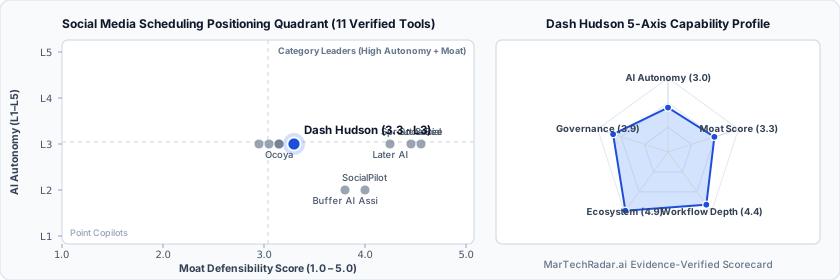
Dash Hudson in-depth review, pricing & architecture analysis
Editor sign-off: Oct 14, 2026. How profiles are made.
What is Dash Hudson? Overview & background
Modern enterprise social media teams require systems that bridge content intelligence with automated execution. Headquartered in Halifax, NS, Dash Hudson was founded in 2013 to solve this operational friction by uniting visual performance analytics with distribution logistics. Backed by $2.7M in venture capital funding, the company targets enterprise marketing leaders, social strategists, and creative operations directors who manage multi-network distribution across TikTok, Instagram, and YouTube. Within the social media scheduling and auto-publishing sector, Dash Hudson functions as a visual intelligence layer connecting content production to cross-channel syndication.
How Dash Hudson works: architecture & workflow
At Level 3 autonomy, Dash Hudson automates publication dispatch while embedding editorial oversight and algorithmic asset screening. Its architecture ingests media files into a central content library, where computer vision algorithms analyze composition, color palettes, and format metadata to generate predictive engagement scores before deployment. The engine maps approved media into multi-channel publishing calendars, queueing posts through authenticated social platform APIs. Integrated community management and link-in-bio redirection modules capture conversion telemetry, funneling audience interaction metrics back into the central analytics repository to refine future asset recommendations, alongside native workflow integrations for Salesforce, BigQuery, Klaviyo, and Zendesk.
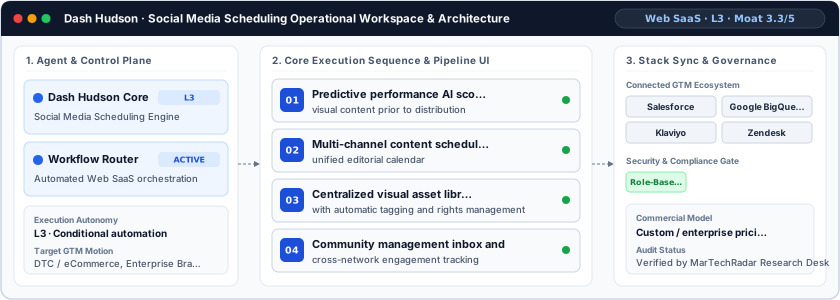
Dash Hudson limitations, drawbacks & risks
Operational considerations and platform boundaries include:
- Platform API Rate Limiting: Third-party network API changes and strict upstream rate limits can intermittently throttle batch auto-publishing queues and delay near-real-time comment synchronization.
- Predictive Drift Across Novel Formats: The visual scoring algorithms require historical training baselines, leading to reduced predictive reliability on rapidly shifting vertical video trends and nascent post types.
- Asset Ingestion Metadata Overhead: Maximizing cross-brand searchability and accurate auto-tagging requires rigorous upfront taxonomic organization and manual catalog governance during initial tenant onboarding.
Dash Hudson pricing, plans & cost breakdown
Dash Hudson provides software-as-a-service subscriptions with commercial pricing available on request through tailored enterprise sales quotes based on organizational scale and seats. The commercial framework organizes accounts into modular tiers such as Engage, which packages multi-channel scheduling, link-in-bio tools, and community management alongside unlimited platform seats for unified brand teams. Upper tiers expand functional access to advanced predictive vision intelligence, multi-brand workspace partitioning, dedicated onboarding programs, and expanded cross-network API volumes.
| Plan / Tier | Verified Price & Billing | Target Seat / Scale Fit | Included Scope & Contract Terms |
|---|---|---|---|
| Enterprise / Custom | Custom quote | Unlimited seats | Custom-quoted plan; terms come from the vendor's sales team. |
How Dash Hudson compares vs. competitors & alternatives
Dash Hudson competes against general-purpose social management tools such as Agorapulse, Antela.ai, Inc., and Apaya. While Agorapulse emphasizes general inbox workflow efficiency and cost-effective scheduling for mid-market agencies, Dash Hudson differentiates through visual-first predictive scoring and asset tagging engineered for creative teams. In contrast to niche automation vendors like Antela.ai, Inc. or Apaya, Dash Hudson provides broader multi-network coverage and robust brand asset governance. The platform is best suited for visual-led consumer enterprises requiring deep creative intelligence paired with governed multi-channel publishing.
Direct competitors & market radar
Top algorithmic competitors based on category positioning, capability overlap, and ICP alignment.
Frequently asked questions about Dash Hudson
Does Dash Hudson publish pricing or require an enterprise quote?
Dash Hudson pricing: Custom / enterprise pricing. No free plan is publicly disclosed. Dash Hudson provides software-as-a-service subscriptions with commercial pricing available on request through tailored enterprise sales quotes based on organizational scale and seats.
What are the top Dash Hudson alternatives in Social Media Scheduling?
Verified Social Media Scheduling alternatives include DaisySocial (Custom / enterprise pricing), Predis.ai ($19–$249/mo · Enterprise plan), Nectar Social (Custom / enterprise pricing), Fermat Commerce (Custom / enterprise pricing). Dash Hudson competes against general-purpose social management tools such as Agorapulse, Antela.ai, Inc., and Apaya.
What are the main limitations and trade-offs of Dash Hudson?
Operational considerations and platform boundaries include: Platform API Rate Limiting: Third-party network API changes and strict upstream rate limits can intermittently throttle batch auto-publishing queues and delay near-real-time comment synchronization. Walk away if you need published self-serve pricing: Dash Hudson is sold by custom quote.
Verified sources & evidence trail
- Official product domain: https://dashhudson.com
- Commercial pricing verification: Verified against official vendor pricing policy (Custom / enterprise pricing)
- Verified corporate entity profiles (
sameAs): LinkedIn Company Profile · Crunchbase Entity Record - First-party governance & documentation links: Trust & Security · Terms · Privacy
- Editor sign-off: Oct 14, 2026 (how profiles are made).
