Blueshift Review (2026): CDP Pricing, Limits & Alternatives
Bottom line
Blueshift is a SaaS Platform tool for CDP (Customer Data Platform & Journey Orchestration) in Lifecycle & CDP. Pricing: Pricing not disclosed. Best suited to B2B Marketing & GTM Teams. Editor ratings: AI autonomy L3 (conditional automation); moat score 3.9/5.0 (Proprietary moat). Fact-checked by Jagmeet Sine on Oct 23, 2026.
AI-powered customer engagement and data platform unifying real-time customer profiles to orchestrate omnichannel lifecycle journeys.
Blueshift buyer fit verdict: when to choose vs. when to walk away
Choose Blueshift if (Best Fit)
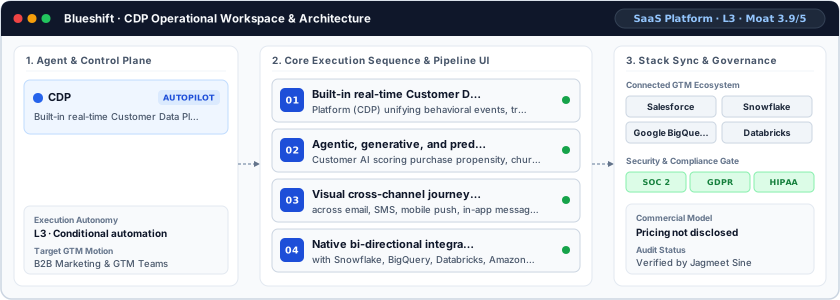
- Target ICP & Stack Fit: You operate as B2B Marketing & GTM Teams requiring a SaaS Platform deployment for CDP, with verified ecosystem connectivity for Salesforce, Snowflake, Google BigQuery, Databricks.
- L3 Architecture & Defensibility: Blueshift establishes a strong enterprise engagement moat by combining a built-in customer data platform, predictive and agentic Customer AI, and 100+ data warehouse and channel integrations, now backed by BlueConic.
- Commercial Model Fit: Your procurement budget aligns with Pricing not disclosed.
Walk away from Blueshift if (Deal-Breakers)
- Walk away if you require transparent self-serve monthly billing or your budget ceiling is under $1,000/mo (Blueshift requires sales-gated custom quoting).
- Walk away if your workflow cannot tolerate event-taxonomy & catalog onboarding bottleneck: Unlocking accurate 1:1 predictive product recommendations and multi-step behavioral triggers requires clean event-stream instrumentation and structured product catalog feeds during initial implementation, creating a multi-week onboarding learning curve.
- Walk away if architectural overlap with existing standalone cdps is a deal-breaker for your team: Organizations that have already standardized on a dedicated warehouse-native CDP (such as Hightouch or GrowthLoop) may encounter functional redundancy and integration friction when adopting Blueshift's bundled data layer alongside BlueConic.
Blueshift key facts & scorecard
| Pricing | Pricing not disclosed |
|---|---|
| Free plan | No / not disclosed |
| Delivery | SaaS Platform |
| Audience | B2B Marketing & GTM Teams |
| AI autonomy level | L3 · Conditional automationEditor-verified |
| Moat tier & score | 3.9 / 5.0 · Proprietary moatEditor-verified |
| Funding | AcquiredAcquired by BlueConic |
| Total funding | $104.6MBacked by Nexus Venture Partners, New Enterprise Associates, SBVA, Espresso Capital, Runway Growth Capital |
| Founders | Manyam Mallela, Mehul Shah, Vijay Chittoor |
| Company size | 51-200 employees |
| Ecosystem integrations | Salesforce, Snowflake, Google BigQuery, Databricks, Amazon Redshift, Shopify |
| Compliance & governance | SOC 2, GDPR, HIPAA |
| Headquarters | San Francisco, California, United States |
| Founded | 2014 |
| Last verified |
Blueshift pros & cons: strengths vs. operational limitations
Pros: core strengths & capabilities
- Built-in real-time Customer Data: Platform (CDP) unifying behavioral events, transactions, and catalog attributes into 360-degree profiles
- Agentic, generative, and predictive: Customer AI scoring purchase propensity, churn risk, optimal send time, and channel affinity
- Visual cross-channel journey orchestration: across email, SMS, mobile push, in-app messaging, web personalization, and paid media syndication
- Native bi-directional integrations: with Snowflake, BigQuery, Databricks, Amazon Redshift, Salesforce, and Shopify under SOC 2, GDPR, and HIPAA compliance
Cons: operational limitations & risks
- Event-Taxonomy & Catalog Onboarding Bottleneck: Unlocking accurate 1:1 predictive product recommendations and multi-step behavioral triggers requires clean event-stream instrumentation and structured product catalog feeds during initial implementation, creating a multi-week onboarding learning curve.
- Architectural Overlap with Existing Standalone CDPs: Organizations that have already standardized on a dedicated warehouse-native CDP (such as Hightouch or GrowthLoop) may encounter functional redundancy and integration friction when adopting Blueshift's bundled data layer alongside BlueConic.
- Enterprise-Oriented Commercial Dependency: Blueshift is not built for micro-merchants or early-stage startups seeking low-cost monthly email newsletters, as its platform architecture and active-profile metering are tailored for high-volume lifecycle programs.
Are you a founder, co-founder, or product/growth lead at Blueshift? Verify your official @blueshift.com email to publish a factual architectural response or 2026 roadmap update below these limitations.
Blueshift TCO & deal-breaker stress test
Simulate 12-month stepped TCO, hidden cost multipliers, contract lock-in exposure, and stack failure modes using only facts verified by Jagmeet Sine on · Capture SHA c5c92d47.
Blueshift triggers high-severity friction under your 5-seat / $800/mo constraints. Benchmark the verified subtrack alternatives below before committing.
| Plan / Tier | Verified Rate | Scale Fit | Scope & Quota Notes |
|---|---|---|---|
| Entry / Starter | $1250/mo | 1–2 seats | Verified $1250/mo published rate on vendor pricing schedule. |
| Enterprise / Custom | Custom quote | 15–50+ seats (Enterprise SLA) | Sales-negotiated annual contract for custom volume, SSO/RBAC governance, and dedicated SLA. |
- Moat Score
- 3.9 / 5.0
- AI Autonomy
- L3
- Free Tier / Trial
- None disclosed
Triggered audit signals & failure modes
- Opaque Enterprise Quoting vs. SMB/Mid-Market BudgetVerified Pricing Ledger
Blueshift does not disclose a public self-serve floor (Pricing not disclosed). Buyers with a $800/mo cap face high sales-qualification friction.
- Sales-Gated Contract TermsFact-checked by Jagmeet Sine
Blueshift operates on an annual SaaS and enterprise subscription model with custom pricing available on request.
- Primary Operational Bottleneck: Enterprise-Oriented Commercial DependencyAudit by Jagmeet Sine
Blueshift is not built for micro-merchants or early-stage startups seeking low-cost monthly email newsletters, as its platform architecture and active-profile metering are tailored for high-volume lifecycle programs.
Hidden TCO Multipliers & Quota Gates
- Profile / Workspace Quota Ceilings: Base tiers cap the number of connected profiles, workspaces, or contact records, forcing tier upgrades before seat limits are reached.
- Event-Taxonomy & Catalog Onboarding Bottleneck: Unlocking accurate 1:1 predictive product recommendations and multi-step behavioral triggers requires clean event-stream instrumentation and structured product catalog feeds during initial implementation, creating a multi-week onboarding learning curve.
- Architectural Overlap with Existing Standalone CDPs: Organizations that have already standardized on a dedicated warehouse-native CDP (such as Hightouch or GrowthLoop) may encounter functional redundancy and integration friction when adopting Blueshift's bundled data layer alongside BlueConic.
When to Walk Away & Negotiation Levers
- Walk away if you require transparent self-serve monthly billing or your budget ceiling is under $1,000/mo (Blueshift requires sales-gated custom quoting).
- Walk away if your workflow cannot tolerate event-taxonomy & catalog onboarding bottleneck: Unlocking accurate 1:1 predictive product recommendations and multi-step behavioral triggers requires clean event-stream instrumentation and structured product catalog feeds during initial implementation, creating a multi-week onboarding learning curve.
- Walk away if architectural overlap with existing standalone cdps is a deal-breaker for your team: Organizations that have already standardized on a dedicated warehouse-native CDP (such as Hightouch or GrowthLoop) may encounter functional redundancy and integration friction when adopting Blueshift's bundled data layer alongside BlueConic.
- Demand a 30- to 60-day paid pilot opt-out clause in the Blueshift order form before signing a 12-month enterprise commitment.
- Require a sandbox proof-of-concept testing event-taxonomy & catalog onboarding bottleneck against your live CRM/data schema before annual sign-off.
Ask a custom procurement or TCO stress-test question about Blueshift
Lower 5-seat floor (~$85/mo vs. Custom Quote) · Transparent self-serve entry without mandatory annual lock-in
Lower 5-seat floor (~$19/mo vs. Custom Quote) · Transparent self-serve entry without mandatory annual lock-in
Blueshift key entities, modules & ecosystem stack
Built-in real-time Customer Data Platform unifying behavioral events, transactions, and catalog attributes into 360-degree profiles
Blueshift moat & subtrack positioning
Blueshift establishes a strong enterprise engagement moat by combining a built-in customer data platform, predictive and agentic Customer AI, and 100+ data warehouse and channel integrations, now backed by BlueConic.
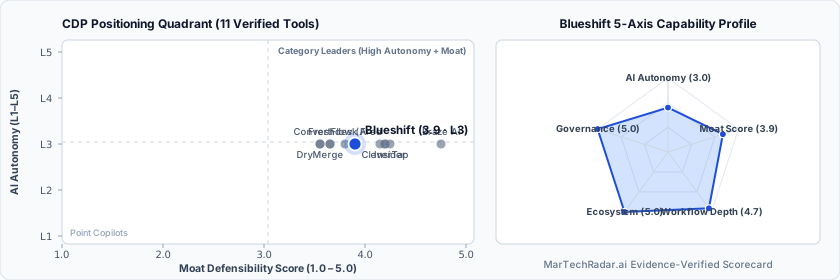
Editorial review
Fact-checked by Jagmeet Sine (Senior MarTech Infrastructure & Agentic Workflow Architect) on .
Background
Founded in 2014 by Manyam Mallela, Mehul Shah, and Vijay Chittoor and headquartered in San Francisco, California, United States, Blueshift (blueshift.com) is an AI-powered customer engagement and cross-channel journey orchestration platform built for mid-market and enterprise consumer brands across e-commerce, financial services, healthcare, and media. Operating with a team of 51-200 employees after raising $104.6M across six funding rounds from lead investors including Nexus Venture Partners, New Enterprise Associates, SBVA, Espresso Capital, and Runway Growth Capital—and subsequently acquired by customer data platform provider BlueConic—the company bridges the gap between raw first-party data and multi-channel execution. Rather than forcing marketing teams to bolt a separate campaign tool onto a disconnected data warehouse, Blueshift embeds real-time profile unification and predictive decisioning into a single operational workspace.
How Blueshift works
Blueshift operates at Level 3 autonomy by pairing its native Customer Data Platform (CDP) with its patented Customer AI engine—spanning predictive, generative, and agentic AI assistants. As customers browse websites, use mobile apps, or complete offline transactions, Blueshift ingests streaming behavioral events and syncs bi-directionally with cloud data warehouses including Snowflake, Google BigQuery, Databricks, and Amazon Redshift alongside Salesforce and Shopify. Customer AI continuously computes individual-level scores for purchase intent, category affinity, churn likelihood, next-best channel, and optimal send window, while dynamic 1:1 recommendation blocks assemble personalized product and content feeds at the moment of message open across email, SMS, mobile push, in-app notifications, and paid ad audiences. Enterprise deployments operate under SOC 2, GDPR, and HIPAA compliance guardrails.
Limitations
Operational limitations and technical trade-offs include:
- Event-Taxonomy & Catalog Onboarding Bottleneck: Unlocking accurate 1:1 predictive product recommendations and multi-step behavioral triggers requires clean event-stream instrumentation and structured product catalog feeds during initial implementation, creating a multi-week onboarding learning curve.
- Architectural Overlap with Existing Standalone CDPs: Organizations that have already standardized on a dedicated warehouse-native CDP (such as Hightouch or GrowthLoop) may encounter functional redundancy and integration friction when adopting Blueshift's bundled data layer alongside BlueConic.
- Enterprise-Oriented Commercial Dependency: Blueshift is not built for micro-merchants or early-stage startups seeking low-cost monthly email newsletters, as its platform architecture and active-profile metering are tailored for high-volume lifecycle programs.
Blueshift pricing
Blueshift operates on an annual SaaS and enterprise subscription model with custom pricing available on request. Commercial packages—spanning Starter, Growth, and Enterprise editions—are metered primarily by monthly active profiles engaged and message volume rather than charging punitive storage fees for dormant historical contacts. Prospective marketing and digital experience teams engage Blueshift's sales organization for a tailored architecture scoping and annual contract proposal.
How Blueshift compares
Within the Customer Data Platform (CDP) & Journey Orchestration category, Blueshift competes against enterprise cross-channel engagement and CDP platforms such as Braze, Iterable, Cordial, Insider, and Klaviyo. Versus mobile-first messaging engines like Braze or Iterable that often require an external CDP for deep data unification, Blueshift differentiates itself through its unified SmartHub CDP architecture and BlueConic backing, combining identity resolution, predictive Customer AI scoring, and cross-channel execution in one system.
Frequently asked questions about Blueshift
How much does Blueshift cost and does it require a custom enterprise quote?
Published pricing summary for Blueshift: Pricing not disclosed. A permanent free plan is not disclosed for Blueshift. Verified tier schedule: Entry / Starter ($1250/mo for 1–2 seats); Enterprise / Custom (Custom quote for 15–50+ seats (Enterprise SLA)). Blueshift operates on an annual SaaS and enterprise subscription model with custom pricing available on request.
How does Blueshift work and how autonomous is its AI architecture?
AI-powered customer engagement and data platform unifying real-time customer profiles to orchestrate omnichannel lifecycle journeys. Within CDP (Customer Data Platform & Journey Orchestration), MarTechRadar rates its execution architecture at L3 · Conditional automation with a verified Moat Score of 3.9 / 5.0 (Proprietary moat). Blueshift establishes a strong enterprise engagement moat by combining a built-in customer data platform, predictive and agentic Customer AI, and 100+ data warehouse and channel integrations, now backed by BlueConic. Corporate profile: Founded by Manyam Mallela, Mehul Shah, Vijay Chittoor, operating at 51-200 employees scale, acquired by BlueConic.
What are the main limitations of Blueshift and when should buyers walk away?
Based on our editorial technical audit, key operational considerations and boundaries for Blueshift include: (1) Event-Taxonomy & Catalog Onboarding Bottleneck: Unlocking accurate 1:1 predictive product recommendations and multi-step behavioral triggers requires clean event-stream instrumentation and structured product catalog feeds during initial implementation, creating a multi-week onboarding learning curve. (2) Architectural Overlap with Existing Standalone CDPs: Organizations that have already standardized on a dedicated warehouse-native CDP (such as Hightouch or GrowthLoop) may encounter functional redundancy and integration friction when adopting Blueshift's bundled data layer alongside BlueConic. (3) Enterprise-Oriented Commercial Dependency: Blueshift is not built for micro-merchants or early-stage startups seeking low-cost monthly email newsletters, as its platform architecture and active-profile metering are tailored for high-volume lifecycle programs. Primary procurement walk-away rule: Walk away if you require transparent self-serve monthly billing or your budget ceiling is under $1,000/mo (Blueshift requires sales-gated custom quoting).
What integrations, compliance certifications, and contract terms apply to Blueshift?
Verified ecosystem and stack integrations include Salesforce, Snowflake, Google BigQuery, Databricks, Amazon Redshift, Shopify, Klaviyo, Braze, Iterable. Documented security and governance attestations include SOC 2, GDPR, HIPAA. Key TCO multiplier to watch: Profile / Workspace Quota Ceilings (Base tiers cap the number of connected profiles, workspaces, or contact records, forcing tier upgrades before seat limits are reached.) Before signing a contract, procurement teams should demand a 30- to 60-day paid pilot opt-out clause in the Blueshift order form before signing a 12-month enterprise commitment.
What are the best Blueshift alternatives and head-to-head competitors in 2026?
Top fact-checked alternatives to Blueshift in CDP (Customer Data Platform & Journey Orchestration) include Cordial (Pricing not disclosed), Insider (Custom / enterprise pricing), GrowthLoop (Pricing not disclosed), Fixture (Pricing not disclosed). Within the Customer Data Platform (CDP) & Journey Orchestration category, Blueshift competes against enterprise cross-channel engagement and CDP platforms such as Braze, Iterable, Cordial, Insider, and Klaviyo.
Verified sources & evidence trail
- Official product domain: https://blueshift.com
- Commercial pricing verification: Verified against official vendor pricing policy (Pricing not disclosed)
- Verified corporate entity profiles (
sameAs): LinkedIn Company Profile · Crunchbase Entity Record - Editorial audit sign-off: Fact-checked by Jagmeet Sine on under the MarTechRadar Evidence-Ledger Protocol.