Bertha AI Review (2026): AI Writing Assistant Pricing, Pros & Cons
Bottom line
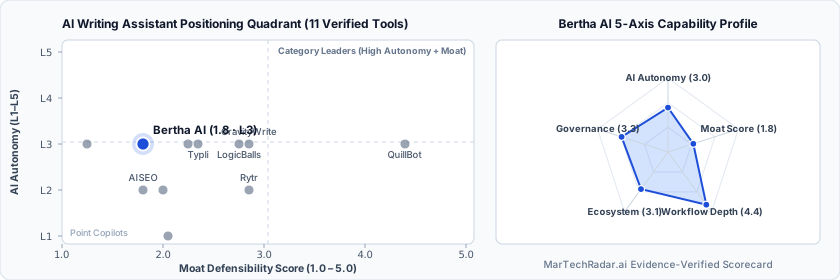
Bertha AI is a Web SaaS tool for AI Writing Assistant (Writing Assistants & Paraphrasing) in Copy & Content. Pricing: Custom / enterprise pricing. Best suited to Creators / Solo. Editor ratings: AI autonomy L3 (conditional automation); moat score 1.8/5.0 (Thin wrapper). Fact-checked by MarTechRadar Research Desk on Oct 14, 2026.
Autonomous copy generation and rephrasing assistant designed for content creators and website operators directly within web publishing environments.
Is Bertha AI worth it in 2026? Buyer fit & when to walk away
Choose Bertha AI if (Best Fit)
- Target ICP & Stack Fit: You operate as Creators / Solo requiring a Web SaaS deployment for AI Writing Assistant.
- L3 Architecture & Defensibility: Defensibility was historically derived from native CMS and browser integration, but commoditization of core LLM wrappers and platform dependencies eliminated technical moats, leading to service decommission.
- Commercial Model Fit: Your procurement budget aligns with Custom / enterprise pricing.
Walk away from Bertha AI if (Deal-Breakers)
- Walk away if you need published self-serve pricing: Bertha AI is sold by custom quote.
- Walk away if your workflow cannot tolerate platform sunset and availability: The system has ceased operations entirely; all active licenses, browser extensions, and backend application interfaces have been terminated and taken offline permanently.
- Walk away if wrapper model fragility is a deal-breaker for your team: The architecture relied heavily on third-party model inference wrappers without differentiated proprietary weights or localized enterprise fine-tuning pipelines.
Bertha AI pricing, free plan & scorecard at a glance
| Pricing | Custom / enterprise pricing |
|---|---|
| Free plan | No / not disclosed |
| Delivery | Web SaaS |
| Audience | Creators / Solo |
| AI autonomy level | L3 · Conditional automationEditor-verified |
| Moat tier & score | 1.8 / 5.0 · Thin wrapperEditor-verified |
| Funding | Bootstrapped |
| Founders | Vito Peleg |
| Headquarters | United States |
| Last verified | Oct 14, 2026 |
Bertha AI pros & cons: strengths vs. operational limitations
Pros: core strengths & capabilities
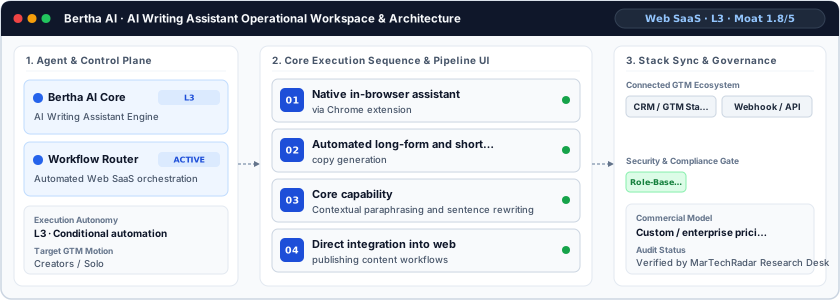
- Native in-browser assistant: via Chrome extension
- Automated long-form and short-form: copy generation
- Core capability: Contextual paraphrasing and sentence rewriting
- Direct integration into web: publishing content workflows
Cons: operational limitations & risks
- Platform Sunset and Availability: The system has ceased operations entirely; all active licenses, browser extensions, and backend application interfaces have been terminated and taken offline permanently.
- Wrapper Model Fragility: The architecture relied heavily on third-party model inference wrappers without differentiated proprietary weights or localized enterprise fine-tuning pipelines.
- Ecosystem Disruption: Rapid release of native generative capabilities directly within major web browsers and content management systems fully bypassed the platform's distribution model.
Bertha AI TCO & deal-breaker stress test
Simulate 12-month stepped TCO, hidden cost multipliers, contract lock-in exposure, and stack failure modes using only facts verified by MarTechRadar Research Desk on 2026-10-14.
Bertha AI triggers high-severity friction under your 5-seat / $800/mo constraints. Benchmark the verified subtrack alternatives below before committing.
- Moat Score
- 1.8 / 5.0
- AI Autonomy
- L3
- Free Tier / Trial
- None disclosed
Triggered audit signals & failure modes
- Opaque Enterprise Quoting vs. SMB/Mid-Market BudgetVerified Pricing Ledger
Bertha AI does not disclose a public self-serve floor (Custom / enterprise pricing). Buyers with a $800/mo cap face high sales-qualification friction.
- Sales-Gated Contract TermsFact-checked by MarTechRadar Research Desk
Prior to operations terminating, commercial access followed a subscription tier model alongside a free tier.
- Primary Operational Bottleneck: Platform Sunset and AvailabilityAudit by MarTechRadar Research Desk
The system has ceased operations entirely; all active licenses, browser extensions, and backend application interfaces have been terminated and taken offline permanently.
Test a custom Bertha AI budget or stack constraint
Lower 5-seat floor (~$15/mo vs. Custom Quote) · Transparent self-serve entry without mandatory annual lock-in
Lower 5-seat floor (~$25/mo vs. Custom Quote) · Transparent self-serve entry without mandatory annual lock-in
Bertha AI AI moat & AI Writing Assistant positioning
Defensibility was historically derived from native CMS and browser integration, but commoditization of core LLM wrappers and platform dependencies eliminated technical moats, leading to service decommission.
Bertha AI in-depth review, pricing & architecture analysis
Editor sign-off: Oct 14, 2026. How profiles are made.
What is Bertha AI? Overview & background
Headquartered in the United States, Bertha AI targeted digital marketers, agency copywriters, and content editors seeking embedded generative writing assistance directly inside content creation interfaces. The application was designed to solve the job of eliminating manual drafting friction by inserting language generation directly into browser fields and publishing platforms. However, escalating competitive density across foundational model providers rendered the tool commercially unsustainable, resulting in the formal shutdown of the service, total rescission of active user licenses, and closure of customer access.
How Bertha AI works: architecture & workflow
Architecturally, Bertha AI functioned at Level 3 autonomy by intercepting text input fields across target digital environments through client-side browser extensions. The system utilized prompt wrappers that structured user inputs, injected predefined voice parameters, and dispatched requests to downstream commercial large language model application programming interfaces. Outputs were rendered inline, enabling operators to accept, reject, or cycle variations without leaving their active content management system, relying entirely on third-party foundational inference layers without private model hosting.
Bertha AI limitations, drawbacks & risks
Operational considerations and platform boundaries include:
- Platform Sunset and Availability: The system has ceased operations entirely; all active licenses, browser extensions, and backend application interfaces have been terminated and taken offline permanently.
- Wrapper Model Fragility: The architecture relied heavily on third-party model inference wrappers without differentiated proprietary weights or localized enterprise fine-tuning pipelines.
- Ecosystem Disruption: Rapid release of native generative capabilities directly within major web browsers and content management systems fully bypassed the platform's distribution model.
Bertha AI pricing, plans & cost breakdown
Prior to operations terminating, commercial access followed a subscription tier model alongside a free tier. Active licenses have now been formally rescinded, and historical commercial pricing is available on request through tailored enterprise sales quotes based on organizational scale and seats for organizations auditing legacy implementations.
| Plan / Tier | Verified Price & Billing | Included Scope & Contract Terms |
|---|---|---|
| Enterprise / Custom | Custom quote | Custom-quoted plan; terms come from the vendor's sales team. |
How Bertha AI compares vs. competitors & alternatives
Within the writing assistant ecosystem, Bertha AI competed directly against Rytr, QuillBot, and AISEO. While QuillBot established defensibility through specialized proprietary paraphrase algorithms and academic workflows, and AISEO focused heavily on programmatic search engine optimization clustering, Bertha AI operated primarily as an inline wrapper. Teams evaluating this category require active, sustained development ecosystems, making stabilized platforms with standalone algorithmic moats or deep enterprise governance the necessary alternative.
Frequently asked questions about Bertha AI
Does Bertha AI publish pricing or require an enterprise quote?
Bertha AI pricing: Custom / enterprise pricing. No free plan is publicly disclosed. Prior to operations terminating, commercial access followed a subscription tier model alongside a free tier.
What are the top Bertha AI alternatives in AI Writing Assistant?
Verified AI Writing Assistant alternatives include Typli (From $14.99/mo), Robinize (Custom / enterprise pricing), Cohesive AI ($25–$45/mo), WordHero (Custom / enterprise pricing). Within the writing assistant ecosystem, Bertha AI competed directly against Rytr, QuillBot, and AISEO.
What are the main limitations and trade-offs of Bertha AI?
Operational considerations and platform boundaries include: Platform Sunset and Availability: The system has ceased operations entirely; all active licenses, browser extensions, and backend application interfaces have been terminated and taken offline permanently. Walk away if you need published self-serve pricing: Bertha AI is sold by custom quote.
Verified sources & evidence trail
- Official product domain: https://bertha.ai
- Commercial pricing verification: Verified against official vendor pricing policy (Custom / enterprise pricing)
- Verified corporate entity profiles (
sameAs): Crunchbase Entity Record - Editor sign-off: Oct 14, 2026 (how profiles are made).
