GravityWrite Review (2026): AI Writing Assistant Pricing, Pros & Cons
Bottom line
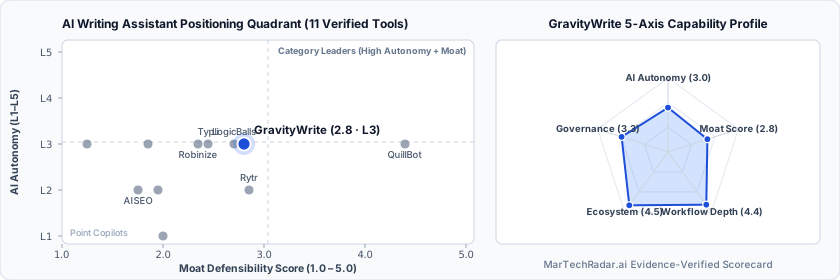
GravityWrite is a Web SaaS tool for AI Writing Assistant (Writing Assistants & Paraphrasing) in Copy & Content. Pricing: From $49/mo. Best suited to Creators / Solo. Editor ratings: AI autonomy L3 (conditional automation); moat score 2.8/5.0 (Workflow-embedded). Fact-checked by MarTechRadar Research Desk on Oct 14, 2026.
Multi-modal generative writing platform consolidating SEO blogging, social copy, and automated website content into a centralized prompt-engineered suite.
Is GravityWrite worth it in 2026? Buyer fit & when to walk away
Choose GravityWrite if (Best Fit)
- Target ICP & Stack Fit: You operate as Creators / Solo requiring a Web SaaS deployment for AI Writing Assistant, with verified ecosystem connectivity for WordPress, Google Analytics 4 (GA4), n8n.
- L3 Architecture & Defensibility: Relies on aggregated workflow templates and credit-metered access to external foundational models, creating low defensibility against platform vendors.
- Commercial Model Fit: Your procurement budget aligns with From $49/mo.
Walk away from GravityWrite if (Deal-Breakers)
- Walk away if your workflow cannot tolerate credit consumption governance: The platform enforces strict monthly AI token credits that deplete rapidly during multi-stage long-form drafting, creating workflow interruptions for high-volume content operations.
- Walk away if fact-checking latency is a deal-breaker for your team: Outputs lack deterministic web verification and citation mechanisms, introducing semantic hallucination risks that mandate continuous manual editorial review before publication.
GravityWrite pricing, free plan & scorecard at a glance
| Pricing | From $49/moVendor pricing page |
|---|---|
| Free plan | No / not disclosed |
| Delivery | Web SaaS |
| Audience | Creators / Solo |
| AI autonomy level | L3 · Conditional automationEditor-verified |
| Moat tier & score | 2.8 / 5.0 · Workflow-embeddedEditor-verified |
| Funding | Bootstrapped |
| Founders | Shyam Sundar |
| Company size | 51-200 employees |
| Ecosystem integrations | WordPress, Google Analytics 4 (GA4), n8n |
| Governance & docs | Privacy ↗ |
| Headquarters | Chennai, IN |
| Founded | 2023 |
| Last verified | Oct 14, 2026 |
GravityWrite pros & cons: strengths vs. operational limitations
Pros: core strengths & capabilities
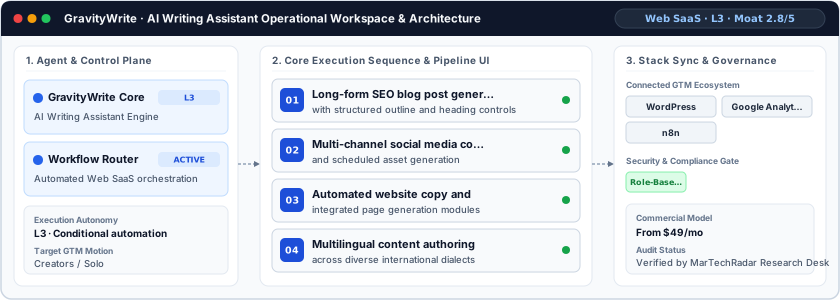
- Long-form SEO blog post generation: with structured outline and heading controls
- Multi-channel social media copywriting and scheduled asset generation
- Automated website copy and integrated page generation modules
- Multilingual content authoring: across diverse international dialects
Cons: operational limitations & risks
- Credit Consumption Governance: The platform enforces strict monthly AI token credits that deplete rapidly during multi-stage long-form drafting, creating workflow interruptions for high-volume content operations.
- Fact-Checking Latency: Outputs lack deterministic web verification and citation mechanisms, introducing semantic hallucination risks that mandate continuous manual editorial review before publication.
- Integration Pipeline Depth: Native publishing connectors to headless enterprise CMS architectures and enterprise DAM repositories are constrained, requiring manual copy-paste transfers or brittle webhook workarounds.
GravityWrite TCO & deal-breaker stress test
Simulate 12-month stepped TCO, hidden cost multipliers, contract lock-in exposure, and stack failure modes using only facts verified by MarTechRadar Research Desk on 2026-10-14 · Capture SHA baac6dbd.
GravityWrite aligns with your 5-seat / $800/mo profile. Review the walk-away triggers and contract levers below before deployment.
- Moat Score
- 2.8 / 5.0
- AI Autonomy
- L3
- Free Tier / Trial
- None disclosed
Triggered audit signals & failure modes
- Published Self-Serve Entry FloorVerified Pricing Ledger
GravityWrite publishes a transparent entry point (From $49/mo) for initial validation before committing.
- Primary Operational Bottleneck: Credit Consumption GovernanceAudit by MarTechRadar Research Desk
The platform enforces strict monthly AI token credits that deplete rapidly during multi-stage long-form drafting, creating workflow interruptions for high-volume content operations.
Test a custom GravityWrite budget or stack constraint
Lower 5-seat floor (~$8/mo vs. From $49 / mo)
Lower 5-seat floor (~$15/mo vs. From $49 / mo)
GravityWrite integrations, API, security & compliance stack
GravityWrite AI moat & AI Writing Assistant positioning
Relies on aggregated workflow templates and credit-metered access to external foundational models, creating low defensibility against platform vendors.
GravityWrite in-depth review, pricing & architecture analysis
Editor sign-off: Oct 14, 2026. How profiles are made.
What is GravityWrite? Overview & background
To consolidate fragmented content production workflows into a single interface, marketing teams increasingly seek unified generative workspaces. Established in 2023 and headquartered in Chennai, IN, GravityWrite addresses this mandate for content marketing leads, SEO specialists, and digital agencies. The platform centralizes multi-channel text generation, replacing disconnected drafting utilities with a single production hub. Operating within the writing assistants and paraphrasing subtrack, it provides structured generative pipelines designed to accelerate long-form editorial planning, social media copywriting, and site-level asset deployment.
How GravityWrite works: architecture & workflow
Operating at an L3 autonomy profile, GravityWrite routes prompt architectures through an array of upstream foundational large language models. The technical engine ingests user-specified keywords, audience criteria, and tonal parameters, parsing these inputs through modular template pipelines tailored for blog creation or site copywriting. The orchestration layer runs contextual checks and structural formatting routines, generating end-to-end articles complete with headings, metadata, and accompanying asset drafts. Rather than requiring open-ended prompting, the platform abstracts prompt engineering into deterministic UI fields, returning structured output across multiple supported languages via automated API endpoints, alongside native workflow integrations for WordPress, Google Analytics, n8n, and Ahrefs.
GravityWrite limitations, drawbacks & risks
Operational considerations and platform boundaries include:
- Credit Consumption Governance: The platform enforces strict monthly AI token credits that deplete rapidly during multi-stage long-form drafting, creating workflow interruptions for high-volume content operations.
- Fact-Checking Latency: Outputs lack deterministic web verification and citation mechanisms, introducing semantic hallucination risks that mandate continuous manual editorial review before publication.
- Integration Pipeline Depth: Native publishing connectors to headless enterprise CMS architectures and enterprise DAM repositories are constrained, requiring manual copy-paste transfers or brittle webhook workarounds.
GravityWrite pricing, plans & cost breakdown
Commercial access is structured via tiered monthly subscriptions and discounted annualized commitments starting from $49 per month. Lower-tier commercial access tiers, such as the Plus Plan, can also scale into an annualized commitment structured at $97 per year. Usage remains metered through discrete monthly AI credit quotas that govern blog generation frequency, synthetic asset creation volume, and feature access tiers across teams.
| Plan / Tier | Verified Price & Billing | Included Scope & Contract Terms | |
|---|---|---|---|
| Plus | $49/mo | A great choice for individual bloggers or small content creators. | |
| Contract Watchout: Annual Billing Headline vs. Monthly Premium | The vendor pricing page advertises an annual-billing discount (Save up to 58%); month-to-month billing carries a higher effective monthly rate. | ||
How GravityWrite compares vs. competitors & alternatives
GravityWrite positions itself against alternatives such as Rytr, QuillBot, and AISEO within the AI Writing Assistant segment. While QuillBot concentrates strictly on sentence-level paraphrasing and Rytr prioritizes lightweight short-form snippets, GravityWrite offers broader content templates encompassing website and social generation. Conversely, AISEO delivers superior programmatic internal linking and algorithmic SERP parsing. GravityWrite serves mid-market marketing departments and boutique agencies that require an accessible, multi-format drafting console without the overhead of bespoke enterprise AI orchestrations.
Frequently asked questions about GravityWrite
How much does GravityWrite cost in 2026?
GravityWrite pricing: From $49/mo. No free plan is publicly disclosed. Commercial access is structured via tiered monthly subscriptions and discounted annualized commitments starting from $49 per month.
What are the top GravityWrite alternatives in AI Writing Assistant?
Verified AI Writing Assistant alternatives include Rytr (Free plan · $7.50–$24.16/mo), QuillBot (Custom / enterprise pricing), AISEO (From $39/mo), Typli (From $14.99/mo). GravityWrite positions itself against alternatives such as Rytr, QuillBot, and AISEO within the AI Writing Assistant segment.
What are the main limitations and trade-offs of GravityWrite?
Operational considerations and platform boundaries include: Credit Consumption Governance: The platform enforces strict monthly AI token credits that deplete rapidly during multi-stage long-form drafting, creating workflow interruptions for high-volume content operations. Walk away if your workflow cannot tolerate credit consumption governance: The platform enforces strict monthly AI token credits that deplete rapidly during multi-stage long-form drafting, creating workflow interruptions for high-volume content operations.
Verified sources & evidence trail
- Official product domain: https://gravitywrite.com
- Commercial pricing verification: https://gravitywrite.com/pricing
- Verified corporate entity profiles (
sameAs): LinkedIn Company Profile · Crunchbase Entity Record - First-party governance & documentation links: Privacy
- Editor sign-off: Oct 14, 2026 (how profiles are made).
