Apten Review (2026): AI SDR Pricing, Limits & Alternatives
Bottom line
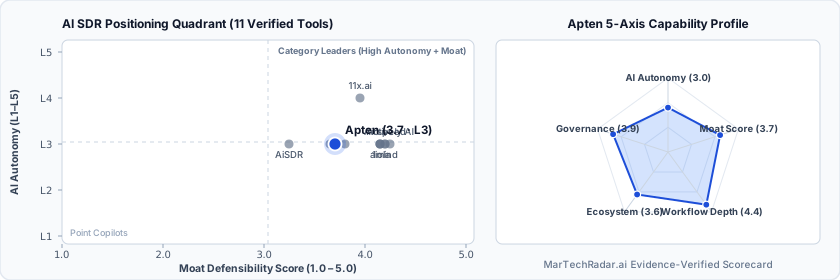
Apten is a Web SaaS tool for AI SDR (Autonomous B2B Sales Agents & AI BDRs) in AI SDR & Outbound. Pricing: Pricing not disclosed. Best suited to B2B SaaS and Marketing & Growth Teams. Editor ratings: AI autonomy L3 (conditional automation); moat score 3.7/5.0 (Proprietary moat). Fact-checked by Jagmeet Sine on Oct 16, 2026.
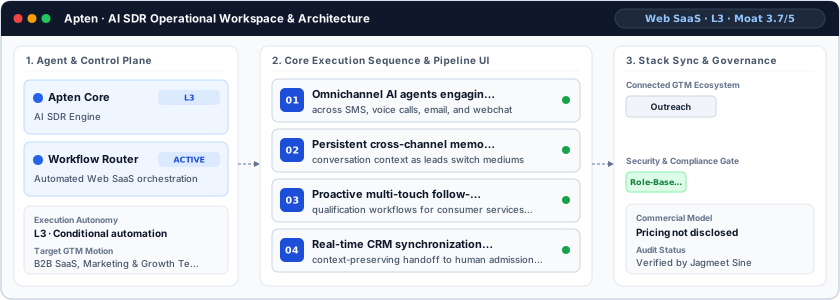
Omnichannel AI sales and enrollment agents that nurture leads across SMS, voice calls, email, and webchat with persistent cross-channel memory.
Apten buyer fit verdict: when to choose vs. when to walk away
Choose Apten if (Best Fit)
- Target ICP & Stack Fit: You operate as B2B SaaS and Marketing & Growth Teams requiring a Web SaaS deployment for AI SDR, with verified ecosystem connectivity for Outreach.
- L3 Architecture & Defensibility: Maintaining persistent conversational memory across SMS, voice, email, and webchat embeds Apten into high-volume consumer services and higher-education enrollment funnels.
- Commercial Model Fit: Your procurement budget aligns with Pricing not disclosed.
Walk away from Apten if (Deal-Breakers)
- Walk away if you require transparent self-serve monthly billing or your budget ceiling is under $1,000/mo (Apten requires sales-gated custom quoting).
- Walk away if your workflow cannot tolerate telecom & a2p 10dlc compliance boundary: Running high-volume automated SMS and outbound voice nurturing in consumer and education sectors requires strict TCPA consent tracking and carrier registration, creating a regulatory governance barrier.
- Walk away if complex financial aid & contract escalation is a deal-breaker for your team: While the AI agent handles top- and mid-funnel qualification effectively, nuanced financial underwriting or custom tuition exceptions struggle with autonomous resolution and require human advisor handoffs.
Apten key facts & scorecard
| Pricing | Pricing not disclosed |
|---|---|
| Free plan | No / not disclosed |
| Delivery | Web SaaS |
| Audience | B2B SaaS, Marketing & Growth Teams |
| AI autonomy level | L3 · Conditional automationEditor-verified |
| Moat tier & score | 3.7 / 5.0 · Proprietary moatEditor-verified |
| Funding | Pre-seed |
| Total funding | $500K |
| Founders | Daniel Ho, Roshan Kumaraswamy |
| Company size | 2-10 employees |
| Ecosystem integrations | Outreach |
| Governance & docs | API & Docs ↗ · Privacy ↗ |
| Headquarters | San Francisco, California |
| Founded | 2023 |
| Last verified |
Apten pros & cons: strengths vs. operational limitations
Pros: core strengths & capabilities
- Omnichannel AI agents engaging prospects: across SMS, voice calls, email, and webchat
- Persistent cross-channel memory preserving: conversation context as leads switch mediums
- Proactive multi-touch follow-up and: qualification workflows for consumer services and higher education
- Real-time CRM synchronization and: context-preserving handoff to human admissions or sales reps
Cons: operational limitations & risks
- Telecom & A2P 10DLC Compliance Boundary: Running high-volume automated SMS and outbound voice nurturing in consumer and education sectors requires strict TCPA consent tracking and carrier registration, creating a regulatory governance barrier.
- Complex Financial Aid & Contract Escalation: While the AI agent handles top- and mid-funnel qualification effectively, nuanced financial underwriting or custom tuition exceptions struggle with autonomous resolution and require human advisor handoffs.
- Multi-Channel Prompt Tuning Learning Curve: Aligning conversational tone and pacing across synchronous voice calls and asynchronous SMS/email threads introduces an onboarding calibration learning curve for marketing operations teams.
Apten TCO & deal-breaker stress test
Simulate 12-month stepped TCO, hidden cost multipliers, contract lock-in exposure, and stack failure modes using only facts verified by Jagmeet Sine on · Capture SHA e03254d1.
Apten triggers high-severity friction under your 5-seat / $800/mo constraints. Benchmark the verified subtrack alternatives below before committing.
| Plan / Tier | Verified Rate | Scale Fit | Scope & Quota Notes |
|---|---|---|---|
| Enterprise / Custom | Custom quote | 15–50+ seats (Enterprise SLA) | Sales-negotiated annual contract for custom volume, SSO/RBAC governance, and dedicated SLA. |
- Moat Score
- 3.7 / 5.0
- AI Autonomy
- L3
- Free Tier / Trial
- None disclosed
Triggered audit signals & failure modes
- Opaque Enterprise Quoting vs. SMB/Mid-Market BudgetVerified Pricing Ledger
Apten does not disclose a public self-serve floor (Pricing not disclosed). Buyers with a $800/mo cap face high sales-qualification friction.
- Sales-Gated Contract TermsFact-checked by Jagmeet Sine
Pricing is available on request through enterprise sales quotes, with customized tiers based on seat counts or usage volume.
- Primary Operational Bottleneck: Complex Financial Aid & Contract EscalationAudit by Jagmeet Sine
While the AI agent handles top- and mid-funnel qualification effectively, nuanced financial underwriting or custom tuition exceptions struggle with autonomous resolution and require human advisor handoffs.
Hidden TCO Multipliers & Quota Gates
- Telecom & A2P 10DLC Compliance Boundary: Running high-volume automated SMS and outbound voice nurturing in consumer and education sectors requires strict TCPA consent tracking and carrier registration, creating a regulatory governance barrier.
- Complex Financial Aid & Contract Escalation: While the AI agent handles top- and mid-funnel qualification effectively, nuanced financial underwriting or custom tuition exceptions struggle with autonomous resolution and require human advisor handoffs.
When to Walk Away & Negotiation Levers
- Walk away if you require transparent self-serve monthly billing or your budget ceiling is under $1,000/mo (Apten requires sales-gated custom quoting).
- Walk away if your workflow cannot tolerate telecom & a2p 10dlc compliance boundary: Running high-volume automated SMS and outbound voice nurturing in consumer and education sectors requires strict TCPA consent tracking and carrier registration, creating a regulatory governance barrier.
- Walk away if complex financial aid & contract escalation is a deal-breaker for your team: While the AI agent handles top- and mid-funnel qualification effectively, nuanced financial underwriting or custom tuition exceptions struggle with autonomous resolution and require human advisor handoffs.
- Demand a 30- to 60-day paid pilot opt-out clause in the Apten order form before signing a 12-month enterprise commitment.
- Require a sandbox proof-of-concept testing telecom & a2p 10dlc compliance boundary against your live CRM/data schema before annual sign-off.
Ask a custom procurement or TCO stress-test question about Apten
Lower 5-seat floor (~$39/mo vs. Custom Quote) · Transparent self-serve entry without mandatory annual lock-in
Transparent self-serve entry without mandatory annual lock-in
Apten key entities, modules & ecosystem stack
Apten moat & subtrack positioning
Maintaining persistent conversational memory across SMS, voice, email, and webchat embeds Apten into high-volume consumer services and higher-education enrollment funnels.
Editorial review
Fact-checked by Jagmeet Sine (Senior MarTech Infrastructure & Agentic Workflow Architect) on .
Background
Founded in 2023 by Daniel Ho and Roshan Kumaraswamy and headquartered in San Francisco, California, Apten (apten.ai) is an omnichannel AI sales and lead-nurturing agent platform built for enterprise consumer services, higher-education enrollment teams, and high-velocity inside sales organizations. Operating with a team of 2 to 10 employees and backed by $500K in Pre-Seed funding from Y Combinator (S24), the company solves lead leakage across long consideration cycles by deploying autonomous agents that converse with prospects across text, voice calls, email, and webchat.
How Apten works
Apten operates at Level 3 autonomy through a unified cross-channel state machine, low-latency voice and text LLM orchestration pipeline, and bidirectional CRM integration layer. When a prospective student or consumer inquiry enters the funnel, Apten initiates immediate outreach and remembers every detail as the user transitions between webchat, SMS, email, and phone calls. Rather than executing rigid drip sequences that ignore replies, the AI agent answers complex program or service questions, follows up persistently over weeks or months to re-engage cold leads, and books qualified appointments directly onto human representative calendars.
Limitations
Operational limitations and technical trade-offs include:
- Telecom & A2P 10DLC Compliance Boundary: Running high-volume automated SMS and outbound voice nurturing in consumer and education sectors requires strict TCPA consent tracking and carrier registration, creating a regulatory governance barrier.
- Complex Financial Aid & Contract Escalation: While the AI agent handles top- and mid-funnel qualification effectively, nuanced financial underwriting or custom tuition exceptions struggle with autonomous resolution and require human advisor handoffs.
- Multi-Channel Prompt Tuning Learning Curve: Aligning conversational tone and pacing across synchronous voice calls and asynchronous SMS/email threads introduces an onboarding calibration learning curve for marketing operations teams.
Apten pricing
Pricing is available on request through enterprise sales quotes, with customized tiers based on seat counts or usage volume. Enterprise consumer service providers and educational institutions can book a live walkthrough via the Apten website to scope lead volume and CRM integration requirements.
How Apten compares
Within the Autonomous B2B Sales Agents & AI BDRs and Consumer Lead Nurturing category, Apten competes against conversational sales alternatives such as Cenote, Structurely, and Verse.ai. Versus ecommerce-focused cart recovery tools like Cenote or SMS-only schedulers, Apten differentiates itself through persistent four-channel context memory (SMS, voice, email, and webchat) tailored for multi-week consumer services and higher-education enrollment funnels. Enterprises managing high-volume inbound inquiries choose Apten to boost conversion without expanding call-center headcount.
Frequently asked questions about Apten
How much does Apten cost and does it require a custom enterprise quote?
Published pricing summary for Apten: Pricing not disclosed. A permanent free plan is not disclosed for Apten. Pricing is available on request through enterprise sales quotes, with customized tiers based on seat counts or usage volume. Enterprise consumer service providers and educational institutions can book a live walkthrough via the Apten website to scope lead volume and CRM integration requirements.
How does Apten work and how autonomous is its AI architecture?
Omnichannel AI sales and enrollment agents that nurture leads across SMS, voice calls, email, and webchat with persistent cross-channel memory. Within AI SDR (Autonomous B2B Sales Agents & AI BDRs), MarTechRadar rates its execution architecture at L3 · Conditional automation with a verified Moat Score of 3.7 / 5.0 (Proprietary moat). Maintaining persistent conversational memory across SMS, voice, email, and webchat embeds Apten into high-volume consumer services and higher-education enrollment funnels. Corporate profile: Founded by Daniel Ho, Roshan Kumaraswamy, operating at 2-10 employees scale.
What are the main limitations of Apten and when should buyers walk away?
Based on our editorial technical audit, key operational considerations and boundaries for Apten include: (1) Telecom & A2P 10DLC Compliance Boundary: Running high-volume automated SMS and outbound voice nurturing in consumer and education sectors requires strict TCPA consent tracking and carrier registration, creating a regulatory governance barrier. (2) Complex Financial Aid & Contract Escalation: While the AI agent handles top- and mid-funnel qualification effectively, nuanced financial underwriting or custom tuition exceptions struggle with autonomous resolution and require human advisor handoffs. (3) Multi-Channel Prompt Tuning Learning Curve: Aligning conversational tone and pacing across synchronous voice calls and asynchronous SMS/email threads introduces an onboarding calibration learning curve for marketing operations teams. Primary procurement walk-away rule: Walk away if you require transparent self-serve monthly billing or your budget ceiling is under $1,000/mo (Apten requires sales-gated custom quoting).
What integrations, compliance certifications, and contract terms apply to Apten?
Verified ecosystem and stack integrations include Outreach. First-party governance and developer endpoints verified on domain include: API Docs (https://docs.apten.ai). Key TCO multiplier to watch: Telecom & A2P 10DLC Compliance Boundary (Running high-volume automated SMS and outbound voice nurturing in consumer and education sectors requires strict TCPA consent tracking and carrier registration, creating a regulatory governance barrier.) Before signing a contract, procurement teams should demand a 30- to 60-day paid pilot opt-out clause in the Apten order form before signing a 12-month enterprise commitment.
What are the best Apten alternatives and head-to-head competitors in 2026?
Top fact-checked alternatives to Apten in AI SDR (Autonomous B2B Sales Agents & AI BDRs) include Structurely (From $0.02 usage-based · Enterprise plan), Verse (Pricing not disclosed), Aircover (Pricing not disclosed), Sellva (Custom / enterprise pricing). Within the Autonomous B2B Sales Agents & AI BDRs and Consumer Lead Nurturing category, Apten competes against conversational sales alternatives such as Cenote, Structurely, and Verse.ai.
Verified sources & evidence trail
- Official product domain: https://www.apten.ai/
- Commercial pricing verification: Verified against official vendor pricing policy (Pricing not disclosed)
- Verified corporate entity profiles (
sameAs): LinkedIn Company Profile · Crunchbase Entity Record - First-party governance & documentation links: API & Docs · Privacy
- Editorial audit sign-off: Fact-checked by Jagmeet Sine on under the MarTechRadar Evidence-Ledger Protocol.