AI Engine Ranker Review (2026): Content Optimization Pricing, Pros & Cons
Bottom line
AI Engine Ranker is a Web SaaS tool for Content Optimization (Content Optimization & SERP Intelligence) in GEO & AI SEO. Pricing: Custom / enterprise pricing. Best suited to DTC / eCommerce and Enterprise Brands. Editor ratings: AI autonomy L2 (workflow copilot); moat score 1.5/5.0 (Thin wrapper). Fact-checked by MarTechRadar Research Desk on Oct 15, 2026.
Generative engine optimization platform tracking brand visibility, recommendation frequency, and competitive citations across foundational conversational.
Is AI Engine Ranker worth it in 2026? Buyer fit & when to walk away
Choose AI Engine Ranker if (Best Fit)
- Target ICP & Stack Fit: You operate as DTC / eCommerce and Enterprise Brands requiring a Web SaaS deployment for Content Optimization, with verified ecosystem connectivity for Twilio Segment.
- L2 Architecture & Defensibility: Defensibility centers on historical prompt corpus benchmarking, multi-model evaluation pipelines, and specialized scoring algorithms tailored for generative search share of voice.
- Commercial Model Fit: Your procurement budget aligns with Custom / enterprise pricing.
Walk away from AI Engine Ranker if (Deal-Breakers)
- Walk away if you need published self-serve pricing: AI Engine Ranker is sold by custom quote.
- Walk away if your workflow cannot tolerate nondeterministic LLM variance: Model updates and temperature fluctuations produce non-deterministic responses, necessitating aggressive query resampling that increases inference token overhead and complicates baseline trend stabilization.
- Walk away if synthetic persona divergence is a deal-breaker for your team: Automated prompt matrices risk drifting from authentic human conversational behavior, resulting in visibility metrics that reflect artificial benchmarking rather than true end-user query interactions.
AI Engine Ranker pricing, free plan & scorecard at a glance
| Pricing | Custom / enterprise pricing |
|---|---|
| Free plan | No / not disclosed |
| Delivery | Web SaaS |
| Audience | DTC / eCommerce, Enterprise Brands |
| AI autonomy level | L2 · Workflow copilotEditor-verified |
| Moat tier & score | 1.5 / 5.0 · Thin wrapperEditor-verified |
| Funding | Pre-seed |
| Ecosystem integrations | Twilio Segment |
| Headquarters | United States |
| Last verified | Oct 15, 2026 |
AI Engine Ranker pros & cons: strengths vs. operational limitations
Pros: core strengths & capabilities
- Multi-model synthetic prompt execution: across ChatGPT, Claude, Gemini, and Perplexity
- Generative citation tracking and brand sentiment analysis in AI outputs
- Competitive displacement monitoring: for high-intent B2B search scenarios
- Algorithmic recommendations: to improve brand inclusion within generative summaries
Cons: operational limitations & risks
- Nondeterministic LLM Variance: Model updates and temperature fluctuations produce non-deterministic responses, necessitating aggressive query resampling that increases inference token overhead and complicates baseline trend stabilization.
- Synthetic Persona Divergence: Automated prompt matrices risk drifting from authentic human conversational behavior, resulting in visibility metrics that reflect artificial benchmarking rather than true end-user query interactions.
- Crawler Blocking and Infrastructure Instability: Third-party AI platforms frequently alter response structures and restrict automated querying, creating potential data collection latency and intermittent pipeline failures during scheduled diagnostic runs.
AI Engine Ranker TCO & deal-breaker stress test
Simulate 12-month stepped TCO, hidden cost multipliers, contract lock-in exposure, and stack failure modes using only facts verified by MarTechRadar Research Desk on 2026-10-15.
AI Engine Ranker triggers high-severity friction under your 5-seat / $800/mo constraints. Benchmark the verified subtrack alternatives below before committing.
- Moat Score
- 1.5 / 5.0
- AI Autonomy
- L2
- Free Tier / Trial
- None disclosed
Triggered audit signals & failure modes
- Opaque Enterprise Quoting vs. SMB/Mid-Market BudgetVerified Pricing Ledger
AI Engine Ranker does not disclose a public self-serve floor (Custom / enterprise pricing). Buyers with a $800/mo cap face high sales-qualification friction.
- Sales-Gated Contract TermsFact-checked by MarTechRadar Research Desk
Commercial procurement for AI Engine Ranker is structured entirely through custom enterprise licensing negotiated directly through sales representatives.
- Primary Operational Bottleneck: Nondeterministic LLM VarianceAudit by MarTechRadar Research Desk
Model updates and temperature fluctuations produce non-deterministic responses, necessitating aggressive query resampling that increases inference token overhead and complicates baseline trend stabilization.
Test a custom AI Engine Ranker budget or stack constraint
Lower 5-seat floor (~$5/mo vs. Custom Quote) · Transparent self-serve entry without mandatory annual lock-in
Lower 5-seat floor (~$23/mo vs. Custom Quote) · Transparent self-serve entry without mandatory annual lock-in
AI Engine Ranker integrations, API, security & compliance stack
AI Engine Ranker AI moat & Content Optimization positioning
Defensibility centers on historical prompt corpus benchmarking, multi-model evaluation pipelines, and specialized scoring algorithms tailored for generative search share of voice.
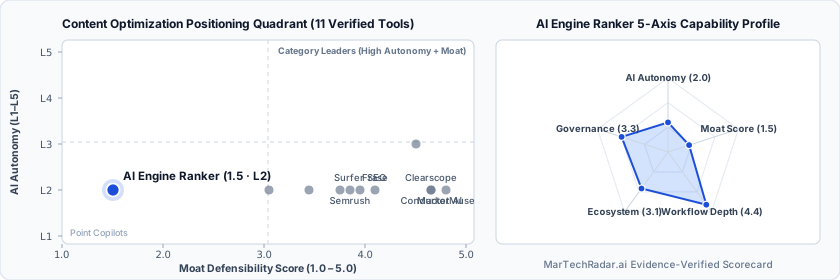
AI Engine Ranker in-depth review, pricing & architecture analysis
Editor sign-off: Oct 15, 2026. How profiles are made.
What is AI Engine Ranker? Overview & background
Enterprises confronting the shift from conventional search indices to conversational answer engines require programmatic ways to monitor corporate visibility. AI Engine Ranker, based in the United States, addresses this requirement by delivering an analytics platform dedicated to generative engine optimization. Built for enterprise search strategists and digital performance teams, the software tracks how commercial brands, products, and competitors are surfaced, cited, and contextualized within large language model responses. Rather than analyzing static link lists, the solution equips organic acquisition teams to audit generative AI discovery funnels systematically.
How AI Engine Ranker works: architecture & workflow
At its architectural core, the platform operates a synthetic evaluation framework functioning with Level 2 autonomy. The ingestion pipeline accepts enterprise taxonomy, category keywords, and competitor lists, subsequently translating them into thousands of structured prompt permutations reflecting high-intent buyer inquiries. These synthetic prompts are executed programmatically across inference endpoints for models including OpenAI ChatGPT, Anthropic Claude, Perplexity, and Google Gemini. The engine parses the resulting natural language responses, calculating brand occurrence ratios, sentiment polarity, and citation positioning. An internal entity graph maps citation origins, identifying which digital assets and technical publications feed generative model outputs.
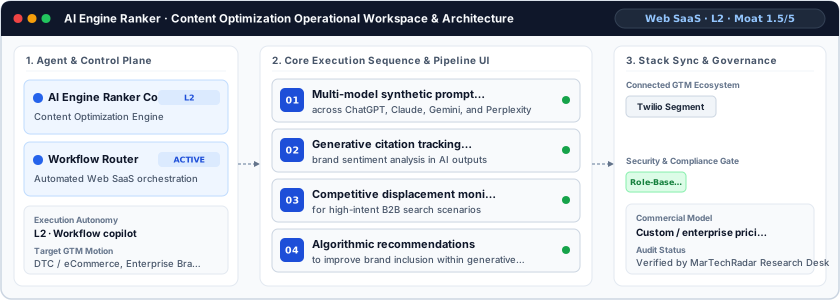
AI Engine Ranker limitations, drawbacks & risks
Operational considerations and platform boundaries include:
- Nondeterministic LLM Variance: Model updates and temperature fluctuations produce non-deterministic responses, necessitating aggressive query resampling that increases inference token overhead and complicates baseline trend stabilization.
- Synthetic Persona Divergence: Automated prompt matrices risk drifting from authentic human conversational behavior, resulting in visibility metrics that reflect artificial benchmarking rather than true end-user query interactions.
- Crawler Blocking and Infrastructure Instability: Third-party AI platforms frequently alter response structures and restrict automated querying, creating potential data collection latency and intermittent pipeline failures during scheduled diagnostic runs.
AI Engine Ranker pricing, plans & cost breakdown
Commercial procurement for AI Engine Ranker is structured entirely through custom enterprise licensing negotiated directly through sales representatives. The commercial model assesses fees based on organizational scale, monitoring scope, tracked query volumes, and seat allocations. Deployments typically require annual subscription commitments covering dedicated prompt simulation credits, recurring analytical reports, and multi-model coverage expansions, without transactional public pricing tiers. Pricing is available on request through tailored enterprise sales quotes, with custom enterprise tiers, subscription plans, and seat licenses structured around organizational scale and monthly workflow volume.
| Plan / Tier | Verified Price & Billing | Included Scope & Contract Terms |
|---|---|---|
| Enterprise / Custom | Custom quote | Custom-quoted plan; terms come from the vendor's sales team. |
How AI Engine Ranker compares vs. competitors & alternatives
AI Engine Ranker targets an emerging category divergent from traditional search intelligence stacks within the Content Optimization segment. Where Ahrefs analyzes deterministic search engine crawling, backlink graphs, and conventional rank metrics, AI Engine Ranker monitors stochastic conversational outputs across generative foundation engines. Compared to localized data platforms like Surfer SEO or on-page semantic grading tools such as Clearscope, AI Engine Ranker concentrates on natural language discovery. The platform is best suited for mature enterprise digital marketing teams that have established organic keyword programs and now require dedicated intelligence on conversational engine visibility.
Frequently asked questions about AI Engine Ranker
Does AI Engine Ranker publish pricing or require an enterprise quote?
AI Engine Ranker pricing: Custom / enterprise pricing. No free plan is publicly disclosed. Commercial procurement for AI Engine Ranker is structured entirely through custom enterprise licensing negotiated directly through sales representatives.
What are the top AI Engine Ranker alternatives in Content Optimization?
Verified Content Optimization alternatives include SEO Tools MCP by CrakSEO (Free plan · From $5 usage-based), Service Stories (From $299/mo), Positional.ai (Custom / enterprise pricing), Neuronwriter (Free plan · $23–$117/mo). AI Engine Ranker targets an emerging category divergent from traditional search intelligence stacks within the Content Optimization segment.
What are the main limitations and trade-offs of AI Engine Ranker?
Operational considerations and platform boundaries include: Nondeterministic LLM Variance: Model updates and temperature fluctuations produce non-deterministic responses, necessitating aggressive query resampling that increases inference token overhead and complicates baseline trend stabilization. Walk away if you need published self-serve pricing: AI Engine Ranker is sold by custom quote.
Verified sources & evidence trail
- Official product domain: https://aiengineranker.com
- Commercial pricing verification: Verified against official vendor pricing policy (Custom / enterprise pricing)
- Editor sign-off: Oct 15, 2026 (how profiles are made).
