Zero vs Zoca
Reviewed by MarTechRadar Research Desk. Pricing & entity snapshots verified Oct 15, 2026.
Zero (Web SaaS) and Zoca (Web SaaS) both compete in Autonomous Marketing Agents & Digital Coworkers. On pricing, Zero lists $60–$77/seat/mo (no free plan disclosed), whereas Zoca lists Custom / enterprise pricing (no free plan disclosed). Technically, Zero is rated L3 · Conditional automation with a 3.0/5.0 (Workflow-embedded (strong)) moat, while Zoca is rated L2 · Workflow copilot with a 1.7/5.0 (Thin wrapper) moat. Corporate profile: Zero (founded 2024, HQ Helsinki, Finland) vs. Zoca (HQ United States). Verified by the MarTechRadar Research Desk (Oct 10, 2026 for Zero; Oct 15, 2026 for Zoca). At a 5-seat team baseline, Zero starts at ~$300/mo vs Zoca at Custom quote.
Zero
Autonomous AI revenue and CRM system automating prospect discovery, signal tracking, and multi-step pipeline actions.
5-Seat Floor: ~$300/mo ($60–$77/seat/mo) · Autonomy: L3 · Conditional automation · Moat: 3.0/5.0 (Workflow-embedded (strong))
Target fit: GTM Operations Teams, Enterprise Marketing Executives, Automated Ops Teams (Web SaaS)
Zoca
Autonomous digital marketing coworker coordinating multi-step campaign orchestration, CRM data synchronization, and contextual task planning.
5-User Team Cost: Custom quote (Custom / enterprise pricing) · Autonomy: L2 · Workflow copilot · Moat: 1.7/5.0 (Thin wrapper)
Target fit: Growth Marketing Teams, Digital Marketing Leaders (Web SaaS)
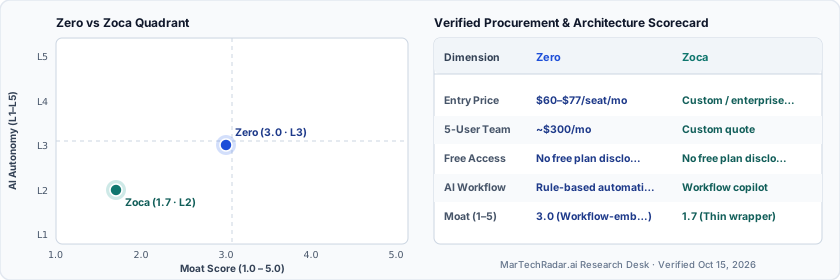
How Zero and Zoca differ
- Pricing model: Zero is per seat, Zoca is enterprise / quote.
- Zero publishes an entry price ($60–$77/seat/mo); Zoca does not (Custom / enterprise pricing).
- AI autonomy: Zero is rated L3 · Conditional automation, Zoca L2 · Workflow copilot on the MarTechRadar scale.
- Moat tier: Zero is rated Workflow-embedded (strong), Zoca Thin wrapper.
- Headquarters: Zero in Helsinki, Finland, Zoca in United States.
- Audience: Zero targets GTM Operations Teams, Enterprise Marketing Executives, Automated Ops Teams; Zoca targets Growth Marketing Teams, Digital Marketing Leaders.
Computed from the fields below. Only editor-verified ratings and vendor-sourced prices are compared.
When to choose Zero vs Zoca (and when to walk away)
Choose Zero if
- Target ICP & Stack Fit: You operate as GTM Operations Teams, Enterprise Marketing Executives and Automated Ops Teams requiring a Web SaaS deployment for AI Marketing Agent, with verified ecosystem connectivity for Salesforce, Outreach, Twilio Segment.
- L3 Architecture & Defensibility: Zero develops an integrated operational data store coupled with continuous background agents that automate pipeline updates, job-change monitoring, and account intelligence without external CRM connectors.
- Commercial Model Fit: Your procurement budget aligns with $60–$77/seat/mo.
Walk away from Zero if
- Walk away if your workflow requires uncapped enterprise volume on the $60–$77/seat/mo entry plan without upgrading tiers.
- Walk away if your workflow cannot tolerate signal latency & scraping boundaries: External signals such as corporate role migrations or funding events rely on third-party web polling cycles, which can experience ingestion delays of up to 48 hours.
- Walk away if contextual token constraints is a deal-breaker for your team: Autonomous message generation accuracy drops on non-standard B2B accounts where sparse digital footprints trigger hallucinated value propositions.
Choose Zoca if
- Target ICP & Stack Fit: You operate as Growth Marketing Teams and Digital Marketing Leaders requiring a Web SaaS deployment for AI Marketing Agent.
- L2 Architecture & Defensibility: Defensibility stems from closed-loop task execution graphs that translate high-level marketing goals into deterministic tool calls across enterprise martech stacks, reducing drift through stateful task graphs.
- Commercial Model Fit: Your procurement budget aligns with Custom / enterprise pricing.
Walk away from Zoca if
- Walk away if you require transparent self-serve monthly billing or your budget ceiling is under $1,000/mo (Zoca requires sales-gated custom quoting).
- Walk away if your workflow cannot tolerate API rate limiting and sync latency: High-frequency task execution is bounded by downstream CRM and ad network rate limits, which can delay real-time campaign adjustments during traffic surges.
- Walk away if schema drift fragility is a deal-breaker for your team: Unannounced mutations in custom fields across enterprise data warehouses or marketing automation platforms disrupt the agent's deterministic field-mapping pipelines.
Side-by-side facts
| Field | Zero | Zoca |
|---|---|---|
| Subtrack | Autonomous Marketing Agents & Digital Coworkers | Autonomous Marketing Agents & Digital Coworkers |
| Pricing | $60–$77/seat/mo | Custom / enterprise pricing |
| Pricing model | Per seat | Enterprise / quote |
| Published pricing tiers | Pro ($60/seat/mo) | Enterprise / Custom (Custom quote) |
| Free access | No free plan disclosed | No free plan disclosed |
| Enterprise plan | Not recorded | Yes |
| AI autonomy level | L3 · Conditional automation | L2 · Workflow copilot |
| Moat tier & score | 3.0 / 5.0 · Workflow-embedded (strong) | 1.7 / 5.0 · Thin wrapper |
| Delivery | Web SaaS | Web SaaS |
| Audience | GTM Operations Teams, Enterprise Marketing Executives, Automated Ops Teams | Growth Marketing Teams, Digital Marketing Leaders |
| Ecosystem integrations | Salesforce, Outreach, Twilio Segment | — |
| Funding & backing | Seed · Backed by Primary Venture Partners, The Twenty Minute VC, Foreword Fund | Seed |
| Company size | 2-10 employees | — |
| Founded | 2024 | 2024 |
| Headquarters | Helsinki, Finland | United States |
| Fact-checked | MarTechRadar Research Desk, Oct 10, 2026 | MarTechRadar Research Desk, Oct 15, 2026 |
| Governance & docs | Trust & Security ↗ · API & Docs ↗ · Changelog ↗ · DPA ↗ · Terms ↗ · Privacy ↗ | — |
Zero vs Zoca: TCO & constraint stress test
Test how both tools behave under your team size, monthly budget ceiling, CRM ecosystem, and governance guardrails.
Zero
Conditional Fit · Contract & Stack Caveats- Annual Contract Lock-in Risk Detected: Zero employs a transparent per-seat subscription structure. The software is priced at $60 per seat per month on an annual commitment for the first 12 months, after which licensing transitions to the standard rate of $77 per seat per month.
- Linear Per-Seat Scaling (5 Seats × $60/seat/mo): Base license scales linearly with operator headcount ($300/mo for 5 seats on Pro).
- Primary Operational Bottleneck: Signal Latency & Scraping Boundaries: External signals such as corporate role migrations or funding events rely on third-party web polling cycles, which can experience ingestion delays of up to 48 hours.
Walk-Away Rule: Walk away if your workflow requires uncapped enterprise volume on the $60–$77/seat/mo entry plan without upgrading tiers.
Negotiation Lever: Validate exact quota thresholds (seats, credits, or API calls) included in Zero's $60–$77/seat/mo tier before converting from monthly to annual billing.
Zoca
High Deal-Risk · Constraint Mismatch- Opaque Enterprise Quoting vs. SMB/Mid-Market Budget: Zoca does not disclose a public self-serve floor (Custom / enterprise pricing). Buyers with a $800/mo cap face high sales-qualification friction.
- Sales-Gated Contract Terms: Zoca operates under an enterprise licensing structure where commercial pricing is available on request through tailored enterprise sales quotes based on organizational scale and seats.
- Primary Operational Bottleneck: Human-in-the-Loop Verification Overhead: Edge-case edge routing requires human validation for budget allocation or public brand messaging, introducing operational bottlenecks when guardrail thresholds trip.
Walk-Away Rule: Walk away if you require transparent self-serve monthly billing or your budget ceiling is under $1,000/mo (Zoca requires sales-gated custom quoting).
Negotiation Lever: Demand a 30- to 60-day paid pilot opt-out clause in the Zoca order form before signing a 12-month enterprise commitment.
Limitations
Zero
Operational considerations and platform boundaries include: Signal Latency & Scraping Boundaries: External signals such as corporate role migrations or funding events rely on third-party web polling cycles, which can experience ingestion delays of up to 48 hours.Full limitations in the Zero review
Zoca
Operational considerations and platform boundaries include: API Rate Limiting and Sync Latency: High-frequency task execution is bounded by downstream CRM and ad network rate limits, which can delay real-time campaign adjustments during traffic surges.Full limitations in the Zoca review
Official vendor architectural differentiators & migration proof
To help buyers evaluate real-world switching costs, verified founders, solutions architects, and PMMs at both Zero and Zoca can submit up to 3 evidence-backed architectural differentiators or verified customer migration case studies.
Why teams choose Zero over Zoca
Work at Zero? Verify your official domain email to publish 3 technical differentiators, migration benchmarks, or a head-to-head buyer sandbox offer on this comparison page:
+ Submit Zero Official Differentiators & Case Study →Why teams choose Zoca over Zero
Work at Zoca? Verify your official domain email to publish 3 technical differentiators, migration benchmarks, or a head-to-head buyer sandbox offer on this comparison page:
+ Submit Zoca Official Differentiators & Case Study →Pricing notes & tier schedules
Zero: $60–$77/seat/mo
Zero employs a transparent per-seat subscription structure. The software is priced at $60 per seat per month on an annual commitment for the first 12 months, after which licensing transitions to the standard rate of $77 per seat per month.
- Pro ($60/seat/mo, 1–2 seats): Then $77 a seat after your first 12 months
- Per-Seat Linear Scaling: Zero prices licenses on a per-user/seat basis ($60–$77/seat/mo); expanding from 2 to 15+ operators multiplies base recurring spend linearly.
- Credit & Usage Burn Multiplier: Workflows on Zero consume metered credits or usage quotas; high-volume AI generation, batch queries, or recurring automation runs can exhaust base allocations and trigger mid-cycle top-up packs.
Zoca: Custom / enterprise pricing
Zoca operates under an enterprise licensing structure where commercial pricing is available on request through tailored enterprise sales quotes based on organizational scale and seats.
- Enterprise / Custom (Custom quote, 15–50+ seats (Enterprise SLA)): Sales-negotiated annual contract for custom volume, SSO/RBAC governance, and dedicated SLA.
- Profile / Workspace Quota Ceilings: Base tiers cap the number of connected profiles, workspaces, or contact records, forcing tier upgrades before seat limits are reached.
- API Rate Limiting and Sync Latency: High-frequency task execution is bounded by downstream CRM and ad network rate limits, which can delay real-time campaign adjustments during traffic surges.
Frequently asked questions: Zero vs Zoca
How does Zero pricing compare to Zoca in 2026?
Zero is listed at $60–$77/seat/mo (per seat, no free plan disclosed), whereas Zoca is listed at Custom / enterprise pricing (enterprise / quote, no free plan disclosed).
How do Zero and Zoca compare on AI autonomy and moat depth?
On the MarTechRadar L1–L5 scale, Zero is rated L3 · Conditional automation with a Workflow-embedded (strong) moat (3.0/5.0), while Zoca is rated L2 · Workflow copilot with a Thin wrapper moat (1.7/5.0).
Which teams are Zero and Zoca built for?
Zero is a Web SaaS product in Autonomous Marketing Agents & Digital Coworkers designed for GTM Operations Teams, Enterprise Marketing Executives, Automated Ops Teams. Zoca is a Web SaaS product in Autonomous Marketing Agents & Digital Coworkers designed for Growth Marketing Teams, Digital Marketing Leaders.
What are the main limitations of Zero vs Zoca?
For Zero: Operational considerations and platform boundaries include: Signal Latency & Scraping Boundaries: External signals such as corporate role migrations or funding events rely on third-party web polling cycles, which can experience ingestion delays of up to 48 hours. For Zoca: Operational considerations and platform boundaries include: API Rate Limiting and Sync Latency: High-frequency task execution is bounded by downstream CRM and ad network rate limits, which can delay real-time campaign adjustments during traffic surges.
What are the hidden TCO drivers and contract negotiation levers for Zero vs Zoca?
For Zero: Per-Seat Linear Scaling (Zero prices licenses on a per-user/seat basis ($60–$77/seat/mo); expanding from 2 to 15+ operators multiplies base recurring spend linearly.) Negotiation lever: Validate exact quota thresholds (seats, credits, or API calls) included in Zero's $60–$77/seat/mo tier before converting from monthly to annual billing. For Zoca: Profile / Workspace Quota Ceilings (Base tiers cap the number of connected profiles, workspaces, or contact records, forcing tier upgrades before seat limits are reached.) Negotiation lever: Demand a 30- to 60-day paid pilot opt-out clause in the Zoca order form before signing a 12-month enterprise commitment.
Excerpts are quoted verbatim from each fact-checked review. Last updated Oct 15, 2026.