xCore Review (2026): Content Optimization Pricing, Limits & Alternatives
Bottom line
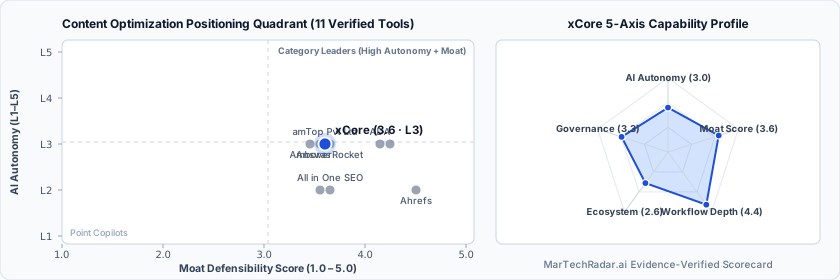
xCore is a Web SaaS tool for Content Optimization (Content Optimization & SERP Intelligence) in GEO & AI SEO. Pricing: Custom / enterprise pricing. Best suited to SEO Directors, Brand Strategy Leaders and Growth Marketers. Editor ratings: AI autonomy L3 (conditional automation); moat score 3.6/5.0 (Proprietary moat). Fact-checked by Julie Brot on Oct 16, 2026.
Autonomous content optimization and SERP intelligence platform streamlining search visibility audits and semantic content enhancements.
xCore buyer fit verdict: when to choose vs. when to walk away
Choose xCore if (Best Fit)
- Target ICP & Stack Fit: You operate as SEO Directors, Brand Strategy Leaders and Growth Marketers requiring a Web SaaS deployment for Content Optimization.
- L3 Architecture & Defensibility: Proprietary natural language processing pipeline paired with automated SERP intent clustering and real-time content scoring mechanics.
- Commercial Model Fit: Your procurement budget aligns with Custom / enterprise pricing.
Walk away from xCore if (Deal-Breakers)
- Walk away if you require transparent self-serve monthly billing or your budget ceiling is under $1,000/mo (xCore requires sales-gated custom quoting).
- Walk away if your workflow cannot tolerate search engine API throttling: High-frequency extraction across enterprise-scale keyword batches introduces latency when upstream search providers enforce dynamic rate limits or anti-scraping defenses.
- Walk away if entity drift across niche verticals is a deal-breaker for your team: In hyper-specialized technical domains, the underlying semantic extraction models occasionally produce generalized lexical recommendations that require manual subject-matter review.
xCore key facts & scorecard
| Pricing | Custom / enterprise pricing |
|---|---|
| Free plan | No / not disclosed |
| Delivery | Web SaaS |
| Audience | SEO Directors, Brand Strategy Leaders, Growth Marketers |
| AI autonomy level | L3 · Conditional automationEditor-verified |
| Moat tier & score | 3.6 / 5.0 · Proprietary moatEditor-verified |
| Funding | Undisclosed |
| Headquarters | Moldova |
| Last verified |
xCore pros & cons: strengths vs. operational limitations
Pros: core strengths & capabilities
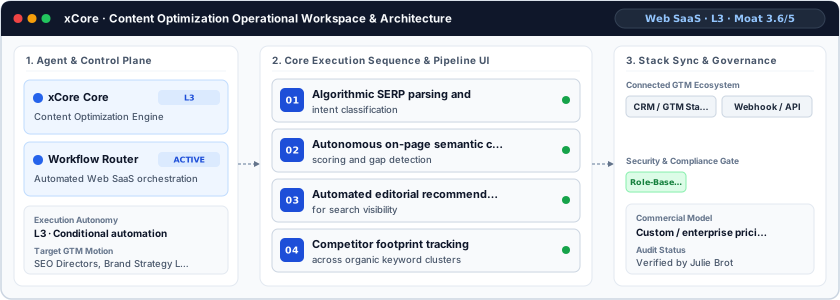
- Algorithmic SERP parsing and: intent classification
- Autonomous on-page semantic content: scoring and gap detection
- Automated editorial recommendation engine: for search visibility
- Competitor footprint tracking: across organic keyword clusters
Cons: operational limitations & risks
- Search Engine API Throttling: High-frequency extraction across enterprise-scale keyword batches introduces latency when upstream search providers enforce dynamic rate limits or anti-scraping defenses.
- Entity Drift Across Niche Verticals: In hyper-specialized technical domains, the underlying semantic extraction models occasionally produce generalized lexical recommendations that require manual subject-matter review.
- CMS Integration Overhead: Executing end-to-end publishing loops requires custom webhook synchronization, demanding continuous engineering maintenance to avoid breaking schema mappings across headless web architectures.
xCore TCO & deal-breaker stress test
Simulate 12-month stepped TCO, hidden cost multipliers, contract lock-in exposure, and stack failure modes using only facts verified by Julie Brot on .
xCore triggers high-severity friction under your 5-seat / $800/mo constraints. Benchmark the verified subtrack alternatives below before committing.
| Plan / Tier | Verified Rate | Scale Fit | Scope & Quota Notes |
|---|---|---|---|
| Enterprise / Custom | Custom quote | 15–50+ seats (Enterprise SLA) | Sales-negotiated annual contract for custom volume, SSO/RBAC governance, and dedicated SLA. |
- Moat Score
- 3.6 / 5.0
- AI Autonomy
- L3
- Free Tier / Trial
- None disclosed
Triggered audit signals & failure modes
- Opaque Enterprise Quoting vs. SMB/Mid-Market BudgetVerified Pricing Ledger
xCore does not disclose a public self-serve floor (Custom / enterprise pricing). Buyers with a $800/mo cap face high sales-qualification friction.
- Sales-Gated Contract TermsFact-checked by Julie Brot
xCore operates under a direct commercial licensing structure where pricing is available on request through tailored enterprise sales quotes based on organizational scale and seats.
- Primary Operational Bottleneck: Search Engine API ThrottlingAudit by Julie Brot
High-frequency extraction across enterprise-scale keyword batches introduces latency when upstream search providers enforce dynamic rate limits or anti-scraping defenses.
Hidden TCO Multipliers & Quota Gates
- Search Engine API Throttling: High-frequency extraction across enterprise-scale keyword batches introduces latency when upstream search providers enforce dynamic rate limits or anti-scraping defenses.
- Entity Drift Across Niche Verticals: In hyper-specialized technical domains, the underlying semantic extraction models occasionally produce generalized lexical recommendations that require manual subject-matter review.
When to Walk Away & Negotiation Levers
- Walk away if you require transparent self-serve monthly billing or your budget ceiling is under $1,000/mo (xCore requires sales-gated custom quoting).
- Walk away if your workflow cannot tolerate search engine API throttling: High-frequency extraction across enterprise-scale keyword batches introduces latency when upstream search providers enforce dynamic rate limits or anti-scraping defenses.
- Walk away if entity drift across niche verticals is a deal-breaker for your team: In hyper-specialized technical domains, the underlying semantic extraction models occasionally produce generalized lexical recommendations that require manual subject-matter review.
- Demand a 30- to 60-day paid pilot opt-out clause in the xCore order form before signing a 12-month enterprise commitment.
- Require a sandbox proof-of-concept testing search engine API throttling against your live CRM/data schema before annual sign-off.
Ask a custom procurement or TCO stress-test question about xCore
Lower 5-seat floor (~$29/mo vs. Custom Quote) · Transparent self-serve entry without mandatory annual lock-in
Lower 5-seat floor (~$50/mo vs. Custom Quote) · Transparent self-serve entry without mandatory annual lock-in
xCore moat & subtrack positioning
Proprietary natural language processing pipeline paired with automated SERP intent clustering and real-time content scoring mechanics.
Editorial review
Fact-checked by Julie Brot (Enterprise SaaS Governance & Procurement Editor) on .
Background
To capture organic search share, growth teams must continuously parse volatile search engine result pages and reconcile legacy editorial inventories against changing intent algorithms. Headquartered in Moldova, xCore delivers a specialized search optimization engine designed for technical SEO directors, content marketing strategists, and enterprise editorial teams. Built to automate labor-intensive SERP parsing and semantic diagnostics, the software centralizes keyword landscape tracking and editorial optimization into a unified search intelligence pipeline.
How xCore works
Under the hood, xCore executes automated data ingestion by querying live search indices and extracting high-ranking documents across designated query clusters. The platform applies natural language processing algorithms and semantic vector modeling to map topical coverage, lexical density, and entity relationships. Benchmarking target drafts against the prevailing SERP corpus, it computes a deterministic content quality score and generates real-time editorial directives, executing conditional workflows without requiring manual intervention for every semantic adjustment.
Limitations
Operational considerations and platform boundaries include:
- Search Engine API Throttling: High-frequency extraction across enterprise-scale keyword batches introduces latency when upstream search providers enforce dynamic rate limits or anti-scraping defenses.
- Entity Drift Across Niche Verticals: In hyper-specialized technical domains, the underlying semantic extraction models occasionally produce generalized lexical recommendations that require manual subject-matter review.
- CMS Integration Overhead: Executing end-to-end publishing loops requires custom webhook synchronization, demanding continuous engineering maintenance to avoid breaking schema mappings across headless web architectures.
xCore pricing
xCore operates under a direct commercial licensing structure where pricing is available on request through tailored enterprise sales quotes based on organizational scale and seats. The procurement process evaluates indexing volume requirements, monitored query clusters, and API throughput thresholds. Enterprise agreements typically encompass customized onboarding, ongoing account governance, and designated pipeline bandwidth without standard self-serve recurring tiers.
How xCore compares
Within the content optimization and search intelligence ecosystem, xCore competes against broad-spectrum data repositories like Ahrefs and niche contextual tools such as Amboras. While Ahrefs prioritizes broad backlink infrastructure and macroscopic keyword discovery, xCore concentrates on automated semantic remediation and granular on-page intent alignment. Conversely, specialized vertically confined systems like Clearscope serve isolated domain operational workflows rather than universal web intelligence. xCore remains best suited for mid-market and enterprise content organizations managing continuous digital publishing cycles.
Frequently asked questions about xCore
How much does xCore cost and does it require a custom enterprise quote?
Published pricing summary for xCore: Custom / enterprise pricing. A permanent free plan is not disclosed for xCore. xCore operates under a direct commercial licensing structure where pricing is available on request through tailored enterprise sales quotes based on organizational scale and seats. The procurement process evaluates indexing volume requirements, monitored query clusters, and API throughput thresholds.
How does xCore work and how autonomous is its AI architecture?
Autonomous content optimization and SERP intelligence platform streamlining search visibility audits and semantic content enhancements. Within Content Optimization (Content Optimization & SERP Intelligence), MarTechRadar rates its execution architecture at L3 · Conditional automation with a verified Moat Score of 3.6 / 5.0 (Proprietary moat). Proprietary natural language processing pipeline paired with automated SERP intent clustering and real-time content scoring mechanics.
What are the main limitations of xCore and when should buyers walk away?
Based on our editorial technical audit, key operational considerations and boundaries for xCore include: (1) Search Engine API Throttling: High-frequency extraction across enterprise-scale keyword batches introduces latency when upstream search providers enforce dynamic rate limits or anti-scraping defenses. (2) Entity Drift Across Niche Verticals: In hyper-specialized technical domains, the underlying semantic extraction models occasionally produce generalized lexical recommendations that require manual subject-matter review. (3) CMS Integration Overhead: Executing end-to-end publishing loops requires custom webhook synchronization, demanding continuous engineering maintenance to avoid breaking schema mappings across headless web architectures. Primary procurement walk-away rule: Walk away if you require transparent self-serve monthly billing or your budget ceiling is under $1,000/mo (xCore requires sales-gated custom quoting).
What integrations, compliance certifications, and contract terms apply to xCore?
Key TCO multiplier to watch: Search Engine API Throttling (High-frequency extraction across enterprise-scale keyword batches introduces latency when upstream search providers enforce dynamic rate limits or anti-scraping defenses.) Before signing a contract, procurement teams should demand a 30- to 60-day paid pilot opt-out clause in the xCore order form before signing a 12-month enterprise commitment.
What are the best xCore alternatives and head-to-head competitors in 2026?
Top fact-checked alternatives to xCore in Content Optimization (Content Optimization & SERP Intelligence) include AI Engine Ranker (Custom / enterprise pricing), Marketmuseai (Custom / enterprise pricing), SearchLens (Custom / enterprise pricing), Service Stories (Custom / enterprise pricing). Within the content optimization and search intelligence ecosystem, xCore competes against broad-spectrum data repositories like Ahrefs and niche contextual tools such as Amboras.
Verified sources & evidence trail
- Official product domain: https://xcore.md/
- Commercial pricing verification: Verified against official vendor pricing policy (Custom / enterprise pricing)
- Editorial audit sign-off: Fact-checked by Julie Brot on under the MarTechRadar Evidence-Ledger Protocol.