Woop AI Review (2026): Content Optimization Pricing, Limits & Alternatives
Bottom line
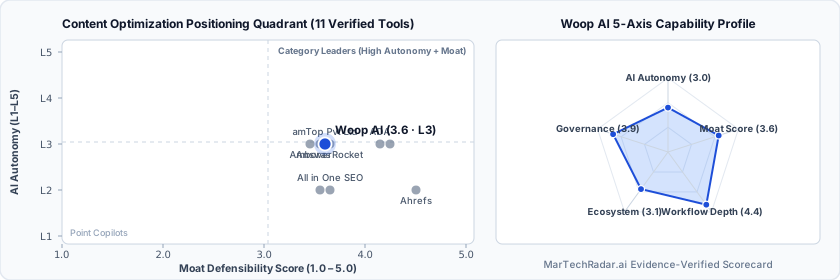
Woop AI is a Web SaaS tool for Content Optimization (Content Optimization & SERP Intelligence) in GEO & AI SEO. Pricing: From $8/mo. Best suited to SEO Directors, Brand Strategy Leaders and Growth Marketers. Editor ratings: AI autonomy L3 (conditional automation); moat score 3.6/5.0 (Proprietary moat). Fact-checked by Jagmeet Sine on Oct 14, 2026.
Woop AI is an AI search monitoring and prompt attribution platform that links generative engine brand mentions directly to downstream pipeline revenue.
Woop AI buyer fit verdict: when to choose vs. when to walk away
Choose Woop AI if (Best Fit)
- Target ICP & Stack Fit: You operate as SEO Directors, Brand Strategy Leaders and Growth Marketers requiring a Web SaaS deployment for Content Optimization.
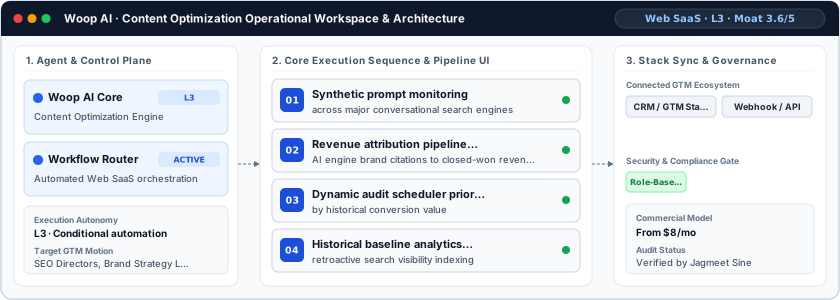
- L3 Architecture & Defensibility: Woop AI attempts to establish defensibility by joining synthetic prompt monitoring with historical revenue attribution tables, dynamically scheduling query audits based on pipeline yield rather than fixed crawl intervals.
- Commercial Model Fit: Your procurement budget aligns with From $8/mo.
Walk away from Woop AI if (Deal-Breakers)
- Walk away if your workflow requires uncapped enterprise volume on the From $8/mo entry plan without upgrading tiers.
- Walk away if your workflow cannot tolerate attribution window lag: The system depends on clean, multi-touch attribution inputs; extended enterprise B2B sales cycles introduce significant latency when correlating prompt visibility variations with final deal outcomes.
- Walk away if LLM scraping brittleness is a deal-breaker for your team: Unannounced interface changes, rate limiting, and aggressive bot mitigation across third-party generative search engines can cause intermittent telemetry gaps and unrecorded citation drops.
Woop AI key facts & scorecard
| Pricing | From $8/moVendor pricing page |
|---|---|
| Free plan | No / not disclosed |
| Delivery | Web SaaS |
| Audience | SEO Directors, Brand Strategy Leaders, Growth Marketers |
| AI autonomy level | L3 · Conditional automationEditor-verified |
| Moat tier & score | 3.6 / 5.0 · Proprietary moatEditor-verified |
| Funding | Pre-seed |
| Total funding | $100K |
| Founders | Priyank Trivedi |
| Company size | 2-10 employees |
| Governance & docs | Trust & Security ↗ · System Status ↗ · API & Docs ↗ · DPA ↗ · Terms ↗ · Privacy ↗ |
| Headquarters | Dubai |
| Founded | 2026 |
| Last verified |
Woop AI pros & cons: strengths vs. operational limitations
Pros: core strengths & capabilities
- Synthetic prompt monitoring: across major conversational search engines
- Revenue attribution pipeline linking: AI engine brand citations to closed-won revenue
- Dynamic audit scheduler prioritizing checks: by historical conversion value
- Historical baseline analytics offering: retroactive search visibility indexing
Cons: operational limitations & risks
- Attribution Window Lag: The system depends on clean, multi-touch attribution inputs; extended enterprise B2B sales cycles introduce significant latency when correlating prompt visibility variations with final deal outcomes.
- LLM Scraping Brittleness: Unannounced interface changes, rate limiting, and aggressive bot mitigation across third-party generative search engines can cause intermittent telemetry gaps and unrecorded citation drops.
- Schema and Identity Resolution: Connecting anonymous AI engine prompt impressions to downstream CRM contact records requires complex heuristic identity matching, which frequently leads to data fragmentation in high-volume funnels.
Woop AI TCO & deal-breaker stress test
Simulate 12-month stepped TCO, hidden cost multipliers, contract lock-in exposure, and stack failure modes using only facts verified by Jagmeet Sine on · Capture SHA 51ae427b.
Woop AI aligns with your 5-seat / $800/mo profile. Review the walk-away triggers and contract levers below before deployment.
| Plan / Tier | Verified Rate | Scale Fit | Scope & Quota Notes |
|---|---|---|---|
| Entry / Starter | $15/mo | 1–2 seats | Prompts 150 150 100 credits none |
| Starter | $63/mo | 5 seats | Monthly $79 $199 $399 |
| Starter | $79/mo | 15 seats | Daily ChatGPT, six months of history, and briefs that name the fix. |
- Moat Score
- 3.6 / 5.0
- AI Autonomy
- L3
- Free Tier / Trial
- None disclosed
Triggered audit signals & failure modes
- Published Self-Serve Entry FloorVerified Pricing Ledger
Woop AI publishes a transparent entry point (From $8/mo) for initial validation before committing.
- Tier Fit for 5-Seat Scale: Starter ($63/mo)Verified Tier Schedule
Monthly $79 $199 $399
- Primary Operational Bottleneck: Attribution Window LagAudit by Jagmeet Sine
The system depends on clean, multi-touch attribution inputs; extended enterprise B2B sales cycles introduce significant latency when correlating prompt visibility variations with final deal outcomes.
Hidden TCO Multipliers & Quota Gates
- Annual Billing Headline vs. Monthly Premium: Headline entry rates reflect annual billing commitments (save 20%); month-to-month flexibility carries a higher effective monthly rate or requires annual prepayment.
- Credit & Usage Burn Multiplier: Automated workflows consume metered credits/usage quotas; multi-step enrichment, voice minutes, or high-frequency agent runs can trigger mid-cycle top-up packs.
- Enterprise Governance & Add-On Gating: Advanced capabilities such as Single Sign-On (SSO), custom role permissions, or specialized analytics modules are gated behind upper tiers or paid add-ons.
When to Walk Away & Negotiation Levers
- Walk away if your workflow requires uncapped enterprise volume on the From $8/mo entry plan without upgrading tiers.
- Walk away if your workflow cannot tolerate attribution window lag: The system depends on clean, multi-touch attribution inputs; extended enterprise B2B sales cycles introduce significant latency when correlating prompt visibility variations with final deal outcomes.
- Walk away if LLM scraping brittleness is a deal-breaker for your team: Unannounced interface changes, rate limiting, and aggressive bot mitigation across third-party generative search engines can cause intermittent telemetry gaps and unrecorded citation drops.
- Validate exact quota thresholds (seats, credits, or API calls) included in Woop AI's From $8/mo tier before converting from monthly to annual billing.
- Require a sandbox proof-of-concept testing attribution window lag against your live CRM/data schema before annual sign-off.
Ask a custom procurement or TCO stress-test question about Woop AI
Lower 5-seat floor (~$29/mo vs. $63 / mo)
Lower 5-seat floor (~$39/mo vs. $63 / mo)
Woop AI moat & subtrack positioning
Woop AI attempts to establish defensibility by joining synthetic prompt monitoring with historical revenue attribution tables, dynamically scheduling query audits based on pipeline yield rather than fixed crawl intervals.
Editorial review
Fact-checked by Jagmeet Sine (Senior MarTech Infrastructure & Agentic Workflow Architect) on .
Background
Architected to solve visibility gaps in generative search engines, Woop AI provides prompt tracking coupled with downstream pipeline attribution. Headquartered in Dubai and established in 2026, the company operates with $100K in pre-seed funding. Engineered primarily for organic growth directors and technical growth teams, Woop AI shifts SERP intelligence away from static keyword trackers toward programmatic monitoring of generative AI response engines.
How Woop AI works
Operating at an L3 autonomy tier, Woop AI structures an automated feedback loop between synthetic prompt execution and closed revenue telemetry. The data ingestion engine continuously simulates target user queries across LLM interfaces, scraping brand citation positions and contextual brand sentiment. These visibility events are mapped against conversion data via direct CRM and attribution webhooks. Rather than polling queries at static intervals, the platform's scheduler dynamically adjusts monitoring frequency based on the calculated revenue value of specific prompt clusters, recommending targeted content remediations when brand share degrades.
Limitations
Operational considerations and platform boundaries include:
- Attribution Window Lag: The system depends on clean, multi-touch attribution inputs; extended enterprise B2B sales cycles introduce significant latency when correlating prompt visibility variations with final deal outcomes.
- LLM Scraping Brittleness: Unannounced interface changes, rate limiting, and aggressive bot mitigation across third-party generative search engines can cause intermittent telemetry gaps and unrecorded citation drops.
- Schema and Identity Resolution: Connecting anonymous AI engine prompt impressions to downstream CRM contact records requires complex heuristic identity matching, which frequently leads to data fragmentation in high-volume funnels.
Woop AI pricing
Woop AI operates a recurring subscription model starting from $8 per month, with options for annual billing commitments. Pricing tiers scale based on monitored prompt capacity, tracking frequency, and workspace seats. Early commercial tiers include baseline query monitoring and introductory historical reporting, while enterprise-grade requirements—such as custom CRM attribution connectors, elevated overage allowances, and priority audit scheduling—command higher-tier licensing agreements.
How Woop AI compares
Within the search intelligence category, Woop AI occupies a distinct operational niche compared to traditional ranking suites like Ahrefs and specialized domain tools like Amboras or Clearscope. While Ahrefs focuses on web index crawling and backlink graph analysis, it lacks direct revenue-weighted generative prompt tracking. Woop AI delivers stronger value for digital-native growth teams prioritizing generative engine optimization over legacy link telemetry, though it lacks the broad keyword indexing depth of entrenched enterprise suites.
Direct competitors & market radar
Top algorithmic competitors based on category positioning, capability overlap, and ICP alignment.
Frequently asked questions about Woop AI
How much does Woop AI cost and what pricing tiers are available?
Published pricing summary for Woop AI: From $8/mo. A permanent free plan is not disclosed for Woop AI. Verified tier schedule: Entry / Starter ($15/mo for 1–2 seats); Starter ($63/mo for 5 seats); Starter ($79/mo for 15 seats). Woop AI operates a recurring subscription model starting from $8 per month, with options for annual billing commitments. Pricing tiers scale based on monitored prompt capacity, tracking frequency, and workspace seats.
How does Woop AI work and how autonomous is its AI architecture?
Woop AI is an AI search monitoring and prompt attribution platform that links generative engine brand mentions directly to downstream pipeline revenue. Within Content Optimization (Content Optimization & SERP Intelligence), MarTechRadar rates its execution architecture at L3 · Conditional automation with a verified Moat Score of 3.6 / 5.0 (Proprietary moat). Woop AI attempts to establish defensibility by joining synthetic prompt monitoring with historical revenue attribution tables, dynamically scheduling query audits based on pipeline yield rather than fixed crawl intervals. Corporate profile: Founded by Priyank Trivedi, operating at 2-10 employees scale.
What are the main limitations of Woop AI and when should buyers walk away?
Based on our editorial technical audit, key operational considerations and boundaries for Woop AI include: (1) Attribution Window Lag: The system depends on clean, multi-touch attribution inputs; extended enterprise B2B sales cycles introduce significant latency when correlating prompt visibility variations with final deal outcomes. (2) LLM Scraping Brittleness: Unannounced interface changes, rate limiting, and aggressive bot mitigation across third-party generative search engines can cause intermittent telemetry gaps and unrecorded citation drops. (3) Schema and Identity Resolution: Connecting anonymous AI engine prompt impressions to downstream CRM contact records requires complex heuristic identity matching, which frequently leads to data fragmentation in high-volume funnels. Primary procurement walk-away rule: Walk away if your workflow requires uncapped enterprise volume on the From $8/mo entry plan without upgrading tiers.
What integrations, compliance certifications, and contract terms apply to Woop AI?
First-party governance and developer endpoints verified on domain include: Trust/Security (https://woop1.com/security), Status (https://woop1.com/status), API Docs (https://woop1.com/api-docs), DPA (https://woop1.com/dpa). Key TCO multiplier to watch: Annual Billing Headline vs. Monthly Premium (Headline entry rates reflect annual billing commitments (save 20%); month-to-month flexibility carries a higher effective monthly rate or requires annual prepayment.) Before signing a contract, procurement teams should validate exact quota thresholds (seats, credits, or API calls) included in Woop AI's From $8/mo tier before converting from monthly to annual billing.
What are the best Woop AI alternatives and head-to-head competitors in 2026?
Top fact-checked alternatives to Woop AI in Content Optimization (Content Optimization & SERP Intelligence) include Content at Scale (Free plan · $0/mo · Enterprise plan), Solara AI (From $29/mo), Amboras ($39–$299/mo), AnswerRocket (Custom / enterprise pricing). Within the search intelligence category, Woop AI occupies a distinct operational niche compared to traditional ranking suites like Ahrefs and specialized domain tools like Amboras or Clearscope.
Verified sources & evidence trail
- Official product domain: https://woop1.com
- Commercial pricing verification: https://woop1.com/pricing
- Verified corporate entity profiles (
sameAs): LinkedIn Company Profile · Crunchbase Entity Record - First-party governance & documentation links: Trust & Security · System Status · API & Docs · DPA · Terms · Privacy
- Editorial audit sign-off: Fact-checked by Jagmeet Sine on under the MarTechRadar Evidence-Ledger Protocol.