Walnut Review (2026): AI Marketing Agent Pricing, Limits & Alternatives
Bottom line
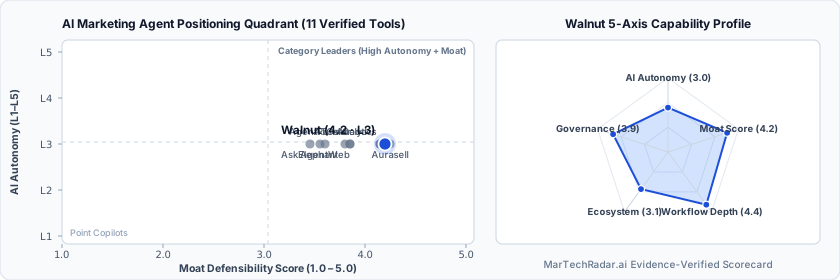
Walnut is a Web SaaS tool for AI Marketing Agent (Autonomous Marketing Agents & Digital Coworkers) in Agent & Marketing Ops. Pricing: Free plan · $0/mo · Enterprise plan. Best suited to GTM Operations Teams, Enterprise Marketing Executives and Automated Ops Teams. Editor ratings: AI autonomy L3 (conditional automation); moat score 4.2/5.0 (Proprietary moat). Fact-checked by Vasilia Xia on Oct 12, 2026.
Interactive product demonstration and digital sales room platform enabling go-to-market teams to capture, edit, personalize, and guide software.
Walnut buyer fit verdict: when to choose vs. when to walk away
Choose Walnut if (Best Fit)
- Target ICP & Stack Fit: You operate as GTM Operations Teams, Enterprise Marketing Executives and Automated Ops Teams requiring a Web SaaS deployment for AI Marketing Agent.
- L3 Architecture & Defensibility: Proprietary front-end DOM virtualization engine coupled with synthetic data manipulation tooling, contextual in-demo autonomous conversational agent (Buyer Xpert), and deep deal room engagement telemetry.
- Commercial Model Fit: Your procurement budget aligns with Free plan · $0/mo · Enterprise plan and want a self-serve free tier for zero-cost initial validation.
Walk away from Walnut if (Deal-Breakers)
- Walk away if your workflow requires uncapped enterprise volume on the Free plan · $0/mo · Enterprise plan entry plan without upgrading tiers.
- Walk away if your workflow cannot tolerate dynamic web application drift: Single-page applications relying on canvas elements, WebGL, or complex shadow DOMs frequently suffer visual desynchronization, requiring manual element tagging and ongoing re-captures when front-end code updates.
- Walk away if synthetic state management is a deal-breaker for your team: Because the virtualized environment lacks persistent database state, complex transactional flows requiring calculation logic or bi-directional state updates must be simulated manually through branching paths.
Walnut key facts & scorecard
| Pricing | Free plan · $0/mo · Enterprise planVendor pricing page |
|---|---|
| Free plan | Yes |
| Delivery | Web SaaS |
| Audience | GTM Operations Teams, Enterprise Marketing Executives, Automated Ops Teams |
| AI autonomy level | L3 · Conditional automationEditor-verified |
| Moat tier & score | 4.2 / 5.0 · Proprietary moatEditor-verified |
| Funding | Series B |
| Total funding | $56MBacked by SV Angel, Felicis |
| Founders | Danni Friedland, Yoav Vilner |
| Company size | 51-200 employees |
| Governance & docs | DPA ↗ · Privacy ↗ |
| Headquarters | New York |
| Founded | 2020 |
| Last verified |
Walnut pros & cons: strengths vs. operational limitations
Pros: core strengths & capabilities
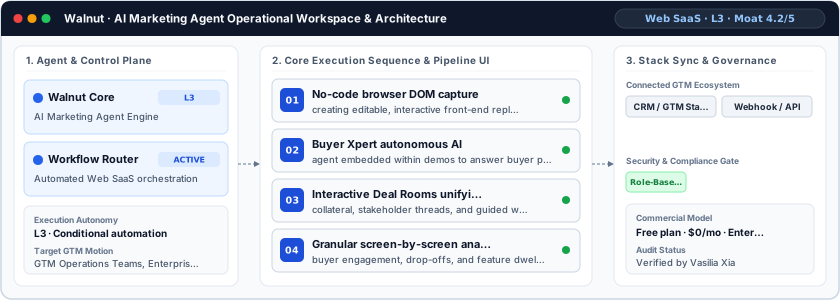
- No-code browser DOM capture: creating editable, interactive front-end replicas disconnected from production databases
- Buyer Xpert autonomous AI: agent embedded within demos to answer buyer product questions
- Interactive Deal Rooms unifying: collateral, stakeholder threads, and guided walkthroughs
- Granular screen-by-screen analytics tracking: buyer engagement, drop-offs, and feature dwell times
Cons: operational limitations & risks
- Dynamic Web Application Drift: Single-page applications relying on canvas elements, WebGL, or complex shadow DOMs frequently suffer visual desynchronization, requiring manual element tagging and ongoing re-captures when front-end code updates.
- Synthetic State Management: Because the virtualized environment lacks persistent database state, complex transactional flows requiring calculation logic or bi-directional state updates must be simulated manually through branching paths.
- Telemetry Attribution Latency: Capturing deep engagement data within external deal rooms creates integration friction with enterprise CRMs, occasionally misattributing anonymous multi-stakeholder visits to single contact records.
Walnut TCO & deal-breaker stress test
Simulate 12-month stepped TCO, hidden cost multipliers, contract lock-in exposure, and stack failure modes using only facts verified by Vasilia Xia on · Capture SHA 96cf53f5.
Walnut is viable for 5 seats, but requires commercial or technical verification on the flagged items below.
| Plan / Tier | Verified Rate | Scale Fit | Scope & Quota Notes |
|---|---|---|---|
| Free / Sandbox | $0 | 1–2 seats (Evaluation) | Entry free tier with capped usage or feature quotas for initial workflow testing. |
| Entry / Starter | $575/mo | 1–2 seats | PER MONTH, BILLED ANNUALLY |
| Enterprise / Custom | Custom quote | 15–50+ seats (Enterprise SLA) | Sales-negotiated annual contract for custom volume, SSO/RBAC governance, and dedicated SLA. |
- Moat Score
- 4.2 / 5.0
- AI Autonomy
- L3
- Free Tier / Trial
- Free plan
Triggered audit signals & failure modes
- Opaque Enterprise Quoting vs. SMB/Mid-Market BudgetVerified Pricing Ledger
Walnut does not disclose a public self-serve floor (Free plan · $0/mo · Enterprise plan). Buyers with a $800/mo cap face high sales-qualification friction.
- Published Self-Serve Entry FloorVerified Pricing Ledger
Walnut publishes a transparent entry point (Free plan · $0/mo · Enterprise plan) with a free tier for initial validation before committing.
- Primary Operational Bottleneck: Dynamic Web Application DriftAudit by Vasilia Xia
Single-page applications relying on canvas elements, WebGL, or complex shadow DOMs frequently suffer visual desynchronization, requiring manual element tagging and ongoing re-captures when front-end code updates.
Hidden TCO Multipliers & Quota Gates
- Per-Seat Linear Scaling: Walnut prices licenses on a per-user/seat basis (Free plan · $0/mo · Enterprise plan); expanding from 2 to 15+ operators multiplies base recurring spend linearly.
- Annual Billing Headline vs. Monthly Premium: Headline entry rates reflect annual billing commitments; month-to-month flexibility carries a higher effective monthly rate or requires annual prepayment.
- Credit & Usage Burn Multiplier: Automated workflows consume metered credits/usage quotas; multi-step enrichment, voice minutes, or high-frequency agent runs can trigger mid-cycle top-up packs.
When to Walk Away & Negotiation Levers
- Walk away if your workflow requires uncapped enterprise volume on the Free plan · $0/mo · Enterprise plan entry plan without upgrading tiers.
- Walk away if your workflow cannot tolerate dynamic web application drift: Single-page applications relying on canvas elements, WebGL, or complex shadow DOMs frequently suffer visual desynchronization, requiring manual element tagging and ongoing re-captures when front-end code updates.
- Walk away if synthetic state management is a deal-breaker for your team: Because the virtualized environment lacks persistent database state, complex transactional flows requiring calculation logic or bi-directional state updates must be simulated manually through branching paths.
- Validate exact quota thresholds (seats, credits, or API calls) included in Walnut's Free plan · $0/mo · Enterprise plan tier before converting from monthly to annual billing.
- Require a sandbox proof-of-concept testing dynamic web application drift against your live CRM/data schema before annual sign-off.
Ask a custom procurement or TCO stress-test question about Walnut
Lower 5-seat floor (~$49/mo vs. Custom Quote)
Lower 5-seat floor (~$25/mo vs. Custom Quote)
Walnut moat & subtrack positioning
Proprietary front-end DOM virtualization engine coupled with synthetic data manipulation tooling, contextual in-demo autonomous conversational agent (Buyer Xpert), and deep deal room engagement telemetry.
Editorial review
Fact-checked by Vasilia Xia (E-Commerce, Lifecycle & Retention Marketing Analyst) on .
Background
To insulate enterprise go-to-market motions from live software staging crashes, revenue leaders require isolated, highly editable sandbox environments that mimic production software. Established in 2020 in New York with $56M in total venture capital funding, Walnut delivers an interactive product demo and digital deal room platform tailored for sales engineering, product marketing, and revenue operations teams. The solution replaces unstable live environments with client-side interactive replicas, allowing teams to deliver customized software experiences across sales cycles.
How Walnut works
Walnut operates by capturing the Document Object Model (DOM) of web applications via a browser extension, decoupling the visual interface from backend production code and live APIs. Once captured, the platform serializes HTML, CSS, and asset trees into an editable cloud repository where users can replace text strings, anonymize PII, and inject customized product data. During prospect execution, Walnut functions at an L3 autonomy level: its embedded Buyer Xpert AI agent autonomously parses prospect inquiries within the demo context, retrieving answers and directing users to relevant workflows without seller intervention.
Limitations
Operational considerations and platform boundaries include:
- Dynamic Web Application Drift: Single-page applications relying on canvas elements, WebGL, or complex shadow DOMs frequently suffer visual desynchronization, requiring manual element tagging and ongoing re-captures when front-end code updates.
- Synthetic State Management: Because the virtualized environment lacks persistent database state, complex transactional flows requiring calculation logic or bi-directional state updates must be simulated manually through branching paths.
- Telemetry Attribution Latency: Capturing deep engagement data within external deal rooms creates integration friction with enterprise CRMs, occasionally misattributing anonymous multi-stakeholder visits to single contact records.
Walnut pricing
Walnut packages its software through a tiered subscription architecture anchored by a self-serve baseline. Prospective teams can test core functionality through a Free tier at $0 per month, which offers limited capture capacity and baseline sharing capabilities. Scaled commercial deployments transition into custom enterprise licensing priced on annual commitments, which scales based on seat counts across creators and viewers, advanced Deal Room hosting, and Buyer Xpert agent interactions.
How Walnut compares
Within autonomous presales and buyer enablement, Walnut operates alongside distinct architectural approaches. While ai-marketing-claude centers on conversational prompt-driven marketing generation and AskElephant focuses on passive conversational intelligence across recorded calls, Walnut emphasizes interactive DOM virtualization with in-demo AI guidance. Meanwhile, tools like allGood target broader pipeline automation. Walnut best serves mid-market and enterprise B2B SaaS organizations requiring deterministic, crash-proof interactive sales environments that capture buyer telemetry without backend engineering overhead.
Direct competitors & market radar
Top algorithmic competitors based on category positioning, capability overlap, and ICP alignment.
Frequently asked questions about Walnut
How much does Walnut cost and what pricing tiers are available?
Published pricing summary for Walnut: Free plan · $0/mo · Enterprise plan. Walnut includes a free tier or sandbox entry point. Verified tier schedule: Free / Sandbox ($0 for 1–2 seats (Evaluation)); Entry / Starter ($575/mo for 1–2 seats); Enterprise / Custom (Custom quote for 15–50+ seats (Enterprise SLA)). Walnut packages its software through a tiered subscription architecture anchored by a self-serve baseline. Prospective teams can test core functionality through a Free tier at $0 per month, which offers limited capture capacity and baseline sharing capabilities.
How does Walnut work and how autonomous is its AI architecture?
Interactive product demonstration and digital sales room platform enabling go-to-market teams to capture, edit, personalize, and guide software. Within AI Marketing Agent (Autonomous Marketing Agents & Digital Coworkers), MarTechRadar rates its execution architecture at L3 · Conditional automation with a verified Moat Score of 4.2 / 5.0 (Proprietary moat). Proprietary front-end DOM virtualization engine coupled with synthetic data manipulation tooling, contextual in-demo autonomous conversational agent (Buyer Xpert), and deep deal room engagement telemetry. Corporate profile: Founded by Danni Friedland, Yoav Vilner, operating at 51-200 employees scale.
What are the main limitations of Walnut and when should buyers walk away?
Based on our editorial technical audit, key operational considerations and boundaries for Walnut include: (1) Dynamic Web Application Drift: Single-page applications relying on canvas elements, WebGL, or complex shadow DOMs frequently suffer visual desynchronization, requiring manual element tagging and ongoing re-captures when front-end code updates. (2) Synthetic State Management: Because the virtualized environment lacks persistent database state, complex transactional flows requiring calculation logic or bi-directional state updates must be simulated manually through branching paths. (3) Telemetry Attribution Latency: Capturing deep engagement data within external deal rooms creates integration friction with enterprise CRMs, occasionally misattributing anonymous multi-stakeholder visits to single contact records. Primary procurement walk-away rule: Walk away if your workflow requires uncapped enterprise volume on the Free plan · $0/mo · Enterprise plan entry plan without upgrading tiers.
What integrations, compliance certifications, and contract terms apply to Walnut?
First-party governance and developer endpoints verified on domain include: DPA (https://www.walnut.io/dpa). Key TCO multiplier to watch: Per-Seat Linear Scaling (Walnut prices licenses on a per-user/seat basis (Free plan · $0/mo · Enterprise plan); expanding from 2 to 15+ operators multiplies base recurring spend linearly.) Before signing a contract, procurement teams should validate exact quota thresholds (seats, credits, or API calls) included in Walnut's Free plan · $0/mo · Enterprise plan tier before converting from monthly to annual billing.
What are the best Walnut alternatives and head-to-head competitors in 2026?
Top fact-checked alternatives to Walnut in AI Marketing Agent (Autonomous Marketing Agents & Digital Coworkers) include Hexus (From $49/mo), QuadSci (Custom / enterprise pricing), Tray.io (Custom / enterprise pricing), GoMarble (From $25/mo). Within autonomous presales and buyer enablement, Walnut operates alongside distinct architectural approaches.
Verified sources & evidence trail
- Official product domain: https://www.walnut.io/
- Commercial pricing verification: https://www.walnut.io/pricing/
- Verified corporate entity profiles (
sameAs): LinkedIn Company Profile · Crunchbase Entity Record - First-party governance & documentation links: DPA · Privacy
- Editorial audit sign-off: Fact-checked by Vasilia Xia on under the MarTechRadar Evidence-Ledger Protocol.