Unbounce Review (2026): AI Landing Page Pricing, Pros & Cons
Bottom line
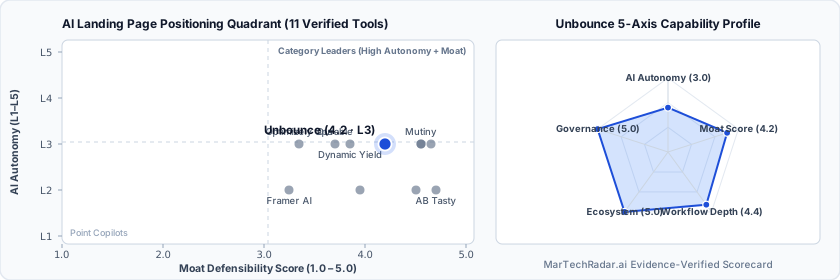
Unbounce is a Web SaaS tool for AI Landing Page (Landing Page Builders & Autonomous CRO) in Lifecycle & CDP. Pricing: From $22/mo. Best suited to B2B SaaS and Marketing Agencies. Editor ratings: AI autonomy L3 (conditional automation); moat score 4.2/5.0 (Proprietary moat). Fact-checked by MarTechRadar Research Desk on Oct 12, 2026.
Conversion rate optimization and landing page engine pairing drag-and-drop authoring with multi-armed bandit automated traffic routing.
Is Unbounce worth it in 2026? Buyer fit & when to walk away
Choose Unbounce if (Best Fit)
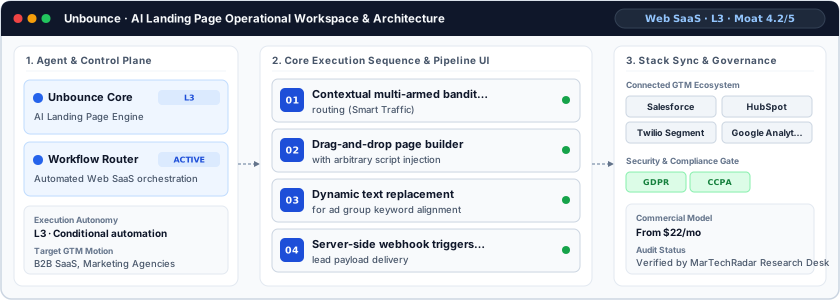
- Target ICP & Stack Fit: You operate as B2B SaaS and Marketing Agencies requiring a Web SaaS deployment for AI Landing Page, with verified ecosystem connectivity for Salesforce, HubSpot, Twilio Segment, Google Analytics 4 (GA4).
- L3 Architecture & Defensibility: Defensibility stems from historical conversion datasets informing contextual multi-armed bandit models (Smart Traffic), coupled with sticky domain-level DNS routing and agency multi-client management workflows.
- Commercial Model Fit: Your procurement budget aligns with From $22/mo.
Walk away from Unbounce if (Deal-Breakers)
- Walk away if your workflow cannot tolerate traffic tier enforcement: Exceeding monthly unique visitor allowances introduces account overage charges or automatic campaign throttling, requiring strict pacing controls on volatile paid media programs.
- Walk away if headless CMS interoperability is a deal-breaker for your team: The platform functions as an isolated presentation island; synchronizing structural page components with decoupled enterprise design systems requires brittle custom scripting.
Unbounce pricing, free plan & scorecard at a glance
| Pricing | From $22/moVendor pricing page |
|---|---|
| Free plan | No / not disclosed |
| Delivery | Web SaaS |
| Audience | B2B SaaS, Marketing Agencies |
| AI autonomy level | L3 · Conditional automationEditor-verified |
| Moat tier & score | 4.2 / 5.0 · Proprietary moatEditor-verified |
| Funding | Venture-backed |
| Total funding | $39.1MBacked by Crestline Investors |
| Founders | Carl Schmidt, Carter Gilchrist, Jason Murphy, Justin Stacey |
| Company size | 51-200 employees |
| Ecosystem integrations | Salesforce, HubSpot, Twilio Segment, Google Analytics 4 (GA4), Zapier, Model Context Protocol (MCP) |
| Compliance & governance | GDPR, CCPA |
| Governance & docs | Trust & Security ↗ · API & Docs ↗ · Terms ↗ · Privacy ↗ |
| Headquarters | Vancouver, British Columbia |
| Founded | 2009 |
| Last verified | Oct 12, 2026 |
Unbounce pros & cons: strengths vs. operational limitations
Pros: core strengths & capabilities
- Contextual multi-armed bandit traffic: routing (Smart Traffic)
- Drag-and-drop page builder: with arbitrary script injection
- Dynamic text replacement: for ad group keyword alignment
- Server-side webhook triggers and lead payload delivery
Cons: operational limitations & risks
- Traffic Tier Enforcement: Exceeding monthly unique visitor allowances introduces account overage charges or automatic campaign throttling, requiring strict pacing controls on volatile paid media programs.
- Headless CMS Interoperability: The platform functions as an isolated presentation island; synchronizing structural page components with decoupled enterprise design systems requires brittle custom scripting.
- Edge Logic Extensibility: Dynamic personalization is restricted to client-side token swapping, lacking serverless edge worker compute for complex real-time database queries.
Unbounce TCO & deal-breaker stress test
Simulate 12-month stepped TCO, hidden cost multipliers, contract lock-in exposure, and stack failure modes using only facts verified by MarTechRadar Research Desk on 2026-10-12 · Capture SHA 6f7caadf.
Unbounce aligns with your 5-seat / $800/mo profile. Review the walk-away triggers and contract levers below before deployment.
- Moat Score
- 4.2 / 5.0
- AI Autonomy
- L3
- Free Tier / Trial
- None disclosed
Triggered audit signals & failure modes
- Published Self-Serve Entry FloorVerified Pricing Ledger
Unbounce publishes a transparent entry point (From $22/mo) for initial validation before committing.
- Primary Operational Bottleneck: Traffic Tier EnforcementAudit by MarTechRadar Research Desk
Exceeding monthly unique visitor allowances introduces account overage charges or automatic campaign throttling, requiring strict pacing controls on volatile paid media programs.
Test a custom Unbounce budget or stack constraint
Fits within $800/mo budget (From $79/mo)
Unbounce integrations, API, security & compliance stack
Unbounce AI moat & AI Landing Page positioning
Defensibility stems from historical conversion datasets informing contextual multi-armed bandit models (Smart Traffic), coupled with sticky domain-level DNS routing and agency multi-client management workflows.
Unbounce in-depth review, pricing & architecture analysis
Editor sign-off: Oct 12, 2026. How profiles are made.
What is Unbounce? Overview & background
Architectured as a specialized conversion operating layer, Unbounce bridges paid traffic acquisition and downstream pipeline capture. Headquartered in Vancouver, British Columbia, established in 2009, and supported by $39.1M in total funding, the vendor engineers dedicated web assets decoupled from monolithic content management systems. The platform serves growth marketing teams, paid media practitioners, and agency operators requiring rapid testing cycles without consuming internal developer bandwidth.
How Unbounce works: architecture & workflow
At its technical core, Unbounce combines visual canvas authoring with an algorithmic traffic allocation engine known as Smart Traffic. Unlike conventional A/B testing frameworks requiring prolonged hypothesis cycles, Smart Traffic leverages a contextual multi-armed bandit model. The system ingests visitor telemetry—including geolocation, device context, and referral parameters—to compute conversion probabilities and route traffic to the optimal page variant after fewer than one hundred initial visits. Runtime page execution occurs via an integrated content distribution network with automated SSL termination, while an Model Context Protocol (MCP) server interface and client-side JavaScript hooks permit bi-directional data flow with analytics tracking suites and CRM destinations, alongside native workflow integrations for Salesforce, HubSpot, Zapier, and Google Analytics under verified GDPR and CCPA governance controls.
Unbounce limitations, drawbacks & risks
Operational considerations and platform boundaries include:
- Traffic Tier Enforcement: Exceeding monthly unique visitor allowances introduces account overage charges or automatic campaign throttling, requiring strict pacing controls on volatile paid media programs.
- Headless CMS Interoperability: The platform functions as an isolated presentation island; synchronizing structural page components with decoupled enterprise design systems requires brittle custom scripting.
- Edge Logic Extensibility: Dynamic personalization is restricted to client-side token swapping, lacking serverless edge worker compute for complex real-time database queries.
Unbounce pricing, plans & cost breakdown
Commercial access operates on a multi-tier recurring subscription indexed against published page volume, domain entitlements, and monthly visitor traffic. Public pricing starts at $22 per month when billed annually, compared to $29 per month on standard billing cycles. Higher subscription tiers expand visitor limits and unlock multi-variant routing algorithms, while enterprise agreements introduce consolidated multi-client management portals and designated support SLAs.
| Plan / Tier | Verified Price & Billing | Included Scope & Contract Terms | |
|---|---|---|---|
| Starter | $22/mo | Set up and launch your first landing pages | |
| Contract Watchout: Annual Billing Headline vs. Monthly Premium | The vendor pricing page advertises an annual-billing discount (Save 25%); month-to-month billing carries a higher effective monthly rate. | ||
How Unbounce compares vs. competitors & alternatives
Within the conversion optimization landscape, Unbounce occupies an operational middle ground between rapid web design tools and enterprise testing suites within the AI Landing Page segment. Framer AI and Dora AI emphasize high-fidelity generative visual canvases and responsive spatial design, yet both lack native conversion-oriented routing algorithms and contextual lead generation utilities. Conversely, Instapage (AI) addresses scaled enterprise ad mapping with higher baseline contract costs and programmatic page generation. Unbounce remains optimized for mid-market growth teams and agencies prioritizing fast turnaround and automated variant routing over complex enterprise workspace governance.
Direct competitors & market radar
Top algorithmic competitors based on category positioning, capability overlap, and ICP alignment.
Frequently asked questions about Unbounce
How much does Unbounce cost in 2026?
Unbounce pricing: From $22/mo. No free plan is publicly disclosed. Commercial access operates on a multi-tier recurring subscription indexed against published page volume, domain entitlements, and monthly visitor traffic.
What are the top Unbounce alternatives in AI Landing Page?
Verified AI Landing Page alternatives include Instapage (AI) (From $79/mo), Mutiny (Custom / enterprise pricing), Dora AI (Custom / enterprise pricing), Fibr AI (Pricing not disclosed). Within the conversion optimization landscape, Unbounce occupies an operational middle ground between rapid web design tools and enterprise testing suites within the AI Landing Page segment.
What are the main limitations and trade-offs of Unbounce?
Operational considerations and platform boundaries include: Traffic Tier Enforcement: Exceeding monthly unique visitor allowances introduces account overage charges or automatic campaign throttling, requiring strict pacing controls on volatile paid media programs. Walk away if your workflow cannot tolerate traffic tier enforcement: Exceeding monthly unique visitor allowances introduces account overage charges or automatic campaign throttling, requiring strict pacing controls on volatile paid media programs.
Verified sources & evidence trail
- Official product domain: https://unbounce.com
- Commercial pricing verification: https://unbounce.com/pricing/
- Verified corporate entity profiles (
sameAs): LinkedIn Company Profile · Crunchbase Entity Record - First-party governance & documentation links: Trust & Security · API & Docs · Terms · Privacy
- Editor sign-off: Oct 12, 2026 (how profiles are made).
