Typa Review (2026): AI Content Marketing Pricing, Limits & Alternatives
Bottom line
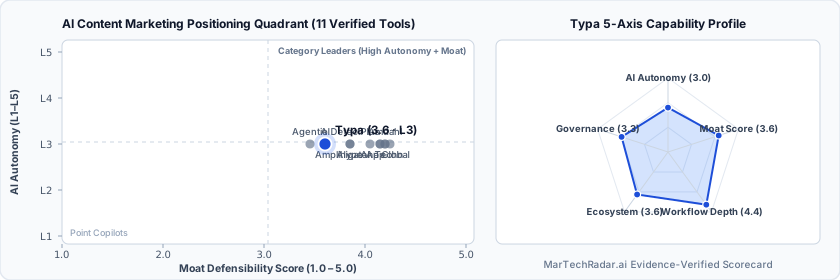
Typa is a Web SaaS tool for AI Content Marketing (Enterprise & Long-Form Brand Content) in Copy & Content. Pricing: Free plan · $0/mo. Best suited to B2B SaaS and Marketing & Growth Teams. Editor ratings: AI autonomy L3 (conditional automation); moat score 3.6/5.0 (Proprietary moat). Fact-checked by Tim Fenolz on Oct 16, 2026.
Voice-calibrated inbound content engine that captures founder and brand insights via web or iMessage to write, schedule, and compound social growth.
Typa buyer fit verdict: when to choose vs. when to walk away
Choose Typa if (Best Fit)
- Target ICP & Stack Fit: You operate as B2B SaaS and Marketing & Growth Teams requiring a Web SaaS deployment for AI Content Marketing, with verified ecosystem connectivity for LinkedIn.
- L3 Architecture & Defensibility: Combining a persistent brand knowledge base and authentic tone-of-voice modeling with low-friction iMessage capture turns executive thoughts into a compounding inbound content engine.
- Commercial Model Fit: Your procurement budget aligns with Free plan · $0/mo and want a self-serve free tier for zero-cost initial validation.
Walk away from Typa if (Deal-Breakers)
- Walk away if your workflow requires uncapped enterprise volume on the Free plan · $0/mo entry plan without upgrading tiers.
- Walk away if your workflow cannot tolerate voice calibration cold start: A primary onboarding limitation is that authentic style replication requires a representative corpus of prior writing; founders with minimal historical posts face a cold start calibration bottleneck before drafts sound natural.
- Walk away if text-first format boundary is a deal-breaker for your team: Because Typa is architected primarily around written narrative, thought leadership, and social posts, it is not built for complex multi-track video editing or 3D product rendering.
Typa key facts & scorecard
| Pricing | Free plan · $0/moVendor pricing page |
|---|---|
| Free plan | Yes |
| Delivery | Web SaaS |
| Audience | B2B SaaS, Marketing & Growth Teams |
| AI autonomy level | L3 · Conditional automationEditor-verified |
| Moat tier & score | 3.6 / 5.0 · Proprietary moatEditor-verified |
| Funding | Seed |
| Founders | Andrew Chung, Hyun Jung, Junyoung Park |
| Company size | 2-10 employees |
| Ecosystem integrations | |
| Governance & docs | Terms ↗ · Privacy ↗ |
| Headquarters | San Francisco, California |
| Founded | 2023 |
| Last verified |
Typa pros & cons: strengths vs. operational limitations
Pros: core strengths & capabilities
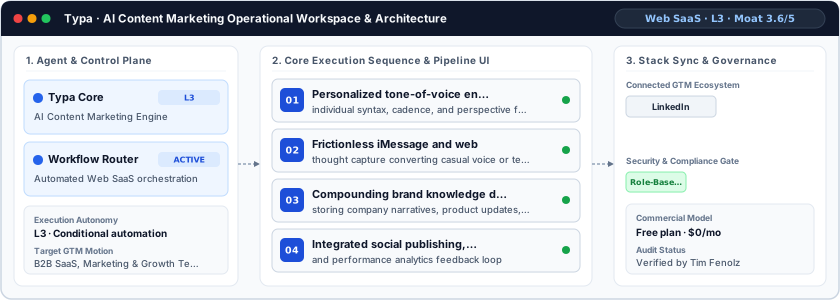
- Personalized tone-of-voice engine learning: individual syntax, cadence, and perspective from historical writing
- Frictionless iMessage and web: thought capture converting casual voice or text notes into structured posts
- Compounding brand knowledge drive: storing company narratives, product updates, and audience insights
- Integrated social publishing, scheduling,: and performance analytics feedback loop
Cons: operational limitations & risks
- Voice Calibration Cold Start: A primary onboarding limitation is that authentic style replication requires a representative corpus of prior writing; founders with minimal historical posts face a cold start calibration bottleneck before drafts sound natural.
- Text-First Format Boundary: Because Typa is architected primarily around written narrative, thought leadership, and social posts, it is not built for complex multi-track video editing or 3D product rendering.
- Multi-Executive Governance Barrier: Scaling iMessage-driven content capture across larger enterprise communications teams introduces editorial approval friction, a workflow learning curve, and compliance governance barriers.
Typa TCO & deal-breaker stress test
Simulate 12-month stepped TCO, hidden cost multipliers, contract lock-in exposure, and stack failure modes using only facts verified by Tim Fenolz on · Capture SHA 81a1aa47.
Typa is viable for 5 seats, but requires commercial or technical verification on the flagged items below.
| Plan / Tier | Verified Rate | Scale Fit | Scope & Quota Notes |
|---|---|---|---|
| Free / Sandbox | $0 | 1–2 seats (Evaluation) | Entry free tier with capped usage or feature quotas for initial workflow testing. |
| Free | $3/mo | 1–2 seats | Verified $3/mo tier from vendor pricing schedule. |
| Pro | $10/mo | 5 seats | Everything in Free, plus: |
| Free | $17/mo | 15 seats | + $10 per connected social account |
- Moat Score
- 3.6 / 5.0
- AI Autonomy
- L3
- Free Tier / Trial
- Free plan
Triggered audit signals & failure modes
- Opaque Enterprise Quoting vs. SMB/Mid-Market BudgetVerified Pricing Ledger
Typa does not disclose a public self-serve floor (Free plan · $0/mo). Buyers with a $800/mo cap face high sales-qualification friction.
- Published Self-Serve Entry FloorVerified Pricing Ledger
Typa publishes a transparent entry point (Free plan · $0/mo) with a free tier for initial validation before committing.
- Tier Fit for 5-Seat Scale: Free ($3/mo)Verified Tier Schedule
Verified $3/mo tier from vendor pricing schedule.
- Primary Operational Bottleneck: Voice Calibration Cold StartAudit by Tim Fenolz
A primary onboarding limitation is that authentic style replication requires a representative corpus of prior writing; founders with minimal historical posts face a cold start calibration bottleneck before drafts sound natural.
Hidden TCO Multipliers & Quota Gates
- Credit & Usage Burn Multiplier: Automated workflows consume metered credits/usage quotas; multi-step enrichment, voice minutes, or high-frequency agent runs can trigger mid-cycle top-up packs.
- Voice Calibration Cold Start: A primary onboarding limitation is that authentic style replication requires a representative corpus of prior writing; founders with minimal historical posts face a cold start calibration bottleneck before drafts sound natural.
- Text-First Format Boundary: Because Typa is architected primarily around written narrative, thought leadership, and social posts, it is not built for complex multi-track video editing or 3D product rendering.
When to Walk Away & Negotiation Levers
- Walk away if your workflow requires uncapped enterprise volume on the Free plan · $0/mo entry plan without upgrading tiers.
- Walk away if your workflow cannot tolerate voice calibration cold start: A primary onboarding limitation is that authentic style replication requires a representative corpus of prior writing; founders with minimal historical posts face a cold start calibration bottleneck before drafts sound natural.
- Walk away if text-first format boundary is a deal-breaker for your team: Because Typa is architected primarily around written narrative, thought leadership, and social posts, it is not built for complex multi-track video editing or 3D product rendering.
- Validate exact quota thresholds (seats, credits, or API calls) included in Typa's Free plan · $0/mo tier before converting from monthly to annual billing.
- Require a sandbox proof-of-concept testing voice calibration cold start against your live CRM/data schema before annual sign-off.
Ask a custom procurement or TCO stress-test question about Typa
Lower 5-seat floor (~$6/mo vs. Custom Quote)
Lower 5-seat floor (~$24/mo vs. Custom Quote)
Typa key entities, modules & ecosystem stack
Typa moat & subtrack positioning
Combining a persistent brand knowledge base and authentic tone-of-voice modeling with low-friction iMessage capture turns executive thoughts into a compounding inbound content engine.
Editorial review
Fact-checked by Tim Fenolz (Lead AdTech, Programmatic & Attribution Analyst) on .
Background
Founded in 2023 by Andrew Chung, Hyun Jie Jung, and Junyoung Park and headquartered in San Francisco, California, Typa (typa.ai) is an AI-native inbound content engine built for startup founders, executive thought leaders, and B2B growth marketing teams. Operating with a team of 2 to 10 employees and backed by institutional accelerator investor Y Combinator (S24), the company helps businesses capture authentic domain insights, translate them into high-performing social and long-form content, and build compounding organic distribution.
How Typa works
Typa operates at Level 3 autonomy across three interconnected architectural pillars: a calibrated Tone-of-Voice model, a persistent Knowledge Drive, and an omnichannel capture-and-publishing pipeline. Unlike generic LLM wrappers that output recognizable corporate clichés, Typa fine-tunes its generation pipeline on a founder's or brand's existing writing samples to mirror their exact sentence rhythm and point of view. Busy executives can text raw ideas or voice notes to Typa directly via iMessage or the web workspace (app.typa.ai), and the system cross-references its stored knowledge repository to draft, schedule, and analyze posts that resonate with target buyers.
Limitations
Operational limitations and technical trade-offs include:
- Voice Calibration Cold Start: A primary onboarding limitation is that authentic style replication requires a representative corpus of prior writing; founders with minimal historical posts face a cold start calibration bottleneck before drafts sound natural.
- Text-First Format Boundary: Because Typa is architected primarily around written narrative, thought leadership, and social posts, it is not built for complex multi-track video editing or 3D product rendering.
- Multi-Executive Governance Barrier: Scaling iMessage-driven content capture across larger enterprise communications teams introduces editorial approval friction, a workflow learning curve, and compliance governance barriers.
Typa pricing
Typa offers self-serve individual plans alongside custom Founder Mode and Team/Enterprise packages. The Free tier ($0/mo) includes $3 in usage credits to test the content engine. The Pro plan is priced at $17/mo (with 1 connected social account included and $10/mo per additional connected social account) and unlocks iMessage texting to Typa, native scheduling, and analytics.
How Typa compares
Within the Enterprise & Long-Form Brand Content category, Typa competes against founder-led content and social growth alternatives such as VibeFlow, Jasper, and Taplio. Versus rigid enterprise templating suites like Jasper or LinkedIn-only scrapers like Taplio, Typa differentiates itself through its conversational iMessage capture workflow and compounding personal knowledge graph. Startup founders and B2B marketing leaders choose Typa to maintain consistent executive publishing without hiring ghostwriters.
Frequently asked questions about Typa
How much does Typa cost and what pricing tiers are available?
Published pricing summary for Typa: Free plan · $0/mo. Typa includes a free tier or sandbox entry point. Verified tier schedule: Free / Sandbox ($0 for 1–2 seats (Evaluation)); Free ($3/mo for 1–2 seats); Pro ($10/mo for 5 seats); Free ($17/mo for 15 seats). Typa offers self-serve individual plans alongside custom Founder Mode and Team/Enterprise packages. The Free tier ($0/mo) includes $3 in usage credits to test the content engine.
How does Typa work and how autonomous is its AI architecture?
Voice-calibrated inbound content engine that captures founder and brand insights via web or iMessage to write, schedule, and compound social growth. Within AI Content Marketing (Enterprise & Long-Form Brand Content), MarTechRadar rates its execution architecture at L3 · Conditional automation with a verified Moat Score of 3.6 / 5.0 (Proprietary moat). Combining a persistent brand knowledge base and authentic tone-of-voice modeling with low-friction iMessage capture turns executive thoughts into a compounding inbound content engine. Corporate profile: Founded by Andrew Chung, Hyun Jung, Junyoung Park, operating at 2-10 employees scale.
What are the main limitations of Typa and when should buyers walk away?
Based on our editorial technical audit, key operational considerations and boundaries for Typa include: (1) Voice Calibration Cold Start: A primary onboarding limitation is that authentic style replication requires a representative corpus of prior writing; founders with minimal historical posts face a cold start calibration bottleneck before drafts sound natural. (2) Text-First Format Boundary: Because Typa is architected primarily around written narrative, thought leadership, and social posts, it is not built for complex multi-track video editing or 3D product rendering. (3) Multi-Executive Governance Barrier: Scaling iMessage-driven content capture across larger enterprise communications teams introduces editorial approval friction, a workflow learning curve, and compliance governance barriers. Primary procurement walk-away rule: Walk away if your workflow requires uncapped enterprise volume on the Free plan · $0/mo entry plan without upgrading tiers.
What integrations, compliance certifications, and contract terms apply to Typa?
Verified ecosystem and stack integrations include LinkedIn. Key TCO multiplier to watch: Credit & Usage Burn Multiplier (Automated workflows consume metered credits/usage quotas; multi-step enrichment, voice minutes, or high-frequency agent runs can trigger mid-cycle top-up packs.) Before signing a contract, procurement teams should validate exact quota thresholds (seats, credits, or API calls) included in Typa's Free plan · $0/mo tier before converting from monthly to annual billing.
What are the best Typa alternatives and head-to-head competitors in 2026?
Top fact-checked alternatives to Typa in AI Content Marketing (Enterprise & Long-Form Brand Content) include VibeFlow (Pricing not disclosed), WeForge (Custom / enterprise pricing), Marblism ($24/mo · Enterprise plan), StoryChief (From $6/mo). Within the Enterprise & Long-Form Brand Content category, Typa competes against founder-led content and social growth alternatives such as VibeFlow, Jasper, and Taplio.
Verified sources & evidence trail
- Official product domain: https://typa.ai
- Commercial pricing verification: https://www.typa.ai/pricing
- Verified corporate entity profiles (
sameAs): LinkedIn Company Profile · Crunchbase Entity Record - First-party governance & documentation links: Terms · Privacy
- Editorial audit sign-off: Fact-checked by Tim Fenolz on under the MarTechRadar Evidence-Ledger Protocol.